Key Takeaways
- Most leak and dent claims start with under-specced parts: ask for 304 interior, 0.4-0.5 mm body thickness, and 24-hour hot/cold retention data on 3 samples per SKU.
- For custom vacuum bottle UK orders, practical MOQ is usually 1,000-3,000 pcs per color, with typical FOB China pricing around USD 2.80-6.50 depending on size, lid, and finish.
- AQL 2.5 for major defects and 4.0 for minor defects is a realistic QC baseline for thermos bulk orders shipping to Europe and North America.
- Allow 7-12 days for pre-production samples and 30-45 days mass production; rushed artwork approval is one of the main causes of logo and coating failures.
You usually spot a bad custom vacuum bottle too late: the sample passed, the PO already shipped from Zhejiang, and then the UK client reports leaks, heat drop after 6 hours, chipped powder coating, or a logo that starts rubbing off within 7 days. We have seen this go sideways on the line. For outdoor retailers and promo brands, this is not a small finish issue. It turns into returns, delayed launches, and stock that sits in the warehouse instead of moving.
The fix is not a lower custom thermos quote. That is the wrong question to ask. The job is to lock the specification before production starts: steel grade, vacuum hold time, lid thread fit, coating thickness, logo process, and the AQL plan need to match the product. On our floor, QC pulled samples with a 0.3 mm thread mismatch and the buyer flagged cross-threading straight away. From Zhejiang, we keep seeing the same avoidable failures in bulk thermos orders, especially from first-time buyers sourcing customized thermos for the UK market.
Where vacuum bottles usually fail
Buyers usually pull 3 to 5 supplier quotes, line up FOB prices, and assume the bottles are the same. They are not. A custom vacuum bottle UK program usually breaks in five spots: vacuum insulation, thread and seal fit, exterior coating, logo application, and carton drop performance. We have seen this go sideways. If you know the failure points before sampling, you can write a tighter RFQ, call out tolerances in mm, and stop suppliers from hiding behind soft wording.
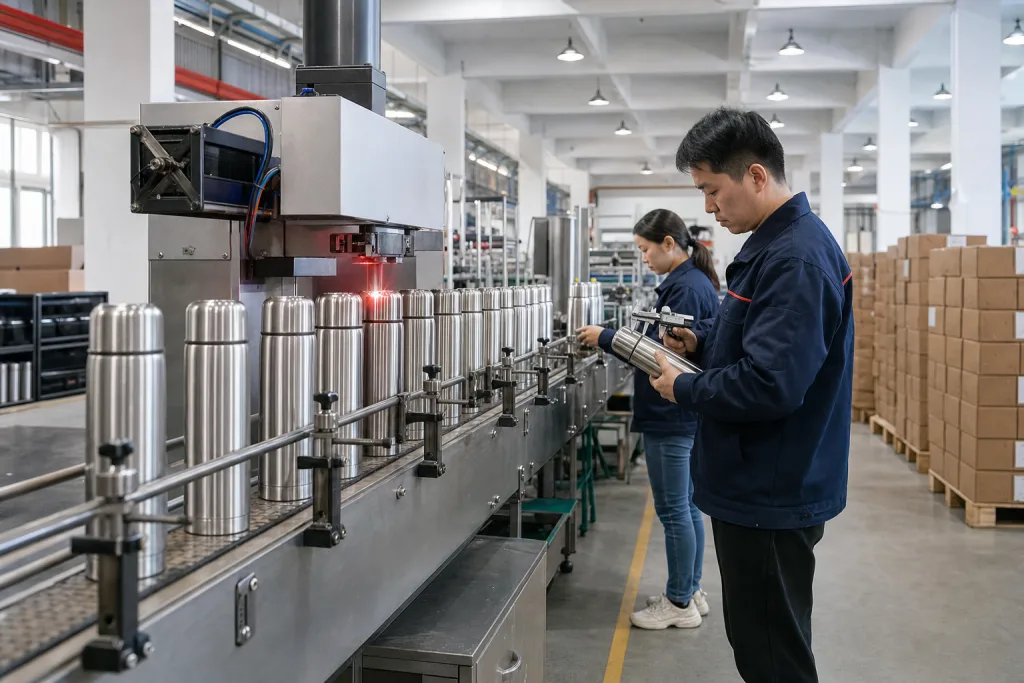
On the factory side in Zhejiang, the bottle body is only one part of the risk. The inner and outer shells, weld quality, vacuum extraction, neck forming, lid injection parts, silicone seal hardness, and the powder line all add variation. On our line, QC pulled the sample once because the neck thread was out by 0.3 mm, and that small miss was enough to create a leak after a tilt test. A manufacturer thermos quotation that is USD 0.35 lower often means thinner steel, a simpler lid structure, lower-grade paint, or fewer in-process checks. This is the wrong question to ask: “Why is this quote cheaper?” Ask what was removed.
- Vacuum loss: poor welds, weak vacuum extraction, or dent damage after impact. We check this after vacuuming and again after a drop sequence because a bottle can pass first inspection and still fail in transit.
- Leakage: thread mismatch, warped PP lid parts, or uneven silicone gaskets. The buyer flagged this on one PO after 200 ml side-lay testing found seepage at the lid seat.
- Heat retention drift: inconsistent vacuum level across production lots. One lot can hold 12 hours, the next slips, and that gap shows up fast in retail complaints.
- Cosmetic defects: orange peel paint, pinholes, scratches, or dust in coating. If the powder booth filter is not clean, the finish tells on us.
- Branding defects: off-position print, color mismatch, laser inconsistency, or weak adhesion. We run a tape test on printed logos because good artwork on screen means nothing if it lifts on the bottle.
At BottleForge Industrial, our stainless thermos lines run up to 450,000 units per month depending on season, and the pattern stays the same. Buyers who send exact acceptance criteria get better bulk thermos results than buyers who ask for a “high quality customizable thermos.” That phrase does not control production. We need numbers, test methods, defect limits, and clear pass/fail standards. Even a simple note like logo position tolerance ±1.5 mm saves arguments later.
If you buy thermos custom for retail or promotion, your specification matters more than the sample photo. Photos hide wall thickness, weld quality, and seal compression. We ship approved samples every week, and a nice photo still will not tell you whether the gasket is 50 or 60 Shore A.
Insulation claims that do not hold
The first failure shows up fast: the bottle does not hold heat or cold as claimed. We see promotional listings throw out 12, 18, or 24 hours with no test method, no fill volume, no start temperature. That is the wrong question to ask in sourcing. Ask for the test report: how full the bottle was, whether they used 95°C water, and what the room temperature was when QC pulled the sample.
A standard check for a 500 ml stainless bottle is hot water at 95°C, filled to rated capacity, capped, then measured after 6, 12, and 24 hours in ambient conditions around 20°C. If a thermos manufacturer only says “up to 12 hours,” ask for the actual 6-hour, 12-hour, and 24-hour readings from the same sample, not a sales sheet line. On our line, a solid target for a 500 ml double-wall 304 bottle is above 55-60°C after 12 hours and above 40-45°C after 24 hours, depending on lid structure and base design.
What to put on your spec sheet
- Inner wall material: SUS304 minimum for beverage contact; use SUS316 only when you genuinely need better corrosion resistance.
- Outer wall material: SUS304 or 201 depending on market and budget; 304 is safer for premium outdoor positioning.
- Body thickness: 0.4-0.5 mm inner and 0.4-0.5 mm outer for mainstream retail-grade bottles.
- Vacuum retention test: 3 pre-production samples and 5 pcs from mass production per SKU.
- Base construction: ask whether the bottle uses copper coating for added insulation performance.
For outdoor retailers, I would not buy a factory thermos below 0.4 mm body thickness just to save USD 0.08-0.12. The math does not work. Thin shells dent faster; we have seen base dents of 1.5 mm after a drop test, and once the shell takes that hit, vacuum performance can slide over time. For thermos bulk projects sold in the UK, where commuter and outdoor use is common, durability matters as much as the laboratory retention number.
If your use case is promotional giveaways rather than premium retail, set the claim to match the build. A customized thermos at USD 2.80 FOB China should not carry the same retention claim as a USD 5.80 retail-focused unit. We have seen this go sideways when a buyer flagged a PO that said “24h hot” for an entry model with a simple plastic lid. That turns into returns, not repeat orders.
Leak paths start at the lid
Most leak claims do not come from the steel body. They start at the lid. A hand sample can thread on fine, then the line starts showing drift across 5,000 pcs once mold wear hits 0.15 mm, shrinkage moves, or gasket loading gets sloppy. On paper, two thermos vendor or thermos supplier quotes can look the same. In production, they are not the same thing.
Common lid materials are PP, Tritan, stainless cap assemblies, and silicone seals. For a custom vacuum bottle UK order, lock the lid structure on the PO, not just the outside look. Ask whether the gasket is removable, what Shore hardness the silicone uses, and whether replacement lids will still be available 12 months later. We ship spare lids for repeat orders all the time, and buyers ask for them after the first container, not before. If you plan long-term distributor thermos business, spare-part continuity is not optional.
Leak failure points to watch
- Thread mismatch: the cap starts smoothly by hand, then cross-threads once torque passes about 1.5 N·m. QC pulled the sample on this exact issue last month.
- Seal compression: a gasket that is too soft or too hard will not seat evenly, and the buyer flagged this on a black-lid run where the seal rolled at one side.
- Flip-top fatigue: the hinge pin or latch loses holding force after repeated use; 3,000 cycle checks tell you more than one clean showroom sample.
- Handle or strap inserts: screws and rivets turn into water ingress points, especially where the insert hole is off by 0.2 mm.
Your QC plan should include an inverted leak test, side-lay test, and hot-fill leak test. We run this on the floor with 70-80°C hot water, fully capped, inverted for 5 minutes, then laid flat for 30 minutes with no visible leakage. For sports-lid versions, test open-close cycles as well. A buyer once pushed for a one-touch lid on an event order with a tight budget. The math did not work. For promotional brands ordering thermos customized for events, a simple screw cap is usually the safer choice unless the budget covers better tooling and cycle testing.
From the factory side in China, we normally recommend AQL 2.5 major defects for leakage, missing seals, and cracked lids. A bottle that leaks is a major defect. This is the wrong question to ask: “Can we treat one or two leaking pieces as acceptable?” No. If your suppliers thermos proposals do not define major vs minor defects clearly, you leave room for disputes after inspection. Put the defect class in writing before deposit payment, even if it is just one extra line on the PO.
Coating and logo defects after shipping
A common complaint: the sample looks clean, then bulk cargo lands with shade drift, base scratches, fuzzy logo edges, or chipped paint around the bottom ring. We have seen this go sideways on promo thermos orders where the print is the product. The right fix is not the showroom sample on one hand-carried piece. It is matching the coating and decoration to real use, carton pressure, and line handling.
For a customizable thermos, the usual exterior options are spray paint, powder coating, rubber finish, metallic paint, water transfer, or special texture coatings. On our line, powder coating is usually the safer commercial choice for commuter and outdoor use because the film build is thicker, often around 60–80 μm, and it takes abrasion better than thin spray paint. If you want a matte premium look, ask for coating adhesion data and scratch test results, not only a Pantone match. This is the wrong question to ask if the buyer only asks for “same as sample color.”
How branding fails
- Silkscreen print scratches because curing stopped early; QC pulled the sample and the ink still marked after a fingernail rub.
- Laser engraving lacks contrast on dark coatings, especially when the coating thickness is uneven.
- Heat transfer film shifts on curved bodies; we have seen 2 mm creep near the shoulder radius.
- Logo position drifts because the fixture is loose or the nest wears out after a few thousand cycles.
- Mixed-batch color variation appears across reorders when the powder lot changes and no sealed sample is kept.
For branded custom thermos orders, ask for a decoration approval sheet showing logo size, position from top and seam, print color code, and tolerance. A realistic logo position tolerance is often ±1.5 mm to ±2.0 mm depending on method. We ship better when this sheet is signed before mass production, because the buyer flagged plenty of POs later over small issues like a 3 mm logo shift or one typo in a color code. For powder-coated bottles, a cross-hatch adhesion test and a basic abrasion rub test should be part of pre-shipment QC. If your thermos distributors or distributors thermos channel relies on exact retail shelf appearance, request master sample sign-off before production.
Do not ignore the carton. A good customized thermos still arrives looking bad if inner partitions are soft or the bottles touch rim to rim in transit. For export from Zhejiang, China to the UK, ask for drop-tested outer cartons, individual polybags or paper sleeves, and separators that keep coated bodies apart by a few mm. We run into this on 20 ft container loads where the bottle itself passes inspection but the packout fails after port handling. A USD 0.05 packaging upgrade can save a much larger cosmetic claim rate.
Compliance gaps buyers discover late
Failure is not just physical. We’ve seen shipments held on paperwork, labeling, and chemical compliance before anyone opened a carton. For Europe and the UK, ask your thermos manufacturer for material declarations and test reports before mass production starts, not after the goods are on the water. On our side, QC usually pulls the pre-production sample and checks the label file against the PO line by line.
For stainless drinkware, buyers usually check REACH-related items for coatings, paint, and accessories, plus LFGB or food-contact migration testing based on the market. Packaging gets checked too: barcode readability, carton marking, and label accuracy. North American buyers often ask for CPSIA-related checks where applicable, California Proposition 65 screening, or ASTM references for certain parts if the bottle is sold for children. This is where late surprises happen. A 2 mm silicone straw tip or a soft-touch coating can trigger extra questions the buyer flagged only after sampling.
Do not assume every thermos suppliers factory has every report ready for your exact SKU. That is the wrong question to ask. Reports are usually tied to a material, component, or finish family. Change the lid resin, paint, seal supplier, or printing process, and the old report may not match the final build anymore. We’ve seen this go sideways after a buyer switched from screen print to powder coat at the last minute and still expected the old file set to pass.
- Ask for steel grade confirmation for inner and outer walls, such as 304 stainless, tied to the same bottle structure on your PO.
- Confirm whether silicone and PP components have food-contact declarations from the actual supplier, not a generic file from 2 years ago.
- Request coating test reports tied to the same finish family used on your order, especially if the line runs rubber paint, metallic spray, or glitter UV.
- Check carton marks, FNSKU, suffocation warning, and country-of-origin labeling before production starts; one wrong digit in the booking code is enough to stop a shipment.
If you are buying thermos bulk for Amazon FBA or major retail, labeling errors can cost as much as quality defects. We’ve had solid orders delayed because the carton marks did not match the booking file, and once because the buyer’s PO had “Made in U.K” typed into the artwork note by mistake. Build a packaging approval step into the timeline. For most projects, 7-12 days for sample and artwork approval plus 30-45 days production is realistic. Trying to squeeze that to 5 days and 25 days is where the math doesn’t work, and the packing line starts missing details.
The quote looks cheap for a reason
If you receive three quotations for a custom vacuum bottle UK project and one is 15% lower, do not celebrate yet. In our factory, that gap usually means something was cut. We see it on the line: 0.35 mm outer wall quoted against 0.45 mm, no copper coating in the vacuum layer, lower-grade powder, cheaper silicone gasket, thinner carton, or no final inspection. Sometimes the price is low because the lead time is stretched from 12 days to 18 days. Cheap manufacturer thermos offers often come back as claims, replacements, and one angry buyer email after another.
For reference, mainstream FOB China pricing for a 500 ml stainless vacuum bottle with powder coating and one-color logo often sits around USD 3.20-4.80 at 3,000 pcs. A more premium lid, gift box, or 18/8 stainless throughout can move it to USD 5.20-6.50. If you see USD 2.40 for a similar-looking unit, ask exactly what changed. This is the right question. "Why are you cheaper?" is too loose; "Is the inner 304, is there copper coating, what is the unit net weight in grams?" gets real answers.
Cost drivers you should compare line by line
- Steel grade: 201 vs 304 outer wall, 304 vs 316 inner wall.
- Wall thickness and net weight.
- Lid complexity and accessory count.
- Coating type and number of decoration passes.
- Individual packaging: white box, color box, gift box.
- Inspection level: factory self-check only or third-party final inspection.
MOQ also matters. We run 1,000 pcs for plain stock colors with a simple screen logo on some thermos factory and thermos manufacturer programs, but true custom body colors or new lid tooling usually push MOQ to 3,000 pcs or more. A custom Pantone powder lot alone can force that jump. We have seen buyers push for 800 pcs with a new mold and gift box; the math doesn't work. If your brand needs low-volume testing, ask whether the supplier can use existing molds with custom coating and packaging first. That route is usually cheaper and safer.
Outdoor retailers should also think about reorder stability. A bottle that is USD 0.20 cheaper today but impossible to match six months later is not cheaper. We have seen this go sideways when the first PO says "matte black" with no Pantone code, then the buyer flagged the reorder because the shade shifted. Ask your thermos distributors, thermos distributor, or direct China factory for color retention standards, approved material lists, and reorder lead times before you commit the launch quantity. QC pulled the sample once on a repeat order here because the gloss reading was 8 GU off the sealed sample.
Build the QC plan before deposit
The cleanest way to avoid failure is to lock the inspection plan before the deposit lands and the line starts. We see buyers spend 2 weeks on artwork, price, and carton marks, then leave QC loose. That is where claims start. One buyer flagged a 1.5 mm logo shift as “defective” after shipment because the PO never set a tolerance. For a custom vacuum bottle UK order, the PO should read like a technical spec, not a simple commercial order.
A workable QC plan for thermos custom sourcing should cover three gates: pre-production approval, inline inspection, and final random inspection. Put the checklist in place before mass production, not after 3,000 pcs are already on the floor. We run first-piece checks with a Pantone book, caliper, and vacuum test fixture, then QC pulled the sample again at packing. If you bring in a third-party inspector, match their checklist with the factory before the first tube goes on the line. Otherwise the factory builds to one standard and the inspector rejects to another. We have seen this go sideways.
Minimum QC points worth writing into the PO
- Reference sample: signed golden sample for color, finish, and logo position.
- Performance: hot retention data and leak test method.
- Appearance: define acceptable scratch length, dent size, and coating pinholes.
- Function: thread smoothness, cap fit, base stability, handle pull test if applicable.
- Packing: barcode placement, carton dimensions, drop-test requirement, count per carton.
- AQL: 2.5 major, 4.0 minor unless your channel requires tighter levels.
For distributor thermos and promotional thermos orders, keep 1 retained production sample per SKU and color for at least 12 months. This is not paperwork fluff; it settles arguments fast. Last year a buyer sent back a complaint photo 8 months later, and the retained sample showed the approved matte finish was already on the signed standard. Also ask your thermos manufacturers source about BSCI or ISO system status if your customer needs social or process compliance. Those certificates do not guarantee a perfect bottle, but they do show whether the factory runs with process discipline.
If you are sourcing from Zhejiang, China for the first time, start with 1 controlled SKU, not 5 lid types at once. A single 500 ml or 750 ml bottle with one coating and one logo method is easier to validate, pack, and inspect at AQL 2.5. We usually suggest MOQ 3,000 pcs on the first run so the defects tell a clear story and the math still works. Once the customized thermos program is stable, scale into thermos customizable variants, gift sets, or seasonal colors. This is the safer sequence. The wrong question to ask first is how fast you can add SKUs.
Send your bottle spec and we will pressure-test it
Share your target price, capacity, logo method, and UK compliance needs. We will review failure risks, MOQ, and a workable China production plan.
Frequently asked questions
What MOQ should I expect for a custom vacuum bottle UK order?
For a standard 500 ml or 750 ml stainless bottle using an existing mold, MOQ is commonly 1,000 pcs per color with one logo position. If you want a fully custom body color, special lid, or gift box, 3,000 pcs is more realistic. New tooling pushes MOQ and lead time higher. In Zhejiang, China, many factories quote low MOQs to win the inquiry, then add surcharges for color changes, packaging, or mixed sizes. Ask for MOQ by SKU, by color, and by print method in one written table. That avoids surprises when you convert from sample to PO.
How do I compare two thermos quotes that look similar?
Ask each thermos supplier for six hard details: steel grade for inner and outer walls, body thickness in mm, net weight, lid material, coating method, and packaging spec. Then check whether the quote includes third-party inspection, logo setup, and spare parts. A 500 ml bottle can differ by USD 0.40-1.20 depending on those factors alone. Also compare the test standard behind any heat-retention claim. If one supplier says 12 hours hot and another says 24 hours, that may only reflect different test points, not better insulation. Weight and wall thickness usually reveal more than marketing language.
What tests matter most before I ship bulk thermos to the UK?
The essentials are leak testing, heat-retention testing, coating adhesion, logo durability, and packaging drop checks. For final inspection, use a random sample plan with AQL 2.5 for major defects and 4.0 for minor defects. For performance, ask for hot-water retention readings at 6, 12, and 24 hours on production samples, not only on development samples. For compliance, request food-contact declarations and any REACH- or market-relevant reports tied to the actual components used. If the order goes to Amazon or large retail, verify barcode, carton mark, and country-of-origin labeling before goods leave China.
Is 304 stainless enough, or should I ask for 316?
For most custom thermos projects, 304 stainless is enough for the inner wall and is the normal commercial choice. It gives good corrosion resistance, food-contact safety, and a sensible cost. Move to 316 only if the product is positioned for more demanding use, such as acidic beverages, premium outdoor retail, or stronger corrosion-resistance claims. Expect a noticeable unit cost increase, often around USD 0.20-0.60 depending on bottle size and steel market conditions. Do not pay for 316 just because it sounds better. Match the material to the product position and the warranty risk you are willing to carry.
How long should production and sampling take for customized thermos?
If you are using an existing mold and a standard powder-coated finish, pre-production samples usually take 7-12 days after artwork and Pantone confirmation. Mass production is commonly 30-45 days for 1,000-5,000 pcs, depending on season and packaging complexity. During peak periods, lead times can extend to 50 days. If a factory promises 15-20 day mass production for a multi-color customized thermos order, ask how they will control coating cure time, logo approval, and packing accuracy. Very short lead times often mean corners are cut on inspection or curing, which shows up later as leaks, scratches, or print defects.