Key Takeaways
- For a standard 500 ml stainless thermos, practical MOQ is often 1,000-3,000 pcs per color, with sample lead time around 7-12 days and bulk lead time 25-40 days
- A complete RFQ should define steel grade, capacity tolerance, coating, logo method, packaging, and testing requirements before you request pricing
- For Germany-bound orders, ask for REACH-related material declarations, LFGB or food-contact test support, and AQL inspection terms written into the PO
- A weak PO creates expensive disputes; spell out unit price, overrun tolerance, carton packing, barcode rules, and leakage criteria before deposit payment
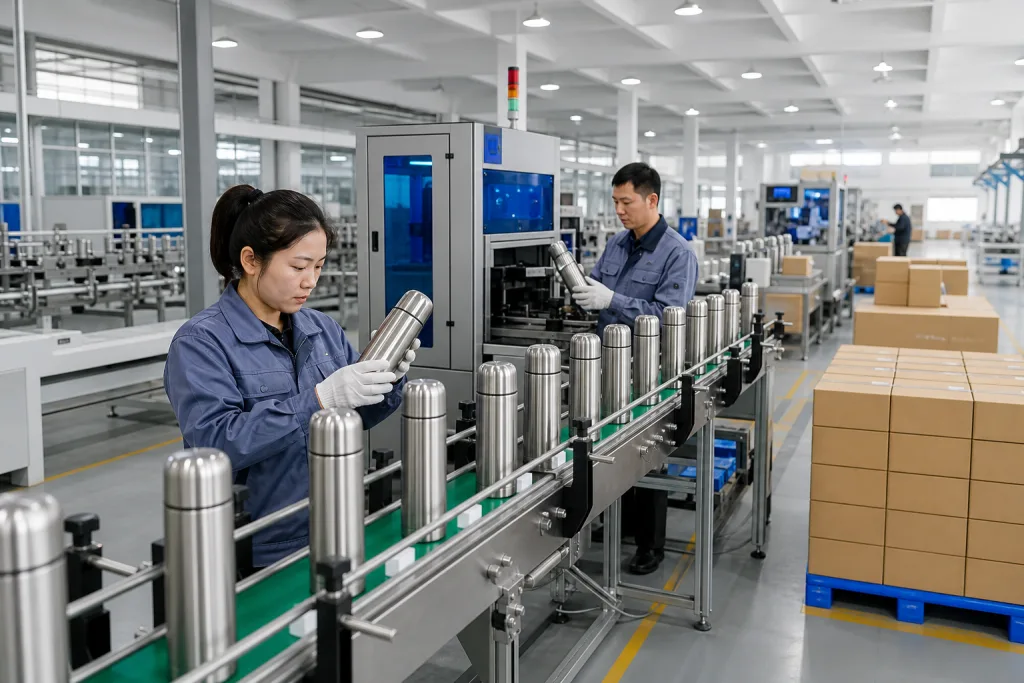
You are not buying a generic bottle. You are buying a stainless thermos that has to clear Germany, fit your brand book, survive retail drops, and still hold temperature after 90 days in a warehouse. On our line, QC pulled samples after a 1.2 m drop test because this is where projects start to go sideways. Outdoor retailers and promo buyers hit the same wall: the bottle looks simple, but the spec sheet is not. A custom vacuum bottle deutschland order can fail on coating adhesion, lid leakage at 0.03 MPa, logo wear after 500 rubs, wrong carton marks, or a PO with one bad line like "mat silver cap" and no Pantone or finish callout.
If you are buying from Zhejiang, China, or comparing a China source with local finishing in Europe, run the job in stages. This is the right question to ask. From RFQ to pre-production sample to bulk thermos approval, each step needs fixed specs, measurable targets, and PO lines that leave no room for guesswork before we run mass production. We have seen buyers save 12 days vs 18 days just by locking carton size, net weight, and logo position in mm before the first sample leaves the factory.
Start with a usable RFQ
Most delays start before the first quote. We see this every week on the line. A buyer asks 3 suppliers for a custom vacuum bottle deutschland price, but one factory quotes a 500 ml straight body, another quotes a 530 ml shape bottle, and the third swaps in a different lid and carton count. Then the numbers look close on paper, but they are not pricing the same bottle.
For outdoor retail and promotional thermos buying, your RFQ needs enough detail that a thermos manufacturer in Zhejiang, China quotes one build, not 4 versions. If you are sourcing a custom thermos, list the exact bottle style, net capacity, steel grade, vacuum structure, lid type, and decoration zones. A 500 ml bottle with 304 inner and 201 outer body does not cost the same as 304/304. Same story on decoration: matte powder coat plus laser logo runs differently from spray paint plus 1-color silk screen. We have seen buyers write “black finish” on the PO, then QC pulled the sample and found gloss black instead of matte.
- Body: 500 ml, double-wall vacuum, 18/8 stainless inner, 0.4 mm inner wall, 0.5 mm outer wall
- Heat retention target: 12 hours hot above 55°C, 24 hours cold below 10°C
- Lid: screw lid with PP inner, silicone seal, BPA-free statement
- Finish: matte powder coating, Pantone reference required
- Logo: laser engraving or silk screen, size in mm, placement from base
- Pack: white box, 20 pcs master carton, carton drop standard if needed
- Compliance: REACH-related statement, food-contact test support, LFGB if requested
This is also the point where you tell the factory thermos supplier your sales channel. Retail shelves, e-commerce, ski shops, and promotional campaigns do not use the same packaging standard. A promotional thermos for a 5,000-piece giveaway often uses simpler box printing and looser cosmetic expectation than a premium outdoor line. We ship both, but the math does not work if you ask for retail-level finish on giveaway pricing.
Put these RFQ line items straight into your inquiry sheet. Ask for the drawing, material breakdown, packing count, and sample lead time in the same email. If a supplier thermos contact replies with only “best price” and no technical answer, that is useful early. The buyer flagged this once on a PO with the typo “slik screen,” and the supplier still approved it without clarifying the process. That is the wrong supplier to compare.
Screen the factory before sampling
Before you pay for a sample, first check if the supplier is built for your order type. Buyers often ask for a customizable thermos. That is the wrong question to ask. What matters is whether the plant holds weld consistency on the line, keeps the vacuum pass rate stable, controls powder coating thickness at 60-80 μm, and gets logo adhesion through bulk production instead of just one hand-picked sample.
Ask direct questions and wait for numbers. A serious thermos factory or manufacturer thermos team should answer without the usual sales script. In Zhejiang, a practical range for a mid-size vacuum bottle line is 150,000 to 300,000 units per month, with MOQ usually 1,000 pcs per model per color for standard tooling. If your order includes gift box packing, mixed-color master cartons, or 4 logo versions on one PO, MOQ usually goes up because changeover loss on the screen-print station and packing line is real. We have seen buyers miss this and the math doesn't work.
What to confirm before sample payment
- Audit status: BSCI, ISO 9001, or retailer-required social/compliance audits
- Testing support: LFGB, EU food-contact migration testing, REACH-related declarations
- QC system: incoming material checks, vacuum testing, leak testing, finish inspection, AQL standard used
- Production fit: standard bulk thermos runs versus low-MOQ custom projects
- Export routine: FOB Ningbo or Shanghai experience, carton marking discipline, barcode accuracy
Ask who owns each step. Some thermos suppliers run forming, welding, vacuuming, coating, and printing in-house. Others send powder coating or logo printing outside. That is not a deal-breaker by itself, but you need the real map before sample payment. Outsourced coating can add 5-7 days, and QC pulled the sample more than once for ΔE color drift after a second batch came back from the coating shop.
Good sourcing is not finding the lowest USD 3.25 quote. It is checking whether the USD 3.25 quote still holds after testing, packaging changes, and the second reorder.
If you are dealing with thermos distributors or a distributor thermos intermediary in Europe, ask a plain question: are they selling ex-stock, private label from China, or a booked factory slot? The answer changes what you can touch. We ship projects where a buyer can change carton marks and lid color in 12 days, and we also see distributor stock programs where even a barcode typo on the PO blocks the label file. The buyer flagged it late, and the option was gone.
Request samples with approval checkpoints
The sample stage is where bulk orders get saved or ruined. For a thermos custom or thermos customized project, ask for the exact sample type instead of “send us a sample.” This is the wrong question to ask. We see buyers mix up reference samples, pre-production samples, and golden samples on the same PO, then the line runs one version and the buyer flagged it later.
A practical sequence looks like this:
- Reference sample: confirms bottle shape, lid feel, and the base quality level; we usually check thread fit by hand and measure key points with a caliper
- Logo mockup or digital proof: confirms artwork size and position; on one order, the PO had the logo note typed as 18 mm instead of 18 cm, so this step matters
- Pre-production sample: confirms final color, final logo method, and packaging; QC pulled the sample from the line setup before mass packing
- Golden sample: signed and archived against bulk production; we seal it with the approved carton spec and keep it for final inspection comparison
Sample lead time for a standard customized thermos is usually 7-12 days after artwork and Pantone confirmation. If you need a new mold, custom lid, or molded silicone part, tooling can add 20-35 days. We’ve seen this go sideways when buyers approve artwork fast but leave lid texture open for 4 more days. For most outdoor retailers, the sample should be tested for leak performance, heat retention, coating adhesion, odor, and general handling. We normally run a basic upside-down leak check and hold the bottle for 30 minutes before sign-off. For promotional buyers, logo legibility and packaging presentation matter just as much.
Your pre-production approval checklist should include exact PO-linked standards:
- Capacity tolerance within plus or minus 3%
- Color tolerance against approved swatch under daylight; we check under the light box, not warehouse lighting
- Logo position tolerance within plus or minus 2 mm
- 100% leak test requirement for finished goods
- Vacuum performance pass rate standard written into QC sheet
- Barcode scan verification if retail pack uses EAN or FNSKU labels; one bad label roll can hold 2,000 pcs
If the product is sold as a custom thermos for the German market, ask for the German copy on packaging before approval, not after production starts. Sounds obvious. Still, we ship plenty of correction rounds for DE text, dishwasher icons, or recycling marks because the buyer sent final copy after carton print. One box reprint can cost 12 days versus 3 days for a label fix.
This is also the stage to compare logo methods honestly. A thermos promotional order with 1-color silk screen is cost-effective for high volume. The math doesn’t work if you expect heavy daily use and premium shelf presentation from the same print. A premium thermos customizable retail program usually looks better with laser engraving or durable powder-coat masking because the logo wear rate is lower over time. We’ve had buyers push back on engraving cost, then switch after the tape test sample showed edge wear on the silk screen.
Build the PO line by line
After sample approval, the purchase order needs to read like a shop-floor instruction sheet. If your PO says only “500 ml custom bottle, black, logo, gift box,” the line will fill the blanks for you, and that is where claims start. We have seen one PO typo on a logo size turn a 45 mm print into 54 mm, and the buyer flagged it only after bulk packing. Good buyers write POs the way the factory runs.
For a custom vacuum bottle deutschland order, your PO should cover commercial terms, technical specs, and inspection points in plain wording. This applies whether you buy from a direct thermos supplier, a thermos vendor, or one of several manufacturers thermos options in China. If 3 factories quote the same bottle and one price is lower by USD 0.18, this is the wrong question to ask unless the steel grade, lid structure, and carton spec match line by line.
Essential PO line items
- SKU and model code: split each colorway and logo version into its own line; we run separate labels and carton marks for each one
- Quantity: state exact qty by variant, such as 3,000 pcs black and 2,000 pcs olive green, not just 5,000 pcs total
- Unit price and term: write it in full, like FOB Ningbo USD 3.85/pc, or EXW if your forwarder books pickup
- MOQ basis: define whether MOQ sits per color, per artwork, or per gift box version; 1,000 pcs per color and 3,000 mixed is not the same deal
- Material spec: list 304 inner, 304 outer, PP lid, food-grade silicone; if the seal ring is 2.5 mm instead of 2.0 mm, note it
- Decoration spec: include Pantone, print size, print position, color code, and engraving depth if relevant; QC pulled the sample before because the logo sat 6 mm too low
- Packing spec: show inner box dimensions, insert type, master carton qty, and carton gross weight cap; 18 kg is a common buyer ceiling
- Labeling: confirm EAN, FNSKU, carton marks, and country of origin wording exactly as printed
- Testing: state leak test, vacuum retention test, coating adhesion, and drop test if needed; on our line, vacuum hold is usually checked after 12 hours, not guessed by touch
- Inspection: write AQL 2.5 major, 4.0 minor, or your own standard; if you skip this, arguments start at final inspection
- Delivery: specify ex-factory date, shipment window, and late-shipment clause if agreed; 12 days vs 18 days matters once carton booking is fixed
- Overrun/underrun: set control at plus or minus 5% unless fixed quantity is mandatory; for Amazon programs, buyers often reject open-ended wording
For 7 out of 10 thermos bulk orders we ship, payment terms start at 30% deposit and 70% balance after inspection pass and before shipment. Repeat orders with the same bottle body and stable forecast can move better after 2 or 3 containers. Do not push payment first and specs later. The math does not work if the coating fails cross-hatch adhesion or the gift box size misses the shelf planogram by 8 mm.
Outdoor brands should also define spare ratio. We usually see 0.3% to 0.5% extra caps or finished units for after-sales replacement, especially for active-use products. Last season, one buyer asked for zero spare stock on a 20,000 pc run, then came back for replacement lids after a hinge issue on less than 60 pcs. We have seen this go sideways.
Control bulk production and QC
Bulk starts quietly, and it goes wrong the same way if nobody is checking the line. After deposit, ask for a dated production schedule with hold points: raw material arrival, body forming, vacuuming, polishing, coating, printing, packing, and inspection. For one standard stainless bulk thermos order, we usually run 25-40 days after sample approval and deposit; in October, the same item can slip 6-8 days if coating and printing both queue up.
For the Germany market, the wrong question to ask is whether you need to inspect every unit yourself. You do not. You need a control plan with records behind it. A capable thermos manufacturer in Zhejiang or elsewhere in China should already run in-process checks, and your job is to confirm those checks are logged, signed off, and tied to release criteria. QC pulled the sample, not just the finished pallet photo.
- Incoming QC: check steel grade, plastic resin, silicone, coating powder, and packaging material; we usually verify carton board thickness and match the PO because one typo in the barcode suffix can hold the whole shipment
- In-process QC: check weld consistency, neck threading, vacuum rate, lid fit, and logo position; on our line, the buyer flags logo drift fast if it moves even 1.5 mm off center
- Final QC: check appearance, leak test, barcode scan, carton quantity, carton weight, and pack drop resistance; if carton weight is off by 0.3 kg, QC will open the case and count again
Ask for inspection photos or short video from the line, not only finished pallets. This matters. Uneven powder coating, denting at the shoulder, or logo ghosting show up earlier during production, when the line can still adjust the spray gun setting or screen position before 3,000 pieces are packed.
If you use third-party inspection, book it early. In peak season, a China inspector may already be full 5-7 days out, and we have seen this go sideways when the booking came after packing. Set the standard clearly: AQL 2.5/4.0 is common, but some retail programs use tighter criteria for logo and finish defects. Define critical defects as leakage, sharp edge, wrong barcode, wrong logo, wrong color family, or failed food-contact compliance documentation.
A thermos factory that can produce 200,000 units per month is not automatically the right partner if your 3,000-piece run gets pushed in as filler between bigger jobs. The math doesn't work if headline capacity looks good but your order misses its ship window by 12 days. For suppliers thermos comparison, consistent execution beats capacity on paper.
Ship for Germany without cleanup work
The last stage is where margin disappears fast. The bottle is finished, then the pallet label is off by one digit, the EAN sticker lands on the logo box, or the outer carton comes in at 605 mm and misses a warehouse inbound limit. For a custom vacuum bottle deutschland shipment, we check these details before cargo leaves China, not after the container hits Hamburg or a German 3PL. We have seen this go sideways over a simple PO typo.
Lock shipping terms early. FOB Ningbo is common for stainless drinkware out of Zhejiang, China because trucking from Hangzhou is routine and port cutoffs are easier to control. If you buy from 2 or 3 thermos manufacturers or distributors thermos sources, ask who owns consolidation at the end. This is the right question. Mixed cargo is where packing-list errors start, and QC pulled one sample last quarter where carton count was 1,200 units but the final list showed 1,080.
Pre-shipment release checklist
- Carton marks: SKU, quantity, gross/net weight, made in China, PO number
- Retail labels: EAN or customer barcode verified and scanned
- Documents: commercial invoice, packing list, test reports if required, declaration paperwork
- Pallet spec: EU pallet compatibility if requested by importer or warehouse
- Booking window: confirm vessel cutoff and factory handover date
If you supply outdoor stores, think past port arrival. Ask whether cartons are shelf-ready or whether the buyer will relabel in Germany. If you supply campaign business, ask whether packs need sorting by client code before we ship. The line can do this at source if the rule is clear. A customizable thermos project with clean carton flow saves handling cost, and the math does not work once a 3PL has to reopen 800 cartons.
The same rule applies to repeat orders. Once the first PO runs cleanly, freeze the approved spec, approved sample, packaging artwork, and QC points in one release file. We usually keep the golden sample tagged at the sample room rack and record torque, color, and drop-test notes against the PO. Then order 2 ships like replenishment, not a fresh development job. That is how a one-off thermos custom project turns into a sourcing program that runs without cleanup work.
Send your RFQ and get a practical thermos quote
Share your target capacity, logo file, packaging needs, and Germany compliance requirements. We will review MOQ, sample timing, and bulk pricing clearly.
Frequently asked questions
What MOQ should I expect for a custom vacuum bottle deutschland order?
For a standard 350-750 ml stainless vacuum bottle, most China factories quote MOQ at 1,000 pcs per color per model if you use existing tooling and standard lid parts. If you want multiple Pantone colors, gift boxes, or separate logos by customer, practical MOQ often becomes 2,000-3,000 pcs because setup waste and carton complexity rise. For a highly customized thermos with a new lid or body mold, MOQ can move to 5,000 pcs or more. If your target is promotional thermos buying, ask whether mixed-color production under one PO is allowed. Some Zhejiang suppliers permit 1,000 pcs total with 500 pcs per color, but the unit cost usually increases by USD 0.15-0.40 per piece.
How long does sampling and bulk production usually take?
If the bottle shape is from existing tooling, a plain reference sample can be ready in 3-5 days, while a branded pre-production sample usually takes 7-12 days after artwork approval and Pantone confirmation. If you need a custom mold, add 20-35 days depending on whether the change is only the lid or the full body. Bulk production for thermos bulk orders typically takes 25-40 days after deposit and final sample sign-off. Peak season can push that to 45 days. If you also need custom packaging inserts, barcode labels, or palletization rules for Germany, add 3-7 days. The safe approach is to book backwards from your warehouse receipt date, not from the ex-factory date.
Which tests and compliance documents matter for Germany and the EU?
For stainless drinkware sold into Germany, buyers commonly ask for food-contact testing support such as LFGB-related testing, plus material declarations covering items like BPA-free PP and silicone components. REACH-related declarations are also standard for many EU customers. On the quality side, you should require leak testing, insulation performance verification, coating adhesion checks, and basic odor review on seals or plastic parts. If the bottle is for outdoor retail, add carton drop expectations and barcode readability. Do not assume every supplier thermos contact includes this by default. Put the requirement into the RFQ and PO. If a lab test is needed, budget roughly 5-10 working days after sample readiness depending on scope and lab availability.
What is the best logo method for custom thermos projects?
It depends on your channel and price point. For large promotional thermos orders, 1-color silk screen is usually the cheapest option and works well on smooth painted or powder-coated surfaces. Expect low setup cost but more visible wear over time if the bottle sees heavy abrasion. Laser engraving costs more than basic screen printing, but it gives a cleaner premium look and better long-term durability, especially for outdoor retail. For high-end customizable thermos programs, some buyers use masked powder-coat logos or multi-process decoration, but that adds cost and longer setup. As a rough guide, upgrading from one simple screen print to laser can add around USD 0.10-0.35 per piece depending on size and quantity.
How do I reduce risk on my first bulk thermos order from China?
Start by locking the specification before negotiating final price. Use a full RFQ, approve a pre-production sample, and write the PO with exact material, finish, logo, packing, and inspection terms. Require a signed golden sample and define AQL, such as 2.5 major and 4.0 minor, before production starts. Ask for in-line production photos and book third-party inspection before the order is fully packed. For first orders, many buyers use 30% deposit and 70% balance after inspection pass and before shipment. Also define overrun tolerance, usually plus or minus 5%, so you do not get a quantity surprise. The safest first project is not the cheapest quote. It is the order with the fewest undefined details.