Key Takeaways
- Start RFQs with 12 core line items; missing just lid type or print method can shift unit cost by USD 0.25-0.80
- Typical MOQ for a 500 ml double-wall 18/8 custom thermos is 1,000-3,000 pcs per color, with sampling in 7-12 days
- A realistic mass production lead time from Zhejiang, China is 25-40 days after sample approval and deposit
- Use AQL 2.5/4.0 plus heat retention, leak, coating adhesion, and drop tests before you release balance payment
You are not buying a souvenir mug. If you are sourcing a custom vacuum bottle American program for outdoor retail or promo campaigns, small spec misses get expensive fast. We have seen a 0.1 mm wall change throw off weight, a wrong lid thread fail on the torque gauge, and a pretty decoration get scuffed after one carton drop test. That turns a workable custom thermos order into returns, delay claims, and lost margin.
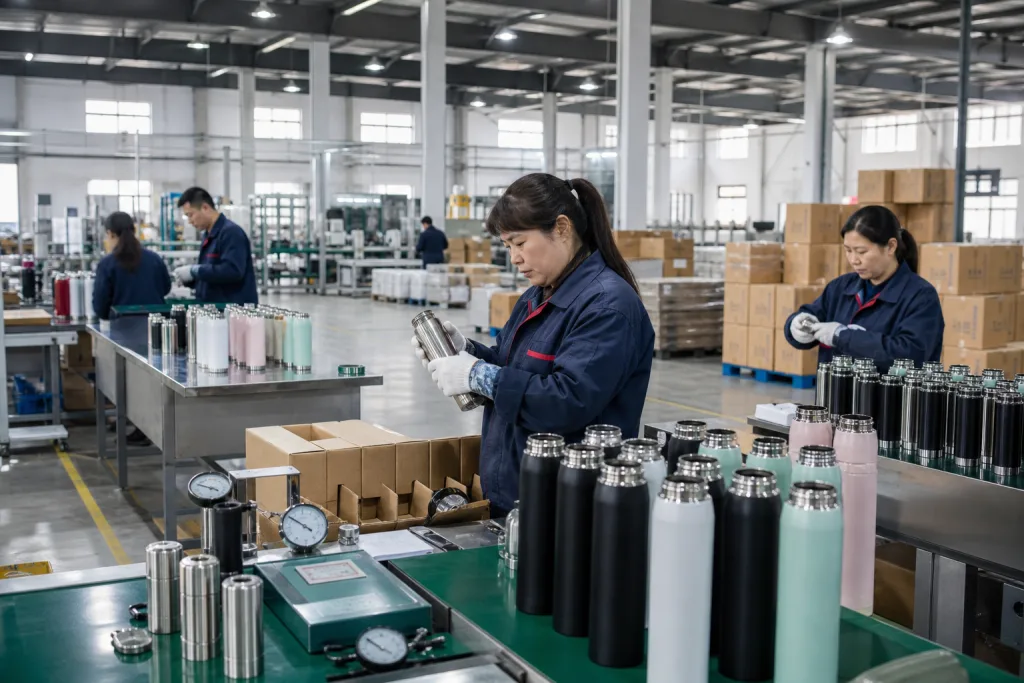
Most buyers in Europe and North America ask for the same result: a stainless bottle that lands on target cost, passes compliance, survives transit, and ships on schedule with the right branding. From Zhejiang, China, that is doable, and we run up to 300,000 units per month in Hangzhou. Still, this is the wrong question to ask if you start with factory capacity alone. The line can run, but the outcome depends on whether your RFQ is built in the right order—material grade, lid fit, decoration method, packaging drop standard, then MOQ.
Start with a usable RFQ
If you want a usable quote for a custom vacuum bottle American project, skip the one-line “send me your best price” email. We see that every week, and it only produces placeholder numbers. A proper RFQ lets a thermos manufacturer in China quote the bottle you plan to buy, not a stripped version with 0.3 mm steel, a lighter lid insert, or a weaker 24 pcs master carton that fails drop check.
Your first job is to lock the commercial skeleton of the order. That sounds basic. It saves money. For outdoor retail, we usually see a tougher spec: 18/8 interior, powder coat, leakproof lid, shelf-ready packaging, sometimes a 72-hour salt spray target on painted parts. For a promotional thermos campaign, the buyer usually pushes on unit price, logo area, and MOQ first. Either way, list the numbers. If the RFQ says “good quality” with no detail, the math doesn’t work.
PO line items to include in the RFQ
- Body size: 350 ml, 500 ml, 750 ml, or 1,000 ml
- Steel grade: SUS304 inside, and if needed SUS304 outside instead of SUS201
- Construction: double-wall vacuum, copper coating optional
- Wall thickness: common range 0.4 mm inner / 0.5 mm outer
- Lid style: screw lid, flip lid, handle lid, tea infuser lid
- Finish: spray paint, powder coat, brushed, full-wrap transfer
- Logo method: silkscreen, laser, UV print, embossed patch
- Packaging: polybag, white box, color box, PDQ tray, master carton count
- Compliance: REACH, LFGB, FDA-contact declaration if requested by your market
- Target quantity: 1,000, 3,000, 5,000 pcs or more
- Trade term: FOB Ningbo or Shanghai, sometimes EXW if you consolidate
- Delivery date: in-store date, not just ex-factory date
If you are comparing thermos suppliers, ask every factory thermos source to quote the same structure, down to carton count and logo size in mm. Otherwise, you are comparing assumptions. We ship quotes from Zhejiang every day, and a spread of 12% to 20% is common when specs are loose. Once the spec is fixed, that spread often drops to 3% to 8%. QC pulled a sample last month from a buyer RFQ that said “304 bottle,” but the PO missed the outside material line, and that gap turned into three days of re-quoting.
Choose the bottle before branding
Most buyers open with the logo position. Wrong starting point. Pick the bottle platform first, then brand it. A customizable thermos may look the same across 6 supplier catalogs, but the neck finish, lid thread fit, vacuum pass rate, and even wall thickness at 0.4 mm vs 0.5 mm change from factory to factory in China. We have seen buyers approve a nice rendering, then QC pulled the sample and found the cap sat high by 1.2 mm.
For outdoor retail, the safer commercial base is usually a 500 ml or 750 ml bottle in 18/8 stainless steel with powder coating and a plain screw cap. Less to fail. On the line, fewer moving parts usually means fewer after-sales claims. A flip straw lid works for sports channels, but it adds silicone rings, hinge wear, and extra leak points; one buyer flagged a straw lid after a 30-minute inverted test because the vent plug shifted. For a bulk thermos promotion, 500 ml often sits in the best cost band because it uses less steel than 750 ml and still feels solid in hand. This is the wrong question to ask: “Which one looks more premium on screen?” Ask which one ships cleanly at MOQ 3,000 with stable assembly.
You are not buying a picture. You are buying a lid system, steel weight, vacuum performance, and carton efficiency.
Ask the manufacturer thermos team for empty weight, carton gross weight, and packed dimensions. Get the numbers early. Freight can wipe out the savings from a lower unit price, and the math doesn't work if the bottle is heavy and the carton cubes out too fast. A 500 ml bottle may weigh 280-320 g, while a heavier premium version can reach 360 g. On a 5,000-piece order, that gap changes ocean freight, warehouse handling, and even sample courier cost; we shipped one 5,000-piece lot where 40 g extra per unit pushed the booking into a higher weight bracket.
PO line items to lock at this stage
- Model code: exact bottle drawing or existing mold reference
- Net weight: acceptable tolerance, for example plus or minus 5%
- Heat retention target: for example 55 to 65 degrees C after 12 hours from 95 degrees C fill
- Leak test standard: no leakage after inverted test for 30 minutes
- Carton spec: for example 24 pcs per master carton
If you are buying from thermos manufacturers or a thermos factory in Hangzhou or wider Zhejiang, ask for production photos of the same model, not only renderings. Better yet, ask for one shot from the necking station and one from final packing. A solid supplier thermos partner should tell you what is standard and what needs new tooling, such as a new lid top, a revised handle, or a base mold change. We have seen this go sideways after a PO typo swapped the cap code, and the buyer did not catch it until pre-shipment. That is how a customized thermos project drifts into avoidable development cost.
Build the sample around approval points
Sampling is where sourcing schedules slip. We see the same mistake on the line: the buyer signs off the look, but the bottle was never approved for finish, coating, or pack-out. Split the sample into three checkpoints: visual, function, and packaging. A custom thermos sample with the right body color but the wrong liner polish or a weak cross-hatch result is not approved. It is half approved, and we've seen this go sideways after deposit.
For a standard stainless bottle, pre-production samples from China usually take 7 to 12 days after artwork and details are confirmed. If you need a new lid color, custom insert, or new gift box, add 3 to 7 more days. On our side, a new spray color usually adds one extra panel check at about 100 x 150 mm before we build the full sample. Sample charges vary, but for an existing 500 ml vacuum bottle, USD 50 to 120 is common, often refundable against a bulk PO. Couriers to the US are usually 3 to 5 days.
PO line items for sample approval
- PPS quantity: 2 to 4 pcs per SKU
- Color standard: Pantone reference or approved spray panel
- Logo file: vector AI or PDF with exact size in mm
- Coating test: cross-hatch adhesion and abrasion check
- Vacuum test: sample retention report attached
- Packaging proof: box artwork, barcode position, carton marks
If your program is for a distributor thermos channel or a thermos promotional giveaway, check the logo area on the real bottle, not a flat mockup. QC pulled a sample last month where a 180 mm wrap looked fine on screen and pinched near the shoulder on a tapered body. Large wraps on tapered bottles distort. Laser marking holds up well, but the mark runs smaller and quieter. Silkscreen works for 1-color jobs and keeps the math clean. UV print gives brighter graphics, but rough powder coat can show missed dots. This is the wrong question to ask: “Which print method is best?” Ask which method fits the bottle shape, finish, and target price. A capable thermos supplier in Zhejiang should say that directly.
Do not move to mass production on photo approval alone. We ship against signed details, not chat screenshots. Ask for a sample approval sheet with model code, finish, logo method, and carton details, then sign it against the physical PPS. One page is enough if it is clear. It protects both you and the manufacturers thermos side once production starts, especially when the buyer flagged a PO typo on carton marks after sealing.
Price the bulk order honestly
After the sample is signed off, the bulk order starts. This is where a lot of buyers ask the wrong question. Don’t chase the lowest FOB line from a thermos vendor before you check carton spec, coating grade, and defect risk, because a cheap offer gets expensive fast if the line runs thin powder, plain brown cartons, or weak packing that fails a 76 cm drop check.
For reference, a standard 500 ml double-wall stainless bottle with powder coat and 1-color silkscreen may quote around USD 2.80 to 4.20 FOB China at 1,000 to 3,000 pcs, depending on steel weight, lid style, and packaging. On our line, a 304 stainless body with heavier steel can shift the quote by USD 0.18 to 0.35 before you even touch the lid. Add a custom color box and you might add USD 0.22 to 0.45. A more technical lid with handle can add USD 0.30 to 0.90. These are not fixed prices, but they are realistic working ranges for thermos bulk sourcing from Zhejiang.
MOQ usually follows decoration and color count. A common MOQ is 1,000 pcs per model, but if you split into 4 body colors with separate print setups, some thermos distributors and factories will ask for 500 to 1,000 pcs per color. We’ve seen this go sideways when a buyer wants 4 colors at 250 pcs each—the math doesn’t work once you add screen setup, color mixing, and line changeover. For highly customized packaging, MOQ can move higher because box printing and insert tooling have their own minimums, and a paper insert die-cut often starts from one dedicated knife mold.
PO line items to confirm before deposit
- Unit price by quantity break: 1,000 / 3,000 / 5,000 pcs
- Sample refund terms: credited against first production PO
- Payment terms: typically 30% deposit, 70% before shipment
- Lead time: 25 to 40 days after sample approval and deposit
- Spare rate: request 0.3% to 0.5% overrun if critical
- Mold or setup fee: list separately, not hidden in unit price
If you work with suppliers thermos regularly, ask for optional freight carton upgrades in the quote. We ship plenty of orders where a 5-ply carton or simple egg-crate divider adds USD 0.04 to 0.09 per unit and cuts claim risk hard. QC pulled one export sample last month with corner crush after stack loading, and the buyer flagged it before booking balance payment. That saved a bigger problem than arguing over another USD 0.03 on FOB.
Control production with checkpoints
After the PO is placed, the job shifts from sourcing to control. Even with a reliable thermos manufacturer in China, we run a checkpoint schedule from day 1. Stainless drinkware looks easy on the table, but the line can fail at laser welding, vacuum hold, powder coating thickness, thread fit, or carton packing. Wait until final inspection and the math doesn't work; fixing root causes at that stage costs more and usually burns 7 to 10 days.
A workable control plan uses 3 checkpoints: raw material and component sign-off, in-line review during coating and assembly, plus final random inspection. On our floor, QC pulled the sample after the first cap torque test hit 1.6 N·m and before mass run started. If the factory is BSCI-audited or runs to ISO-style procedures, fine, but this is the wrong question to ask. Audit papers do not replace product inspection.
PO line items for production control
- Material confirmation: SUS304 declaration for food-contact parts
- In-line check date: usually when 20% to 30% of goods are completed
- Final inspection level: AQL 2.5 major, 4.0 minor
- Function tests: leak, vacuum, lid torque, barcode scan
- Drop test: packed carton drop according to transit requirement
For a thermos custom or thermos customized retail order, I would also check color consistency under D65 light and normal office light. We use a light box, and matte black is where buyers usually push back because batch A can read warmer than batch B. For a distributors thermos order with 6 or 8 SKUs, confirm inner box labels, FNSKU labels if needed for Amazon, and carton assortment before sealing cartons. We have seen this go sideways over one PO typo on a 12oz item packed into a 17oz assortment.
Factories in Zhejiang, China move fast once materials land. Good for lead time. Bad if approvals are still floating. On one recent run, artwork changed after coating started and the shipment moved from 12 days to 18 days because the buyer flagged the logo position after the first 500 pcs. A disciplined thermos distributor or brand buyer treats artwork freeze dates as seriously as vessel cutoff dates.
Ship only when paperwork matches
The last step is not production. It is paperwork matching. We ship good bottles every week and still see import holds when the carton mark says one SKU, the invoice says another, or the UPC sheet missed a color split. One buyer flagged a single typo in the PO suffix, and customs asked for a corrected file set. This hits outdoor chains, promo distributors, and any account with a compliance desk.
Before balance payment, collect the final inspection report, packing list, commercial invoice draft, and any required declarations. QC pulled the sample, checked the master carton print against the approved PDF, and matched barcode labels one by one. If your bottle will enter Europe, discuss REACH-related obligations and food-contact documentation early. If it is headed to the US, make sure packaging claims are accurate and any children-oriented item follows relevant ASTM or CPSIA checks where applicable. Not every stainless bottle needs every test. Every claim on the packaging needs backup. This is the wrong question to ask: “Can we ship first and send documents later?” We’ve seen this go sideways.
PO line items to clear before shipment
- Shipping mark: PO number, SKU, quantity, country of origin
- Barcode list: EAN or UPC matched to each color/SKU
- Inspection release: pass result from your QC team or third party
- Document pack: invoice, packing list, declaration, test reports if requested
- Booking plan: ETD, port, forwarder contact, pallet requirement if any
A good customizable thermos project ends with repeat orders that run cleaner than the first PO. Save the approved sample photos, print file, carton spec, and QC checklist under one SKU record. We usually keep the AI file version, carton dimensions to the nearest mm, and the drop-test note in the same folder. When you reorder from the same thermos manufacturers or thermos suppliers in China, do not restart from zero. Tighten tolerance. Cut lead time to 12 days vs 18 days where the line can support it. Remove avoidable cost from each repeat PO, because the math doesn't work if your team rechecks the same artwork every season.
That is how you turn a one-off customized thermos buy into a stable sourcing program from Zhejiang, not a seasonal scramble. One clean file pack beats 20 email threads.
Send your RFQ and get a workable bottle spec
Share target price, capacity, logo method, and quantity. We will review the PO structure, suggest factory-ready specs, and quote realistic MOQ and lead time.
Frequently asked questions
What MOQ should I expect for a custom vacuum bottle American order?
For an existing stainless model, MOQ is usually 1,000 pcs per model and often 500 to 1,000 pcs per color, depending on coating and print setup. A simple 500 ml custom thermos with standard lid and 1-color logo is easier to run at lower MOQ. If you need a custom color box, molded insert, or special lid color, practical MOQ may move to 3,000 pcs because packaging vendors in China have their own minimums. In Zhejiang, some factories will accept a mixed-color run under one PO, but you should expect price differences and possibly separate setup charges. Ask for MOQ by model, by color, and by packaging type, not just one headline MOQ.
How much does a bulk thermos order usually cost?
A standard 500 ml double-wall stainless bottle commonly lands around USD 2.80 to 4.20 FOB China at 1,000 to 3,000 pcs. That range depends on steel weight, lid complexity, finish, and packaging. Add powder coat if not standard, plus roughly USD 0.10 to 0.25. Add a color gift box, and another USD 0.22 to 0.45 is normal. Laser logo may cost less than a large UV print, while multiple print locations raise labor cost. For a premium 750 ml outdoor bottle with heavier gauge steel and handle lid, prices can move above USD 4.80 FOB. Always compare FOB with the same carton spec and same compliance scope.
How long does sampling and production take from China?
For an existing model, pre-production samples usually take 7 to 12 days after artwork and details are confirmed. If you need custom packaging or accessory color matching, add 3 to 7 days. Courier transit to the US is often 3 to 5 working days. After sample approval and deposit, mass production for a stainless thermos order is commonly 25 to 40 days in Zhejiang, China. Peak season can stretch that by 7 to 10 days, especially before major holidays or when powder coating lines are full. If your order includes inspection and ocean freight booking, build in another week for QC, document checks, and port handling. Do not plan retail launch dates off sample timing alone.
What tests matter most for a customized thermos order?
Start with the functional basics: leak test, vacuum retention, coating adhesion, and carton drop test. For vacuum performance, many buyers ask for hot water retention from 95 degrees C fill and check temperature after 6 or 12 hours. For coating, a cross-hatch adhesion check and abrasion review are common. If you sell into Europe, ask about REACH-related material compliance and food-contact declarations. For the US market, make sure claims on packaging are supportable and any kids-oriented item is reviewed against relevant ASTM or CPSIA requirements. On final inspection, use AQL 2.5 for major defects and 4.0 for minor defects as a practical starting point for bulk thermos shipments.
How do I compare thermos suppliers without getting misleading quotes?
Force quote parity. Send the same spec sheet to every thermos supplier and require them to fill the same columns: capacity, steel grade, wall thickness, net weight, lid type, finish, logo method, packaging, MOQ, lead time, and FOB term. Ask each supplier thermos contact to confirm whether the quote includes sample refund, spare pieces, and export carton spec. Without that, one factory may quote a lighter bottle or cheaper carton and look cheaper by USD 0.20 to 0.50. Also request production photos, inspection process, and whether they accept third-party QC. The best manufacturer thermos partner is not the one with the lowest opening number. It is the one whose quote survives detail.