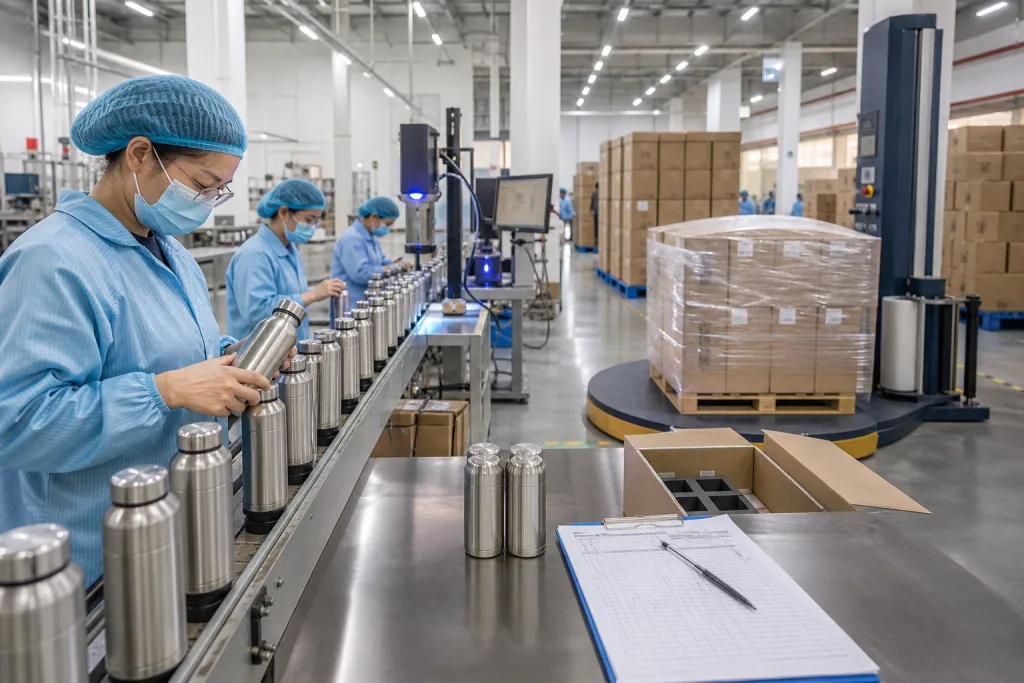
Key Takeaways
- For a custom thermos program, MOQ is typically 1,000 to 3,000 pcs per SKU, with 35 to 45 day lead time after sample approval
- A real stainless vacuum bottle spec should state 304 inner and outer, 0.4-0.5 mm wall thickness, and a 12-24 hour heat retention target
- Decoration cost can add USD 0.18 to 0.90 per unit depending on silk screen, laser engraving, powder coat, or full-wrap transfer
- Pre-shipment control should use AQL 2.5 major and 4.0 minor, plus 100% leak testing and carton drop tests before loading
You are not struggling to find a stainless bottle. You are trying to buy the right one without getting burned by weak insulation claims, decoration that fails after 200 dishwasher cycles, or an MOQ of 3,000 pcs when your channel needs 500 to start. For outdoor retailers and promotional brands in North America, a custom vacuum bottle America program usually has to hit two targets at once: stable product performance and pricing that still holds after freight, duty, and retail packaging are added.
A practical sourcing checklist matters more than a polished catalog. If you are comparing a factory thermos offer from Zhejiang, China with a domestic stock-and-print option, ask the questions that change cost, compliance, and sell-through. This is the wrong question to ask: “Who has the lowest unit price?” We’ve seen that go sideways. The details are plain stuff from the line: 18/8 steel, copper lining, lid leakage at 0.03 MPa, AQL level, carton drop test from 76 cm, and whether your supplier thermos quote is FOB Ningbo or landed.
What are you actually buying?
Buyers ask for a “custom thermos” and mean 3 different items: a vacuum flask for camping, a commuter bottle for retail, or a promo piece for a 5,000-unit event order. They look similar on the screen. On the line, they are not the same product. Outdoor retail usually needs better dent resistance, a powder coat that passes a simple cross-hatch tape check, and a lid that survives repeated open-close cycles. Corporate gifting is different. The buyer often cares more about logo size, gift box fit, and shelf presentation than 2 extra hours of heat retention. This is the wrong question to ask if you start with shape only.
For a custom vacuum bottle America project, send a short spec sheet before you ask any thermos manufacturer for price. One page is enough. Put in capacity, steel grade, mouth diameter, insulation target, finish, logo method, unit packaging, and compliance market. We run quotes faster when those basics are clear; otherwise sales has to chase 6 emails over details like whether the mouth is 45 mm or 55 mm. A serious manufacturer thermos quote from China should come back with exact dimensions, net weight, gross weight, carton quantity, and CBM.
- Common capacities: 350 ml, 500 ml, 750 ml, 1,000 ml
- Typical steel: SUS304 inside and outside; sometimes 201 outside for lower-cost promotional thermos orders
- Common wall thickness: 0.4 mm body, 0.5 mm bottom on mid-range models
- Popular finish: powder coat, spray paint, brushed, electroplated accent band
If a suppliers thermos proposal only says “double wall stainless steel” and skips material grade, retention data, and packaging details, it is not a usable quote. It is just the first pass. QC pulled a sample last month from a market bottle like this, and the PO even had a typo on the steel callout; that is how claims start later. In Zhejiang, China, decent factories are used to exact questions because export buyers in Europe and North America ask for REACH, LFGB, or FDA-related material declarations. You should ask the same way. If not, we've seen this go sideways.
Which specs drive cost most?
The fastest way to control budget on thermos bulk orders is to know which specs actually move the quote. Volume matters, but less than first-time buyers think. On our line, decoration, lid structure, packaging spec, and steel thickness usually shift cost more than adding 100 ml. We see this in costing sheets every week. A body wall change from 0.4 mm to 0.5 mm shows up faster than buyers expect.
A 500 ml manufacturer thermos in 304/304 stainless, standard screw lid, plain box, and one-color silk screen may land around USD 3.20 to 4.80 FOB Ningbo at 3,000 pcs. The same bottle with a custom lid, powder coat, laser logo, color gift box, and spare gasket can move to USD 4.80 to 7.20. If you ask for a customized thermos with a new mold, your tooling can add USD 2,000 to 8,000 depending on body and lid complexity. Last month a buyer flagged the lid as “just a small change,” but the new hinge core meant fresh tooling and two more sample rounds. The math doesn't work if you treat that as a free edit.
Cost checklist buyers should use
- Material: 304 outside costs more than 201 outside, but helps corrosion resistance and premium positioning. We cut random cups after forming, and the spectrometer reading settles arguments fast.
- Weight: Heavier body often means 10% to 20% higher steel cost, but fewer dent complaints. A 30 g increase across 3,000 pcs is not small.
- Lid: A simple PP screw lid is cheaper than a flip lid with locking parts and silicone straw. More parts, more assembly stations, more leak-risk points. QC pulled the sample once because the spring pin sat 0.6 mm off center.
- Finish: Powder coating adds grip and shelf value; expect roughly USD 0.25 to 0.60 more than basic spray. The cure oven time is longer, and scratch-retest scrap is higher.
- Packaging: A kraft box may cost USD 0.18; a full-color gift box with insert may be USD 0.45 to 0.90. We ship plenty of gift sets where the box costs more than the lid assembly.
For distributor thermos and distributors thermos programs, packaging can make or break margin. Retailers may need barcode labels, inner packs of 12, or display-ready cartons with a 3A drop test standard. Promotional buyers often ask for individual white boxes and repeat runs that match the first PO exactly, even down to carton marks. We've seen this go sideways over a barcode typo on a PO and a wrong outer carton count. A good thermos factory asks where the product will be sold before finalizing the quote. That is not sales talk. It is cost control.
You do not buy “the same bottle with a logo.” You buy a full landed cost structure built from material, labor, decoration, packaging, and freight efficiency.
How do you judge insulation honestly?
Heat-retention claims are where specs get sloppy fast. We see catalogs print “keeps hot 12 hours, cold 24 hours,” then nobody says whether the test used 95 degrees C water or 85 degrees C, full fill or 80% fill, 20 degrees C room temp or an air-conditioned lab at 26 degrees C. For a thermos custom order, ask the factory thermos team for the exact method: starting water temperature, ambient temperature, fill rate, bottle position, and the time points recorded. This is the right question to ask. Last month a buyer flagged a report because the PO said 500 ml but the sample was tested at about 450 ml fill.
A workable benchmark for a 500 ml stainless vacuum bottle is simple: fill with hot water at 95 degrees C, store it at about 20 degrees C room temperature, then check it at 6 and 12 hours. On our line, mid-range product usually stays above 60 degrees C at 6 hours and above 45 degrees C at 12 hours if the vacuum pull is stable. Premium designs with a copper-coated inner wall and tighter vacuum control do better. Cold retention is easier to hit. We usually check this with a digital probe thermometer after QC pulled the sample from the aging rack.
The construction details matter:
- Vacuum quality: poor vacuum kills performance even if the body uses better steel; we catch this at the vacuum station before packing
- Copper lining: improves thermal reflection and shows up more often on better custom thermos models; the coating needs even coverage on the inner wall
- Lid structure: a weak gasket leaks heat and liquid; a 2 mm silicone ring out of position will fail fast
- Mouth diameter: a wider opening is easier to drink from but loses heat faster; we have seen this go sideways on wide-mouth promo bottles
If you are buying bulk thermos for outdoor stores, ask for sample testing under rough use, not shelf-display conditions. Put the bottle in a truck cup holder, open and close the lid 200 times, then run a leak test upside down for 30 minutes. We ship plenty of bottles that pass insulation but fail after cap cycling because the thread fit loosens. A custom vacuum bottle America buyer should also ask whether the bottle sweats externally in high humidity and whether the base cap survives impact. One common inspection finding is a dented base after a 1.2 m drop test.
Most thermos suppliers in Zhejiang can provide retention reports from in-house tests, but for major programs, get third-party lab confirmation with migration and contact-material tests. The math doesn't work if you skip it. One lab report costs far less than one container of returns, rework, and chargebacks. We usually suggest checking insulation, leak, and AQL 2.5 appearance in the same sample set so the buyer is not comparing three different bottles.
What MOQ and lead time are normal?
MOQ is where sourcing plans usually break. We often get a target like 300 pieces in four colors, custom packaging, and two logos on one SKU. The buyer wants flexibility. The math doesn't work. Most thermos manufacturers do not decline this because the order is annoying; they decline it because setup cost, print changeover, and carton allocation eat the margin before the line even starts. For a standard customizable thermos using existing molds, normal MOQ is 1,000 pcs per color per size, sometimes 500 pcs if you accept limited finish choices and standard inner boxes. For new tooling, expect 3,000 pcs or more. On our side, one silk-screen plate change and one carton mark change can already burn half a shift.
At BottleForge Industrial in Hangzhou, Zhejiang, monthly output on stainless drinkware programs can reach 300,000 units across mixed models, but line planning still depends on finish and decoration. A plain spray finish runs faster than powder coat with laser logo plus strap assembly. QC pulled the sample last month on a bottle with a 0.8 mm logo offset, and that one detail pushed approval back two days. A realistic schedule looks like this:
- Stock sample: 2 to 5 days
- Pre-production logo sample: 7 to 12 days
- Mass production: 25 to 35 days for repeat orders, 35 to 45 days for first orders
- Peak season buffer: add 7 to 15 days from August to November
If you are buying thermos promotional product for a dated campaign, do not build the plan around best-case timing. Build it around approval risk. We have seen this go sideways over small things: artwork revised three times, a Pantone callout missing on the PO, one barcode digit changed, or retail packaging copy updated after the sample was signed. One buyer even typed the wrong item code on the deposit slip, and production had to stop for reconfirmation. A good thermos supplier should lock artwork, carton marks, and label placement before deposit.
For thermos distributor and thermos distributors buyers in North America, ocean transit from China can still range widely by port and season. We ship the same bottle to Los Angeles in one window and New York in another, and the spread can be 12 days vs 18 days before port congestion even starts. This is the wrong question to ask if the first PO is still changing every week. Do not over-customize your first PO. Use a proven bottle body, customize the finish and logo, then add new lid tooling only after sell-through is confirmed.
What compliance should North America require?
Compliance is set by sales channel first, geography second. An outdoor retail bottle needs clean food-contact paperwork and labeling that matches the retail pack; we’ve seen a buyer flag a missing bilingual warning on a 24 oz gift box at final check. A kids-oriented item needs closer review on CPSIA-related points and physical safety details, down to cap parts and pinch gaps under 5 mm. A bottle for corporate gifting still needs material-safety documents, though the file set is often lighter. This is the wrong question to ask if it starts with “what certificate do you have?” Ask which documents match this SKU and this sales channel.
For custom vacuum bottle America shipments, ask your thermos vendor or thermos supplier for the following where relevant:
- Food-contact material declarations for stainless steel, PP, Tritan, silicone, and paint system
- FDA or LFGB-related testing depending on your market and customer request
- REACH screening for coatings and accessories if you also sell into Europe
- Prop 65 review for California exposure concerns on certain components or decorations
- BSCI or social compliance audit if your brand policy requires factory review
Quality documents should cover production control, not only lab reports. Ask if the thermos factory runs 100% leak testing on the line, usually with an air-pressure fixture after vacuuming, whether raw steel is checked by grade certificate, and whether incoming accessories are verified for odor and fit. QC pulled the sample last month on a lid set because the silicone ring was 0.8 mm oversize and sat proud after assembly. For pre-shipment inspection, AQL 2.5 for major defects and 4.0 for minor is a practical baseline for stainless drinkware.
Outdoor retailers should add simple durability checks: coating adhesion, handle pull test if applicable, and carton drop tests from 76 cm to 92 cm depending on pack weight. We ship to US and Canada accounts that ask for ASTM-style test wording, FNSKU labels, and scannable UPC placement, so regular export factories already know the drill. You do not need every certificate on a supplier’s wall. You need the right set for the channel, and each document should match the exact SKU on the PO, not an older 500 ml model with a similar lid.
How should branding and packaging be handled?
Decoration is the point where a custom thermos stops looking like a catalog item and starts looking like your SKU. It is also where rejects start. Curved stainless is unforgiving; on our line, a logo that runs 2 mm too close to the side seam or uses strokes that are too thin will fail fast. We’ve seen this go sideways. The bottle body was fine, but the print made it look low grade.
For customized thermos orders, these are the usual methods:
- Silk screen: economical for 1-color or 2-color logos; usually USD 0.18 to 0.35 each
- Laser engraving: durable and premium; usually USD 0.20 to 0.50 depending on size
- Heat transfer or water transfer: good for wrap graphics; setup is heavier, and defect rate is more sensitive on curved bodies
- Embossed or debossed mold detail: best for long-term brand programs, but needs tooling
If you are a promotional brand, ask for logo endurance tests. We run 3M tape adhesion, a 50-cycle rub test, dishwasher caution statement review if applicable, and scratch checks on powder coat after curing. QC pulled the sample last month because the white logo chipped at the edge after tape pull. If you are an outdoor retailer, check hand feel with a wet hand, not just appearance. A bottle can photograph well and still feel slippery on shelf. That is the wrong question to ask if you only review renderings.
Packaging needs to fit the sales channel and the freight math. For thermos bulk sold to distributors, a clean brown or white box usually does the job, and MOQ stays easier to manage at 1,000 pcs. For retail-ready custom vacuum bottle America launches, buyers usually ask for bilingual copy, item number, FNSKU or UPC position, and warning statements on the gift box panel. Carton count matters too. A 24-pack master might save a little on box cost, but once a 750 ml bottle is packed, the carton weight can pass 18 kg and warehouse damage goes up. In our shipments, 12 pcs per carton is safer for 750 ml and above.
Good manufacturers thermos teams in Zhejiang will send a packaging dieline for approval before printing. Read every panel. We have seen a PO with the item number typoed by one digit, and we have seen barcodes fail because the quiet zone was squeezed by 1.5 mm. Those delays do not come from bottle production; they come from artwork files that nobody checked twice.
What should your first PO checklist include?
Your first PO should cut risk, not pile on custom options. We’ve seen buyers load one trial order with a new body shape, a fresh lid mold, 3 finishes, 2 box styles, and 4 logo files on the same PO. That is the wrong way to start. If QC pulled the sample and found an issue, you would not know whether it came from screen printing, tooling tolerance, or lid fit on the line.
Use a tighter first-PO checklist for any custom vacuum bottle America program:
- SKU count: keep to 1 or 2 bottle bodies maximum
- Color count: 2 or 3 proven Pantones only
- Decoration: one method per SKU, not mixed methods on the same run
- Packaging: standard box with final barcode and carton marks locked before deposit
- Inspection: pre-production sample approval plus pre-shipment AQL inspection
- Terms: confirm FOB port, payment schedule, and who pays for retest if failure occurs
Ask your supplier thermos team one direct question: what usually goes wrong on first orders of this exact model? Ask that, not “what’s your best price?” An experienced China factory should answer fast. We usually see 3 problems: Pantone shift on textured powder coat after oven cure, logo misalignment on tapered bodies by 1.5 mm to 2 mm, and lid color variation between PP and silicone parts. One buyer flagged this last year because the red lid ring matched the approved chip under D65 light but failed under store lighting.
Treat your thermos vendor like a production partner, not a quote machine, and the job gets easier. Short specs win. You need exact tolerances, a realistic MOQ like 1,000 pcs, and samples that match mass production, not one hand-polished piece from the bench. We ship clean first orders when the carton mark, seal test, and artwork file are locked before deposit. That is how outdoor retailers and promotional brands avoid the expensive gap between approval sample and container reality.
Build your custom stainless thermos program with clear numbers
Send your target capacity, logo method, packaging idea, and order volume. We will reply with MOQ, FOB pricing, lead time, and compliance options.
Frequently asked questions
What is a realistic MOQ for a custom stainless thermos order?
For an existing bottle mold, 1,000 pcs per size and color is the most common starting point. Some thermos suppliers in China will accept 500 pcs if you use a standard finish, one logo color, and plain packaging. If you want a new lid, custom base, or retail gift box, MOQ usually moves to 2,000 to 3,000 pcs. For a fully new bottle mold, expect 3,000 pcs minimum plus tooling, often USD 2,000 to 8,000 depending on complexity. If your program is smaller, ask for a stock body with custom logo first. That gives you a lower-risk entry point and faster repeat ordering once sell-through is proven.
How long does production take for North American custom vacuum bottle orders?
For a first order, plan 35 to 45 days after sample approval and deposit. A stock sample can be ready in 2 to 5 days, while a logo sample usually takes 7 to 12 days. Repeat orders often run in 25 to 35 days if materials and packaging are unchanged. Add 7 to 15 days during peak season from late summer to early Q4. Ocean transit from China to North America is separate, so your launch calendar should include production, inspection, booking, sailing, and customs clearance. If your date is fixed, such as a promotional campaign, do not approve artwork late. Most delays come from packaging edits, barcode changes, and color confirmation, not metal production itself.
Which material spec should I request for a durable premium thermos?
For a reliable premium bottle, ask for SUS304 stainless steel on both inner and outer walls, with body thickness around 0.4 mm and a stronger bottom section near 0.5 mm if the model is meant for outdoor retail. Request food-grade PP or Tritan for lid components and silicone gaskets with odor check. If you want better insulation, ask whether the inner wall has a copper coating and request retention data at defined time points, such as 6 and 12 hours. Avoid vague descriptions like “stainless steel vacuum bottle” with no grade listed. If a lower-cost promotional thermos is acceptable, some factories use 201 on the outer wall, but for long-term brand value, 304/304 is the safer specification.
What quality checks matter most before shipment?
The basics should be non-negotiable: 100% leak test, visual check for coating and logo, and carton verification before loading. For final inspection, AQL 2.5 major and 4.0 minor is a practical standard for stainless drinkware. Add heat-retention spot checks, assembly fit check, barcode scan test, and carton drop test from around 76 cm to 92 cm depending on carton weight. If the bottle has a handle or strap, request a pull test as well. For coated bottles, ask for adhesion and rub resistance checks. The most common claims on first orders are leaking lids, scratched finish, and misprinted packaging, so your QC plan should focus there before worrying about less frequent defects.
Is it better to buy from a China factory or use a domestic stock-and-print source?
It depends on quantity, lead time, and how custom you need the product to be. For short runs under 500 pcs with urgent timing, a domestic stock-and-print source can make sense even at a higher unit cost. For 1,000 pcs and above, especially with custom colors, retail packaging, or a brand-specific lid, a thermos factory in Zhejiang, China usually gives you more control and better economics. The trade-off is longer planning time. You will need sample approval, production management, and freight coordination. If your program is strategic, not just one event, sourcing direct from a manufacturer thermos partner usually gives stronger pricing, more decoration options, and a repeatable supply base.