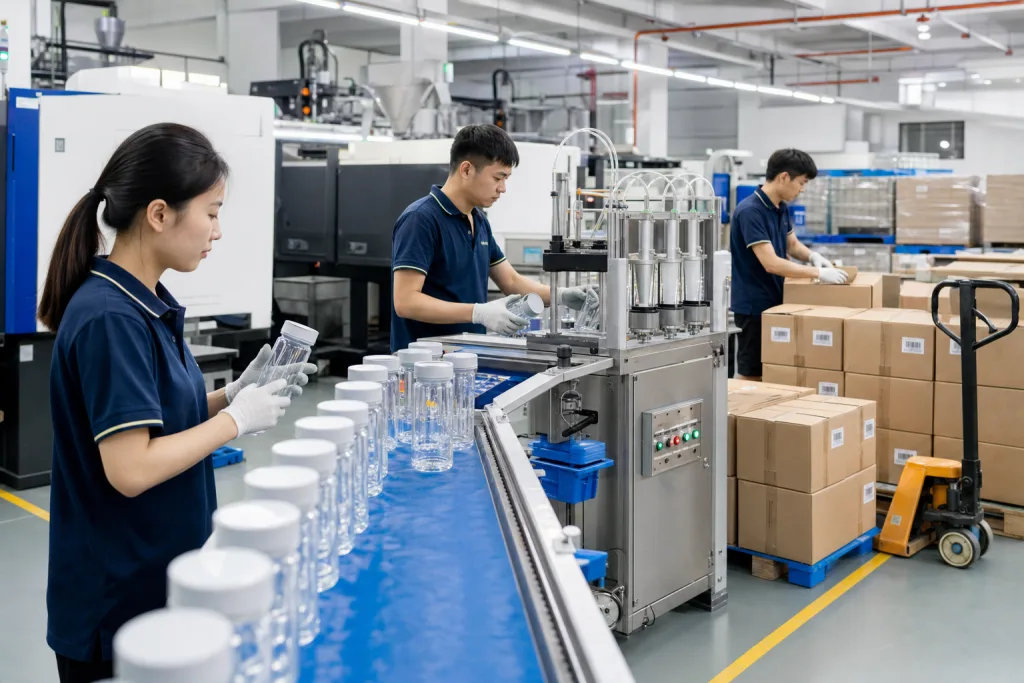
Key Takeaways
- A practical MOQ for a custom tritan water bottle is usually 1,000-3,000 pcs per color, with 25-35 day production after sample approval.
- Single-wall Tritan bottles typically land around USD 1.60-3.80 FOB China depending on 500 ml vs 1,000 ml size, lid type, and decoration.
- For repeat orders, ask for wall thickness of 0.6-0.8 mm and AQL 2.5 final inspection to control cracking, haze, and leak issues.
- Silkscreen is cheaper for 1-color logos, but UV print or sleeve decoration fits canteen customized programs needing 2-4 colors and retail shelf impact.
You’re not buying a bottle. You’re buying complaint rate, landed cost, lead time, and whether the logo still looks clean after 90 days in a gym bag. A custom tritan water bottle looks straightforward on the screen, then QC pulled the sample and the gaps show up: 0.6 mm wall versus 0.8 mm, lid leak rate at 3 out of 200 pcs, print adhesion after tape test, carton drop at 76 cm, and whether the factory can hold color consistency across 10,000 units on the same line.
For B2B buyers in Europe and North America, the first question is channel. Event canteen promo is one spec. A retail launch is another. Distributor restock sits in the middle, and this is where buyers mix them up. We run all three in Zhejiang, but the math doesn’t work if you ask one bottle to cover every job. One buyer flagged a PO last month with the wrong lid code, and that small typo turned a 12 day sample loop into 18 days. If you want fewer surprises, compare bottles head-to-head before you ask for a quote.
What changes the buying decision
A custom tritan water bottle sits in a tricky price band. It is cheaper and lighter than stainless, tougher than basic AS or PET, and simpler to decorate than insulated bottles. On paper, that looks easy. On the line, the buying call changes fast once the use case is fixed.
If you supply schools, gyms, or corporate promos, buyers usually push price and lead time first; shelf-ready packaging comes later. We ship these jobs with standard export cartons and no inserts all the time. If you are building a retail drinkware line, the buyer flagged the cap feel, Pantone match, and shelf look before asking about freight on one recent PO. For a private label launch, color is not the first decision. Structure is. This is the wrong question to ask first if the lid style, neck finish, and decoration area are still floating.
- Event or promotional use: 500-700 ml, single-color logo, standard screw lid, MOQ 1,000-2,000 pcs.
- Retail sports use: 700-1,000 ml, carry loop or flip straw, Pantone body color, hangtag or color box.
- Outdoor or team use: impact resistance, leak control, wider mouth, stronger handle connection.
- Distributor restock: stable carton dimensions, repeatable accessories, low SKU complexity.
At BottleForge Industrial in Hangzhou, Zhejiang, we see buyers send the same RFQ to 6 or 8 suppliers before they lock the basics. That wastes a week. A canteen project with a basic lid might be USD 1.75 FOB China at 1,000 pieces. Switch to a flip straw lid with a molded handle, and the same body can move to USD 2.40-2.90. Add a color box, hangtag, or shrink bag, and the math doesn’t work the same anymore. We have seen QC pull a sample where the bottle body passed, but the straw lid leaked after 300 open-close cycles, so the quote should never be compared on body cost alone.
The practical point is simple. When a supplier says “same bottle,” it often is not the same bottle once tooling, seal design, and decoration are counted. A 1.5 mm wall, a different silicone ring hardness, or a wider print area will move cost and lead time. We’ve seen this go sideways because of one typo on a PO. That is why a spec table beats a mood board.
Head-to-head spec table that matters
Start with this table. Most B2B buyers we ship to compare these four directions first for a custom canteen or custom drinkware program built on Tritan. On our line, the first thing QC checks is body weight against the BOM before decoration starts.
Core comparison
| Spec | Value Promo | Gym Retail | Outdoor Utility | Kids/School |
|---|---|---|---|---|
| Capacity | 500-650 ml | 700-1,000 ml | 750-900 ml | 350-500 ml |
| Wall thickness | 0.6 mm | 0.7 mm | 0.8 mm | 0.7 mm |
| Mouth style | Regular | Wide | Wide | Regular or straw |
| Lid type | Screw | Flip straw | Screw + handle | Straw + bumper |
| FOB China | USD 1.60-2.10 | USD 2.20-3.20 | USD 2.50-3.80 | USD 2.10-3.10 |
| MOQ | 1,000 pcs | 2,000 pcs | 2,000 pcs | 3,000 pcs |
| Best decoration | Silkscreen | UV print | Laser-marked lid + screen | Wrap print or decal |
This table works because each column points to a different failure point, and this is the wrong question to ask if you only want the “best-looking” bottle. Promo bottles usually fail on margin once buyers add a 0.7 mm body, premium lid color, and retail box to a USD 1.60-2.10 target. Gym retail bottles fail at the lid. We’ve seen straw seals seep after 800 cycles and carry loops snap during a 10 kg pull test. Outdoor bottles fail in cold-drop checks or after hinge-pin movement shows up on the line. Kids bottles fail compliance when ink migration, material traceability, or small-part retention is loose; last year a buyer flagged a bumper that came off below the pull-force spec.
You are not choosing the “best” bottle. You are choosing the cheapest bottle that still survives your channel, your claims, and your customer behavior.
A serious canteen vendor or canteen factory should be able to talk through all four columns without guessing. Ask for lid cycle test data, the exact leak test method, and average unit weight tolerance. For a 700 ml Tritan body, a normal weight tolerance is around plus or minus 3 g. We check that on a digital scale at in-line QC, and if drift shows up, the mold setting gets reviewed fast. If the canteen suppliers cannot give you those numbers, the math doesn't work for repeat retail orders.
Use-case fit by sales channel
Not every custom tritan water bottle fits every sales channel. We’ve seen buyers pick one bottle structure and push it into 4 programs, then get hit with margin loss on one side and return claims on the other. This is the wrong question to ask. Start with channel fit first, then bottle spec. On the line, even a 0.3 mm mismatch at the lid thread can be manageable for promo orders and a headache for retail.
Corporate gifting and canteen promotional orders: Keep it simple. A 500-600 ml bottle with a screw lid, one-color silkscreen, and polybag packing is usually enough. For a canteen customized program, don’t open new lid tooling below 5,000 pieces; the math doesn’t work. Buyers usually want fast approval, low defect risk, and a logo that sits straight on the panel, not wrapping into the parting line. A canteen supplier in Zhejiang can often turn this in 20-25 days after deposit if body color is clear or stock tint. We run these with standard screen fixtures and a go/no-go gauge on the neck finish to keep trouble down.
Retail and e-commerce: The bottle needs a visual hook, and it needs to survive delivery. A customizable canteen with a flip straw, matte finish, and custom box can justify a higher FOB, but only if the leak rate stays under control. Ask for carton dimensions, FNSKU labeling support, and drop-test packaging for Amazon FBA or DTC. We’ve had a buyer flag a 3A carton as “good enough,” then QC pulled the sample after a corner-drop and found a cracked hinge on 2 out of 12 pieces. One cracked lid in transit can damage your review score faster than a late vessel.
School, youth, and clubs: These orders look easy on paper. They are not. Small hands need lids that open without too much torque, and parents notice odor fast, sometimes the same day the goods arrive. This is where certified raw material, REACH testing, and if relevant ASTM-oriented checks matter. A customized canteen for kids should avoid hinge assemblies with deep pockets that trap mold or snap after 200-300 wash cycles. We’ve seen this go sideways when the buyer approved a cute cap shape but ignored the cleaning path inside the straw seat.
Distributor replenishment: If you are a distributor canteen buyer or manage distributor growler and distributor drinkware lines, standardization beats novelty. Hold 2-3 body sizes, cut lid variations, and lock carton quantities early. That saves you warehouse space and fewer picking mistakes; one PO we saw even mixed “48 pcs/ctn” and “36 pcs/ctn” on the same page. Repeatability is where experienced canteen manufacturers in China make your life easier. A factory running 600,000 units per month can support rolling forecasts better than a workshop that only reacts order by order. We ship these best when the SKU tree stays tight.
The same logic applies if your range includes custom growler or customizable growler products. Large-volume drinkware is less forgiving on leak control and packaging weight. A 64 oz body puts more stress on the cap, the handle area, and the master carton during transit, so the discipline you build on Tritan bottles carries across the line.
Decoration, color, and brand durability
Most logo complaints are not about the Tritan body. They start with the wrong decoration for the actual use. For daily-use customized drinkware, the print has to hold up to hand oil, dish soap, moisture, and bag rub. On our line, QC pulled samples after a simple cup-holder abrasion check, and weak ink failed fast.
- Silkscreen: fits 1-2 colors, curved surfaces, and tighter budgets. Typical add-on is USD 0.08-0.18 per color per unit. We usually run a 120-140 mesh screen for this, depending on logo line width.
- UV print: better for multi-color artwork or gradients. Expect USD 0.20-0.45 depending on coverage. It looks sharp, but the buyer needs to check cured-ink hardness, not just approve the first pre-production sample.
- Heat transfer or decal: works for wrap graphics, but test adhesion on textured finishes. We have seen decal edges lift on matte bottles after 48 hours if surface prep was sloppy.
- Laser mark: usually used on lids or metal trim, not the Tritan body itself. If a sales rep suggests laser on pure Tritan, that is the wrong question to ask.
For a canteen customizable retail order, ask for three plain answers. What is the logo adhesion test? What is the color reference standard? What scratch result can the factory show on an approved sample? Baseline is simple: cross-hatch adhesion test, then 24-hour cure confirmation before packing. For color, use Pantone references and stay realistic on transparency. Transparent or smoke tints repeat more easily than milky or heavy saturated tones. We check tinted bottles under a light box at 6500K, not by the warehouse door.
Chinese factories sometimes say a color is “same as sample” when the resin batch is only close. That does not work for a branded collection. We have had buyers flag a lid and body mismatch that was only half a shade off under store lighting. A disciplined Zhejiang supplier will keep a signed master sample, record the resin lot, and compare each batch under controlled lighting. Ask for that process, and ask who signs the lot-release card.
If you are comparing canteen customized versus customized growler or other larger-format products, decoration risk goes up with panel size. Big graphics look good on a mockup. On the line, they expose registration drift and rough edges fast, sometimes by 0.5 mm, which is enough for a retail buyer to reject them. In most cases, a clean brand mark placed well beats a full wrap that pushes rejection rates from 2% to 6%. We have seen this go sideways, and the math does not work.
Compliance and quality checks worth paying for
Tritan is a known material, but compliant resin alone does not make the whole bottle compliant. The lid, silicone seal, masterbatch, printed ink, and even the inner polybag all count. We have seen buyers approve the bottle body, then QC pulled the sample and found the straw seal failed odor review. If you sell into Europe or North America, ask your canteen manufacturer for the document list before sampling gets too far. Ask before the second sample, not after the PO typo is already on 10,000 boxes.
- REACH and food-contact declaration for relevant materials
- LFGB if your channel needs German-market confidence
- BPA-free statement tied to actual resin source
- BSCI or similar social compliance if required by your customers
- Factory quality process, ideally ISO-based document control
For inspection, AQL 2.5 is a sensible starting point for major defects on finished drinkware. Critical defects should be zero tolerance. Define defects in writing: leak after 30 minutes upside down, cracked body at the gate, sharp flash over 0.3 mm on the lid edge, wrong logo size, wrong Pantone, odor, or a loose handle. This is the wrong question to ask: “Can you make good quality?” We have seen this go sideways. Buyers say “good quality,” suppliers say “normal quality,” and then both sides argue at loading.
Ask for test details, not just “passed.” On our line, a basic Tritan bottle routine usually includes 100% leak test, visual check under standard light, and random drop or torque testing by lot. A screw-lid torque check might target 6-9 kgf·cm depending on thread design and seal compression. We run that with a torque tester, not by hand feel. Too low, the bottle leaks. Too high, the buyer flagged it because end users cannot open the lid without two hands.
If you buy from canteen suppliers in China, a pre-shipment inspection by a third party costs far less than a rejected container at destination. The math doesn't work any other way. One PSI at AQL 2.5 is cheap; one held container can burn 12 days vs 18 days once rework, rebooking, and destination claims start stacking up. This matters even more if you are also sourcing adjacent products from canteen manufacturers, such as customized growler formats or mixed distributor drinkware assortments, because one weak SKU can hold the full shipment while the line waits for replacement cartons.
Lead time, MOQ, and quote traps
The cheapest quote on page one often turns into the highest landed cost after revisions. We see this on the line all the time. For a custom tritan water bottle, the extra cost usually sits in mold tweaks, box assumptions, or decoration setup that was never written clearly on the first PI.
A normal project flow in China looks like this:
- Artwork and spec confirmation: 2-4 days
- Pre-production sample: 5-10 days
- Mass production: 25-35 days
- Peak season buffer: add 7-10 days
MOQ follows the actual level of customization, not the headline bottle style. This is the wrong question to ask if the buyer only says, “What is your MOQ?” and sends no artwork. If you pick an existing canteen factory mold and standard lid colors, 1,000 pieces can work. If you want a custom body tint, printed box, and exclusive cap color, 2,000-3,000 pieces is the normal range. If you ask a canteen manufacturer for a new lid mold, expect tooling cost around USD 1,500 to 4,000 based on part complexity, slide count, and texture requirement. We’ve seen this go sideways over a 0.2 mm logo recess that looked minor on the drawing and changed the tool cost fast.
When you compare canteen vendors, ask every factory to quote in the same format: FOB Ningbo or Shanghai, unit price by quantity break, sampling charge, tooling charge, packaging spec, carton size, G.W./N.W., and lead time from deposit plus artwork approval. Use one sheet. Same columns. Same terms. QC pulled a sample last month where the buyer flagged the carton count because one supplier quoted 24 pcs/ctn and another built cost on 36 pcs/ctn, so the unit price looked lower but the freight math didn’t work. Zhejiang factories close to Ningbo often give cleaner logistics terms than inland suppliers, and that saves argument later.
Watch the “free sample” line. In plenty of quotes, the sample is free only for a digital mockup or a stock-color bottle with a quick print, not a production-standard decorated sample from the actual setup. For retail programs, ask for a true pre-production sample. We ship these after color check and print position approval, and the extra USD 50-150 is cheap insurance. Last season one PO even said “matte blue lid” while the artwork file showed gloss navy; that small typo cost 6 days.
If you run a broad range including custom canteen, custom growler, and customizable drinkware, one disciplined RFQ template will save more money than pushing for 3 cents off the unit price. Good canteen distributors already work this way. New buyers usually learn after one bad order, one missed pack spec, or one quote that excluded the insert tray.
Send your bottle spec and get a workable quote
Share capacity, lid type, decoration, target price, and quantity. We will flag the risks, suggest the right spec, and quote FOB China clearly.
Frequently asked questions
What is a realistic MOQ for a custom tritan water bottle?
For an existing bottle mold with standard accessories, 1,000 pcs is realistic from many canteen manufacturers in China. If you want a custom Pantone body, custom lid color, and printed retail box, expect 2,000-3,000 pcs per style. For fully new lid tooling, the MOQ may still start at 3,000 pcs, but you also need to budget roughly USD 1,500-4,000 for the mold. Buyers often ask for 500 pcs, but that only works if the factory has stock components and you accept limited customization. For repeat orders, MOQ usually becomes easier once the factory holds your approved master sample and packaging files.
How much should I budget per bottle from China?
A practical FOB China range for a custom tritan water bottle is USD 1.60-3.80 per unit. At the low end, you are looking at a 500-650 ml single-wall bottle with screw lid, one-color silkscreen, and simple polybag packing. At the higher end, you get 700-1,000 ml capacity, a more complex straw or handled lid, 2-4 color decoration, and a color box. Add around USD 0.08-0.18 per extra print color for silkscreen, or USD 0.20-0.45 for UV print. If your project includes custom canteen or customized growler lines in the same container, ask for mixed-SKU carton planning so freight efficiency is not lost.
Is Tritan suitable for retail and promotional programs?
Yes, but the spec should match the channel. For canteen promotional orders, Tritan works well because it is clear, lightweight, and easier to brand than insulated steel. A 500-600 ml bottle with 0.6 mm wall thickness is usually enough. For retail, especially sports and e-commerce, use a more robust structure: 0.7-0.8 mm wall, better lid sealing, and stronger print protection. Tritan is not the cheapest material, but it usually gives a better balance of appearance and durability than entry-level plastics. If you are selling to schools or family channels, request documentation on raw material source, colorant safety, and food-contact compliance rather than relying on a generic BPA-free claim.
What quality checks should I require before shipment?
Start with a written inspection standard and AQL 2.5 for major defects. Define zero tolerance for leaks, cracks, wrong artwork, sharp flash, and odor. Ask for 100% leak testing and random verification of lid torque, print adhesion, and assembly fit. For decorated bottles, require a pre-production sample that matches mass-production method, not just a digital mockup. If the order is above 5,000 pcs or for retail launch, use a third-party pre-shipment inspection in China. Also confirm carton drop performance and barcode labeling if you ship to FBA or major retail DCs. These checks cost far less than replacing inventory after arrival.
How do I choose between a canteen supplier, trader, and factory?
Ask direct process questions. A real canteen factory should give you molding details, wall thickness, monthly capacity, sample lead time, and quality checkpoints without vague answers. A trader can still be useful if they manage several canteen suppliers, but then you need transparency on who makes what. Ask who owns the mold, where final assembly happens, and whether the party quoting you can control decoration and packaging in-house. In Zhejiang, many strong drinkware suppliers are close to Ningbo or Hangzhou logistics routes, which helps on lead time and communication. If your program includes custom drinkware, customized canteen, and customizable growler categories, one capable factory group is usually better than too many fragmented vendors.