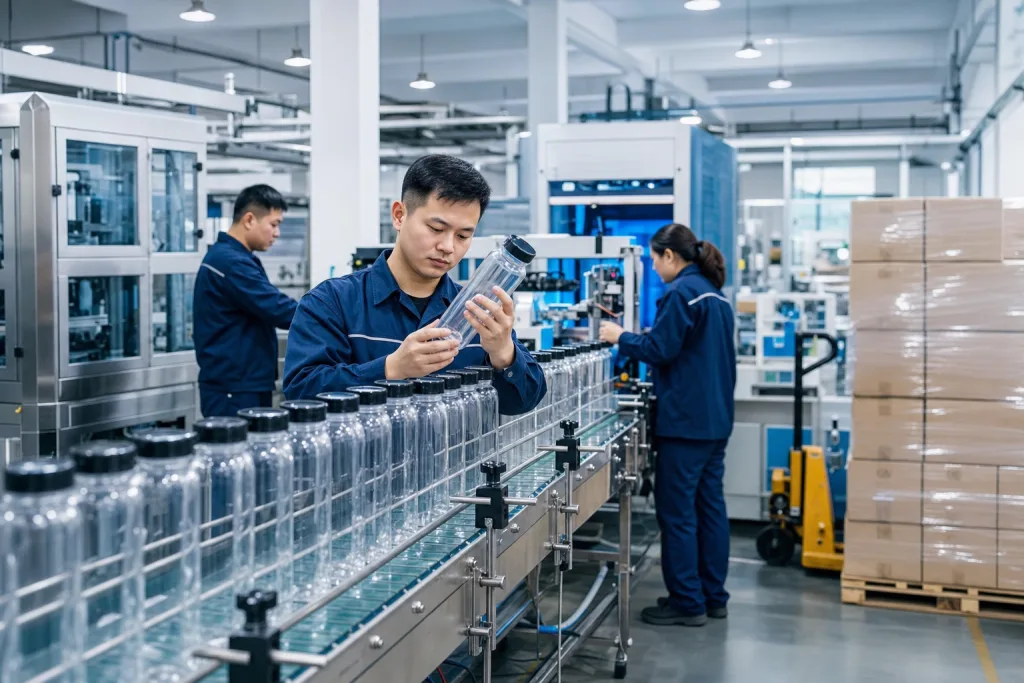
Key Takeaways
- Typical first-run MOQ is 1,000-3,000 units, with 25-35 days lead time after sample approval
- Expect factory pricing around USD 1.45-3.20 per unit depending on size, lid, and decoration
- For the UK market, ask for REACH and food-contact declarations plus leak testing on 100% of sampled units
- A serious canteen manufacturer in Zhejiang should show monthly capacity above 300,000 units
If you’re sourcing a custom tritan bottle uk for retail, corporate gifts, or distributor stock, the bottle is usually not the hard part. The hard part is repeatable quality, compliant raw material, and decoration that still looks clean after carton drops, courier handling, and a second PO six months later. On our line, QC pulled a sample last month with a 0.4 mm wall-thickness drift, and that small miss was enough to change the hand feel and squeeze strength. Tritan is not complicated, but the margin lives in the details: lid torque in N·m, leak testing at 100%, color tolerance, and whether the factory can hold the same shade on 5,000 units and 50,000 units. Buyers ask about price first. That’s the wrong question to ask.
In Zhejiang, good canteen factories speak with numbers. We run the same way. Ask for MOQ, lead time, AQL standard, REACH documents, and whether the canteen manufacturer will make a pre-production sample before the line starts. For UK buyers, the first workable run is usually 1,000-3,000 units, with 25-35 days for production after approval. We’ve also seen POs delayed over one typo in a logo code, so get artwork sign-off tight before molding and printing. If a canteen supplier cannot answer those basics in one email or one call, you are not buying a custom drinkware program yet; you are buying risk.
What buyers mean by Tritan
Buyers asking for a custom tritan bottle uk usually mean one thing: a clear, lightweight bottle that looks close to glass but survives daily knocks. On our line, the buyer is usually comparing it against cheap PET samples that haze fast. Tritan is a copolyester, and the selling points are straightforward: good clarity, solid impact resistance, and less odor retention after use. For retail and promo orders, that matters. We have seen buyers flag bottles that turned cloudy after 2 wash cycles or held a detergent smell after a hot-water rinse at 60°C.
Do not stop at the material name. This is the wrong question to ask. Ask the canteen manufacturer for the actual resin grade, wall thickness, and whether the bottle is BPA-free by declaration and test report. A practical wall thickness is often 1.2-2.0 mm depending on the capacity and shape. For 600-750 ml bottles, a well-made body should feel rigid without being heavy; on sample review, we usually check the sidewall with a caliper before we sign off. If the canteen supplier cannot tell you the material grade or only says “food grade,” treat that as incomplete. We have seen this go sideways on repeat POs.
- Check clarity: sample should stay clear after repeated washing; QC pulled one last month that showed light haze after 5 dishwasher cycles
- Check impact resistance: drop-test from 1.2 m on a hard floor; for a 650 ml body, the base should not crack on first drop
- Check odor: no plastic smell after hot water rinse; if the buyer flagged a sharp resin smell, we hold the lot
MOQ, price, and lead time
For most UK importers, the price only starts to work once the order can absorb tooling, logo setup, and freight. For a custom Tritan bottle with a simple screw lid and one-color logo, the common range is USD 1.45-2.20 at 1,000-3,000 units. If you add a flip lid, carry handle, or stainless insert, the unit price usually moves to USD 2.40-3.20. At 10,000 units, you should press for a lower ex-factory price if the design is locked and the line is not changing every PO. We see buyers ask for 500-piece MOQ with custom color, custom mold, and printed carton; this is the wrong question to ask. The math does not work. On our side, even a basic color match gets checked against a Pantone chip under the light box before mass run.
Lead time is where weak canteen vendors get exposed. A normal program is 7-12 days for sample development, then 20-35 days for production. If a factory says 10 days from artwork approval for a custom canteen order, ask how many injection machines and assembly lines they run, not just what sales promised in email. A real canteen factory in Zhejiang should be able to show monthly output above 300,000 units if they are handling export programs. We run into this on the floor: QC pulled the sample, the lid torque was off by 0.3 N·m, and shipment slipped two days because nobody checked the first-off sample properly. Smaller plants can still be good, but you need to know the ceiling before you plan a distributor drinkware launch. We have seen this go sideways when the buyer flagged a late carton approval and the factory had no spare line capacity.
Practical rule: do not chase the lowest FOB price if the factory cannot hold a 98% on-time shipment rate.
Decoration methods that last
The decoration method decides fast whether the bottle still looks sharp after 6 months or starts looking cheap after one dishwasher cycle. For customized drinkware, we usually run silkscreen, UV print, pad print, or laser engraving on metal lids. On Tritan bodies, silkscreen and UV are the two options buyers use most, and the right pick depends on the bottle curve, logo coverage, and whether the artwork has solid blocks or thin text. For a customizable canteen program, 1-2 print colors is usually the safe call if you want stable yield on the line. Buyers ask for 4 colors on a tapered body all the time; this is the wrong question to ask if repeatability matters.
If you are building a canteen promotional line for retail or events, keep the artwork clean and practical. Fine lines under 0.3 mm fail often on curved surfaces; QC pulled samples last month where 0.25 mm strokes broke after the first pass on the jig. For a custom growler or larger bottle with a wide body, the printable area is better, but you still need to confirm ink adhesion and abrasion resistance before mass production. Ask the factory for tape test or abrasion test results, not just a nice pre-production photo. A workable target is 50-100 rub cycles without obvious fading, depending on the ink system, and we have seen cheap UV jobs go sideways at 30 cycles.
What to specify in the PO
- Logo size in mm, not just “big on front”
- Pantone number for each color
- Print position and maximum wrap length
- Durability requirement: dishwasher-safe or hand-wash only
Compliance for UK importers
UK buyers need more than a nice sample. You need paperwork that clears customs and stands up in a customer audit. For custom drinkware, ask for the food-contact declaration, a REACH statement for the UK market, and test reports for heavy metals, phthalates, and overall migration where the product risk calls for them. If the lid has 304 stainless, silicone, or PP parts, each material needs its own coverage on file. We see this on the line all the time: QC pulled one lid set with a silicone gasket at 2.0 mm, and the buyer asked why the bottle report did not mention the gasket. Fair question.
Do not accept “UK ready” on its own. Ask for the lab name, report date, and product code on every document, and make sure the code matches the PO because we have seen a one-letter typo hold shipment. If you sell through a distributor canteen channel or a retailer network, you may also need barcode labels, outer carton marks, and batch traceability. A solid Zhejiang factory keeps retention samples for at least 12 months and production records by batch. This is the wrong question to ask if you only focus on price. Six months later, when a customer wants replacements from batch KT-042 and the buyer flagged a lid crack, those records save days.
- Paperwork to request: food-contact declaration, REACH statement, test report, carton list with product code and PO reference
- Quality record: batch code, production date, inspector sign-off, retention sample log
- Labeling: country of origin, capacity, care instruction, barcode if the channel requires it
How to vet the factory
Buyers ask for a canteen supplier. The better question is repeatability. We need a factory that can run the same bottle twice and hit the same fit, color, and seal result, not just send one good pre-production sample. On the floor, that means mold control, incoming inspection, and a finished-goods checkpoint before cartons are taped. If you are dealing with a canteen distributor instead of a direct canteen factory, ask who owns the mold and who signs the QC release. We have seen this go sideways: the buyer flagged a lid crack, and the trader had to call a third-party plant before anyone would even pull the mold file.
Use a short audit checklist and ask for straight answers. Check whether the plant works to ISO 9001, whether they inspect to AQL 2.5 for major defects and 4.0 for minor defects, and how they test leak resistance on the line. For customized canteen projects, a 1-meter drop test and 30-minute inverted leak check are a fair starting point; QC pulled the sample, filled it to the shoulder line, then left it upside down on kraft paper so leaks showed fast. Ask how many export lines they run in Zhejiang and how many are tied up with domestic orders. If they say “we do both” and stop there, that is the wrong answer. We ship for buyers who ask for line count, daily output, and MOQ in one email because vague capacity talk usually means vague delivery priority.
Good factories answer with photos, numbers, and timing. Bad ones answer with “no problem” and change the subject.
Checklist before you place PO
Before you place the PO, review the order like an ongoing distributor SKU, not a one-shot promo buy. Lock down size, lid, print method, packing spec, and repeat-order rules. A custom canteen for the UK market should be written tightly enough that PO#2 matches PO#1 without opening new tooling or changing a 2 mm logo position on the bottle body. If you plan a customizable drinkware line for retail, Amazon, and trade orders, set the SKU logic now. After the cartons are printed, the math doesn’t work.
Use this checklist and make the factory confirm every line by email, not just on the PI. We run into this all the time: the buyer flags a lid color, but the PO only says “black cap.” Then the line stops.
- Capacity: 500 ml, 650 ml, 750 ml, or 1,000 ml
- Material: Tritan body, PP lid, silicone seal, stainless parts if any
- Decoration: silkscreen, UV print, or laser on lid
- Packing: individual box, bulk pack, or FNSKU-ready carton for Amazon
- Testing: leak test, drop test, migration report, and odor check
- Commercials: MOQ, unit price, sample cost, and freight terms
If you need a canteen customized for a promotion or a customized canteen for retail, keep the first run tight. A 1,500-unit launch with one lid and one logo is easier to hold than three bottle colors, two cap styles, and mixed packing inserts. QC pulled the sample once on a mixed-pack order because the inner box mark did not match the outer carton PO typo. We have seen this go sideways. Smart canteen distributors protect margin by learning with a simple first order, then adding options on the repeat.
Send your bottle spec for a factory quote
We’ll review your Tritan bottle, logo, MOQ, and compliance needs, then give you a practical quote from our Zhejiang production team.
Frequently asked questions
What MOQ should I expect for a custom tritan bottle UK order?
For a standard custom tritan bottle uk order, a realistic MOQ is 1,000-3,000 units. If the design uses an existing mold and one-color print, some factories in Zhejiang may accept 500 units, but the unit price usually rises by 15-30%. If you want a unique cap or shape, expect 3,000-5,000 units because tooling and setup costs need to be spread across volume. For distributor drinkware programs, 5,000 units is often the point where pricing becomes workable.
Can I put my logo on Tritan without it rubbing off?
Yes, but the method matters. For tritan body printing, silkscreen and UV print are common. If the logo is on a stainless lid, laser engraving is usually the most durable. Ask the canteen manufacturer for a tape test or abrasion test result. A basic standard is 50 cycles with no obvious peeling, and many buyers ask for 100 cycles for retail programs. If the bottle will be hand-washed daily, specify that in the PO so the factory selects the right ink system.
What compliance documents do UK buyers need?
At minimum, ask for a food-contact declaration, REACH-related declaration, and lab test reports for the finished bottle and lid materials. If the item includes silicone seals or stainless parts, those materials should be included in testing. Good canteen suppliers in China will also provide carton markings, batch numbers, and traceability records. If you are selling through retail or Amazon, keep copies of all reports by SKU because a distributor canteen customer may request them months later.
How long does production usually take?
For a normal custom drinkware run, sample development takes 7-12 days. After sample approval, production is usually 20-35 days for 1,000-10,000 units, depending on decoration and packaging. If the factory has enough line capacity and the order uses existing tooling, some Zhejiang plants can move faster, but you should not plan your launch on a promised 10-day turnaround. Add 25-40 days for sea freight to the UK, or 5-10 days by air if the shipment is urgent.
What is the difference between a canteen factory and a canteen distributor?
A canteen factory makes the product, controls molding and assembly, and usually offers better pricing and faster engineering changes. A canteen distributor or canteen vendor may stock products, combine multiple SKUs, or help with smaller orders, but the actual manufacturing may happen elsewhere in China. If you need custom canteen work, go direct to the factory whenever possible. If you only need a small mixed order, a distributor can be useful, but confirm who owns the mold and who handles QC before you pay.