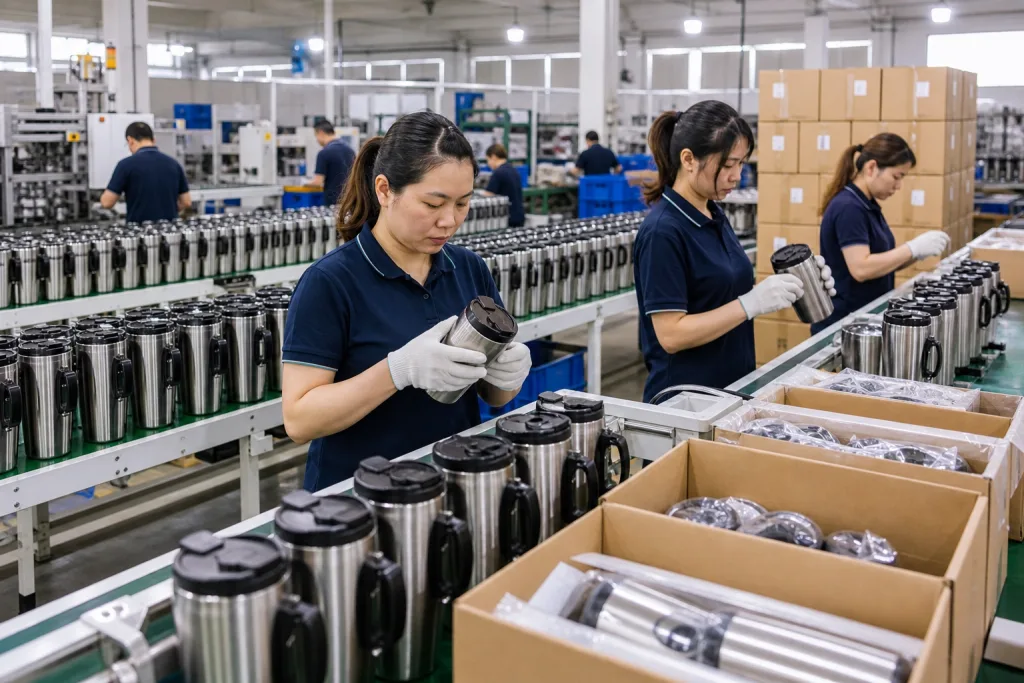
Key Takeaways
- A usable RFQ for a custom travel mug should lock 10 core specs before sampling, including capacity, 18/8 vs 18/10 steel, lid type, finish, logo method, and drop test target
- Typical MOQ for a stock-shape travel tumbler is 500-1,000 pcs per color, while fully custom tooling usually starts around 3,000 pcs with 25-35 day production after sample approval
- Expect sample charges of USD 60-200 for logo mock samples and USD 800-3,500 for new molds, depending on lid complexity and silicone parts
- AQL 2.5 for major defects, leak testing at 100%, and carton drop testing from 76 cm should be written into your PO before bulk starts
You already know a custom travel mug is not just a logo on steel. Trouble starts earlier. We see it on the line every week: capacity not defined, lid spec written as “spill proof,” artwork approved on a flat screen then stretched on a curved wall, or a PO that says “black tumbler” with no Pantone, no finish, no lid code. Last month a buyer even typed 380ml on the PO and 400ml on the carton mark file. That is how a simple tumbler turns into delayed samples, rework, and a landed cost that is 12% higher than planned.
If you source from Zhejiang, China, process beats factory size. A plant can make 300,000 units a month and still ship the wrong lid if the RFQ is thin; we’ve seen this go sideways over a 2 mm thread difference that QC pulled on the sample stage. You need clear specs, sample checkpoints, and PO line items from day one. This is the right question to ask. It applies whether you are buying a bulk coffee travel mug for retail, a coffee mug customized for a campaign, or a coffee mug private label program for distribution in Europe or North America.
Start with a complete RFQ
If you ask three coffee mug manufacturers for “a 20 oz tumbler with logo,” you will get three different products and three prices that do not line up. We see this every week. One factory quotes 0.4 mm inner wall with a push-on lid, another builds 0.5 mm with a screw lid, and the third swaps in a cheaper coating. Then the buyer says the prices are far apart. Of course they are. A complete RFQ is not paperwork for its own sake. It stops cost drift and cuts risk before the line starts.
For a custom travel mug, state the exact body style first: straight wall or tapered, with or without handle, single-wall or double-wall vacuum, and target capacity in ml and oz. Put both brimful capacity and usable fill if you have it; we have seen a PO typed as 600 ml while the approved sample held 580 ml to the rim. Ask for material by grade, not just “stainless steel.” For beverage contact, 18/8 stainless steel is the normal starting point. If you need a premium spec, say it early. Then define coating: powder coat, spray paint, electroplated, or raw brushed finish. Each one behaves differently in cross-hatch adhesion and scratch tests. This is the wrong question to ask: “What is your best price?” Ask what construction sits behind that price.
Put these line items into your RFQ
- Capacity: 350 ml, 500 ml, 600 ml, 20 oz, 30 oz
- Body construction: double-wall vacuum or single-wall
- Steel grade: inner 304 / outer 304, or your approved equivalent
- Wall thickness: for example 0.4 mm inner / 0.5 mm outer
- Lid type: slide lid, flip lid, screw lid, straw lid
- Color and finish: Pantone target if painted
- Logo method: silkscreen, laser engraving, UV print, embossing
- Packaging: egg-crate bulk pack, white box, color box, barcode label
- Compliance market: EU REACH, LFGB, US FDA, California Prop 65 if needed
- Incoterm: FOB Ningbo, EXW Hangzhou, or DDP if you insist
For a bulk coffee tumbler order from Zhejiang, China, prices can shift by USD 0.30-1.20 per unit just by changing lid tooling, powder coat texture, or gift box style. The math moves fast. A new lid insert can add 12 days on tooling, and a rigid color box can push carton drop-test failures from 0 to 3 samples if the fit is loose. If you are a coffee mug distributor or managing coffee mug promotional products, ask the supplier to quote separate lines for product, decoration, packaging, and testing. We ship cleaner quotes that way, and QC pulled the sample faster because everybody was checking the same build. Otherwise you are comparing mixed numbers, and we have seen this go sideways.
Your RFQ should make it impossible for the supplier to “fill in the blanks” with assumptions.
Screen the factory before samples
Do not pay for samples before you check whether the supplier fits your sales channel. A mug factory that works for low-price domestic wholesale often fails on Amazon FBA prep, retail gift-set packing, or a private-label program with 3-language packaging and barcode rules. This is the wrong question to skip. You are buying process control, not just a cup. On our side, one quick tell is whether the line has a carton drop-test corner and a weighing scale set to 0.1 g for pack-out checks.
Ask straight questions and ask for numbers. How many units per month? What is the real MOQ by color, 500 pcs or 1,000 pcs? How many vacuum leak testers are on the line, 2 or 6? Do they run AQL in-house or wait until you book a third-party inspection? At BottleForge Industrial in Zhejiang, for example, a standard stock-shape tumbler program might run at 300,000 units per month with MOQ 500-1,000 pcs, while custom lid projects need 12 days setup vs 5 days for a stock lid and tighter scheduling around mold trials. Those are the numbers that matter. A showroom with 40 random samples tells you little.
Factory checks worth doing early
- Audit status: BSCI, ISO 9001, or retailer-specific social audit
- Test capability: vacuum retention, salt spray, dishwasher simulation if offered, drop test
- Export routine: Europe and North America shipment history
- Documentation: REACH declarations, FDA/LFGB test reports, carton specs
- QC method: incoming inspection, in-line checks, final AQL level
If you are working from a coffee mug supplier directory or a coffee mug supplier list, assume 5 out of 10 suppliers are traders until they prove factory access. That is not bad by itself, but the control points change and we've seen this go sideways on packaging approvals. If you want coffee mug factory direct purchasing, ask for workshop photos with date stamps, production video, and copies of recent export documents with sensitive pricing blacked out. Ask for one clip of the vacuum tester running and one shot of the laser marking area. A serious coffee mug OEM manufacturer will understand the request. A trader who only has office photos usually stalls here.
Before you request formal samples, send a draft PO sheet. Even if quantities are not final, it shows whether the supplier reads details or skims. We run this check all the time. Last month, a buyer flagged a supplier who copied the lid color code wrong and missed a 5 mm logo offset note on page 2. QC never saw it because the order was still at quote stage. Slow or vague replies here usually turn into chargebacks, remake claims, or bulk stock you cannot ship.
Use samples to kill ambiguity
Sampling is where first-time buyers burn 7-10 days for no reason. They ask for “one sample with logo,” and the factory guesses what matters. That is the wrong question to ask. Build a staged sample plan by risk: one body-color sample to check coating, one logo sample to check print quality and placement, then one pre-production sample for the exact approved build before the line starts bulk.
For a stock-shape custom travel mug, sample charges are usually modest: USD 60-200 for a decorated sample plus courier. A new mold for a lid or handle can cost USD 800-3,500 and adds 15-25 days. We’ve seen this go sideways when a buyer skips packaging approval on a corporate gifting order. A gift box that grows by 12 mm can change carton quantity, CBM, and even Amazon prep fees, so spend the extra week and sign off the pack sample too.
Your sample approval should cover
- Capacity tolerance: check actual fill, not nominal catalog size; QC should test with a graduated cylinder, not a guess
- Weight: compare against quote if freight matters; a 20 g delta on 5,000 pcs changes the shipping math
- Logo size and position: specify mm from seam or rim; “centered” causes arguments later
- Color match: Pantone reference under daylight and office light; we usually check under a D65 light box and standard shop lighting
- Lid fit: thread smoothness, gasket compression, leak angle; QC pulled samples before because the silicone sat proud by 0.5 mm
- Base diameter: important for car cup holder fit; buyers flag this after receiving, not before
- Surface defects: dust nibs, pinholes, scratches, weld marks; rotate the cup under side light, because front-view photos hide defects
If you are buying a coffee mug custom made for a coffee subscription brand, ask for a heat retention test result with a simple method noted on paper, for example: fill with 95°C water, ambient 20°C, after 6 hours target above 55°C. Not every factory runs the same method, so force a repeatable test. We ship reports like this with the sample because “keeps hot for hours” means nothing. For a coffee mug customizable program with multiple colorways, approve one golden sample per finish family. Matte powder coat and metallic spray do not behave the same on the line, and the buyer flagged a silver finish last season because the logo edge looked softer than the matte black version.
Put sample status in writing: “for reference only,” “for color approval,” or “approved for mass production.” Use those exact words on the PO or sample sheet. We have seen a typo on a PO flip “reference” to “approved,” and then nobody agrees what bulk should match. Without that status line, a supplier may treat a rough logo sample as final approval. That is how a bulk coffee mug turns into a claim case.
Build a PO that controls production
A purchase order should not read like a shopping list. It should read like a production instruction sheet. On our line, a thin PO turns into default settings from ERP to packing table, and that is where custom tumbler jobs drift off spec. We have seen this go sideways on retail programs and branded café orders, especially when the buyer approved a sample but left the bulk PO vague.
Start with SKU-level detail. If you have three body colors, two lid colors, and two logo versions, build separate line items for all 12 combinations. Do not write “mixed colors.” Write the exact split, like 600 matte black with clear lid and white logo, 400 navy with black lid and silver logo. Packaging needs its own line item too, because a color box, PDQ display, master carton print, FNSKU label, and suffocation warning each add cost and line time. Last month a buyer flagged a PO typo on carton marks, and we had to reprint 5,000 labels.
PO line items that save you later
- SKU code and product name
- Ordered quantity by color: for example 1,200 black, 800 navy
- Unit price and currency: USD FOB Ningbo
- Material spec: 304 inner/304 outer, PP lid, food-grade silicone gasket
- Decoration file version: AI/PDF date and revision number
- Packaging spec: white box 350 gsm, 1 pc/box, 24 pcs/ctn
- Carton limit: under 15 kg if your warehouse requires it
- Barcode and labeling: UPC, FNSKU, carton marks
- Testing/QC: 100% leak test, AQL 2.5 major / 4.0 minor
- Shipment date and late-shipment rule
For a bulk coffee mug or bulk coffee travel mug order, spell out spare parts too. If you are buying 5,000 units with a complex flip lid, add 1-2% spare lids or gaskets on the PO. The math does not work if you skip them and later air-ship replacements for after-sales claims in Europe or North America. We run into this with hinge-pin lids more than standard screw lids. If you are a coffee mug supplier to promotional agencies, specify overrun and underrun tolerance as well. A standard tolerance might be plus or minus 5%, but paid orders often require exact quantity, and the buyer will push back if 4,850 units land against a 5,000-unit PO.
Factories in China like precise POs for a simple reason: they cut handoff time from sales to engineering to production. A clear work order means QC pulled the sample, engineering matched the artwork revision, and packing followed the right carton limit without three rounds of WeChat questions. This is the wrong question to ask: “Can the factory handle it?” The better question is whether your PO gives the factory enough instruction to run it right the first time.
Watch the bulk stage closely
After the deposit lands, the risky part starts. This is where bulk orders slip: coating lots shift 0.5-1.0 on the color card, silicone gaskets come in softer, and a tumbler that looks fine on the table leaks once QC runs a shake test on the line. Standard lead time for stock-shape tumblers from Zhejiang is often 25-35 days after deposit and sample approval. Peak season from August to November runs longer. With custom packaging, add 5-10 days unless the box plant has already cut the die line and signed off the carton spec.
A solid supplier sends a pre-production confirmation pack before mass production: approved sample photos, logo file, carton layout, and key dimensions. Check it the same day. Three days of silence can cost a full week if your slot gets bumped and the screen-print line moves to another PO. We have seen a single typo in a shipping mark hold 8,000 pcs.
Bulk checkpoints that matter
- Material incoming inspection: check steel thickness with a micrometer, confirm plastic resin consistency, and match the color masterbatch to the approved chip
- In-line decoration check: test print adhesion with 3M tape, measure logo position, and watch color consistency lot by lot
- Vacuum and leak testing: ideally 100% leak test for lidded tumblers; this is the right standard, not random spot checks on 20 pcs
- Assembly check: confirm gasket seating, thread smoothness, and straw fit if applicable; the buyer flagged one batch last year because the straw popped out under light pull
- Packing audit: verify accessory count, barcode scan, and carton weight before sealing; a 0.3 kg carton gap usually means something is missing
Ask for plain production updates with quantities. No soft wording. “Body forming complete: 4,000 pcs. Powder coat complete: 2,500 pcs. Lid assembly started.” That is useful. “Production is going well” tells you nothing. If you are managing coffee mug in bulk orders across several SKUs, ask for a packing list draft before final inspection so you catch carton ratio errors early. This is where the math doesn't work if one colorway is packed 24 pcs per carton and the PO says 36.
For promotional deadlines, book inspection dates before production finishes. Third-party inspectors in China fill up fast in peak season, and AQL 2.5 bookings near Ningbo can slide by 2 days if you wait. If your cargo ships FOB Ningbo, one missed inspection window can push vessel loading and add storage or rebooking costs. Good buyers run the calendar, not just the artwork.
Inspect, ship, and handle claims right
Final inspection is the point where you confirm the factory built the approved sample, not the point where you realize the PO missed a lid color or logo position. For a custom travel mug, we usually run AQL-based random inspection plus functional checks on the line and again at packing. AQL 2.5 for major defects and 4.0 for minor defects is a solid starting point. Critical defects, such as sharp edges on the drinking surface or obvious contamination, stay at zero acceptance. This is the wrong stage to ask for changes. We have seen buyers flag a 3 mm logo shift at final inspection when the signed artwork already allowed it.
Functional testing should cover leak test, appearance check, barcode scan, carton drop review, and count verification. QC pulled the sample, filled it, inverted it for 30 minutes, then checked the lid seam and base ring. For corporate-gift orders with presentation boxes, packaging finish needs its own check. A good bulk coffee tumbler still looks low-end if the insert fit is loose by 5 mm or the box corners crush after one drop.
Shipping and claim terms to lock down
- Incoterm and port: FOB Ningbo is still the cleanest for many importers
- Final document set: invoice, packing list, bill of lading details, test reports if required
- Claim window: for example 15-30 days after receipt
- Evidence standard: photos, quantity count, batch code, defect rate by carton
- Remedy: credit note, replacement in next order, or spare parts shipment
If you are a coffee mug distributor, a coffee mug supplier to hospitality clients, or working with coffee mug distributors across North America, ask the factory to print or laser a batch code discreetly on the base. We usually place it near the mold mark, about 2 mm high, so it does not disturb retail appearance. Traceability is not glamorous, but it keeps claims factual. Without a code, the buyer flagged it, the factory denied it, and the whole discussion turns into opinion.
The best coffee mug factory relationships in Zhejiang are not built on the lowest first quote. They come from repeatable specs, fast approvals, and clear accountability when something goes wrong. We ship smoother when the carton mark, batch code, and approved golden sample all match the paperwork. The math does not work on a cheap opening quote if 2 cartons out of 500 arrive with mixed lids and nobody can trace the batch. That is how one-off coffee mug promotional buys turn into a stable coffee mug private label program with lower hidden cost each quarter.
Send your custom travel mug RFQ today
Share your target capacity, lid style, logo file, packaging, and quantity. We will review feasibility, MOQ, pricing, and lead time before sampling.
Frequently asked questions
What MOQ should I expect for a custom travel mug order?
For a stock-shape custom travel mug with your logo, MOQ is usually 500-1,000 pcs per color in China. If you want a new lid, new body mold, or a handle tool, MOQ often moves to 3,000 pcs or more because tooling and setup have to be amortized. Packaging also changes MOQ. A plain white box may work at 500 pcs, but a custom color gift box often needs 1,000 pcs minimum per design. If you are buying as a coffee mug distributor and need mixed colors, ask whether the factory allows color assortments under one total MOQ. Many Zhejiang suppliers do, but only if the logo process and packaging stay the same.
How much does a bulk coffee travel mug usually cost?
A standard 20 oz or 30 oz double-wall stainless steel bulk coffee travel mug from China typically lands in the USD 3.20-6.80 FOB range for stock shapes, depending on steel grade, wall thickness, lid style, coating, and decoration. A single-color silkscreen logo is cheaper than laser plus gift box. Add roughly USD 0.20-0.80 for upgraded packaging, and more if you need a complex flip lid or straw kit. Very low quotes often hide thinner steel, lighter vacuum performance, or basic QC. Ask for separate pricing on product, logo, packaging, and testing so you can compare apples to apples.
What tests should I require before bulk shipment?
At minimum, require 100% leak testing on assembled tumblers, plus AQL final inspection for appearance and packaging. For stainless travel mugs, I also recommend heat retention testing with a defined method, coating adhesion checks, and carton drop testing from 76 cm if the product is shipping through parcel networks. If your market is the EU, ask for REACH-related compliance support and food-contact documentation. For the US, many buyers ask for FDA-related declarations and, where relevant, California Prop 65 review. If your order includes custom plastic lids, confirm that the gasket and drinking components are tested as the final assembly, not only as raw material.
How long does production take after sample approval?
For a stock-shape custom travel mug, normal lead time is about 25-35 days after deposit and approved pre-production sample. In peak season, especially from late summer into Q4, 35-45 days is more realistic. A new mold adds development time: often 15-25 days for tooling and sample revision before mass production even begins. Custom gift boxes can add another 5-10 days unless the box supplier is booked in advance. If you need vessel timing for Europe or North America, back-plan from ETD, not from factory finish date. Leave room for inspection, booking, and possible carton rework.
Should I buy from a trader or go factory direct?
Factory direct works well when you have clear specs, stable repeat orders, and someone on your side who can manage details. You usually get better technical answers, cleaner cost breakdowns, and faster correction loops. A trader can still be useful if your order mixes categories or you need English-heavy project management, but then you need stronger control over approvals and QC. If your goal is a coffee mug private label line or regular coffee mug bulk buying, direct from a Zhejiang factory is usually more efficient over time. Just verify they really manufacture the product: ask for production photos, audit records, and recent test reports tied to similar tumblers.