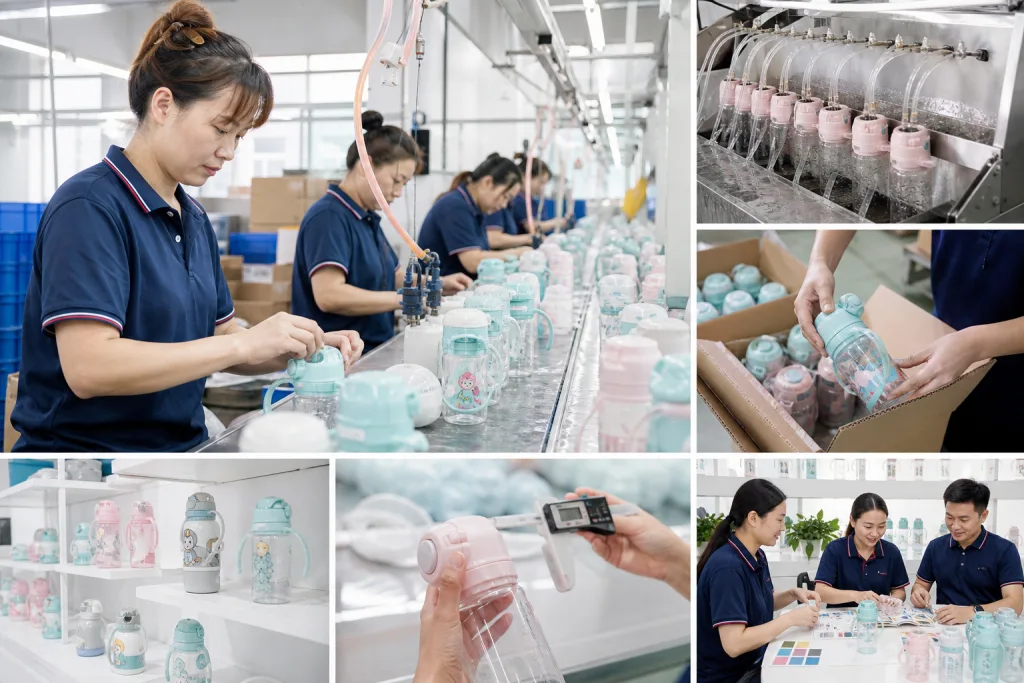
Key Takeaways
- For toddler bottles, practical MOQ starts around 1,000-3,000 pcs per color depending on lid tooling and print method
- Ask for LFGB, REACH, CPSIA, ASTM F963, or FDA-related reports based on your sales market, not just a generic SGS file
- A 304 stainless inner wall at 0.4-0.5 mm is common for durable children’s insulated bottles
- Sampling normally takes 7-12 days; bulk production from Zhejiang, China is usually 30-45 days after deposit and artwork approval
A custom toddler bottle is not a shrunken adult sports bottle. You are buying for children who drop it from a stroller tray, chew the silicone spout, leave it in a 45°C car, and send parents straight to a one-star review. We have seen one weak flip lid turn a 5,000-unit order into credit notes and replacement cartons. The math does not work.
On our factory floor in Zhejiang, China, the worst RFQ we still get is: “350 ml kids bottle, logo, safe material.” Too thin. Before any canteen supplier gives FOB pricing, lock the real capacity, mouth design, coating, print method, testing scope, carton packing, and acceptable defect limits. QC pulled a toddler bottle sample last month because the straw gap measured 1.8 mm off the drawing, and the buyer flagged leakage during a 30-minute inverted test.
What should you specify first?
Before you ask any canteen manufacturer for a quotation, lock the use case. A custom toddler bottle for daycare, a school gift, a retail shelf item, and a promo run all drive different lid cost, carton testing, and artwork setup. Last week QC pulled a sample because the buyer had never said daycare and the straw hole came in at 28 mm. The buyer who gives the clearest spec usually gets the truest price.
Start with capacity. Most toddler bottles sit between 250 ml and 420 ml. Below 250 ml, parents start complaining about refill frequency. Above 420 ml, the bottle gets heavy once filled, especially in double-wall stainless steel. For children aged 2-5, 300 ml or 350 ml is the safe middle ground. This is the first place people guess wrong.
Then choose construction. Single-wall stainless is lighter and cheaper, but it sweats with cold drinks and gives you no insulation story. Double-wall vacuum construction costs more, usually USD 0.60-1.20 extra depending on size and finish, but we run the line for it every week because retail buyers keep asking for a cleaner sell sheet. If you are a distributor drinkware buyer selling into Europe or North America, insulation usually earns back that extra cost. The wrong question is, "Which one is cheaper?"
Checklist for your RFQ:
- Capacity in ml and acceptable tolerance, such as 350 ml ±5%, so the filling line and carton fit stay aligned
- Material grade: 304 stainless inner, 201 or 304 outer, PP lid, silicone straw, with the exact food-contact parts called out
- Age range and warning label requirements, including any choking or hot-liquid notes for 2-5 years
- Leakproof expectation: upright only or inverted test for 30 minutes, since QC will test it that way
- Logo method, print size, Pantone colors, and carton mark, plus where the mark sits on the box
- Target FOB price and annual forecast, not just first order quantity, because MOQ and tooling change the math
A good canteen factory in China can quote from rough ideas, but you will burn days fixing assumptions. We have seen a PO with 350ml on page one and 350 ml on page two send the art file back to the laser room. Treat the RFQ as an engineering document, not a mood board.
Which materials are acceptable?
For toddler products, material choice is the place to be stricter than the marketing brief. Cute colors mean nothing if the lid fails migration testing or the straw smells after hot-water soaking. We’ve had QC pull a pink silicone straw after a 60°C odor check because the color masterbatch was the problem, not the silicone base. Serious canteen factories usually quote 304 stainless steel for the inner wall, PP for rigid lid parts and handles, and silicone for the straw, gasket, or bite valve, with each material tied to a test report.
For stainless toddler bottles, we recommend 304 inside and either 304 or 201 outside. A 304/304 build is cleaner for premium retail and export documentation. A 304/201 build saves cost on painted outer shells, but do not leave 201 steel exposed at the rim or base, where rust claims start after dishwashing or salt-spray exposure. On our line, incoming QC checks coils with an XRF gun before cutting, because one wrong outer-shell roll can turn a 5,000 pcs PO into a chargeback.
Wall thickness matters. For a 300-350 ml insulated toddler bottle, 0.4-0.5 mm inner wall and 0.5 mm outer wall are common. Go thinner and the math looks good on the quotation, but dents show up fast in drop testing. We run 1.0 m drops onto a steel plate during sampling, and a 0.35 mm inner wall often looks fine until the third corner hit. Toddlers are excellent impact testers, just without lab reports.
For plastic toddler bottles, Tritan is used for clear bodies when the buyer wants shelf appeal. PP works better for many flip lids, handles, and lower-cost bodies because it takes abuse well. HDPE shows up on some squeeze-style designs, though it is less common for gift retail. If the bottle includes a soft straw, ask whether the silicone is 100% food contact grade and whether the pigment is cleared for your market; we have seen a buyer flag the same lid after changing from grey to mint green.
Minimum documents to request:
- Food contact test report for stainless, plastic, silicone, and coating, with the tested part names shown clearly
- REACH or LFGB for EU sales, matched to the actual lid, straw, and coating color
- CPSIA and ASTM F963 where the item is treated as a children’s product in the US
- BPA-free declaration, but do not accept that as a replacement for testing
About 7 out of 10 canteen suppliers can show reports, but “Do you have certificates?” is the wrong question to ask. Ask whether the tested material matches your production material. Check report dates, model references, coating codes, and lid color. If the PO says blue lid and the factory ships teal because sales copied an old color code, a retest may be needed after changing coating or lid color.
How should the lid be designed?
The lid is where complaints start. A custom toddler bottle usually runs with a straw lid, flip lid, spout lid, or screw cap, and each one fails in a different place. Straw lids sell well, but the silicone seal and vent hole need tight control, usually checked with a 0.05 mm feeler gauge on the lid gap. Flip lids fit preschool use, but the hinge pin and push button take abuse. Screw caps leak less in testing, but a 3-year-old often cannot open them without help.
If you are sourcing customizable drinkware for a children’s retail line, do not pick a lid just because the catalog photo looks fresh. This is the wrong question to ask. Ask the canteen vendor for the open-close cycle test report. For toddler bottles, 3,000 cycles is a basic target; 5,000 cycles is better for premium programs. Also ask for drop test results from 1.0 m, filled with water, at room temperature. On our line, QC pulled one flip-lid sample after 1,200 cycles because the button spring lost tension by 1.5 mm.
Leakproof claims need test conditions written down. “Leakproof” can mean upright in a backpack pocket, or inverted and shaken for 10 minutes. Those are different jobs. We suggest putting the test into your purchase order: filled to 90%, lid closed, inverted for 30 minutes, no visible leakage. If the bottle has a straw vent, define whether a few drops after pressure release are acceptable. We have seen this go sideways when a PO said “no leak” but the buyer’s lab tested the bottle upside down in a rotary shaker at 60 rpm.
Procurement questions worth asking:
- Is the straw removable for cleaning, and what is the straw outer diameter in mm?
- Can the silicone bite valve be replaced after chewing damage?
- Are spare lids available for after-sales service, and what MOQ applies?
- Is there any small detachable part under 31.7 mm that may be a choking hazard?
- Can the lid pass dishwasher testing if you claim dishwasher safe, for example 20 cycles at 70°C?
A good canteen supplier should push back if your requested lid is too complex for your target price. That is not bad service. It is the factory trying to stop a field failure before we ship 8,000 pieces with a weak hinge or a valve that toddlers bite through in two weeks.
What customization actually works?
Toddler bottles are small, curved, and often powder coated. Branding space is tight. We usually measure the straight printable area with a flexible ruler before quoting, because a 360 ml toddler bottle may only give 35-45 mm of clean logo height. You can still build a solid customized drinkware program, but the decoration choice should follow durability, artwork detail, and MOQ, not a pretty mockup from the sales deck.
Silkscreen printing works best for simple logos. One-color printing on a toddler bottle may add USD 0.05-0.12 per piece depending on size and order quantity. Multi-color printing needs tighter registration control and higher setup cost; QC pulled one sample last month where the second color shifted 0.8 mm on the curve, and the buyer flagged it at once. Heat transfer is better for full-color characters and retail patterns, but we run tape testing, wash testing, and scratch testing before mass production. Laser engraving lasts on stainless steel, but it will not give you bright colors.
Powder coating is common for premium toddler bottles. Standard colors are easier to manage at MOQ 1,000 pcs per color. Custom Pantone coating usually needs 2,000-3,000 pcs per color because the coating line setup and powder waste are not small. We once lost half a bag of powder just dialing in a matte lavender sample, so six custom shell colors on a small order is the wrong question to ask. If you are a canteen distributor managing mixed SKUs, run two standard bottle colors with different logo prints instead.
Packaging customization gets ignored too often. A printed white box, kraft box, belly band, hang tag, instruction leaflet, and barcode label can change the retail feel more than another logo position, but each item needs its own file check. We have seen a PO with the FNSKU typed correctly and the carton mark typed wrong by one digit, which is exactly how warehouse problems start. For Amazon or retailer delivery, you may need FNSKU labels, suffocation warnings on polybags, and carton drop-test strength.
The same logic applies across custom canteen, custom growler, customizable canteen, and customizable growler programs: the larger the decoration surface, the easier small mistakes are to see. On toddler bottles, the problem flips. The print area is small, so fine text below 5 pt often fills in or becomes unreadable after ink spread on the curve. Send vector artwork early and ask for a digital mockup before sample production; the math does not work if the first real artwork check happens after the line is ready.
How much should it cost?
Price comes down to six line items: capacity, material, lid parts, coating, packaging, and test scope. For a 300-350 ml stainless steel custom toddler bottle, a realistic FOB China range is often USD 2.30-4.80 per piece at 3,000 pcs. A basic single-wall plastic or PP bottle can be lower, sometimes USD 1.20-2.20, but it will not sit on the same retail shelf without pushback from buyers. Small bottle, many details. On our costing sheet, even a 0.18 mm change in steel thickness or one extra silicone gasket changes the unit price.
Watch quotes that land 20% below the other 4 suppliers on your list. The saving can be clean if the canteen factory owns the mold and we run the item every week. It can also come from thinner steel, weak powder coating, recycled plastic content, loose inspection, or skipped testing. Ask one direct question: which spec changed to reduce the cost? We have seen this go sideways when QC pulled the sample and the wall thickness was 0.38 mm instead of the 0.45 mm shown on the approved drawing.
At BottleForge Industrial in Hangzhou, Zhejiang, our regular drinkware capacity is about 600,000 units per month across stainless bottles, tumblers, and related custom drinkware. For toddler bottle projects, MOQ normally starts at 1,000 pcs for existing mold with simple logo, 3,000 pcs for custom color, and 8,000-15,000 pcs if new lid tooling is required. The lid is usually where the math breaks. A buyer once asked us to hit 2,000 pcs with a new flip straw lid, two-color injection, and spare straw packed inside; the tooling cost alone made the target price look fake.
Typical cost drivers:
- New mold: USD 1,500-8,000 depending on lid complexity, especially hinge, straw, vent hole, and silicone seal structure
- Custom powder color: usually adds USD 0.15-0.35 per piece, with the line cleaned before we spray the next Pantone shade
- Retail box: USD 0.12-0.40 depending on paper grade and print, and 350 gsm white card costs less than a laminated color box
- Third-party testing: USD 300-1,200 per test package, often covering migration, heavy metals, and lid material checks
- Pre-shipment inspection: around USD 180-350 per man-day in China, with AQL 2.5 commonly used for appearance and function checks
If you are comparing canteen vendors, make every supplier quote the same Incoterm, usually FOB Ningbo or FOB Shanghai for Zhejiang production. Mixing EXW, FOB, and DDP quotes makes the cheapest supplier look better than the real landed cost. This is the wrong place to save USD 0.08. We ship through Ningbo most weeks, and a missing carton mark or one typo on a PO can cost more time than the price gap you thought you won.
How do you control quality?
Quality control for toddler bottles should start before the line runs, not after cartons are sealed. We need one approved golden sample on the QC desk, signed artwork with revision number, approved material list, and written inspection standard. If those four files are missing, your AQL inspection turns into a debate over photos instead of a yes-or-no decision.
For mass production, we recommend AQL 2.5 for major defects and AQL 4.0 for minor defects on most distributor canteen orders. Critical defects are zero tolerance. Sharp edges, cracked plastic, loose small parts, severe leakage, strong odor, or the wrong food contact material should stop shipment. QC should pull suspect lids straight off the line, not “watch the next batch.”
Functional tests should be simple and strict. We run leak testing with filled bottles inverted for 30 minutes, lid open-close cycling, coating adhesion, print rub test, capacity check, and carton drop test. For powder coating, cross-hatch adhesion testing with a 3M tape pull catches poor surface preparation before the buyer sees peeling. For printed logos, alcohol rub testing matters because parents wash these bottles often.
Factory inspection checklist:
- Confirm PO quantity, color split, and carton packing
- Measure bottle height, diameter, weight, and capacity
- Check logo position within ±2 mm if specified
- Test 20-50 pcs for leakage depending on order size
- Inspect lid assembly and silicone seals
- Check barcode readability and carton marks
A serious canteen manufacturer in China will accept inline inspection, final random inspection, or your nominated third-party inspector. If a canteen vendor refuses inspection before balance payment, treat it as a red flag. Good factories do not enjoy inspection pressure, but we know why buyers need it. We have seen this go sideways from one PO typo in the color split.
What should your purchase order include?
A purchase order for a custom toddler bottle needs more detail than a standard promo bottle PO. For children’s items, vague wording causes rejects. Your PO should list the approved sample number, artwork file name, Pantone or color chip standard, test requirements, packing method, inspection level, shipment date, and the penalty process for non-conforming goods. We run into problems when the buyer writes “same as sample” but does not name the sample; last month QC pulled two lids from the line because the PP sample had a 6.8 mm straw hole and bulk parts came out at 7.4 mm.
Do not rely on email threads. Put the key terms into one document. If you buy through canteen distributors or a trading company, ask them to confirm the actual canteen factory name, production address, and whether subcontracting is allowed. Subcontracting is not the issue. Hidden subcontracting is. We have seen this go sideways when a PO said “Hangzhou factory” but the order moved to a small coating shop in Yongkang without written approval.
For timeline planning, allow 7-12 days for sample making, 3-5 days for sample shipping, 30-45 days for bulk production after deposit, and 3-7 days for final inspection and export paperwork. Ocean freight to North America or Europe may add 25-45 days depending on port and season. If you need holiday retail delivery, count backwards and add two weeks of buffer. The math does not work if artwork approval lands on October 18 and the buyer still wants a November shelf date; even with FOB Ningbo, the vessel schedule will not save that plan.
PO lines you should not skip:
- “Mass production must match approved pre-production sample.” Add the sample date and sample seal number if your supplier uses one.
- “Food contact parts must match submitted test reports.” Name the parts: bottle body, lid, straw, gasket, and printed area.
- “No material, mold, coating, or lid change without written approval.” This includes resin grade changes and gasket hardness changes.
- “Final inspection under AQL 2.5/4.0 before shipment.” We suggest adding carton drop test, barcode scan check, and lid leakage test.
- “Shipment under FOB Ningbo unless otherwise agreed.” Check this against the PI; one typo on a PO can move costs by hundreds of dollars per container.
This same discipline works for customized canteen, distributor growler, customized growler, and broader customizable drinkware programs. The toddler category gives you less room for mistakes. If you define the product properly, the canteen suppliers you approach can quote with fewer assumptions, flag tooling risks earlier, and ship a cleaner first order.
Send us your toddler bottle RFQ today
Share capacity, target price, logo artwork, market, and delivery date. We will return practical options, MOQ, lead time, and test suggestions.
Frequently asked questions
What is the normal MOQ for a custom toddler bottle?
For an existing mold with one simple logo, MOQ is usually 1,000 pcs. If you need a custom powder-coated Pantone color, plan for 2,000-3,000 pcs per color. A new lid mold can push the practical MOQ to 8,000-15,000 pcs because tooling, testing, and setup costs must be spread across enough units. If you are testing a market, start with existing molds and customize logo, color, and packaging first.
Can toddler bottles be certified for both the US and EU?
Yes, but you need to define the compliance package before production. For the EU, buyers often request LFGB and REACH for food contact and restricted substances. For the US, CPSIA, ASTM F963, and FDA food-contact related testing may apply depending on how the product is sold. Test cost can range from USD 300 to over USD 1,200. Make sure the tested materials match your actual lid, straw, coating, and bottle body.
Is stainless steel better than plastic for toddler bottles?
Stainless steel is usually better for durability and premium retail positioning. A 304 stainless inner wall handles drops, odor, and staining better than many plastics. However, plastic bottles are lighter and cheaper, which can be useful for daycare promotions or low-price campaigns. For a 350 ml bottle, stainless may land around USD 2.30-4.80 FOB China, while plastic can be closer to USD 1.20-2.20 depending on material and lid.
Which logo method is safest for toddler bottles?
Laser engraving is the most durable on stainless steel, but it is limited in color. Silkscreen printing is economical for simple one-color logos, while heat transfer is better for full-color patterns. For toddler bottles, the key is adhesion testing. Ask for tape testing, alcohol rub testing, and washing simulation before mass production. Avoid very small text under 5 pt, because curved bottle surfaces and powder coating can reduce readability.
How long does a first custom toddler bottle order take?
A normal first order takes 45-65 days before ocean transit. Sampling is usually 7-12 days, sample delivery 3-5 days, approval 2-5 days, and bulk production 30-45 days after deposit and confirmed artwork. Final inspection and export documents add several days. If new tooling or full third-party compliance testing is required, add 2-4 weeks. For Q4 retail programs, confirm capacity with your China supplier at least 90 days ahead.