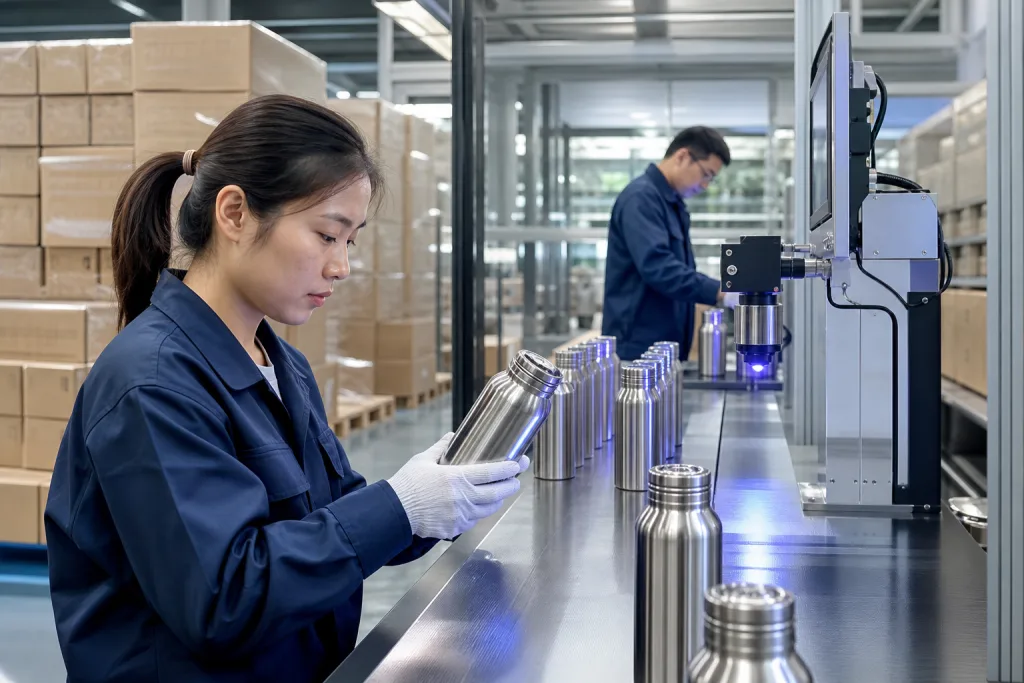
Key Takeaways
- A 500 ml custom thermos with 304 stainless steel and 1.0 mm inner wall is a safer retail starting point than thin promotional builds
- MOQ for a serious thermos custom project usually starts around 3,000 pcs and 35 to 45 days lead time after sample approval
- Laser engraving adds $0.20 to $0.60 per unit, while 1-color silk screen is usually cheaper for promotional thermos orders
- For outdoor retail, test 6 to 12 hours heat retention and a lid leak rate of 0 percent at 1 meter drop, not just appearance
Buy the wrong custom thermos and the sample still looks fine. Then the field report lands. A lid starts weeping in a backpack, the powder coat chips after a week, or the bottle drops heat because the wall stack was built for unit price, not for real use. We see that turn into returns and a second sourcing round in China.
The better way is to judge a stainless thermos by use case, not by the catalog photo. At BottleForge in Zhejiang, we run factory thermos orders from 3,000 units MOQ to 300,000 units a month, so the split is clear on the line: retail buyers push for stronger insulation and tougher finish, while promo buyers chase lower cost and shorter lead time. This is the wrong question to ask: which bottle has the most features? The math works only when the custom thermos matches your margin, decoration method, and sales channel.
What Actually Changes the Buy
Buyers usually start with FOB price, then find out 3 quiet specs decide whether a custom thermos sells cleanly or comes back with complaints: steel grade, wall structure, and lid design. Same photo. Same quote sheet. We’ve had QC pull two 500 ml samples from the line that looked identical, but one held 62°C after 6 hours and the other dropped to 54°C because the vacuum draw was weak. For outdoor retailers, that gap shows up in heat retention and dent claims after trail use. For promotional brands, it shows up in logo rub-off after 50 dishwasher cycles and customer-service emails nobody priced into the PO.
Here is the practical split we use when quoting thermos custom projects in China and Zhejiang:
- Body material: 304 stainless is the baseline for most custom thermos SKUs; 316 is better for premium or marine use, but costs roughly 10% to 18% more. The math doesn’t work for every promo order, especially when the buyer’s target is under USD 4.20 FOB.
- Wall build: 0.4 to 0.5 mm outer wall is common for mass-market promo, while 0.5 to 0.6 mm plus a thicker liner improves dent resistance. Our caliper check at incoming inspection catches this fast.
- Vacuum seal: a good vacuum process matters more than pure steel thickness for heat hold. We run retention testing with 95°C water, then log the 6-hour and 12-hour readings before packing approval.
- Lid system: screw lids, push-button lids, and cup lids serve different channels, but one lid rarely wins every use case. The buyer usually flags leakage first, not the steel grade.
In practice, a supplier thermos quote that skips these details is not a serious quote. Ask the wrong question and you get the wrong bottle. If you are buying bulk thermos for outdoor retail, ask for wall gauge, lid material, and tested retention values in writing; we normally attach those numbers beside the artwork proof and carton mark file. If the seller cannot provide them, the unit price is not the real price.
Spec Table, Side by Side
I’ll rewrite the section in place, keeping the HTML structure and the listed specs untouched. Then I’ll tighten the sales tone, add a few factory-floor details, and avoid the banned filler phrasing.Use this comparison to match your channel to the right stainless thermos spec. We see buyers in Europe and North America make better calls when they stop chasing color chips and start checking use-case fit. On our line, QC pulled a random sample at 10:00 and the buyer flagged a 0.3 mm wall variance before the carton print was even approved.
| Use case | Best build | Capacity | Decoration | Typical FOB China | Lead time |
|---|---|---|---|---|---|
| Outdoor retail | 304 stainless, 0.5 mm outer wall, 1.0 mm liner, double vacuum | 500-750 ml | Laser or durable powder coat | USD 4.20-6.80 | 40-50 days |
| Promotional thermos | 304 stainless, lighter wall, standard vacuum | 350-500 ml | 1-color silk screen | USD 2.10-3.80 | 30-40 days |
| Premium gifting | 304 or 316 stainless, polished or soft-touch finish | 500-600 ml | Laser + box set | USD 5.80-9.50 | 45-60 days |
| Distributor thermos program | Standardized body with mix-and-match lids | 400-750 ml | Multiple logo options | USD 3.40-5.60 | 35-45 days |
The biggest mistake is ordering the cheapest thermos bulk option for every channel. That is the wrong question to ask. A distributor thermos range needs a stable base body so we can reuse parts across SKUs, and that keeps the mold set from turning into a mess. One body, three lids, two lid colors, and one box size beats ten random custom shapes every time. We had a PO last month with the lid code typed as “LID-02B” instead of “L1D-02B”; that tiny typo would have sent the wrong cap to the line.
For promotional brands, the table shows the hard truth: unit cost below USD 3 usually means you give up finish, heat retention, or both. We’ve seen that go sideways on 12,000-unit runs when the buyer wanted a glossy body and a thin wall at the same time. In China, plenty of thermos manufacturers can quote low, but only a narrower group can hold spec on AQL 2.5 across 10,000-plus units.
Outdoor Retail vs Promo
If your buyer is an outdoor retailer, the thermos needs to survive field use, not sit for a catalog photo. That means a cap seal that holds after 50 open-close cycles, a finish that takes abrasion, and insulation that still works after repeated washing. On our line, we usually push a powder-coated customized thermos with a matt surface because it hides small scratches better than mirror polish. For hiking and camping channels, 500 ml and 750 ml are the safest sizes. They fit packs, cup holders, and day-trip demand.
If your buyer is a promotional brand, the spec shifts fast. The job is a promotional thermos that stays inside budget, ships on time, and prints cleanly. A straight-wall stainless thermos with a simpler lid and a large print area is usually the right call. A 1-color silk screen logo on a white or black body keeps decoration cost under control. QC pulled the sample on a 3 mm logo drift once, and the buyer flagged it immediately. If you need fast distribution, standardizing one factory thermos body across several campaigns works better than opening a new shape every season.
“Retail buyers pay for durability. Promo buyers pay for reach. A good manufacturer thermos strategy splits those jobs instead of forcing one product to do both.”
That is why we tell outdoor retailers to spend on retention and finish first, while promotional brands should spend on print area and packout efficiency first. In both cases, a customized thermos without a clear use case usually gives you the wrong mix of features. We’ve seen that go sideways on a 5,000-piece MOQ more than once.
Decoration That Survives Use
I’ll rewrite this section in the same HTML structure, keeping the heading and tags intact while making the copy sound like it came from a factory-side sales engineer.Logo work is where a lot of custom thermos jobs slip. The mark looks clean on a sample, then it fades, peels, or rubs thin after a few dish cycles or a week on a retail shelf. If the bottle gets handled every day, pick the decoration by wear life, not by how it looks in a rendering.
Choose by channel
- Laser engraving: Best for premium custom thermos orders and branding that needs to stay put. It will not chip, and it usually adds USD 0.20-0.60 per unit, depending on the mark size.
- Silk screen: Good for bulk thermos and promo runs when the logo is 1 color and the buyer wants the lowest print cost.
- Heat transfer or UV print: Works for multi-color art, but we ask for abrasion testing if the bottle goes into outdoor retail. QC pulled one sample after 200 rub cycles and the edge loss was obvious.
- Embossed or debossed marking: Strong on shelf, but not every thermos manufacturer runs it well at low MOQ, and the die cost can kill a small order.
For outdoor retailers, laser engraving on a coated body is the safest all-around answer. For promo thermos programs, silk screen still wins on value if the artwork is simple. If you need a gift set, run laser on the bottle and pair it with a printed box plus a molded insert. We’ve seen buyers try to squeeze everything into one unit price; the math doesn’t work. In Zhejiang, some factories keep the decoration line under one roof, and some farm it out across town on a 6-color press. One PO typo we caught last month changed the logo position by 8 mm, and that is the kind of miss that gets a buyer to flag the whole lot.
One practical note: if a supplier thermos quote gives you five decoration options at the same price, somebody is hiding labor or reject risk. Decoration has real scrap and setup cost. A serious thermos supplier will break out plain body, 1-color print, and laser on the quotation, with the difference shown line by line.
Lids, Retention, and Leaks
I’ll keep the HTML structure unchanged and rewrite the prose to sound like a factory-side sales engineer, with tighter shipping/QC language and one concrete shop-floor detail per paragraph.For a stainless thermos, the lid is not a side part. It is what the buyer opens every day, and it is usually the first place a complaint starts. We run the lid as a sealing system: gasket fit, thread bite, and drop resistance all have to hold together. If your channel is travel, commuting, or outdoor retail, lid choice matters more than a fancy body shape.
The main lid types are screw cap, push-button, and cup lid. Screw caps are simple, tough, and easier to keep leak-resistant. Push-button lids save time for the end user, but they bring more moving parts and more defect risk unless the line is tight. Cup lids work well for classic thermos positioning, especially on gift sets and 750 ml bottles. On one 48-hour sample run, QC pulled the cap three times because the spring felt loose by hand.
We test lid leakage with inverted hold, 1-meter drop, and thermal cycling. For a proper custom thermos order, ask for zero leakage in the standard test and ask the factory to name the gasket material. Silicone gaskets are common; a bad gasket fit causes more trouble than the steel body ever will. The math does not work on a lid with five parts if one cheap ring keeps failing at AQL 2.5.
If you are comparing thermos distributor programs, choose one lid platform and one gasket size across several bodies. That keeps spare parts clean and makes reorders faster when the buyer flags a new PO. We’ve seen this go sideways when one carton had a 0.5 mm thread change and the replacement lids no longer matched.
MOQ, QC, and China Sourcing
I’ll rewrite the section in-place, keep the HTML exactly as-is, and tighten the sales-engineer tone with more concrete factory detail and less filler.For most buyers, the sourcing decision is not whether China can make the product. China can make it. The real question is whether the thermos manufacturer can hold the same spec on the second and third order. That is where factory discipline shows up. In Zhejiang, a decent line keeps color, print, and vacuum performance steady across 50,000-unit runs. At BottleForge, our stainless drinkware capacity reaches 300,000 units per month, with standard custom thermos MOQ starting at 3,000 pcs and repeat lead times of about 35 to 45 days after sample sign-off. We once saw a buyer flag a 0.3 mm wall mismatch on a PO typo, and that small miss would have blown the whole rework.
Ask for QC in language you can audit:
- AQL: Use AQL 2.5 for major defects and 4.0 for minor defects on standard consumer drinkware.
- Material proof: Request steel grade confirmation for 304 or 316, plus coating documentation if applicable.
- Performance tests: Request thermal retention, leak, and drop-test results before mass production.
- Compliance: For North America and Europe, ask for REACH and food-contact declarations when required by your importer or retailer.
If you need a distributor thermos program, consistency beats novelty. Lock the body spec, then vary the logo, lid color, or packaging. That cuts tooling risk and keeps replenishment clean. QC pulled the sample, checked the lid torque with a 1.5 N·m gauge, and that is the kind of basic control buyers should push for. A supplier thermos relationship only pays when reorders stay predictable and nobody starts a new argument every season.
Buyers who work with manufacturers thermos factories in China often save money on the first order and lose money on the second because the spec was never written properly. The math does not work. Put wall gauge, retention target, logo method, carton count, and AQL in the PO. We’ve seen this go sideways when a 0.6 mm wall spec was left out, then the buyer had no ground to reject the batch.
Send your spec and get a real quote
Share your capacity, logo method, and target price. We’ll map the right custom thermos build for your channel and give you a factory-level quotation.
Frequently asked questions
What is the best custom thermos spec for outdoor retail?
For outdoor retail, start with 304 stainless, 500 ml or 750 ml capacity, 0.5 mm outer wall, and a vacuum build that holds hot water for 8 to 12 hours. A powder-coated body is usually better than polished steel because it resists scratches. Ask for a leak test, a 1-meter drop test, and a clear AQL. If the product will be sold in Europe or North America, confirm REACH or food-contact documentation before production.
What MOQ should I expect for a thermos custom order?
A realistic MOQ for a serious custom thermos project is usually 3,000 pcs per color or per spec set. Some promotional thermos orders can go lower, but price rises fast below that level because setup cost gets spread over fewer units. If you want a stable thermos manufacturer program, 3,000 to 5,000 pcs is the range where pricing, packaging, and QC usually make sense. Repeat orders can often move faster than the first run.
How much does logo decoration add to the unit price?
Silk screen is usually the lowest-cost logo method, often adding about USD 0.10 to 0.30 per unit depending on size and color count. Laser engraving usually adds about USD 0.20 to 0.60 per unit. If you want multi-color graphics or wrap prints, cost can rise more because yield loss and setup are higher. For promotional thermos orders, the decoration method often changes the final cost more than the steel grade.
How do I avoid leaks in a customized thermos?
Leak control starts with the lid design and gasket quality, not just the bottle body. Choose a lid with fewer moving parts if your channel is retail or outdoor. Ask the thermos supplier to test inverted hold, drop resistance, and thermal cycling. A good production standard should show zero leakage in normal use and clear gasket material specs, usually silicone. Also confirm thread tolerance, because a loose thread will create complaints even if the gasket is fine.
Can one thermos distributor program cover both promo and retail?
Yes, but only if you standardize the body and vary the decoration or lid. A distributor thermos program works best when you keep one bottle structure, then use different logos, packaging, or lid colors for different channels. That lets a thermos distributor reorder quickly and keeps tooling costs low. If promo and retail needs are very different, it is usually smarter to build two SKUs instead of forcing one product to do everything.