Key Takeaways
- A serious custom thermos RFQ should include capacity, steel grade, MOQ, lid type, decoration area, carton specs, and target FOB price
- Typical MOQ is 1,000 pcs per color for powder coating and 3,000 pcs when using a fully customized molded lid
- Sampling normally takes 7-12 days for stock-shape logo samples and 25-35 days for new tooling confirmation
- Bulk production should be checked by AQL 2.5/4.0 inspection, vacuum retention testing, and carton drop testing before shipment
If you sell outdoor gear or run promotional programs in the USA, a custom stainless thermos looks simple until the RFQ lands. Then the line items start: 500ml or 750ml, 304 stainless or mixed steel, laser logo size in mm, carton drop-test result, 12 days for samples vs 18 days after a revised artwork file. We’ve seen this go sideways when a buyer approves a polished sample photo but never checks the bulk powder-coating thickness.
You need a sourcing path that protects margin and brand reputation. From our factory base in Zhejiang, China, we quote custom thermos usa projects every week for retailers, event agencies, and distributors, often at 1,000 to 5,000 pcs per SKU. The process works when you define the product, confirm the sample, write the PO properly, and inspect against measurable standards instead of nice photos; last month QC pulled the sample because the PO said “matte black,” while the artwork file named it “soft-touch black.” Small wording. Big headache.
Start With A Buyer-Grade RFQ
A weak RFQ says, “Please quote 20 oz stainless thermos with logo.” We see this every week. It is not enough for a serious thermos manufacturer in China, and it often leads to a spread like USD 3.20 to USD 6.10 before anyone checks the lid, coating, or carton spec. A buyer-grade RFQ lets the factory thermos team build the cost sheet before they answer; otherwise the first quote is just a guess from an old Excel file.
For a custom thermos usa order, send capacity in ounces and milliliters, body diameter, height limit, target weight, lid style, drinking function, insulation target, color quantity, logo process, packaging, and Incoterm. If you already have a retail shelf price or promotional budget, share the target FOB Hangzhou or Ningbo price. We run the numbers backward from steel thickness, coating method, decoration, testing, and carton packing. Last month QC pulled a 750 ml sample that was 2.5 mm over the buyer’s shelf-height limit; that tiny miss killed the display plan.
Your RFQ should also separate “must have” from “nice to have.” Outdoor retailers often need durable powder coating, leak-resistant lids, and 12-24 hour thermal claims, with drop-test notes written into the sample request. Promotional brands may care more about logo approval within 48 hours and carton count that fits a US warehouse pick face. Both are valid. They are not the same product, and asking for the cheapest version with retail-grade performance is the wrong question to ask.
RFQ line items to request
- Product: 18/8 stainless steel vacuum thermos, 500 ml, 750 ml, or 1,000 ml; include target height and mouth diameter in mm.
- Material: inner SS304, outer SS201 or SS304, food-contact silicone; ask the supplier to confirm thickness by part, not just grade.
- Finish: powder coating, spray paint, electro-polish, or brushed steel; give Pantone code and acceptable color tolerance before sample spraying.
- Logo: laser engraving, silkscreen, pad print, heat transfer, or full wrap; send AI/PDF artwork and mark the logo size in mm.
- MOQ: by model, color, and logo version; do not mix two lids and three colors under one loose MOQ line.
- Commercial term: FOB Ningbo/Shanghai, EXW Zhejiang, or DDP USA if needed; name the destination ZIP code for DDP USA.
- Compliance: FDA food contact, LFGB, REACH, CPSIA if children’s use is implied; tell the factory which lab report your buyer will accept.
At BottleForge Industrial in Zhejiang, China, our regular MOQ is 1,000 pcs per color for stock-shape stainless thermos orders. Monthly output for vacuum drinkware is about 420,000 units across thermos, tumbler, and bottle lines, so the bottleneck is usually decoration and lid assembly, not body forming. We ship more smoothly when the PO matches the approved sample sheet; we once had a buyer typo “matte black” as “metal black,” and the line stopped for half a day while sales, spraying, and QC checked the color board.
Choose The Thermos Construction
Before you argue about laser logo or silk print, lock the construction. A custom thermos is a welded double-wall vacuum body with a lid system, gasket set, coating layer, and export carton that has to survive stacking in a 40HQ. We’ve seen this go sideways: QC pulled one sample where the base plug was fine, but the thin lid thread made the whole bottle feel like a giveaway item. Cheap one part, and the buyer feels it in 3 seconds.
For outdoor retail, we run SS304 inner wall and SS304 outer wall when the target price has room. SS201 outer wall is common for promotional thermos programs because it lowers cost by roughly USD 0.20-0.45 per piece depending on size, but it rusts faster if the powder coating gets scratched. Wall thickness is usually 0.4-0.5 mm for standard bottles and 0.5-0.6 mm for heavier-duty SKUs. Thicker steel gives better dent resistance, but the math does not always work once the carton weight hits the freight quote.
The vacuum process matters. After inner and outer shells are welded, the bottle is vacuumed and sealed at the base; on our line the operator checks the base weld before the copper tail is capped. Random sampling should test insulation retention, not only the first hot water reading. A practical test is 95°C water, sealed for 6 hours at 20°C room temperature, then recorded. For a 750 ml stainless thermos, 8 out of 10 good production samples retain 65-75°C after 6 hours, depending on mouth width and lid design.
Lids deserve more attention than buyers usually give them. Screw caps are reliable and easier to pass leak tests. Flip lids sell well on convenience, but hinges, silicone hardness, and button fit need tighter control; one 2024 PO had “black gasket” typed in the line note while the approved sample used gray, and the buyer flagged it before shipment. Cup lids suit camping and field use. Straw lids are popular, but they are the wrong choice for hot liquid because of pressure and burn risk. If your audience is hikers, guides, construction crews, or fishing customers, a simple leak-resistant lid often outsells a clever lid that breaks after three months.
PO line items for construction
- Model number and approved drawing revision.
- Capacity tolerance, usually ±5% by volume.
- Inner and outer steel grade, stated separately.
- Wall thickness target and acceptable tolerance.
- Lid material, silicone grade, gasket color, and spare parts requirement.
- Thermal retention test method and pass level.
This is where a supplier thermos quote becomes comparable. Without these details, one thermos supplier may quote a 285 g lightweight promotional item while another quotes a 365 g outdoor-grade bottle with thicker steel and a better cap. The lower price is often not better sourcing. It is a different product.
Decide Decoration Before Sampling
Decoration changes the quote, sample schedule, reject rate, and MOQ. We see this on almost every custom stainless thermos order. A customizable thermos might need a 28 mm one-color logo, a 210 mm wrap, an engraved badge effect, or a gift box with UPC, insert card, and retail color callouts. Decide the method before sample approval. If the buyer changes from silkscreen to wrap print after the golden sample, the line needs new films, a revised jig, and usually another 5-10 days. Last month QC pulled a 750 ml sample where the logo was centered, but the print sat 3 mm too low once the lid was installed.
Laser engraving is clean and hard to wear off, so we run it often for outdoor and corporate gift programs. It burns through the coating and shows the 304 stainless underneath. On curved bodies, keep the logo width under 45-60 mm unless the factory has rotary laser fixtures; without that fixture, the edge of the logo starts to fade. Silkscreen printing works for simple promotional thermos artwork, usually one or two colors, and the math is better at 1,000 pcs than at 200 pcs. It still needs ink adhesion testing on powder coating. We use a 3M tape pull after curing, then check the edge under a desk lamp. Heat transfer and water transfer handle larger graphics, but tapered bottles push the film and raise rejects. Full-color UV printing looks sharp for short-run promotions, but some coatings reject the ink after a scratch test.
Color matching needs discipline. No guessing. Powder coating should reference Pantone or RAL, but the stainless body and surface texture shift the final color after curing. If your USA retailer requires a fixed brand color, approve a physical color chip instead of only a PDF on a laptop screen. We had one PO with “navy blue” typed in the item line and Pantone 2965C attached on page 6; the buyer flagged it after pre-production, and the sample clock restarted. For repeat programs, keep the powder batch number if the factory can trace it. Small color movement between lots is normal, but your PO should state the tolerance, such as Delta E under 1.5-2.0 for strict retail programs when measurement is available.
Do not approve a thermos custom sample only because the logo is centered. Check adhesion, scratch resistance, hand feel, and whether the logo position still works on every size in the range.
Decoration PO line items
- Final AI or PDF artwork with logo size in millimeters, not “same as sample.”
- Logo position from bottle base or top shoulder, such as 92 mm from base to logo center.
- Decoration method and color count, with separate notes for lid, body, and box if needed.
- Pantone, RAL, or approved physical color chip.
- Adhesion test requirement, such as 3M tape pull after curing.
- Retail barcode, hangtag, insert, or gift box artwork version.
If you are buying for a distributor thermos catalog, keep decoration simple across sizes. A 500 ml, 750 ml, and 1,000 ml family should look related, but the logo scaling cannot be copied blindly. We usually reduce the mark by 10-15% on the 500 ml body after checking the printable area with a caliper. Stretching artwork until it fits is the wrong move. We’ve seen this go sideways: the smallest bottle looks like a cheap giveaway while the 1,000 ml version looks retail-ready.
Use Samples As Contracts
A sample is not a souvenir. Treat it as a physical contract. For custom thermos usa sourcing, approve at least one appearance sample and, on higher-value orders, one pre-production sample made with the same decoration process and retail packaging as bulk. Stock-shape logo samples normally take 7-12 days after artwork confirmation. New body tooling or custom lid molds can take 25-35 days before the first usable sample. On our line, the first sample is checked with a digital caliper to 0.1 mm before it leaves Hangzhou.
When the sample arrives, measure it. Check height, diameter, mouth opening, empty weight, capacity, lid fit, coating feel, logo size, and carton fit if packaging is included. Fill it with hot water and run your own retention check. Turn it upside down for a leak test. Put it in a backpack pocket and shake it for 3 minutes. Simple test. Procurement teams often stare at photos and miss the lid tolerance; we have seen 18 of 60 warranty claims in one program start from a loose flip cap, not the bottle body.
Sample approval should be written, not casual. If you approve by email, include photos of the approved unit, date, model number, artwork version, color reference, and any changes required before mass production. If you need three changes, list each one as a mandatory PO condition, with wording the merchandiser can copy into the work order. We once had a PO typo calling Pantone 186C “189C,” and QC pulled the sample only because the signed spec sheet had the correct red. A good thermos factory wants this paperwork. It cuts arguments later.
Sample PO or proforma line items
- Sample type: stock logo sample, prototype, or pre-production sample.
- Quantity: usually 2-5 pcs per color or logo version.
- Sample charge: often USD 50-150 for logo samples, higher for tooling.
- Courier method: DHL, FedEx, UPS, or buyer account.
- Approval standard: physical sample plus signed specification sheet.
- Change list before bulk: clear yes/no items, not vague comments.
For outdoor retailers, ask for one extra sample to keep sealed in your office as a control sample. Send one to your sales team, one to quality, and keep one untouched. Tape the carton shut and write the PO number, model code, and approval date on the box. If a bulk dispute happens, the control sample beats any online message thread. This is not overkill; the math does not work when a USD 80,000 order depends on a compressed chat screenshot.
Price The Bulk Order Properly
Bulk thermos pricing is more than the FOB unit price. Your landed cost includes tooling, sample charges, carton artwork, inspection, inland freight from Hangzhou to Ningbo or Shanghai, ocean or air freight, duty, customs entry, warehousing, and a defect allowance. Check the full sheet. If a buyer compares only FOB unit prices, the cheaper quote often wins on paper and loses after QC pulls the sample and finds a loose lid fit or weak powder coating.
For a standard 750 ml customized thermos from a Zhejiang factory, a realistic FOB China range may be USD 4.20-7.80 depending on steel grade, lid type, coating, logo process, packaging, and order quantity. A simple one-color promotional thermos at 3,000 pcs costs less than a retail-ready outdoor bottle with SS304 outer wall, powder coating, engraved logo, color box, and instruction insert. We run this costing every week. A molded custom lid can add USD 2,000-6,000 in tooling and push MOQ to 3,000-5,000 pcs because the plastic parts and silicone seals need stable injection runs; if the seal groove is off by 0.3 mm, the leak test will not forgive it.
Ask suppliers thermos quotes to show price breaks at 1,000, 3,000, 5,000, and 10,000 pcs. This shows whether the saving comes from steel purchasing, logo setup, or loading more pcs into one master carton. For distributors thermos programs, a mixed-color order may look large, but the factory prices it by color and logo version. Five colors at 500 pcs each is not the same as one color at 2,500 pcs. We’ve seen this go sideways when a PO said “assorted colors” and the buyer expected five equal colors, while the line planned one 2,500 pcs coating run.
Bulk PO line items
- SKU, model, capacity, color, and logo version by quantity; do not let “same as sample” replace a real spec.
- FOB port, payment terms, and shipment window, such as FOB Ningbo with a 28-35 day production slot after deposit and artwork approval.
- Unit price and any tooling or setup charges separately, so a USD 2,000 lid mold does not hide inside the bottle price.
- Packaging: master carton quantity, carton dimensions, gross weight, and barcode placement; we usually need carton size in cm before booking space.
- Inspection standard: AQL 2.5 major, 4.0 minor, 0 critical is common, with leak test, coating adhesion, and logo position checked from pulled samples.
- Allowed over/under shipment tolerance, usually 0-3% unless agreed; write it on the PO because accounting will flag 30 extra pcs later.
Payment terms vary with order size and relationship. A common first order term from China is 30% deposit and 70% before shipment after inspection. Larger repeat buyers may negotiate 20/80 or partial credit terms, but factories rarely extend credit on a first custom thermos order with unique colors and logos. This is the wrong question to ask too early; before credit terms, we need to see the artwork file, target ship date, and whether the buyer accepts pre-shipment inspection photos plus a third-party report.
Control Production Before It Ships
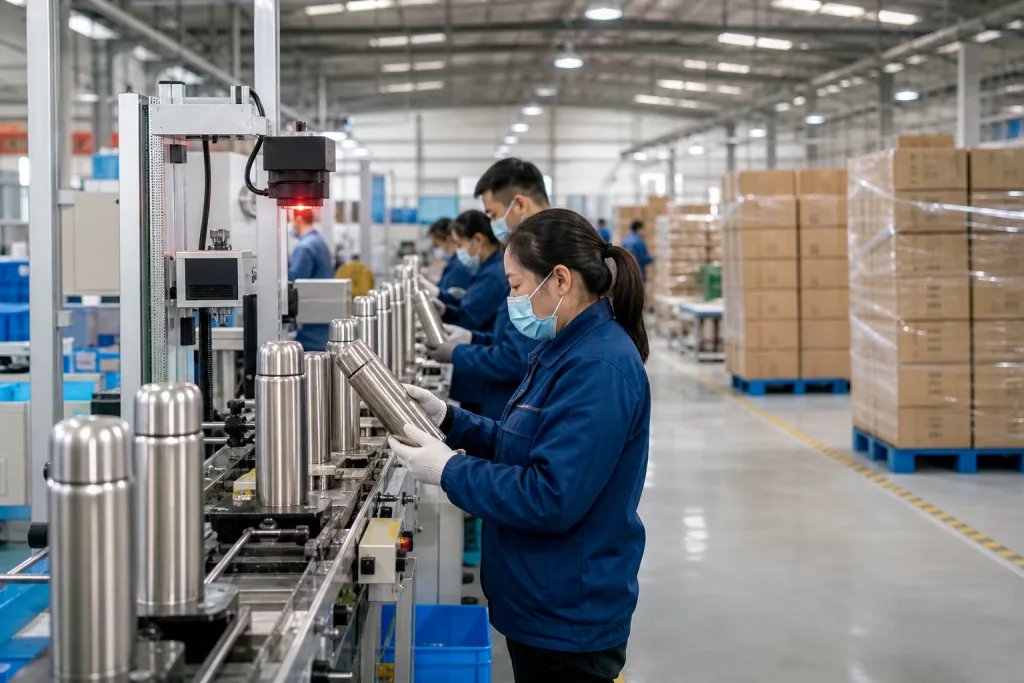
After the deposit lands, the risk moves from artwork approval to the line actually making what the PO says. We run stainless thermos orders through steel cutting, forming, welding, vacuuming, polishing, coating, decoration, assembly, leak testing, packing, and final inspection. Bulk trouble usually shows up in 6 places: coating scratches from poor rack spacing, color drift between spray booths, weak logo adhesion after 3M tape testing, lid leakage at the silicone gasket, crushed export cartons under 14 kg stacking, and barcode labels mixed between SKUs.
Set checkpoints before the workshop starts coating. Ask for material and color confirmation against the signed sample, not just a phone photo under yellow factory lights. After the first 50-100 pcs are assembled, request production-line photos showing the logo, lid fit, inner wall, bottom stamp, and carton label. For a large or date-sensitive order, book a mid-production check before 50% completion, because fixing a spray color at 2,000 pcs is painful but fixing it at 18,000 pcs is a claim. Require final random inspection when at least 80% is packed and 100% is finished. For a USA retail or promotional order, AQL inspection should include appearance, function, dimensions, capacity, leak test, thermal retention sampling, barcode scan, carton drop check, and packaging count. QC pulled one sample last month with 486 ml actual capacity on a 500 ml claim; that is the kind of small miss buyers flag fast.
Compliance must match the sales channel printed on the carton and listing. For adult stainless thermos products entering the USA, food-contact safety and accurate labeling matter. If the product may be used by children, discuss CPSIA and ASTM considerations early, before mold opening or lid material selection. For Europe, buyers often ask for LFGB, REACH, and packaging compliance. BSCI or ISO 9001 factory documents may be requested by larger retailers, but certificates do not replace product inspection. This is the wrong place to save USD 180 on testing when one PO typo, such as “304 stainless” on the carton while the approved spec says 201 outer shell, can stop the shipment at buyer review.
Pre-shipment PO checklist
- Approved pre-production sample available to QC inspector, with signed color chip and logo position marked in mm.
- Inspection booked 3-5 days before planned vessel closing, not the same morning the container arrives.
- AQL levels and defect definitions attached to PO, including what counts as a major leak, scratch, dent, or barcode failure.
- FNSKU, UPC, or retail barcode file tested before carton printing with a handheld scanner on a curved bottle label and flat carton mark.
- Carton marks include PO number, SKU, quantity, gross/net weight, and country of origin.
- Commercial invoice and packing list match the actual shipped quantities, including spare lids, display boxes, and inner carton counts.
If you sell on marketplace channels, carton and unit labeling can matter as much as the bottle. A wrong FNSKU or unreadable barcode can cost more than a small cosmetic defect; we have seen 1,200 good bottles delayed because the warehouse scan failed on the outer carton. Make label approval part of production control, not a last-day warehouse task.
Plan Freight And Reorders Early
Thermos bulk orders are bulky, not just heavy. A 750 ml stainless bottle with a color box usually packs 24 pcs per master carton, and one 40HQ container holds roughly 28,000-38,000 pcs depending on bottle diameter, handle design, and carton size. On our line, a 1,000 ml bottle with a wide powder-coated body can add 2-3 cm per unit, which looks small on the drawing but eats container space fast. If your first PO is 3,000 pcs, LCL ocean freight is usually the cleanest choice unless a fixed promo date forces air shipment. Air freight is fast. The math gets ugly, especially on 1,000 ml bottles.
Build the timeline backward from your launch date. For a stock-shape customized thermos, use 7-12 days for sampling, 3-5 days for approval and deposit, 30-45 days for mass production, 3-5 days for inspection and export documents, then freight time. Ocean freight to the USA West Coast may be around 18-25 days port to port, while East Coast routing can run 30-40 days. Add customs clearance, chassis booking, drayage, and the receiving window your 3PL gives you. We have seen a finished order sit 6 days at warehouse dock because the buyer forgot to book delivery. A safe first-order timeline is 75-100 days from RFQ to warehouse receipt.
Reorders are where a good thermos manufacturer proves value. Keep the same model number, drawing revision, color code, lid version, gasket specification, and carton layout. If you change one component, update the SKU record and send the revised file, not a chat screenshot. QC pulled the sample last year on a repeat order because the PO said matte black MBK10 while the approved sample card read M-BK01. We traced 7 repeat-order complaints that quarter to undocumented “small improvements” nobody approved.
For promotional brands, reserve production capacity before your client signs final artwork if the event date is fixed. This is the wrong question to ask: “Can you rush it after approval?” Ask whether the line has open capacity in the week your deposit lands. For outdoor retailers, forecast by season. Spring and Q3 production slots in China tighten because USA buyers prepare summer outdoor programs and Q4 gifting at the same time. On our production board, bottle assembly slots are booked by model family, and switching from 500 ml to 750 ml means changing fixtures, test plugs, and carton labels.
A reliable thermos supplier relationship is built on boring documents: clear RFQ, approved sample, detailed PO, inspection report, and reorder file. We ship smoother when the file includes artwork version, Pantone code, carton mark, barcode placement, and the last inspection photos. Pretty renderings do not protect your margin. A clean paper trail does, especially when you buy a custom thermos from Zhejiang, China for custom thermos USA programs.
Send Your Thermos RFQ For Factory Review
Share capacity, quantity, logo, target price, and USA delivery date. We will reply with a practical spec, MOQ, and FOB quote.
Frequently asked questions
What MOQ should I expect for a custom thermos usa order?
For a stock stainless thermos body with your logo, expect 1,000 pcs per color as a practical MOQ from many China factories. If you need multiple colors, the MOQ is normally calculated per color, not total order quantity. A molded custom lid or special body shape usually moves the MOQ to 3,000-5,000 pcs because tooling, plastic injection, silicone parts, and assembly setup must be spread across enough units. For a first outdoor retail test, 1,000-2,000 pcs in one color is cleaner than 500 pcs across four colors.
How long does sampling and bulk production usually take?
A stock-shape logo sample usually takes 7-12 days after artwork and color confirmation. If you need a new lid mold, custom body tooling, or a special coating trial, plan 25-35 days for prototype samples. Bulk production for stainless thermos orders is commonly 30-45 days after deposit and sample approval. Add 3-5 days for inspection and documents. If shipping to the USA by ocean, allow another 18-40 days depending on destination coast and routing.
Which logo method is best for an outdoor promotional thermos?
Laser engraving is usually the safest choice for outdoor use because it is durable and does not depend on ink adhesion. It works especially well on powder-coated stainless bottles. Silkscreen is cheaper for one-color promotional thermos orders and can look very clean, but it needs proper curing and tape testing. Heat transfer or UV printing is better for large colorful graphics, but reject rates may be higher on curved or textured surfaces. For rugged retail positioning, choose powder coating plus laser engraving first.
What should be included in my stainless thermos purchase order?
Your PO should include model number, capacity, steel grade, wall thickness target, color code, logo method, artwork file version, packaging type, barcode requirements, carton marks, unit price, tooling cost, Incoterm, payment terms, lead time, inspection standard, and approved sample reference. For quality, state AQL levels such as 2.5 major, 4.0 minor, and 0 critical. Also include thermal retention and leak test requirements. A vague PO makes disputes harder, especially when several SKUs or distributors are involved.
Can a China thermos factory ship directly to my USA warehouse?
Yes, but define the service level. FOB China means you or your forwarder control ocean freight after the port. DDP USA means the supplier or its forwarder handles freight, duty, customs, and delivery to your warehouse, but the cost is built into the quote. For first orders, many buyers prefer FOB Ningbo or Shanghai because pricing is more transparent. If you need Amazon or 3PL delivery, confirm carton labels, pallet requirements, FNSKU or UPC placement, and appointment rules before production starts.