Key Takeaways
- A practical MOQ for custom thermos US programs is usually 1,000-3,000 units per SKU
- Typical FOB China pricing runs USD 3.20-8.80 depending on size, coating, lid, and decoration
- Sampling takes 7-15 days; mass production normally needs 30-45 days after artwork approval
- For retail, budget 3-5% more for stronger cartons, barcode labels, and AQL inspection
If you search for custom thermos us, you will get pages of clean product photos and almost no hard numbers. We counted 27 listings last week where the capacity was shown, but the MOQ, carton drop test, and lead time were missing. That hurts when you need to quote an outdoor retailer, build a promo program, or lock a seasonal launch date. Buyers ask for “best price” first. Wrong question.
A stainless vacuum bottle is simple on the shelf, but the order can still go sideways: 304 stainless thickness, cap mold cost, logo process, carton burst strength, compliance testing, and vessel schedule all change the landed price. On our Hangzhou line, QC pulled a 500ml sample last month because the silicone gasket was 0.4mm off and the cap leaked after the inverted test. US buyers save money when they sort the real cost drivers from cosmetic upgrades before sending an RFQ to a thermos factory in Zhejiang, China.
What You Are Actually Buying
A custom thermos is not just a bottle with a logo. For US outdoor retail and promo buyers, you are buying a small assembly: inner stainless shell, outer stainless shell, vacuum insulation, copper lining if specified, powder coating, lid system, silicone seals, print method, carton packing, and export documents. One loose lid gasket at QC can stop the carton from closing cleanly. Each part changes cost and lead time.
Most serious manufacturer thermos orders use 304 stainless steel for the inner wall. Some budget programs use 201 stainless on the outer wall, which works if the coating passes cross-hatch tape testing and the item is not sold as premium. For food-contact surfaces, do not bargain away 304 stainless. Bad math. We once had a buyer push for USD 0.10 savings here, then spend more on re-testing after their distributor asked for material proof.
Wall thickness also matters. A common range is 0.4-0.5 mm for the inner liner and 0.5-0.6 mm for the outer shell. Thinner steel cuts weight and cost, but it dents faster in outdoor channels. QC pulled a 0.38 mm outer-shell sample last year after a drop test left a flat spot near the bottom curve. If your customer sells to hikers, camping clubs, construction crews, or college bookstores, dent resistance will show up in returns.
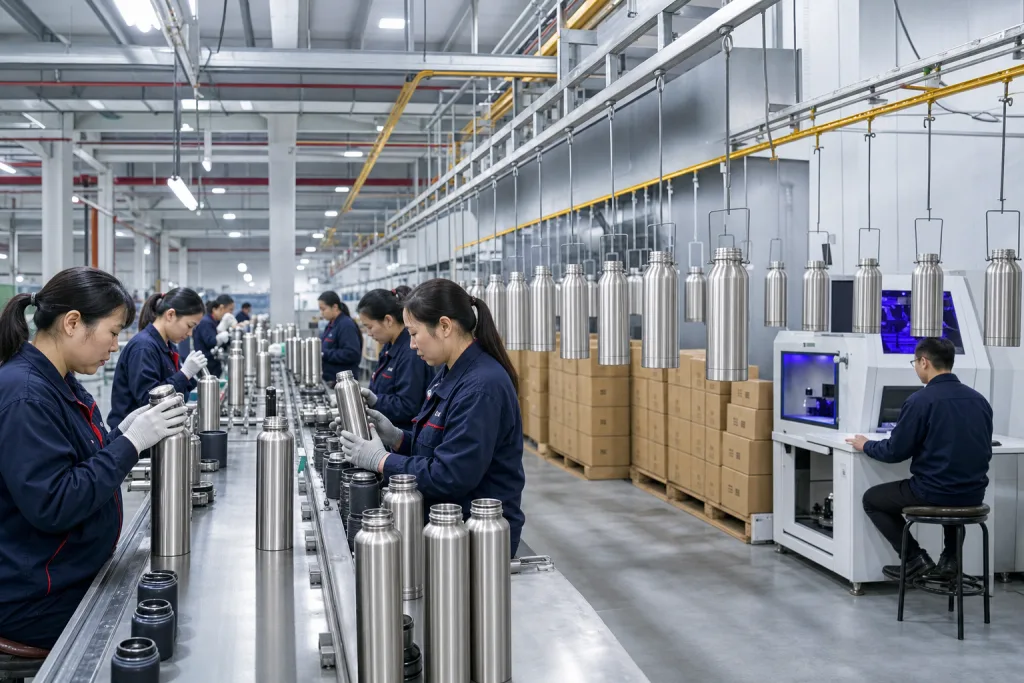
At our Zhejiang facility, a normal stainless thermos line can produce about 450,000 units per month across bottle and tumbler formats, but booked capacity is the real number to check. The line fills before summer promos and Christmas replenishment. A thermos supplier may quote 35 days in March and 50 days in August for the same item, especially when powder coating needs two passes or the PO has a color-code typo like Pantone 186C written as 168C.
FOB Cost Ranges That Hold
For a realistic bulk thermos quote, lock the capacity, lid type, coating, logo method, and packaging before asking for price. Without those details, any number from a thermos vendor is just bait. We see this weekly: a buyer asks for “500 ml bottle, best price,” then the PO shows matte black, full-wrap logo, kraft box, and a spare gasket. FOB Ningbo or FOB Shanghai gives US buyers the cleanest comparison, because it strips out local trucking and import duty noise.
As a working range, a 350 ml to 500 ml stainless vacuum thermos with a basic screw lid usually lands at USD 3.20-5.20 FOB China at 3,000 units. A 600 ml to 750 ml model with powder coating, carry handle, and better heat retention usually runs USD 4.80-7.20. Large 1,000 ml bottles or food thermos styles with wide-mouth lids can reach USD 6.50-8.80 before gift packaging. On our line, the jump often comes from wall thickness, 304 stainless inner cup weight, and whether QC runs 100% air-pressure leak testing or only pulls by AQL 2.5.
Several cost drivers get missed on the first quote sheet:
- Powder coating: often adds USD 0.25-0.55 versus plain stainless, more for textured finishes; our coating room checks film thickness with a gauge, and rough texture usually burns more powder.
- Laser engraving: usually USD 0.12-0.35 per unit depending on logo size and location; a 45 mm side logo runs faster than a curved wrap near the bottom radius.
- Silkscreen printing: economical for one-color logos, often USD 0.08-0.20 per unit after screen setup; the buyer flagged ghosting once on a white logo over PMS 186 red, so we now test adhesion with 3M tape before mass run.
- Custom color matching: can require 3,000 units per color and a 5-7 day color sample cycle; lab dip approval by photo is risky, because matte navy under warehouse LED looks different from outdoor light.
- Retail box: commonly USD 0.18-0.60 per unit depending on flute, printing, and inserts; a 350 g greyboard insert costs more than a simple egg-crate divider, but it saves complaints when Amazon cartons get crushed.
If a supplier thermos quotation is 20% below the market, ask what was removed. The wrong question is “can you match this price?” Ask for the BOM. It may be copper lining, carton thickness, inner 304 steel, leak testing time, or the after-sales buffer. We’ve seen this go sideways: one PO typo changed 0.5 mm carton flute to 0.3 mm, and the buyer paid for replacements after the first pallet arrived with dented gift boxes. Cheap is fine. Hidden cheap is expensive.
MOQ Tiers and Price Breaks
MOQ is where 7 out of 10 US programs get stuck. A customizable thermos looks simple on the buyer’s line sheet until sales asks for matte black, navy, and white, then marketing adds two logo versions and a gift box. The factory counts each mix as a SKU. Three colors with two logo versions means six SKUs, not one order; our ERP and carton labels treat them separately, and QC pulled the sample by SKU, not by “total project.”
For existing molds, a practical MOQ from a thermos manufacturer is usually 1,000 units per SKU for laser engraving or simple printing. At 1,000 pieces, the unit price is higher because powder coating setup, artwork checking, carton printing, and line changeover are spread across fewer bottles. Small runs pay for stops. For an outdoor retailer testing a new design, 1,000 units works if the retail margin can absorb it and the PO does not split into 4 colors of 250 pieces.
At 3,000 units per SKU, pricing becomes more stable. This is the tier we run for most promotional thermos and retailer replenishment programs. Coating loss drops, the packing team can hold one printed carton spec, and production planning is less likely to push the job behind a 20,000-piece chain-store order. At 5,000-10,000 units, the discussion changes from standard catalog stock to a serious thermos customized program: exclusive Pantone coating with ΔE control, cap adjustment after torque testing, silicone color matching, or accessories packed in the same inner box.
Private mold development is different. A new lid or body shape may require USD 2,000-8,000 in tooling for simple parts, and USD 10,000-25,000 for a more complex assembly. Lead time for tooling is normally 25-45 days before first samples, then another round if the lid leaks at the 30-minute inverted test. For most first-time distributor thermos buyers, use an existing mold first. Prove the channel before paying for exclusivity; we have seen this go sideways when the buyer spent on tooling before confirming shelf price.
For US promotional jobs, MOQ pressure is usually caused by too many colors, not by the bottle itself.
Lead Time From Quote to Warehouse
A clean thermos custom order does not start when the purchase order lands in our inbox. It starts when our merchandiser has locked the artwork, Pantone colors, packaging dieline, shipping marks, barcode format, payment terms, and inspection standard in one job folder. One missing UPC file or a typo in the PO color code can burn 5-7 days before the line even sees the job card.
This is the timeline we run for a standard customized thermos order shipping from China to the US:
- Quotation and spec confirmation: 1-3 working days if you send capacity, lid type, order quantity, logo method, and target port. A 500ml bottle with powder coating quotes faster than a mixed-lid program with 4 SKU colors.
- Pre-production sample: 7-15 days for existing molds with logo and coating. QC usually checks logo position with a caliper in mm, then rub-tests the print before we release photos.
- Sample approval: 2-7 days depending on your internal buyer or retailer review. We have seen samples sit on a retailer desk longer than they sat in our sample room.
- Mass production: 30-45 days for 1,000-10,000 units after deposit and final approval. The coating line needs the approved Pantone chip, not a screenshot from a phone.
- Inspection and booking: 2-5 days for AQL inspection, carton check, and vessel booking. QC pulled the sample carton last month because the side mark showed “24pcs” while the packing list said “25pcs.”
- Ocean freight: roughly 18-32 days to US West Coast, 30-45 days to US East Coast, port conditions excluded. Ningbo to LA is not the same planning risk as Ningbo to New York.
Air freight saves days, but the math usually does not work for full thermos bulk orders because stainless bottles are heavy and take carton volume fast. It works for 50-200 urgent samples or a shortage carton. For 5,000 retail units, we push back unless the promotion value can absorb the freight cost per bottle.
If product must be on a US warehouse floor by October 1, approving samples in late August is the wrong plan. Normal ocean freight will not rescue it. For Q4 promotional brands, artwork should be approved by mid-July, with packaging files checked before deposit. Zhejiang factories, forwarders, and inspection teams get crowded before the main holiday export windows, and we have seen bookings slip from 12 days to 18 days after one buyer delayed carton mark approval.
Decoration Choices and Hidden Setup
Logo decoration changes both cost and risk. A thermos promotional order for a corporate campaign may only need a one-color logo on a matte black bottle. A retail outdoor brand may ask for a 6-color mountain print, hang tag, color box, and inner leaflet. Those are two different jobs. On the line, QC pulled one sample at 9 a.m. and the buyer flagged a 2 mm shift on the logo.
Laser engraving is durable and clean. It works well on powder coated bottles because the laser removes the coating and exposes stainless steel underneath. It is not a fit for complex full-color artwork. Silkscreen printing is cheaper for simple logos, but adhesion must be tested, especially on textured powder coating. Heat transfer or water transfer can handle larger graphics, but setup cost and defect risk are higher. We once saw ink lift after a 24-hour tape test on a 220-grit surface, and the buyer wanted gradients that the process could not hold.
For thermos customizable programs, ask for artwork placement proof with dimensions in millimeters, not just a mockup on a photo. A logo that looks fine on a flat PDF can distort on a curved 70 mm bottle body. For large wrap prints, request a printed sample and do a tape test before mass production. QC pulled the sample twice on one run because the wrap line was off by 1.5 mm at the seam.
Packaging can become the silent lead-time killer. UPC labels, FNSKU labels, suffocation warnings, inner carton labels, and master carton shipping marks should be locked before production starts. If you sell through marketplaces or retail DCs, label accuracy matters as much as bottle quality. One wrong barcode can delay receiving even when the product is perfect. We had a PO with one digit off on the carton count, and the warehouse held the whole lot at pallet stage.
Good thermos suppliers will ask annoying questions early. That is a good sign. The expensive problems come from factories that say yes to every file and find the conflict after the line is running. If a supplier accepts a cap mold number, a print file, and a carton spec without checking, the math does not work. We have seen that go sideways.
Quality, Compliance, and Inspection
For the US market, quality control belongs in the purchase order, before we cut steel or print the first logo. Your thermos factory should check vacuum performance, leakage, coating adhesion, logo position, cap fit, silicone odor, carton drop resistance, and packaging accuracy. Put the limits in writing: logo tolerance within 1.5 mm, no water leakage after 30 minutes upside down, barcode scannable on the master carton. We have seen a buyer flag a whole lot because the PO said “matte black” and the approved sample tag said “soft-touch black.” Small words cost money.
Common inspection terms include AQL 2.5 for major defects and AQL 4.0 for minor defects. Some retail buyers demand tighter levels, especially for visible coating issues on powder-coated bottles. For vacuum insulation, we run hot water temperature retention over a fixed time, then QC pulls samples for random cutting tests or vacuum testing from each batch. For a 500 ml bottle, 7 out of 10 US buyers we deal with expect water to stay above 60°C after 6 hours when filled at around 95°C starting temperature. The lid matters. A slim tea-filter cap will not perform the same as a solid PP stopper, and pretending otherwise is the wrong question to ask.
Compliance depends on your sales channel. For food contact, ask for FDA food-contact related documentation and LFGB or REACH support if you also sell in Europe. For children’s products, ASTM and CPSIA considerations may apply. If the item is for a retail chain, they may require a BSCI audit, ISO 9001 documentation, or their own factory questionnaire. On the factory floor, we keep 304 stainless material reports, silicone test files, and coating MSDS sheets in the order folder, because buyers often ask for them 2 days before shipment. That rush is avoidable.
A third-party inspection in China usually costs USD 200-350 per man-day, depending on location and scope. For a 5,000 unit manufacturers thermos order, that inspection fee is smaller than one rejected pallet sitting in a US warehouse. Do the inspection before final balance payment and before the container leaves Ningbo or Shanghai. We ship from both ports, and once the container is gated in, fixing a wrong insert card or a loose lid seal becomes expensive fast. The math does not work.
How to Brief a Factory
If you want fast, clean pricing from thermos manufacturers, send a brief we can quote without guessing. Give capacity in ml or oz, order quantity by SKU, stainless grade, lid drawing or reference photo, coating finish, Pantone code, logo process, packaging type, destination port, compliance needs, and delivery date. We price 500 pcs differently from 5,000 pcs. Simple as that. A buyer once sent “best price custom bottle” with no lid photo; our merchandiser had to quote three lids and two carton sizes, and the final price moved by USD 0.42 after QC checked the actual sample.
For outdoor retailers, spell out where the bottle will be used. Ski shops need glove-friendly lids, usually with a push button above 18 mm wide, and powder coating that survives a cross-hatch tape test. Fishing stores often ask for a carry loop and a wider mouth for ice cubes. Campground gift shops usually care more about a 500 pcs MOQ and box artwork that looks good on a wooden shelf. The right thermos distributor brief lets us run an existing mold, not open tooling because one sketch was missing a diameter.
For promotional brands, split the fixed requirements from the “nice if price allows” ideas. If the event date is locked, use an existing factory thermos body, choose one coating color, and take laser engraving; we ship that type of order faster because the line already has fixtures. If the campaign has 90-120 days, custom packaging and several body colors are possible, and a more complex thermos manufacturer development can be tested with a pre-production sample. We have seen this go sideways when the PO says matte black but the artwork file says Pantone 426C.
When comparing thermos distributors, thermos suppliers, or a direct China factory, make every quote stand on the same base. FOB term and MOQ must match. Carton size, logo process, sample charge, tooling charge, inspection standard, and payment terms need to be visible before anyone calls it “cheaper.” QC pulled one sample last year where the low quote used a thinner inner wall and a smaller master carton; the math did not work after the buyer added AQL 2.5 inspection and real sea freight volume.
A good thermos vendor will push back when your target cost and specification fight each other. That is not bad service. It is the useful part of the conversation. If you ask for 304 stainless, powder coating, gift box, spare lid, and 1,000 pcs at a price built for a plain bottle, we will say so before the deposit. Better to fix the brief on day 2 than argue about margin 12 days before shipment.
Send your thermos brief for a real factory quote
Share quantity, size, logo, packaging, and delivery date. We will return practical FOB pricing, MOQ options, and lead-time notes.
Frequently asked questions
What is a realistic MOQ for custom thermos US orders?
For existing stainless thermos molds, 1,000 units per SKU is a common starting point for laser engraving or one-color printing. At 3,000 units per SKU, FOB pricing improves and factories are more flexible on coating color, packaging, and production priority. If you want three colors, treat them as three SKUs. A 3,000 unit total order split into three colors may price like three 1,000 unit runs, not one 3,000 unit run.
How much should a stainless custom thermos cost FOB China?
A standard 350-500 ml stainless vacuum thermos usually runs USD 3.20-5.20 FOB China at around 3,000 units. A 600-750 ml model with powder coating and upgraded lid is commonly USD 4.80-7.20. Large 1,000 ml bottles can reach USD 6.50-8.80 before premium retail packaging. Logo method, steel thickness, lid complexity, carton quality, and testing requirements can move the price by 10-25%.
Can I get a custom thermos delivered to the US in 45 days?
It is possible only if the product is an existing mold, the logo is simple, the sample is approved quickly, and you use air freight or have production capacity reserved. Normal timing is 7-15 days for sampling, 30-45 days for production, then 18-45 days by ocean freight depending on US coast. For a retail or promotional launch, plan 75-110 days from confirmed artwork to warehouse arrival.
Which logo method is best for promotional thermos programs?
For most promotional thermos orders, laser engraving is the safest choice because it is durable, clean, and fast to control in production. It normally adds about USD 0.12-0.35 per unit. One-color silkscreen can be cheaper at around USD 0.08-0.20, but adhesion must be tested on powder coating. For full-color graphics, heat transfer is possible, but setup time, defect rate, and sample approval time are higher.
Do I need third-party inspection for thermos bulk orders?
Yes, especially above 3,000 units or when shipping directly to a US retailer, marketplace warehouse, or distributor. A standard China inspection often costs USD 200-350 per man-day and can check AQL defects, leakage, coating, logo position, barcode labels, carton strength, and quantity. It is much cheaper to catch a 5% coating defect rate in Zhejiang before shipment than after the goods arrive in a US warehouse.