Key Takeaways
- Specify 304 stainless steel at 0.45-0.50 mm inner wall and 0.50-0.60 mm outer wall for most retail thermos programs
- Ask for 100% leak testing plus AQL 2.5/4.0 final inspection before shipment
- Powder coating should pass 3M tape adhesion and 24-hour room-temperature water immersion checks
- For U.S. promotional programs, lock logo method, carton drop test, FNSKU rules, and spare lid policy before deposit
If you sell outdoor gear or promo products in the United States, one bad thermos order does not stop at a leaky cup. It turns into refunds, retailer chargebacks, Prop 65 or food-contact questions, and FBA receiving holds when the carton label is off by 1 digit. We have seen this go sideways over a loose gasket that QC caught with a 5-minute upside-down leak test, but the PO only said “good lid.” That is the wrong spec.
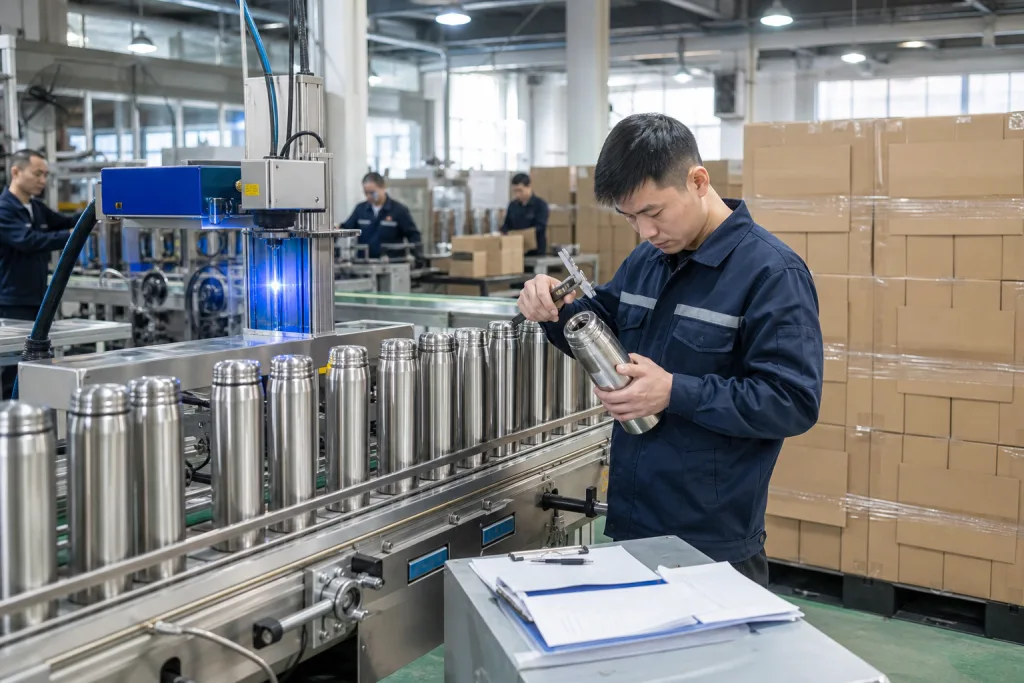
From our Zhejiang production base in China, we run into the same failure points on custom thermos jobs: lids with too much play, powder coating under 60μm, vacuum retention that drops after the hot-water test, logos shifted 2-3 mm, and export cartons that crush after 6 layers on the pallet. A normal MOQ for a customized thermos starts around 1,000 pieces per color, with 35-45 days production after artwork approval. The buyer often pushes for “same as sample,” but the line needs drawings, logo position, coating spec, carton drop-test requirement, and the exact barcode file before we ship.
Vacuum loss starts with vague steel specs
The first failure mode in a custom thermos United States order often hides until the product is already in use. The bottle looks clean, the logo passes, the carton is square. Then a customer fills it with coffee and gets lukewarm liquid after lunch. Vacuum failure usually traces back to loose laser-welding control, weak evacuation on the vacuum line, or steel specs written so broadly that the mill sheet tells us almost nothing.
For a retail-grade stainless thermos, specify food-contact 304 stainless steel for the inner liner. Some budget thermos factory offers use 201 stainless on the outer shell, acceptable for dry exterior use if the quote says so clearly. For outdoor retailers, we normally quote 304 inner and 304 outer unless the buyer is chasing a price target that leaves no room for it. A practical wall thickness range is 0.45-0.50 mm inner and 0.50-0.60 mm outer for 500 ml to 1,000 ml models; our incoming QC checks this with a digital micrometer before the coil goes to the cutting press.
Do not accept only the phrase “stainless steel” on a quotation. It is too vague. Ask your thermos manufacturer for material certificates and incoming material records, and make sure the grade on the PO matches the sales contract, not just the sample tag. If you are buying thermos bulk for a national promotion, add random XRF spot checks during inspection; we have seen this go sideways when a buyer approved 304 on email but the PO line only said “SS bottle.” It costs less than replacing 5,000 bad units after a winter campaign.
Retention testing should also be written into the purchase order. A fair test is to fill with 95°C water, close the lid for 6 hours at 20-25°C ambient temperature, and record the final temperature. Depending on capacity and shape, 8 out of 10 double-wall vacuum models in this category should hold roughly 65°C or higher after 6 hours when the vacuum is stable. Wide-mouth bottles lose heat faster than narrow-mouth bottles, so do not compare them blindly; the buyer flagged this once after testing a 750 ml sports lid against a 500 ml narrow-neck sample, and the math did not work.
Leaking lids are usually design decisions
About 6 out of 10 leak complaints we see get blamed on the gasket first. Sometimes the gasket is the problem, but the real cause is often a lid design that skipped fit trials, PP parts drifting by 0.20 mm after molding, or a sip mechanism picked because the product photo looked cleaner. For U.S. outdoor retail, the lid is the highest-risk component after the vacuum body. QC pulled one flip-lid sample last month where the hinge pin sat 0.35 mm off center. It looked fine on the table. It leaked after two shakes.
Your spec should name the lid material, gasket material, and leak test. Common lid materials are PP, Tritan, stainless steel, and silicone. For food-contact parts entering the United States, ask your thermos supplier for FDA food-contact declarations and LFGB or EU food-contact reports if you also sell in Europe. Silicone gaskets should be odor-controlled and removable for cleaning. A fixed gasket can pass the leak test and still create complaints because users find coffee residue under the lip after 12 days of use. We check this with a simple pull hook and a 0.01 g scale, not guesswork.
A useful production test is 100% water leak testing: fill the bottle, close the lid, invert for 3 minutes, then shake or roll according to your model. For flip lids and straw lids, add a pressure or squeeze simulation if the design has a vent hole. A “leakproof” sports cap and a “spill-resistant” coffee lid are not the same thing. This is the wrong place to accept fuzzy wording on a PO. We run 60 bottles per table at a time, and one operator logs wet caps with a red marker before the cartons reach final QC.
If your promotional thermos will be handed out at events, simple screw lids are safer. Fewer moving parts. If your outdoor retail SKU needs one-hand drinking, budget more time for pre-production testing. In Zhejiang, China, our engineering team often asks for 7-10 days only for lid fit trials before mass production. On a new straw lid, 7 days vs 18 days can be the difference between a clean launch and a pallet of returns. The math does not work if a buyer saves three days on sampling and then gets 2% distributor thermos returns after delivery.
Coatings fail before the bottle fails
Powder coating, spray paint, and plating cause 6 of the 10 defects U.S. buyers complain about after delivery. The vacuum body can pass the hot-water test, but if the coating chips after one week in a Costco-style club pack, the customer calls the bottle cheap. We see this in thermos custom projects when the buyer pushes the FOB down by USD 0.18 and the line cuts sanding from 18 seconds to 12 seconds per body. Bad trade.
For powder-coated stainless thermos orders, specify coating thickness around 60-90 microns, depending on finish and color. Require an adhesion test using 3M tape after cross-cut scoring, plus a 24-hour room-temperature water immersion check. QC should pull the sample after the curing oven, not before packing, and measure the film with a coating thickness gauge at the shoulder, belly, and bottom edge. For matte finishes, ask for a rub test because dark matte colors show oil marks and carton abrasion faster than gloss finishes.
Color control needs a standard. “Navy blue” is not enough; we had one PO say “dark blue like last time,” then the buyer flagged the bulk as too purple under warehouse LED light. Use Pantone for basic matching, but Pantone on paper and powder coating on curved steel will never match 1:1. For larger bulk thermos programs, approve a physical color chip or golden sample. Keep one sample at your office and one at the thermos factory.
Laser engraving is durable, but it exposes the steel underneath, so the final look depends on coating thickness and laser power. Silkscreen is cheaper for a one-color logo, yet it scratches if the ink mix or curing time is wrong; we run a fingernail check and a 3M tape pull before release. Heat-transfer printing works for complex artwork, but QC needs to inspect the edges near the seam and bottom radius. A good manufacturer thermos quotation should separate the bottle price and logo cost instead of hiding everything in one number, because that is where the math goes sideways.
Logo placement becomes a retail problem
A crooked logo does not stop a thermos from holding heat, but it can stop a retailer from booking the stock into their DC. We have seen a U.S. buyer reject 3,200 pcs because the mascot sat 4 mm off center on a school fundraiser order. Painful mistake. For promotional brands, logo defects hurt more because the order is often tied to a launch date, conference, school program, or sponsor contract. Thermos promotional orders need a print control plan, not just an AI or PDF file sent by email.
Start by locking the printable area in millimeters. The line needs that number before we make the silk-screen jig. Curved bodies distort large artwork, especially near shoulders and base tapers. For a 500 ml narrow thermos, a front logo width of 45-65 mm is usually safer than a wraparound graphic. For a 1,000 ml outdoor bottle, you get more room, but handles, powder texture, and weld lines still push the logo out of position if nobody checks the fixture.
Your artwork approval should include final vector artwork, logo size with tolerance, position from base or shoulder, and print method with Pantone number. If you need barcode labels, FNSKU labels, retail hang tags, or country-of-origin marks, put those in the same approval packet. We ship labels from the same packing line, so a missing FNSKU location drawing can hold 80 cartons while QC runs a phone scan test. 9 out of 10 thermos suppliers can apply labels at the factory, but they need placement drawings and scan results, not a note saying “same as last order.”
For inspection, use AQL rules but add cosmetic defect definitions. For example, reject if logo tilt exceeds 2 mm across the printed width, if pinholes are visible at 30 cm, or if color variance is beyond the approved sample. QC pulled the sample under a D65 light box last month and the buyer flagged a red logo that looked fine under warehouse lamps. These rules feel strict, but this is the wrong place to be flexible; they protect both you and the thermos manufacturers from arguing over subjective defects at the end of production.
Packaging is where margins disappear
Too many outdoor retailers and distributor buyers spend 2 weeks squeezing USD 0.08 out of the bottle price, then leave packaging to the last 5 days. Wrong place to save money. We’ve seen weak cartons, loose inner boxes, bad EAN-13 barcode position, and missing compliance marks turn a clean stainless thermos order into U.S. rework, chargebacks, and angry warehouse emails.
For e-commerce or FBA-style fulfillment, lock the master carton weight, carton L×W×H, barcode placement, and polybag requirement before the line starts packing. A typical stainless thermos master carton should stay under 15-18 kg if warehouse workers handle it manually; our packing table scale flags anything over 18.5 kg. For retail, decide early between kraft box, color box, window box, or gift tube, and ask for the dieline in mm. Gift tubes look premium, but the math often does not work: more CBM, higher freight, and more dents on the rim after vibration.
Carton strength matters. Ask for at least 5-ply export cartons for ocean freight and run an ISTA-style drop test or a practical 10-drop carton test from 76 cm for smaller cartons. QC pulled the sample last month after corner crush at drop 6, even though the bottle inside passed vacuum testing. If the order ships from China to the U.S. West Coast, then moves by truck to Ohio or Georgia, that carton may see 12-18 touch points before your customer opens it.
Lock carton markings before production. Country of origin should read clearly as made in China where required, and the PO should match the artwork; one buyer once typed “Made in Chian” on the routing sheet, and nobody laughed when 200 cartons were already printed. If your customer has routing guides, send them to the thermos vendor before deposit, not after goods are packed. Re-labeling 200 cartons in Zhejiang before shipment is annoying. Re-labeling them in a U.S. 3PL warehouse is expensive.
Inspections need numbers, not trust
A solid thermos manufacturer accepts written inspection rules because they stop arguments at the packing table. A weak supplier thermos shop hides behind “don’t worry, quality is good.” We hear that line, then QC pulls 13 scratched lids from one carton. Write the numbers down first.
For most custom thermos orders, use AQL 2.5 for major defects and AQL 4.0 for minor defects. Critical defects should be zero tolerance: sharp metal burrs, contamination inside the bottle, broken glass parts if any, major leaks, or unsafe lid edges. The inspection checklist should state capacity in ml, weight in grams, height and diameter in mm, wall finish under normal light, odor after rinsing, upside-down leak test, temperature retention hours, logo position, packaging artwork, barcode scanning, and carton drop result. A 1.5 mm logo shift sounds small until the buyer flags it on the shelf mockup.
Pre-production samples are not enough. They are usually made slowly by the best technicians, often one piece at a time with extra hand polishing. The real risk shows up during mass production when 20,000 pieces must be coated, printed, assembled, and packed on schedule. Our Hangzhou-area Zhejiang network can support around 300,000 stainless drinkware units per month across standard and custom lines, but that scale does not replace line checks or final random inspection. We have seen this go sideways when the sample passed and the third coating shift used the wrong spray-gun pressure.
If you are new to thermos customizable programs, use checkpoints that match the line: pre-production sample approval, mid-production inspection at 20-30% completion, and final inspection when 80-100% is packed. The mid-production check catches coating and lid problems while there is still room to rework cartons, lids, or printed sleeves. Final inspection alone is the wrong place to discover 2,400 lids are tight on the thread gauge. The math does not work.
Price pressure creates hidden substitutions
The cheapest thermos suppliers are not automatically cheating you. Sometimes they quote the build their costing sheet allows: 0.38 mm body instead of 0.45 mm, 201 outer shell instead of 304 stainless, 3-layer carton instead of 5-layer export carton, basic flip lid, no SGS/FDA/LFGB test. We see this on the line when QC weighs a 500 ml blank and it comes in 18 g light. If your only target is “best price FOB Ningbo,” you can hit the price and still miss the U.S. shelf.
For a standard 500 ml double-wall stainless custom thermos, a rough FOB China range is USD 3.20-5.80 depending on steel grade, lid parts, coating process, logo method, packaging spec, and order volume. A 1,000 ml outdoor bottle runs higher because it uses more steel, needs a larger powder-coating area, and takes more carton volume; we ship fewer pieces per master carton once the bottle diameter passes 90 mm. Use these as working ranges, not a promise. A USD 0.30 saving is not small money in production. It can remove a vacuum test, downgrade the outer steel, or cut the carton corner protection. The math doesn’t work if the buyer still expects retail-grade finish.
Ask every thermos distributor or supplier to quote against the same spec sheet. Put the material grade in writing, set capacity tolerance such as ±5 ml, name the coating code, give logo size in mm, define the lid drawing, confirm packaging, testing, MOQ, sample fee, production lead time, and Incoterm. Details matter. We once had a PO say matte black in the email and “gloss black” on the attachment; the buyer flagged it after PP sample photos. A factory thermos quote without these details is not comparable.
For U.S. outdoor and promotional buyers, the practical route is not to over-engineer every bottle. Decide which failures you cannot accept. If the program is for hikers, we run extra checks on lid torque, leak testing at 45 degrees, grip coating, and heat retention. If it is a corporate giveaway, the buyer usually cares first about logo position, carton marks, and the ship date matching the event schedule. Good manufacturers thermos programs are built around the failure modes your customer will notice first. We’ve seen this go sideways when a buyer pays for a premium cap but forgets to lock the logo color under a Pantone number.
Send your thermos spec before you place the order
We will review steel, lid, coating, logo, packaging, MOQ, and lead time so your U.S. program is quoted correctly.
Frequently asked questions
What MOQ should I expect for a custom thermos United States order?
For a standard custom thermos using an existing mold, expect an MOQ of about 1,000 pieces per color. If you need a new lid, new body shape, or fully customized thermos structure, MOQ often moves to 3,000-5,000 pieces because tooling, testing, and line setup take longer. For promotional thermos programs with one-color logos, some factories may accept 500 pieces, but unit price rises and color options are limited. Production is usually 35-45 days after sample and artwork approval, plus sea freight time from China to the United States.
Which stainless steel grade is best for outdoor retail thermos bottles?
For outdoor retail, specify 304 stainless steel for the inner liner as the baseline. It is widely used for food-contact drinkware and handles coffee, tea, and water well. For the outer shell, 304 is ideal, while 201 can be used on budget models if clearly declared and tested. For marine or high-corrosion use, some buyers ask for 316, but the cost increase is usually not necessary for normal bulk thermos programs. Also specify wall thickness, such as 0.45-0.50 mm inner and 0.50-0.60 mm outer, instead of only naming the steel grade.
How do I compare quotes from different thermos manufacturers?
Do not compare only the FOB unit price. Ask each thermos manufacturer to quote the same capacity, steel grade, lid material, coating thickness, logo method, packaging type, AQL level, and lead time. A USD 3.80 quote and a USD 4.20 quote may describe different products. One may include 5-ply cartons, 100% leak testing, and powder coating; the other may use a lighter carton and basic spray paint. Put every supplier thermos offer into a comparison sheet with MOQ, sample cost, tooling cost, Incoterm, and test reports.
What tests should be done before shipping thermos bulk orders?
At minimum, require 100% leak testing during production and final random inspection under AQL 2.5 major and AQL 4.0 minor. Add temperature retention testing, coating adhesion, logo rub testing, odor check, capacity check, barcode scan test, and carton drop test. For U.S. sales, keep food-contact declarations and relevant test reports on file. If the order is more than 5,000 pieces, a mid-production inspection at 20-30% completion is worth the cost because it catches coating, lid, and logo issues before all units are packed.
Can one thermos vendor handle retail packaging and FBA labeling?
Yes, many China-based thermos vendor teams can handle color boxes, kraft boxes, UPC labels, FNSKU labels, carton labels, insert cards, and master carton marks. The risk is timing. You need to provide label files, placement drawings, barcode numbers, and packaging dielines before mass production starts. For FBA-style shipments, confirm carton weight under practical handling limits, often 15-18 kg, and test barcode scanning on finished packaging. If you wait until the goods are packed, relabeling can delay shipment by 3-7 days.