Key Takeaways
- A realistic MOQ is 500 units for stock colours and 1,000-3,000 units for full custom powder coating
- Double-wall 304 stainless thermos bodies should hold hot water above 60°C for 6-12 hours depending on capacity
- Typical production lead time is 25-40 days after artwork approval and deposit
- UK buyers should check LFGB, REACH, food-contact reports, AQL inspection level, and carton drop-test records
If you are buying a custom thermos United Kingdom program, the bottle shape is usually the easy part. The real risk sits in late vessel production, loose compliance wording, weak logo adhesion, and export cartons that fail UK retail or promotional fulfilment checks. We have seen this go sideways when a buyer approved a nice 500ml sample, then QC pulled the bulk sample and found the silk-screen logo 3mm off centre. Outdoor retailers need a thermos that survives repeated use. Promotional brands need the same logo position across 1,000 or 20,000 units.
As a Zhejiang, China manufacturer thermos exporter, we get the same buyer questions most weeks: what MOQ is realistic, what insulation claim is honest, which powder coat scratches, and whether a customized thermos order ships in 12 days or 18 days after artwork approval. The line runs differently for laser engraving, 1-colour screen print, and full-wrap transfer, so the math does not work if every option is priced like a plain stock bottle. The notes below are a practical procurement checklist, not a catalogue speech.
Start with the actual use case
Before asking a thermos supplier for a quote, pin down where the bottle will be used. A hiking shop, a corporate winter gift, and a school outdoor program should not be buying the same spec. Body diameter, lid style, coating, retail packaging, and test standard can move the unit price by 8% to 15% before we even talk about logo cost. We check this on the line with a digital caliper, because a 74 mm body that sounds fine on paper may not sit well in a UK car cup holder.
For outdoor retailers in the United Kingdom, 500 ml and 750 ml are the regular sizes we ship because they fit backpack side pockets and car cup holders better than oversized bottles. For promotional thermos campaigns, 350 ml and 500 ml usually give the best balance between shelf value and freight cost. A 1,000 ml bulk thermos looks strong in a sample photo, but the math often breaks at carton level: 24 pcs can push the carton above 18 kg, and the buyer then asks why air freight jumped. We have seen this go sideways after PO approval.
Use this first checklist when briefing a thermos manufacturer:
- Capacity: 350 ml, 500 ml, 750 ml, or 1,000 ml. Ask for the actual brimful capacity too; a 500 ml selling claim should not measure 465 ml when QC fills it on the bench scale.
- Usage: retail outdoor, employee gift, event giveaway, loyalty program, or distributor thermos range. A school program needs tougher lids than a one-day conference giveaway.
- Branding: laser engraving, silk screen, UV print, full-wrap print, or embossed sleeve. Send the logo as AI or PDF, not a 72 dpi PNG copied from a website.
- Finish: stainless steel, matte powder coat, gloss paint, rubber paint, or textured coating. Matte black hides small handling marks better than cream on a warehouse picking table.
- Packaging: plain white box, kraft box, colour retail box, barcode label, or FNSKU-ready carton. We need the barcode position early, because moving it after box proofing means new plates and lost days.
A good thermos factory should push back if your brief does not match real use. For example, a wide full-wrap print on a tapered body may look clean in a mock-up but distort when the bottle rotates under the screen frame. A light powder coat can pick up dust marks faster in outdoor retail, and QC pulled samples before for grey scuffing after only 20 rub cycles. A promotional thermos with a narrow mouth can annoy users who want to add ice cubes. Small details decide the repeat order.
What MOQ should UK buyers expect?
The honest MOQ depends on how far you move away from the items already running on the line. For a stock stainless thermos with one-colour logo printing, 500 units is usually workable. For a custom thermos with a non-standard Pantone powder coat, expect 1,000 to 3,000 units because the coating line needs setup time, powder loss allowance, and colour matching approval under the D65 light box. For a new mould lid or unique bottle shape, MOQ can move to 5,000-10,000 units. No shortcut there.
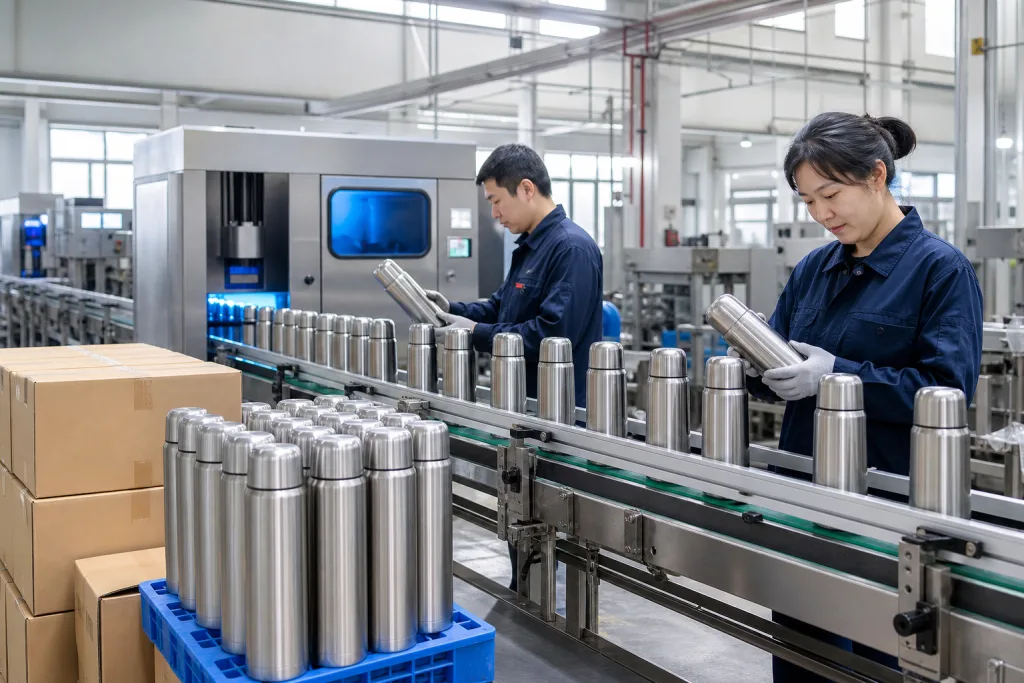
At our Zhejiang facility, normal monthly output for stainless vacuum drinkware is about 450,000 units, but that does not mean every small customized thermos order can jump the queue. Production has fixed stages: tube cutting, water expansion or stretching, welding, vacuuming, polishing, coating, printing, inspection, and packing. QC pulled one 500 ml sample last month for a 0.4 mm rim scratch after powder coating, and that small finding still stopped carton sealing for half a shift. If your purchase order arrives during the August-October peak season for Christmas and winter promotions, add 7-10 days of buffer.
For budget planning, most UK buyers we deal with start from this rough FOB China range for stainless thermos bulk orders:
- 350 ml: USD 3.20-5.20 depending on lid and coating.
- 500 ml: USD 3.80-6.50 for most promotional thermos specifications.
- 750 ml: USD 5.20-8.80 for outdoor retail grade models.
- 1,000 ml: USD 6.80-11.50 with cup lid or handle lid.
These numbers are not promises without a specification sheet. Steel grade, wall thickness, lid material, box type, and inspection level all affect the final price; even changing a white box from 250 gsm to 300 gsm adds cost when we ship 1,000 cartons. If a thermos vendor quotes far below the market, ask which part changed: 201 stainless instead of 304, thinner body, no copper lining, cheaper PP lid, or no third-party test report. Cheap thermos custom orders often become expensive after returns, and we have seen this go sideways when the buyer flagged rust spots at UK warehouse intake.
Insulation claims need test numbers
Product pages often print “keeps hot for 12 hours” or “cold for 24 hours.” We’ve had 3 UK buyers flag that wording during carton artwork approval because it gives them nothing to defend in retail. Ask for the test method, starting temperature, room temperature, fill volume, and measurement interval. Without those numbers, a factory thermos claim is just advertising. QC should be able to pull the lab sheet, not point to a sales brochure.
For a practical 500 ml double-wall vacuum flask made with 304 stainless steel, we use a fair benchmark: hot water starting near 95°C and staying above 60°C after 6 hours at a room temperature around 20°C. A stronger vacuum and copper plating between walls can improve performance, but the lid still decides a lot. The math doesn’t work if the body is good and the lid bleeds heat. A push-button lid with 6 plastic parts may lose heat faster than a simple screw cup lid. A wide-mouth thermos is easier to clean, but the larger opening loses more heat when customers open it 10 times on a hike.
Ask your thermos suppliers for these checks before approving thermos customized production:
- Vacuum test: 100% checked on the line with a vacuum detector, not random only.
- Hot water test: clear temperature record at 2, 6, and 12 hours, with the sample number written on the sheet.
- Leak test: inverted and shaken after filling, especially for handle lids; QC pulled the sample if one drop shows at the silicone ring.
- Salt spray or coating adhesion: useful for outdoor retail finishes, with tape test photos after the coating trial.
- Dishwasher claim: only if tested; 8 out of 10 powder-coated bottles we ship should be hand-wash only.
Wall thickness is another point to confirm. Most retail-grade stainless thermos bodies we run use 0.4-0.5 mm 304 stainless steel before forming. Thinner material cuts cost, but dent resistance suffers. For a distributor thermos range sold through outdoor shops, saving USD 0.20 by using a weaker body is the wrong question to ask. We’ve seen this go sideways after drop testing from 1 m onto a steel plate. Consumers judge the whole brand when the first dent appears.
Branding choices that survive real use
A customizable thermos earns its place only when the logo still looks clean after 6 months in a van, rucksack, or dishwasher basket. For stainless steel bodies, we usually push buyers toward laser engraving because it cuts through the coating or marks the metal itself; on our line we check depth with a 0.01 mm caliper after the first 20 pcs. It suits outdoor retailers in the United Kingdom who want a plain, premium finish. Colour is the trade-off. Laser normally gives silver, grey, or dark contrast, depending on the base coating and whether we run powder coat, bare 304 stainless, or electroplated finish.
Silk screen printing works when the artwork has one or two colours and the bottle wall is straight. We ship plenty of promotional thermos orders to the United Kingdom this way because the screen charge is low and the edge stays sharp on a 70 mm diameter cylinder. For curved or tapered bodies, keep the logo inside the safe print area we mark on the dieline. The buyer often asks us to “wrap it a bit more”; that is where the math doesn't work, because registration drift of even 1.5 mm shows up fast on a tapered cup.
UV printing is better for multi-colour logos, gradients, and small campaign artwork. Still, ask for an adhesion test on the exact coating, not on a random bottle from the sample room. QC pulled the sample last month where UV passed on bare stainless steel but lifted on soft-touch rubber paint after a 3M tape test. Full-wrap heat transfer can look strong in photos, but if the thermos will be sold as outdoor gear, we run scratch testing with a 500 g load before we let the buyer sign off.
Use this artwork checklist before you release a purchase order:
- Vector artwork in AI, EPS, or PDF format, with fonts outlined before our prepress team opens the file.
- Pantone references for printed colours and coating colours, not a screenshot from a website.
- Logo size in millimetres, not “make it look nice”; 45 mm wide and 32 mm high is a spec, a feeling is not.
- Position measured from base or centre line, with a clear front-facing direction if the lid has a handle or button.
- Pre-production sample approved under normal daylight, because office LED lighting hides colour shifts we catch at the packing table.
A serious thermos manufacturers thermos team will send a digital proof, then a physical pre-production sample for larger orders. For 500 units, you may approve a photo sample if timing is tight, but make sure the ruler is in the photo and the logo position is visible from base to centre line. For 3,000 units or more, pay for a physical sample. We have seen this go sideways: one PO had “logo 60 m” instead of “60 mm,” the buyer flagged it late, and fixing 3,000 badly positioned logos cost more than the sample ever would.
UK compliance is not optional
For the United Kingdom and Europe, stainless drinkware compliance starts with food-contact safety. Ask for LFGB or EU food-contact reports covering the 304 stainless body, the PP or Tritan lid, the silicone gasket, the outside coating, and the logo ink if it touches the drinking area. REACH matters for powder coating, spray paint, rubber parts, and any black plastic component where restricted substances get questioned. For children’s bottles, push for the exact child-safety review and packaging warnings. Do not accept “kids lid” as proof. Last month QC pulled a 350 ml sample where the straw cap passed leak testing, but the warning label artwork was missing the age mark.
For North American programs managed by UK promotional brands, ASTM and FDA-related food-contact expectations can enter the discussion. Tell your supplier thermos partner the sales market, not only the address on your PO. We have seen this go sideways: a London buyer wrote “UK warehouse” on the order, then shipped 8,000 pcs to the US and asked for FDA backup after production. The math does not work after printing and packing. A China factory can build the right test plan only when the destination market is clear before mass production.
On audits, distributors thermos buyers usually ask for BSCI, Sedex, ISO 9001, or factory audit reports; our export team sees these requests on about 7 out of 10 UK enquiries. These documents do not replace product testing, but they help your compliance team check labour records, quality control flow, and traceability from coil material to finished carton. If you supply a national retailer, expect audit files plus batch-level QC records, including incoming steel thickness checks in mm and vacuum test logs from the line. Paperwork matters. So do records.
Your purchase contract should state the inspection standard. A common setup is AQL Level II with critical defects at 0, major at 2.5, and minor at 4.0, although some retailers use stricter limits. Define defects before inspection: leaking at the lid thread, poor vacuum after the 95°C hot-water hold test, sharp rim edge, wrong Pantone logo colour, coating scratch over 3 mm, barcode scan failure, crushed colour box, or carton marking mistake. The buyer flagged one PO typo as “mat black” instead of “matt black”; small wording, big argument. A thermos distributor that waits until goods reach Felixstowe to define defects has already lost leverage.
Compliance paperwork should match the exact material, colour, and lid used in your order. A test report for a different bottle is not strong protection.
Lead time, freight, and landed cost
For a normal manufacturer thermos order from China to the United Kingdom, plan 25-40 days for production after deposit and artwork approval. Add 3-7 days for sample approval if you need a physical pre-production sample; our pre-production sample usually goes through logo position check with a 0.5 mm tolerance before QC releases photos. Sea freight to a UK port commonly takes around 30-40 days depending on routing and congestion. Door delivery, customs clearance, and warehouse booking can add another 5-10 days.
If your promotional thermos is tied to an event date, work backward with a buffer. A safe schedule for a custom thermos United Kingdom campaign is 90 days from confirmed artwork to UK warehouse arrival. Faster is possible. The problem is the trade-off: tight schedules push buyers into skipping samples, paying air freight, or accepting a stock colour that does not match the campaign. We have seen this go sideways when the buyer flagged the lid colour 6 days before vessel closing.
When comparing thermos suppliers, do not look only at FOB unit price. This is the wrong question to ask if the carton data is missing. Check the full landed cost:
- FOB Ningbo or Shanghai unit price.
- Inner box and export carton size, including the 3-ply or 5-ply carton spec.
- Carton gross weight, usually kept under 15-18 kg for handling.
- Sea freight, duty, customs entry, and UK delivery.
- Inspection fee, test fee, and sample courier cost.
Zhejiang is close to Ningbo and Shanghai ports, which helps export scheduling. Our Hangzhou line can truck finished cartons to Ningbo in the same day if the booking is clean, but that does not replace clear cut-off dates. During peak season, vessel space can tighten in 48 hours. If you are building a thermos bulk program for several outdoor retailers, split the order by SKU and delivery window. Ship the first 3,000 units on time rather than wait for all 9,000 units because one colour box is delayed. The math usually supports it.
Final supplier checklist before deposit
Before paying a deposit to any thermos factory, stop and check the items that turn into debit notes later. A proforma invoice saying “500 ml stainless bottle with logo” will not protect you. We like an order file clear enough that a new QC inspector, holding a calliper and a 0.1 g scale on the line, can match the sample without reading 42 emails.
Use this final checklist for a factory thermos or suppliers thermos decision:
- Confirmed material: 304 stainless steel inner wall, 304 or 201 outer wall if agreed, food-grade PP lid, silicone gasket.
- Capacity tolerance and product dimensions in millimetres, including height, bottom diameter, mouth diameter, and lid height.
- Net weight target and acceptable tolerance, checked on a scale before mass packing starts.
- Coating type, Pantone colour, and surface finish standard, with one signed colour sample kept by QC.
- Logo method, size, position, and approved artwork file, not a screenshot copied from WhatsApp.
- Packaging dieline, barcode, recycling marks, and carton shipping marks, including any UK importer text the buyer requires.
- Testing documents required before shipment, such as FDA, LFGB, salt spray, or insulation test report if agreed.
- AQL inspection standard and who pays for reinspection if goods fail.
- Payment terms, usually 30% deposit and 70% before shipment for first orders.
- Incoterm: FOB Ningbo, FOB Shanghai, CIF, DDP, or another agreed term.
For a first order, do not change too much at one time. Use an existing thermos manufacturer body, then adjust colour, logo, and packaging only after the sample is signed. We have seen buyers ask for a new lid, new powder coating, and a new gift box on a 500 pcs trial; the math does not work once mould fee, pre-production sample time, and rework risk are counted. Test market demand with 500-1,000 units before you put 10,000 units on the water.
The best thermos vendor is not the factory that says yes in 3 minutes. It is the one that marks the risky points, writes measurable specs, and ships the same product you approved. Last year QC pulled a sample where the PO said matt black, but the approved sample was gloss black; that one typo held the cartons for 2 days. This is how a one-off promotional thermos order turns into a stable distributor thermos line.
Send your thermos brief for a practical quote
Share capacity, quantity, logo method, UK delivery date, and compliance needs. We will reply with MOQ, FOB pricing, lead time, and risks.
Frequently asked questions
What is the best MOQ for a first custom thermos order in the United Kingdom?
For a first custom thermos United Kingdom order, 500 units is a sensible starting point if you use an existing bottle body, stock colour, and one-position logo. If you need a Pantone-matched powder coat, plan for 1,000-3,000 units because the coating line has setup loss and colour approval work. For new moulds, such as a unique cap or exclusive body shape, 5,000-10,000 units is more realistic. Outdoor retailers often start with 500 ml and 750 ml sizes, while promotional brands usually test 350 ml or 500 ml to control freight cost.
How long does a customized thermos order take from China to the UK?
A standard customized thermos order normally needs 25-40 days of production after deposit and artwork approval. Add 3-7 days if you require a physical pre-production sample. Sea freight from China to the United Kingdom is commonly around 30-40 days port to port, with another 5-10 days for clearance, delivery, and warehouse booking. For a fixed event date, allow about 90 days from approved artwork to UK warehouse arrival. Air freight can save time, but it often damages the economics on heavy stainless thermos bulk orders.
Which branding method is best for a promotional thermos?
For durability, laser engraving is usually the safest choice, especially on powder-coated stainless steel. It will not peel, and it gives a clean premium look. For low-cost promotional thermos orders with one or two logo colours, silk screen printing is practical and affordable. For multi-colour campaign artwork, UV printing works well, but you should request an adhesion test on the exact coating. For 1,000 units or more, approve a physical pre-production sample before mass production. A 2 mm logo position error may look minor on a PDF but obvious on a retail shelf.
What tests should I request from thermos suppliers for UK retail?
Ask for food-contact test reports covering the stainless body, lid plastic, silicone gasket, coating, and ink. LFGB or EU food-contact reports are commonly requested for UK and European sales, and REACH is relevant for coatings and restricted substances. For quality control, request vacuum testing, hot water retention data, leak testing, coating adhesion, and carton drop-test records. Use AQL Level II as a baseline, with critical defects at 0, major at 2.5, and minor at 4.0 unless your retailer requires stricter limits. Make sure reports match your actual material and colour.
Is FOB or DDP better for thermos bulk orders?
FOB Ningbo or FOB Shanghai is usually better if you already have a freight forwarder and want control over shipping, insurance, customs, and UK delivery. DDP can be convenient for smaller promotional thermos orders, but you need to check exactly what is included: duty, VAT handling, customs entry, delivery appointment, and insurance. For thermos bulk shipments above 3,000 units, FOB often gives more transparent landed cost. Ask for carton dimensions and gross weight before comparing quotes. A lower unit price can disappear if cartons are oversized or packed inefficiently.