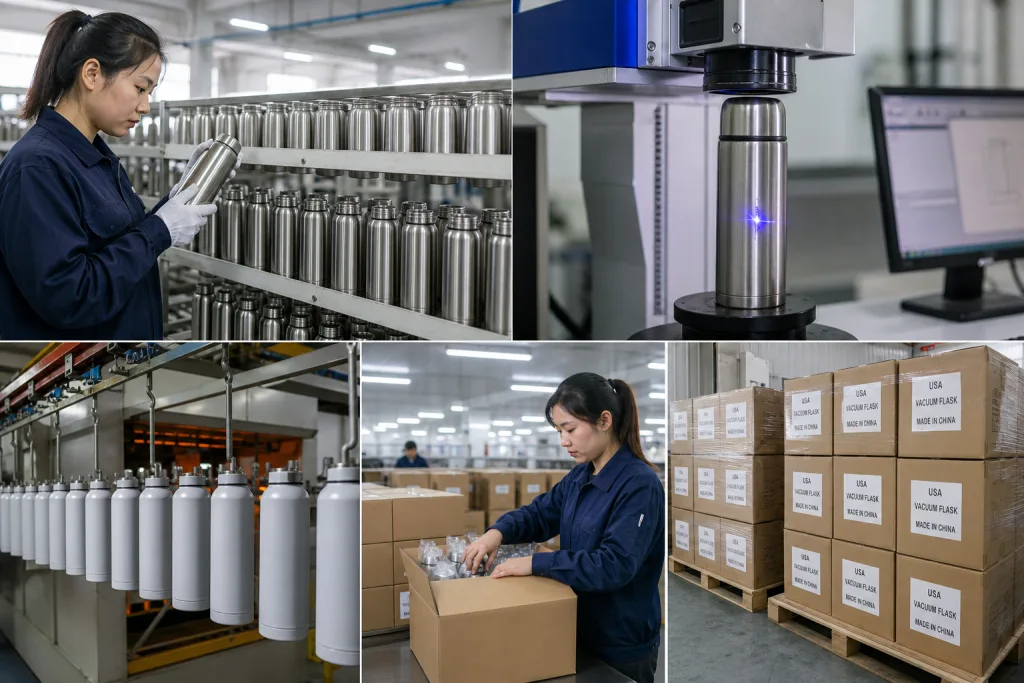
Key Takeaways
- For custom thermos flask USA projects, plan 3,000 pcs MOQ per color for most powder-coated models
- 304 stainless steel is usually enough for bottles; 316 is useful for saltwater or acidic drink positioning
- Laser engraving is cleaner for small logos, while silkscreen works better for 2-4 color promotional layouts
- A realistic production lead time is 35-45 days after sample approval, plus ocean or air transit
If you sell to hikers, corporate gifting teams, campus stores, or outdoor clubs in the USA, a custom thermos looks simple until the first quotation sheet lands in your inbox. Two bottles may both say 18/8 stainless steel, 500 ml, vacuum insulated, and BPA-free, but the real gap shows up in the details: laser logo tolerance at 0.3 mm, powder coating scrap rate, carton cube, and whether the lid passes a 24-hour leak test after QC pulls the sample from the line.
We build stainless drinkware in Zhejiang, China, and the buyers with the cleanest launches compare specifications before unit prices. Good habit. A bulk thermos order is not just a bottle order. It has to fit the sales channel, whether that means a retail shelf, promotional thermos giveaway, distributor thermos catalog, Amazon FBA carton, or winter outdoor kit. We have seen this go sideways when a PO says “matte black” but the approved sample is satin black, and the buyer flagged it only after 3,000 pcs were packed.
The buyer comparison table
A USA buyer asking for a custom thermos usually starts with capacity and logo method. That is the wrong first question. For outdoor retail and promo programs, we ask for a head-to-head spec sheet before the quote; last month a buyer flagged a 0.38 mm outer wall after sampling because the PO only said “stainless body.” Same shape, different bottle.
| Spec item | Retail outdoor fit | Promotional fit | Distributor catalog fit |
|---|---|---|---|
| Body material | 304 inner and outer, 0.45-0.50 mm outer wall | 304 inner, 201 or 304 outer depending budget | 304 inner and outer for fewer complaints |
| Capacity | 500 ml, 750 ml, 1,000 ml | 350 ml, 500 ml | 500 ml and 750 ml core range |
| Finish | Powder coating or brushed steel | Powder coating, silkscreen logo | Matte powder coating with neutral colors |
| Decoration | Laser engraving, debossed sleeve, full wrap for premium lines | Silkscreen, pad print, laser for 1-color logo | Laser plus private label carton |
| MOQ | 3,000 pcs per color | 1,000-3,000 pcs depending model | 5,000 pcs mixed SKU planning |
| Typical FOB China | USD 4.20-7.80 | USD 2.90-5.20 | USD 3.80-6.50 |
That table earns its place. It stops a thermos vendor from quietly quoting a cheaper outer shell, a thinner coating, or a carton that fails a 76 cm drop test. QC pulled the sample, not the sales team. Our Zhejiang factory output is about 850,000 stainless units per month across bottles and tumblers, with food jars running on a separate line, but we still lock specifications before sampling. Scale does not fix vague instructions.
304 versus 316 stainless steel
Most custom thermos flask USA programs should run 304 stainless steel on the inner liner. It is food-contact safe, handles coffee, tea, milk drinks, and plain water without drama, and USA compliance teams already know the spec. The common shorthand is 18/8 stainless steel, meaning roughly 18 percent chromium and 8 percent nickel. For a manufacturer thermos quote, ask whether the inner wall, outer wall, cap insert, and tea filter are all 304. We check this on incoming material with a handheld XRF gun before the line starts. Some low-cost thermos manufacturers switch the outer shell to 201 stainless to shave about USD 0.12-0.20 per 500 ml bottle. That is not automatically a deal breaker, but hiding it on the PI is where we have seen this go sideways.
316 stainless steel has molybdenum, so it stands up better to chloride corrosion. Use it for a premium coastal outdoor line, a marine gift program, or a bottle sold for lemon water and sports hydration. It usually adds USD 0.25-0.70 per unit depending on capacity and wall thickness. If your retail price is USD 29.99 or higher, 316 can support the selling story, and the buyer’s packaging team has room to explain it on the hangtag. If the item is a 10,000 pc promotional thermos for a trade show, 304 is usually the practical choice. The math does not work if the end user keeps it in a booth tote bag for one week.
Wall thickness also matters. A 0.35 mm outer wall may pass casual inspection, but it dents faster in USA distribution, especially when cartons get stacked 5 layers high on a mixed pallet. We usually recommend 0.45 mm for 500 ml and 0.50 mm for 750-1,000 ml outdoor bottles. Inner wall thickness is often 0.30-0.40 mm. Ask your thermos factory to confirm the gauge range, not just the steel grade. Last month QC pulled the sample after drop testing and found two small flats near the shoulder; the PO said 304, but the real problem was a thin outer wall.
For most buyers, the best value spec is 304 inner and outer, 0.45 mm outer wall, copper-plated vacuum layer, and a lid design with replaceable silicone gasket. We run this spec often because it balances cost, dent resistance, heat retention, and after-sales risk.
Capacity and lid use-case fit
A customizable thermos has to match how the end user carries it. For USA outdoor retail, we usually quote 750 ml and 1,000 ml because they look serious on shelf and fit day hiking, camping, snow work, and a 90-minute commute. One REI-style buyer once pushed back on a 500 ml sample because it looked “too office” next to headlamps and dry bags. Promotional brands usually land on 350 ml or 500 ml because freight, carton size, and desk use beat backcountry capacity.
A 500 ml thermos customized with logo is still the safest all-purpose SKU. It fits most vehicle cup holders if the lower diameter stays around 68-72 mm, and we check that with a simple cup-holder gauge on the sample table. A 750 ml bottle gives a stronger outdoor feel but can exceed cup holder diameter at 78-86 mm. A 1,000 ml stainless thermos works well for thermos bulk retail, but carton cube jumps fast. A 1,000 ml model may pack 12 pcs per carton instead of 24 pcs, which changes landed cost even if FOB looks reasonable. The math does not work if the buyer only compares unit price.
Lids deserve more attention than they get. A twist cup lid is classic for hot drinks and winter programs. A push-button stopper is convenient, but we run tighter leak testing and fatigue testing because one weak silicone seal can kill a reorder. QC pulled one sample after a 30-minute inverted test at 95°C because the button seeped at the vent pin. A wide-mouth lid is easier to clean and works for ice cubes and soup-style lunch packs. A straw lid looks modern but is not suitable for boiling liquid, so the carton artwork should carry a temperature-use warning.
- Outdoor retail: 750 ml wide-mouth or cup lid, powder coat that passes cross-hatch tape test, laser logo, stronger handle.
- Corporate gift: 500 ml slim body, cup-holder friendly at 68-72 mm, one-color logo, gift box with barcode space.
- Distributor thermos catalog: 500 ml and 750 ml shared color palette, same lid family, mixed case planning for warehouse picking.
- Event giveaway: 350 ml or 500 ml, standard mold, lower MOQ, simple carton that survives courier handling.
If you are comparing thermos suppliers, ask for filled weight, empty weight, diameter, height, and carton dimensions on the quote. These five numbers reveal more than product photos. We have seen this go sideways: one PO typed 86 mm as 68 mm, and the buyer flagged the issue only after the sample missed the cup-holder test.
Decoration methods face off
Decoration is where 6 out of 10 custom thermos projects start losing margin. A logo that prints fine on a flat T-shirt can break up on a curved 80 mm powder-coated bottle, especially near the shoulder. We run the first check with a paper wrap and a caliper before artwork approval. For a thermos custom program, match the decoration method to the logo detail and the sales channel.
Laser engraving is the safest pick for outdoor retail and higher-end corporate gifts. It removes the top coating and shows the stainless steel underneath. Clean result. Low drama. It works for small wordmarks, GPS coordinates, mountain icons, and club names under about 60 mm wide. The buyer sometimes asks for red engraving; the math doesn't work because laser gives a stainless mark, not a red, blue, or full-color graphic. Setup cost is usually USD 40-80 per artwork, and unit decoration cost can be USD 0.08-0.25 depending logo area.
Silkscreen printing fits a promotional thermos where brand color has to match the Pantone book on the buyer's desk. One-color printing is economical; 2-4 colors need tighter registration, film checking, and artwork with clean vector lines. On curved bodies, a 120 mm wide logo can start looking stretched at the edges. For powder-coated bottles, we test adhesion with 3M tape, alcohol rub, and cross-hatch tests before mass production. QC pulled one sample last year where the print passed tape but failed after 30 alcohol rubs.
Heat transfer and water transfer handle complex graphics and full wraps better than screen print. They suit private-label retail lines, but sampling needs patience. Expect longer sample time, usually 10-14 days instead of 5-7 days for laser or simple screen print. A full-wrap file also needs a bleed area, seam position, and barcode clearance if the bottle goes into retail packaging. Full-wrap decoration can add USD 0.40-1.20 per unit.
Embossed silicone sleeves, metal badges, and woven straps can make a customized thermos feel retail-ready instead of giveaway-grade. They add failure points too: glue that lifts after heat testing, sleeve colorfastness, strap stitching, and mold cost. If you want a thermos manufacturer to develop these parts, budget USD 300-1,500 for tooling depending complexity. We have seen this go sideways when a PO says “black sleeve” but the approved sample was PMS 432C. China factories can do this well, but not cheaply if you also want consistent AQL results.
Compliance for USA importers
For the USA, stainless thermos compliance is simpler than electronics, but the file still has to match the cup we ship. Food-contact steel, lid plastic, silicone ring, and inner coating should be covered by FDA food-contact paperwork. About 6 out of 10 North American buyers we deal with also ask for LFGB because they want to sell the same SKU into Europe, where odor and migration results get checked harder. If your outdoor retailer sells in both the USA and EU, ask for FDA food-contact statements, LFGB test reports, and REACH declarations before deposit. We have seen this go sideways when the PO says “304 stainless” but the approved sample tag says “316 inner,” and QC pulled the sample before packing.
For children’s products, the bar rises fast. If the product is marketed to children under 12, CPSIA and ASTM considerations can apply, including lead in paint and small parts. Do not turn an adult 350 ml bottle into a kids bottle by adding cartoon artwork and a smaller strap. That is the wrong shortcut. The testing plan changes, the warning label changes, and the buyer may ask for age grading on the color box. A kids-oriented thermos supplier should provide child-use material reports, coating heavy metal results, and packaging warnings by age group. On the line, we also check straw caps with a small-parts cylinder because one loose silicone plug can stop a USA shipment.
Quality inspection should use AQL, not a loose promise that “we check everything.” A normal USA order commonly uses AQL 2.5 for major defects and 4.0 for minor defects. Critical defects should be zero. For drinkware, critical checks include leakage, sharp edges, odor, missing silicone ring, contamination, and wrong material. Major defects include visible dents, poor logo position, weak vacuum, lid threading issues, and coating scratches above the agreed limit. QC pulled 13 cartons from a 3,000-piece lot last month and found 2 lids with rough threads at the first turn; that is the kind of detail an AQL sheet catches before the buyer flags it in California.
Vacuum performance is easy to overclaim. A good 500 ml stainless bottle may keep water above 60°C after 12 hours when tested from 95°C in a 20°C room, but lid design and capacity change results. Ask for the exact test method. A thermos manufacturers catalog saying 24 hours hot is not enough. The math does not work without starting temperature, ambient temperature, fill volume, and final temperature. We run the test with a probe thermometer, full fill to the shoulder, and a timer on the bench; a wide-mouth 500 ml bottle and a slim 500 ml bottle will not always give the same curve.
MOQ, price, and lead time
Custom thermos flask USA buying only works when MOQ, unit price, and delivery date are checked on the same quote sheet. A supplier thermos quote at USD 3.20 means little if the MOQ is 10,000 pcs per color and the lid mold is not on our mold rack. We had one PO last March with “matte balck” typed in the color line; QC caught it before the powder supplier mixed 60 kg of the wrong shade. A USA promotional buyer may need 2,000 pcs in four weeks. An outdoor retailer may need 12,000 pcs in three colors before fall inventory. Same bottle, different math.
For standard molds at our Zhejiang, China facility, normal MOQ is 3,000 pcs per color for powder coating and 1,000-2,000 pcs for laser logo on stock color when components are available. For custom PMS powder coating, 3,000 pcs is more realistic because the coating line needs setup time, powder loss is visible on the floor, and the first color-matching spray often wastes 20-30 pcs. For a new lid, handle, silicone boot, or unique body mold, tooling can range from USD 1,200 to USD 8,000, and MOQ may move to 10,000 pcs or more. Asking for 500 pcs with a private mold is the wrong question to ask; the math doesn't work.
Typical FOB Ningbo or Shanghai pricing for a 500 ml 304 stainless custom thermos is USD 3.40-6.20 depending on finish, lid structure, carton spec, and decoration method. A 750 ml model often lands at USD 4.30-7.80 FOB China. Gift boxes add USD 0.25-0.70. Individual polybags are cheap, but outdoor retail buyers now flag them during packaging review, especially when the carton shows a recycle mark but the bottle is still wrapped in plastic. FSC paper sleeves or kraft boxes cost more, and we check the sleeve fit with a 0.5 mm gap gauge so it does not slide off in the master carton.
Lead time usually runs like this: 5-10 days for plain sample, 7-14 days for decorated sample, 35-45 days for mass production after sample approval and deposit, and 3-7 days for final inspection booking. Ocean freight to the USA West Coast may take about 18-28 days port-to-port, while East Coast can be 30-40 days. Air freight fixes the calendar but hurts the margin on thermos bulk orders because stainless bottles are heavy and bulky. We ship 500 ml bottles at roughly 24 pcs per export carton, and once the carton hits the scale, the buyer sees why “just send all by air” goes sideways.
How to pick your supplier
A good thermos supplier answers technical questions before asking for a sample fee. You want a factory thermos partner that can talk through 304 stainless, 316 options if needed, vacuum loss rate, coating adhesion, AQL inspection, carton burst strength, and USA labeling from a real order sheet, not from a brochure. We run into this often: the buyer asks for “same as Stanley feel,” then the supplier cannot confirm wall thickness in mm. Trading companies have their place, but for repeat distributor thermos programs, direct manufacturer thermos support cuts down the back-and-forth.
Ask for a current BSCI or ISO 9001 audit if your retailer requires social or quality management documentation. Ask whether the factory has in-house vacuum testing, salt spray testing for coated parts, dishwasher testing if claimed, and drop testing from 1.0 m or 1.2 m. If they say yes, request photos of the equipment and one sample report with date, model number, and inspector name. QC pulled one sample last month after 24 hours in the vacuum chamber because the lid seal lost 3°C more than the approved sample. Real thermos manufacturers in China should show process control, not just showroom samples.
Packaging is part of supplier selection. USA distributors thermos programs often need UPC labels, FNSKU labels for Amazon FBA, suffocation warnings, master carton marks, and pallet plans. Confirm whether your thermos vendor can apply labels at the unit and carton level, and whether they can provide carton drop test results. A 5-ply export carton with fitted dividers is worth the small cost increase over soft packaging; we have seen powder-coated bottles rub through after 12 days on the water plus 6 days in a domestic truck. The math does not work if you save USD 0.08 on a carton and lose a 48-piece claim.
Test communication discipline. Send the same RFQ to two or three thermos suppliers and check who returns a complete answer: material grade with wall thickness in mm, capacity tolerance, decoration method, MOQ, FOB port, sample time, production time, carton size, gross weight, and compliance documents. Short answers are a warning. One buyer flagged a PO typo where “matte black” became “mate black,” and the supplier who caught it before tooling saved the order. The lowest number is tempting, but the clearest number costs less by the time the goods reach a USA warehouse.
Send your thermos spec sheet for factory review
We will check capacity, material, decoration, MOQ, carton data, and realistic FOB pricing before you commit to sampling.
Frequently asked questions
What MOQ should I expect for a custom thermos flask USA order?
For a normal stainless custom thermos using an existing mold, expect 3,000 pcs per color for custom powder coating. If you accept a stock body color and only add laser engraving, some factories can support 1,000-2,000 pcs. For a new lid, special handle, silicone boot, or exclusive body shape, MOQ often rises to 10,000 pcs because tooling, component setup, and line changeover become more expensive. For USA promotional deadlines, ask whether the MOQ applies per color, per logo, or per total order. Those are three different answers.
Is 304 stainless steel enough for outdoor retail thermos bottles?
Yes, 304 stainless steel is the standard choice for most outdoor retail and promotional stainless thermos programs. It is suitable for coffee, tea, water, and normal sports drinks. For premium marine, fishing, or coastal outdoor programs, 316 stainless steel can be useful because it resists chloride corrosion better. The upgrade may add USD 0.25-0.70 per unit depending on capacity. More important than the grade label is confirming which parts use 304: inner wall, outer wall, infuser, lid insert, and any food-contact accessories.
Which logo method is best for a promotional thermos?
For a one-color or small logo, laser engraving is usually the safest because it is durable and clean. For brand color accuracy, silkscreen printing is better, especially on powder-coated bottles. A 2-color silkscreen logo is common, but large curved graphics need careful sampling because registration can shift around the bottle radius. Full-wrap heat transfer works for retail graphics but can add USD 0.40-1.20 per unit. Always approve a physical decorated sample before mass production, not just a digital mockup.
How long does production take after sample approval?
For standard stainless thermos models, plan 35-45 days after deposit and sample approval. A simple laser sample can take 5-7 days, while custom PMS coating or full-wrap artwork may take 10-14 days. Final inspection usually needs another 3-7 days for scheduling, especially before peak shipping months. Ocean freight from China to the USA West Coast may take 18-28 days port-to-port, and East Coast routing can take 30-40 days. If your launch date is fixed, start RFQ work at least 90 days ahead.
What inspection standard should I use for thermos bulk orders?
Use AQL inspection with clear defect definitions. A common setting is AQL 2.5 for major defects and 4.0 for minor defects, with critical defects at zero. Critical defects include leakage, sharp edges, strong odor, contamination, missing silicone gasket, or unsafe packaging. Major defects include weak vacuum performance, wrong logo position, visible dents, lid threading failure, and coating scratches above the approved limit. For a 5,000 pc order, a third-party pre-shipment inspection is usually worth the cost, especially for first-time thermos suppliers.