Key Takeaways
- Plan 1,000 units per color as a realistic MOQ for powder-coated stainless thermos orders
- Use 18/8 stainless steel, 0.4–0.5 mm inner wall, and 0.5–0.6 mm outer wall for stable retail quality
- Set AQL at 2.5 for major defects and 4.0 for minor defects before mass production starts
- Reserve 35–50 days production plus 30–38 days sea freight from China to the UK
A UK outdoor retailer usually does not lose money because the bottle shape is wrong. It loses money because the order was written too loosely: “500 ml stainless flask, logo printed, gift box.” Then the factory has to guess the steel grade, lid plastic, carton strength, coating thickness, spare gasket count, and inspection level. We have seen that turn into a mess on the line. Last week, QC pulled a sample where the buyer had not even specified the cap finish, and the PO typoed the carton size too.
If you are sourcing a custom thermos flask uk program from China, you need a buyer file that a Zhejiang factory can build and a QC inspector can check without chasing emails. That is the whole game. BottleForge Industrial runs stainless thermos production in Hangzhou, Zhejiang, with typical MOQ from 1,000 units per color and export lead time of 35–50 days after artwork approval. Our vacuum test bench and leak check station catch bad lids before cartons close, so the buyer does not pay for avoidable rework. The wrong question is not “Can you make it?” It is “Can you spec it properly the first time?”
Start with the retail use case
Use a buyer case we see often. A UK outdoor retail chain wants a 750 ml custom thermos, and the same campaign also needs a 500 ml promotional thermos for corporate gifting. They should look like the same family on shelf and in the catalogue, but forcing the same lid or carton is where the cost starts to drift. Last month, a buyer flagged this exact issue after seeing a 42 mm lid on both samples; it looked neat in the PDF, but the smaller bottle felt top-heavy in hand.
For the outdoor retailer, the bottle has to take backpack rub, wet grass, and dishcloth cleaning after muddy weekend use. I would run a double-wall vacuum stainless body, 304 stainless steel inside and outside, 750 ml capacity, 73–78 mm body diameter, and a screw lid with a silicone carry loop. Simple spec. For the promotional brand, the bottle is more likely to sit beside a laptop than on a hillside, so a 500 ml straight-wall shape with a simpler leakproof lid keeps the landed cost under control. On the line, QC pulled one powder-coated sample after 30 tape pulls because the coating failed around the shoulder radius; that is the kind of detail a desk-use bottle can sometimes avoid with a lower-cost finish.
This is where UK buyers often mix up “custom thermos” and “fully custom mould.” Wrong question. A customizable thermos from an existing factory thermos range is usually the safer first order. You select the body size and coating color, then lock the logo method, lid option, and packaging against the quote sheet. A new mould can cost USD 3,000–12,000 and add 25–40 days before sampling. For a first thermos bulk order, the math usually works better if that budget goes into better coating, stronger 5-layer export cartons, or third-party inspection at AQL 2.5.
Brief a thermos supplier in China with a product specification, not a mood board. Include capacity tolerance, dimensions, stainless grade, coating type, lid material, leak test, vacuum performance, packaging, barcode placement, and compliance documents. We quote from that. A good manufacturer thermos team can then compare the same bottle, lid, carton, and test standard across each option. A weak brief lets every thermos vendor quote a different product while using the same photo; we have seen this go sideways over a PO typo where “matte black” became “match black” and the buyer only caught it after pre-production samples.
Build the specification sheet
Your specification sheet should split into two pages: one commercial, one technical. The commercial page covers quantity, colors, logo, packaging, Incoterm, target delivery date, and ship-to country. The technical page is where you stop the costly back-and-forth later; we have seen a PO say “matte black” while the approved sample was Pantone Black 6C with a rubber oil coating.
For a mid-range UK retail customized thermos, I would specify 304 stainless steel for the inner tank and outer shell, also called 18/8 stainless. Do not write “food grade steel” and leave it there; the buyer flagged this on a 3,000 pcs order because the mill certificate showed no grade. Wall thickness needs agreement because it changes dent resistance and weight. A practical range is 0.4–0.5 mm for the inner wall and 0.5–0.6 mm for the outer wall. Thin steel can look fine in photos, then arrive with pressure marks after carton drop testing on the warehouse floor.
For vacuum performance, write the test method in numbers. A common requirement is 95°C water filled to rated capacity, lid closed, tested at 20°C ambient temperature. After 6 hours, water temperature should remain above 65°C for a 500 ml flask and above 68°C for a 750 ml flask, depending on neck opening and lid design. “Keeps hot 12 hours” is the wrong line to approve unless the test method is written; QC pulled one sample at 6 hours and it was already down to 58°C because the lid plug had a poor silicone fit.
Lid material matters for UK and EU compliance. Ask for PP or Tritan where appropriate, LFGB-grade silicone gasket, and BPA-free declaration. For UK market sales, keep REACH, LFGB or EU food contact migration reports, plus retailer files if Tesco, Boots, or a giftware chain asks for their own form. If the flask is for children, ask about relevant ASTM or EN considerations, even if the product is not sold as a toy. We run a simple gasket pull check with calipers and a 3 kg hand pull, because loose silicone rings cause more complaints than buyers expect.
A supplier thermos quote should state unit weight, carton quantity, carton size, gross weight, and HS code. Without those numbers, your UK landed cost is a guess, not a buying decision. The math does not work when a 24 pcs carton changes from 12.8 kg to 15.6 kg after sampling, because your forwarder will price the shipment on the higher chargeable weight.
Choose decoration before sampling
Choose the decoration route before you ask for samples. Logo method changes cost, lead time, defect rate, and the hand-feel on the shelf. For a custom thermos flask uk order, we usually quote silkscreen printing, laser engraving, heat transfer, or full-body powder coating with the logo added after coating. The wrong question is “which logo is cheapest?” Ask which process will survive the buyer’s use case. We had one PO where “matte black” was typed as “mate black,” and the line still stopped for 2 hours while merchandiser and coating room confirmed the chip.
Silkscreen works well for one or two spot colors. On a straight bottle wall, you might pay USD 0.08–0.18 per position. On a curved shoulder or textured coating, the mesh tension and bottle jig start to matter, and QC will catch more broken edges around small letters under a 3M tape test. Laser engraving costs more, often USD 0.15–0.35 per position, but it lasts. Outdoor retailers like it because the mark will not peel after repeated handling. It exposes the stainless steel underneath, so it looks best on dark coatings or brushed steel.
For promotional thermos work, buyers often ask for exact Pantone matching. Be careful. Powder coating can get close, but it is not paper printing. Ask your thermos manufacturers for a physical color chip or a pre-production sample under D65 light, not just a JPG on email. For high-volume orders above 5,000 units, custom powder makes sense because the powder supplier can run a dedicated batch. For 1,000 units, a stock factory color may save USD 0.20–0.45 per unit and cut a 18-day coating wait down to about 12 days. We have seen this go sideways when a buyer approved artwork but never approved the actual coating panel.
Packaging decoration should be locked at the same time. A plain kraft box with barcode label is fine for distributor thermos stock, and we ship plenty of those in 5-layer export cartons. A retail gift box with CMYK printing, product claims, care instructions, UKCA-style importer details where relevant, and recycling marks needs artwork control from the start. If your customized thermos packaging claims “keeps hot 12 hours,” the QC test must support that claim. QC pulled the sample, filled it at 95°C, checked it with a probe thermometer after 12 hours, and recorded the result on the inspection sheet.
My practical advice: approve the bottle finish, logo, and box together. A beautiful bottle in a weak box still creates chargebacks when cartons arrive crushed in a UK warehouse. We usually ask for carton edge-crush specs and a 76 cm drop test on retail packs before mass production, because the math does not work if you save USD 0.06 on packaging and lose 3% at receiving.
Price the order like a buyer
A factory thermos quote should not be judged by the FOB unit price alone. For this scenario, assume 1,500 units of 750 ml outdoor flask in two colors and 2,000 units of 500 ml promotional flask in one color. A normal FOB Ningbo or Shanghai range from a Zhejiang manufacturer thermos supplier might be USD 4.20–6.80 for the 750 ml flask and USD 3.10–5.20 for the 500 ml flask, depending on lid, coating, logo, and packaging. We run these numbers in an Excel cost sheet down to carton CBM; last month QC pulled a 750 ml sample that looked fine in photos but weighed 28 g less than the approved sample.
The cheap quote usually saves money somewhere the buyer cannot see in a photo: 0.40 mm steel instead of 0.45 mm, a lower-grade gasket, powder coating that fails the cross-cut tape test, a 5-layer carton changed to 3-layer, no spare parts, or a rushed final inspection. Do not chase the highest quote either. That is the wrong question to ask. Make every thermos supplier quote against the same spec sheet, same logo size, same carton drop-test requirement, and same AQL 2.5 inspection plan.
Ask for a price table with these lines separated:
- Base bottle: stainless body, lid, gasket, standard coating; ask the supplier to state steel thickness in mm and finished bottle weight in g.
- Logo: laser, silkscreen, transfer, or emboss where available; include logo size, position, and whether the line needs a curved-screen jig.
- Packaging: polybag, egg-crate divider, white box, kraft box, or printed gift box; confirm carton size, gross weight, and whether the buyer’s PO says “giftbox” while the artwork file says “white box.”
- Testing: in-house vacuum test, leak test, coating adhesion, and any third-party lab cost; we usually record vacuum readings after 24 hours and flag lids that sweat at the thread.
- Spare parts: extra gaskets or lids, usually 0.5–1% of order quantity; for a 2,000-unit run, 20 spare gaskets costs little but saves a distributor from sending a whole replacement flask.
For UK buyers, Incoterms also matter. FOB China gives you control over the freight forwarder and keeps the freight invoice visible. DDP looks simple on email, but you need to know who is importer of record, who pays duty, and whether VAT is handled correctly. We have seen this go sideways when a buyer thought “DDP UK warehouse” included VAT, then their accounts team flagged a missing import entry. For repeat distributors thermos programs, FOB is often cleaner once annual volume reaches 10,000 units.
If a thermos distributor asks for exclusivity, tie it to purchase numbers: 20,000 units per year, two rolling forecasts, and no more than three late payment events. Put the territory, channel, and review date into the agreement. Vague exclusivity helps nobody; the math does not work if one buyer blocks Manchester, Birmingham, and London but only places 3,000 units after we reserve mould time on the line.
Sample as if production depends on it
Sampling is not paperwork. It is your cheapest chance to catch a bad assumption. For a thermos custom order, I push three sample stages when the schedule gives us room.
First, ask for a stock sample from the thermos factory within 3–5 days. We check size, hand feel, lid function, and weight on a bench scale. It will not prove final color or logo. Second, approve a logo sample, usually 7–12 days after artwork confirmation. This checks position, scale, color, engraving depth, and whether the logo walks off the curve. A buyer once tried to skip this step and go straight to mass production. The math does not work.
For orders above 3,000 units, I want a pre-production sample with final coating, final packaging, and final barcode. Ask the factory in China to ship at least two physical units to the UK: one for procurement, one for the sales or marketing team. People catch different faults. Buyers spot carton and barcode issues. Sales teams catch the bad feel, the heavy cap, the glossy finish that looks cheap under office lights. QC pulled the sample once and found a 2 mm barcode shift that looked fine in a photo.
Test the sample hard, but test it like a buyer would. Fill it with hot water, leave it upside down on kitchen paper for 2 hours, check the outer wall for sweating, wash the lid by hand ten times, and rub the logo with a damp cloth. We run a 1 m drop on packed units as well. If you use a dishwasher claim, confirm the coating and logo method were built for it. I push back on blanket dishwasher claims. Most stainless vacuum flasks with decorated finishes go out as hand-wash recommended.
Once approved, freeze the golden sample. One stays with you, one stays with BottleForge in Zhejiang, and one goes to the inspection company if we need it. Tag each one with the PO number and revision code. If a later shipment drifts, this is the reference we use on the line.
QC the mass order properly
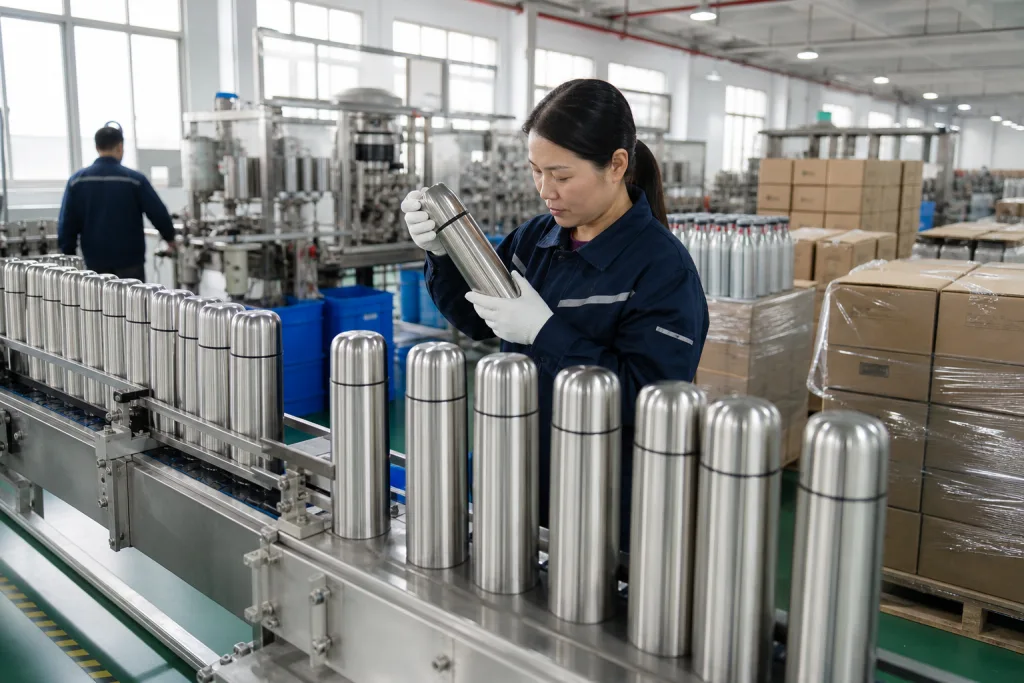
QC for custom thermos production has to start before the goods are sealed in master cartons and stacked on pallets. Our normal line runs tube cutting, forming, welding, vacuuming, polishing, coating, decoration, assembly, leak testing, packing, and final inspection, with an IPQC point after welding and another after coating. Defects do not wait for final inspection. Last April, QC pulled the sample after powder coating and found 7 cups with tiny black dust trapped near the lower radius, 18 mm from the base, before any logo printing started.
Set AQL before production starts, and put it on the PO, not only in an email thread. A practical export standard is AQL 0 for critical defects, 2.5 for major defects, and 4.0 for minor defects. Critical defects include sharp edges over 0.2 mm burr height, unsafe material, contamination, or severe leakage. Major defects include failed vacuum insulation, lid not sealing after a 180-degree inversion test, wrong logo, wrong color, exposed rust, or carton barcode mismatch. Minor defects include small coating dust, slight print position shift within tolerance, or tiny surface marks outside the main display area. We once had a UK buyer flag “matte sage” on the artwork while the PO said “sage green”; that one-word mismatch stopped the line for 6 hours.
For a 3,500-unit combined order, a final random inspection under ISO 2859-1 might check around 200 units, depending on inspection level. Do not make this only a beauty check. The inspector should run leak testing, capacity check by scale or measuring cylinder, barcode scan with a handheld scanner, carton drop review, coating cross-hatch adhesion on sample units, logo rub test using alcohol and a white cotton cloth, and vacuum temperature test on selected units. For retail cartons, confirm FNSKU, EAN, or retailer SKU placement if the goods may move through marketplace or 3PL warehouses. We usually ask the inspector to record water temperature at 0 hours and 6 hours; if the spec sheet promises 6-hour heat retention, “feels warm” is not a test.
Carton strength is boring until it costs you money. For sea freight from China to the UK, I prefer 5-ply export cartons for stainless thermos, with gross weight kept under 15 kg where possible. If each carton holds 24 units, use dividers or individual boxes so the bottles do not grind against each other during the 30 to 38 days on the water. The math does not work if you save RMB 1.20 per carton and then get 86 scuffed units at the UK warehouse. Mark cartons with item number, color, quantity, gross weight, net weight, carton dimensions, and country of origin, and check the first 20 cartons against the shipping mark file before pallet wrapping.
A serious thermos manufacturer will welcome a written QC checklist. It protects the factory too because arguments become measurable instead of emotional. We run better when the checklist says “logo center tolerance ±1.5 mm” instead of “logo must look nice.” Simple stuff, but it saves claims.
Ship, receive, and reorder smarter
After final inspection passes, paperwork becomes the next place orders get stuck. For a UK-bound bulk thermos shipment, we check the commercial invoice, packing list, bill of lading, certificate of origin if required, plus the food contact test reports your retailer or distributor asks for, such as LFGB or FDA files. The product name must match across every sheet: stainless steel vacuum flask, capacity, item code, and quantity. Simple rule. Do not let one document say “mug” while another says “thermos bottle” if your customs broker already classified the product. We have seen a PO typo like “500ml tumbler” on a 750ml flask hold clearance for 3 working days.
Sea freight from Ningbo or Shanghai to a UK port is commonly 30–38 days port to port, but door delivery, customs clearance, and warehouse booking can add 7–14 days. Air freight works for urgent promotional thermos launches, but the math often does not work once freight eats the product margin. If the event date is fixed, lock artwork and deposit at least 70 days before the required UK delivery date. On the line, we need time for logo film, spray colour approval, carton drop test, and final AQL 2.5 inspection before the container gate-in cut-off.
When the goods arrive, inspect a receiving sample before releasing stock to stores or clients. Pull cartons from the top layer, the middle stack, and the bottom near the pallet boards, because damage does not spread evenly. Check coating rub, wet cartons, crushed gift boxes, and barcode readability with an actual scanner, not just by eye. Keep photos. QC pulled the sample for a UK buyer last winter and found 11 gift boxes with corner crush on one pallet, while the bottles inside were fine. If there is a claim, a China supplier thermos team moves faster when you send carton marks, defect rate, and clear images instead of “quality issue” in one email.
The reorder is where margin improves. Keep the same body and lid, then adjust colour mix based on sell-through. If black sold 60% and olive sold 25%, do not reorder equal quantities because the original purchase order looked tidy. This is the wrong question to ask. The better question is which colour, capacity, and lid set turned stock fastest by channel. For a steady distributors thermos program, place forecast orders quarterly and keep artwork, packaging dielines, and QC records under one revision number. We ship cleaner reorders when the buyer sends “Rev B, 500ml, black 3,000 pcs, olive 1,200 pcs” instead of attaching four old PDFs from last season.
Send your UK thermos brief for factory review
Share capacity, quantity, logo, packaging, and delivery date. We will return a practical FOB quote and QC-ready specification.
Frequently asked questions
What MOQ should I expect for a custom thermos flask UK order?
For stainless vacuum flasks from China, a realistic MOQ is usually 1,000 units per color for powder-coated stock shapes with your logo. Some thermos suppliers will accept 500 units, but the unit price often rises by USD 0.40–1.20 because coating, setup, and packing labor are spread over fewer pieces. For fully custom moulds or private lid tooling, expect 3,000–5,000 units per model plus tooling cost. If you are testing the UK market, choose an existing BottleForge body, use one or two colors, and spend the savings on better packaging and inspection.
How long does a custom thermos order take from artwork to delivery?
For a normal custom thermos order, allow 7–12 days for logo or pre-production samples, 35–50 days for mass production after sample approval and deposit, and 30–38 days for sea freight from Ningbo or Shanghai to the UK port. Customs clearance and final delivery can add another 7–14 days. A safe planning window is 75–100 days from artwork approval to UK warehouse receipt. Air freight can shorten transit to about 5–9 days, but it often damages the margin on thermos bulk orders.
Which logo method is best for outdoor retail stainless thermos flasks?
For outdoor retail, laser engraving is usually the safest choice because it does not peel and handles abrasion better than standard printing. It works especially well on matte black, navy, green, and other darker powder coatings. Silkscreen is cheaper, often USD 0.08–0.18 per print position, and works well for promotional thermos orders with simple one-color logos. For complex artwork or large wrap designs, heat transfer may be better, but you should test adhesion and scratch resistance before approval. The best method depends on surface texture, logo size, and retail claim.
What compliance documents should UK buyers request?
At minimum, ask for food contact test reports for stainless steel, plastic lid components, and silicone gaskets. For UK and EU-facing programs, many buyers request LFGB, REACH-related material declarations, BPA-free confirmation, and sometimes retailer-specific migration test formats. If the product is for children, ask additional questions around small parts, strap safety, and age grading. Also request BSCI or social audit information if your retailer requires it. Documents should match the actual materials used in production, not a similar bottle made three years ago by another thermos manufacturer.
How do I compare quotes from different thermos manufacturers fairly?
Send every thermos supplier the same specification sheet and require the quote to separate bottle cost, logo cost, packaging, testing, spare parts, carton details, and Incoterm. A USD 3.80 quote may not be cheaper than a USD 4.40 quote if it uses thinner steel, weak cartons, no inspection support, or lower-grade coating. Ask for steel grade, wall thickness, unit weight, carton size, and vacuum test method. Also compare lead time and payment terms. For UK buyers, FOB China pricing is often easier to compare than mixed DDP offers.