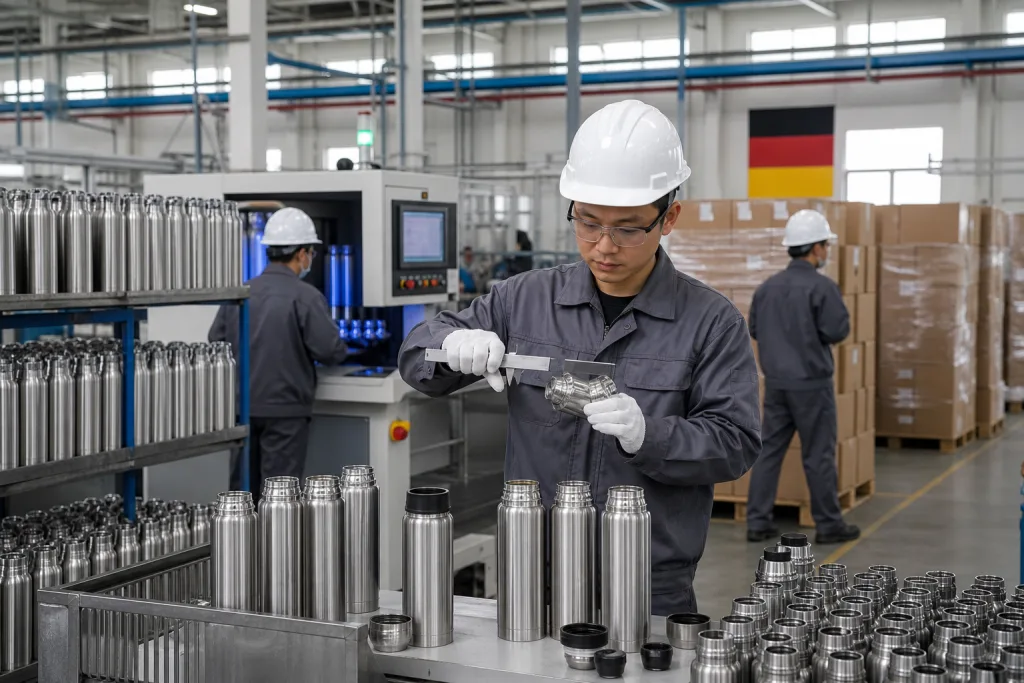
Key Takeaways
- A realistic MOQ for custom stainless thermos production is 1,000 pcs per color, with lower logo-only runs possible from 500 pcs
- For Germany, ask for LFGB food-contact testing, REACH packaging checks, and AQL inspection before balance payment
- A 500 ml double-wall 304 stainless custom thermos usually lands around USD 3.20-5.80 FOB China depending on cap, coating, and packaging
- Plan 35-45 days production after sample approval, plus 30-38 days ocean transit to Hamburg or Bremerhaven
A German outdoor retailer or promo brand often sends the same short RFQ: custom thermos flask Germany market, no returns, no smell complaints, no leaking caps, no late delivery. Fair request. But “500 ml stainless bottle with logo” is not a spec. On our line, that phrase can mean 0.4 mm or 0.5 mm wall thickness, 201 or 304 stainless, powder coating or spray paint, and a lid gasket that passes or fails after a 24-hour upside-down leak test.
Let’s use one buyer case from RFQ to shipment. You need a 500 ml vacuum insulated stainless thermos for an outdoor campaign in Germany, retail-ready packing, logo, barcode, and EU documents. BottleForge is in Hangzhou, Zhejiang, China, and our thermos factory plans around 450,000 stainless units/month. We run this daily, not from a catalog page. Last month QC pulled 32 samples from a 3,000 pcs order because the buyer flagged a 1 mm logo shift on the pre-production sample; that is the kind of detail that decides whether shipment leaves in 12 days or slips to 18 days.
Start with the German sales case
Your first decision is not the logo. It is the sales channel and the use case. A custom thermos flask Germany order for an outdoor retailer has different pressure points from a promotional thermos for an insurance company or brewery gift pack. Retail buyers check shelf packaging, margin, EAN barcode accuracy, 5-layer export carton strength, repeat availability, and after-sales risk. Promotional brands push harder on delivery date, visible branding, gift-box appearance, and keeping the unit price inside a campaign budget. We have seen a buyer flag a 1 mm barcode quiet-zone issue during pre-shipment QC, so this is not paperwork decoration.
For this walkthrough, we will specify a 500 ml stainless vacuum flask for a German outdoor retailer’s autumn season. Target retail price is EUR 19.95-24.95. The buyer wants matte black and forest green, laser logo on the body, a leakproof screw cap, and individual kraft box packaging. Expected order is 3,000 pcs, split into two colors. That quantity is enough for stable custom thermos production without pushing the unit price into sample-shop territory. On our line, 3,000 pcs lets us run proper fixture setup for laser marking instead of treating the job like 80 showroom samples.
At RFQ stage, send your thermos supplier these details in one sheet: capacity, body diameter, height limit, lid type, finish, logo method, packaging, certification need, destination port, and required delivery date. Do not ask only for “best price for customized thermos.” That is the wrong question to ask. You will get quotes that look comparable but are not. One factory thermos quote may use 201 stainless steel on the outer wall, another may use thinner 0.35 mm sheet, and another may exclude inner cartons or testing. We once received a PO with “mat back” instead of “matte black”; QC pulled the sample before bulk printing because the artwork file and PO did not match.
For Germany, we normally suggest a 500 ml body around 68-72 mm diameter and 245-265 mm height. That size fits most backpack side pockets and fits car cup holders less reliably than a travel tumbler, but it feels right for outdoor use. If the product must fit cup holders, say it early. A manufacturer thermos team can adjust mold choice before sampling, but after tool selection and artwork approval, changing diameter may restart the process. The math does not work if you approve a 72 mm body, then ask for 66 mm after the powder coating sample is signed off.
Translate the idea into specs
A useful specification protects your buyer margin and our thermos factory from rework. For a German retail stainless thermos, we would write it like this: inner wall 304 stainless steel, outer wall 201 if the price target is tight or 304 for a cleaner retail pitch, double-wall vacuum insulation, optional copper plating, food-contact silicone seal, PP cap components, matte powder coating, laser-engraved logo, 500 ml nominal capacity, leakproof at room temperature, individual kraft box. Put it on the PO. Last year a buyer missed “matte” on one line, and the first pre-production sample came out glossy.
The inner wall matters most because it touches the drink. For Germany and wider EU distribution, 304 stainless steel is the normal choice. Some buyers ask for 316 stainless steel, but for a standard bulk thermos used for coffee, tea, or water, 304 makes better commercial sense. 316 can add USD 0.25-0.60 per unit depending on thickness and market price, and most consumers will not pay extra unless the brand story gives them a clear reason. We run PMI spot checks with a handheld alloy analyzer when QC pulls the sample, because a stamped “304” on the base is not proof.
Wall thickness is where cheap quotations hide. A common range is 0.4-0.5 mm for inner and outer stainless sheets before forming. Go too thin, and the body dents during carton drop tests or when retail staff handle open stock. Go too thick, and the thermos bulk order becomes heavier, freight costs rise, and the shelf price starts to look wrong. The math does not work. Vacuum performance also depends on welding quality, vacuum pumping time, and sealing. On the line, we check the mouth weld and base weld before vacuum pumping, because one pinhole can turn a 12-hour claim into a return complaint.
For insulation claims, be careful. Product pages often promise “keeps hot 12 hours, cold 24 hours.” That can be true under laboratory conditions using 95°C water, a full bottle, and room temperature around 20°C. For a customized thermos sold in Germany, we prefer writing the test method into the spec: fill with 95°C water, close cap, ambient 20°C ± 2°C, measure after 6 hours and 12 hours. A strong 500 ml model should still show around 65°C or higher after 6 hours, depending on mouth diameter and cap design. We use a calibrated probe thermometer, not a finger test, and we record the first sample result before approving mass production.
Logo method also affects quality. Laser engraving is durable and works well for outdoor retail. Silk screen is cheaper for large, flat artwork, but it scratches if the coating is weak. For a premium thermos custom project, laser on powder coating gives a clean metal contrast and avoids ink migration questions. If your brand color must be exact, send Pantone codes and accept a tolerance because powder coating on curved stainless steel will not match paper print. We have seen this go sideways when a buyer compared the bottle to a brochure under office LED light and flagged the shade as wrong.
Price the order without guessing
For the 3,000 pcs order in this scenario, a workable FOB China price range for a 500 ml custom thermos is about USD 3.20-5.80 per unit. At USD 3.20, we are normally talking about an existing mold, 304 inner and 201 outer, a basic screw lid, one-color powder coating, and a plain kraft box packed 24 pcs per export carton. The USD 5.80 side is a different build: 304 inner and outer, copper lining, a cap with more parts, retail packaging with a color sleeve, and test cost included. If a thermos vendor quotes USD 2.60 on the same sheet, ask what changed. QC pulled samples like this before and found the outer wall switched from 201 to a thinner 0.4 mm sheet.
MOQ depends on what you customize. Logo-only on an existing bottle can start from 500 pcs, especially laser engraving. Custom color usually starts at 1,000 pcs per color because powder coating setup and color changeover create waste; our line can lose 35-60 pcs during cleaning, gun adjustment, and first-run color matching. A new cap mold or body tooling can move MOQ to 5,000-10,000 pcs, plus tooling charges from USD 1,500 to more than USD 8,000. For most German outdoor retailers testing a new line, existing mold plus custom color and logo is the practical route. Asking for a new shape on a 1,200 pcs trial order is the wrong question to ask; the math doesn't work.
You should ask for a quotation table instead of one blended number. Split the bottle cost from logo cost, packaging, testing, inland freight, and export carton so both sides can see where the money goes. This makes negotiation cleaner. If your promotional thermos budget is fixed at EUR 6 landed cost, the supplier thermos team can change the box from 350 gsm color box to white box, or swap a push-button cap for a screw cap. If your target is a retail product with a EUR 24.95 shelf price, saving USD 0.18 by using a weaker carton is not smart. We have seen this go sideways when the buyer flagged crushed corners after a 14 kg drop-test carton came out soft.
Payment terms for a first order from China are often 30% deposit and 70% before shipment after inspection. For established buyers, we may discuss 30/70 against bill of lading copy, but not before both sides know each other. FOB Ningbo or FOB Shanghai are common for Zhejiang factories. Hangzhou is close enough to both ports for steady trucking; we ship to Ningbo in about 3.5 hours when the driver leaves before 7 a.m. This is one reason stainless drinkware factories cluster in Zhejiang, China. One small detail: if the PO says FOB Shenzhen by mistake, we fix it before deposit, not after cartons are sealed.
Do not compare prices until the specification, packaging, inspection level, and Incoterm are the same. Otherwise you are comparing risk, not bottles.
Build the sample approval trail
Sampling is not a photo exercise. It is the first quality gate. For this custom thermos flask Germany project, we first send a stock sample from the shelf to confirm hand feel, cap action, capacity, and body shape. That sample can usually ship in 3-5 working days. After you approve the base model, we run a pre-production sample with the correct coating, logo size, packaging layout, and barcode position. That normally takes 7-12 working days after artwork confirmation. On the line, QC checks the lid torque by hand and with a simple torque meter; if the cap feels gritty at sample stage, the mass order will not get better by itself.
Your sample approval file should include front, back, top, bottom, packaging, carton mark, and any insert sheet. German distributors often need EAN codes, SKU codes, and sometimes retailer-specific labels. If you sell through online channels, you may need FNSKU labels on the unit or outer carton. Tell your thermos manufacturer before mass production. Relabeling 3,000 boxes after packing is slow, annoying, and avoidable. We have seen a buyer flag one wrong digit in an EAN on the PO after cartons were sealed; that single typo cost 2 extra days in the packing area.
Check the sample like a buyer, not like a fan of your own logo. Fill it with water and leave it upside down for 2 hours. Open and close the lid 50 times. Put coffee inside for 4 hours, then wash and smell the seal. Measure filled weight and actual capacity with a kitchen scale and a 500 ml measuring cup. Look at the laser engraving under side light; weak engraving may look fine in a phone photo but poor on shelf. If the coating is matte black, rub it with a dry white cloth and then with a damp cloth. This is where we’ve seen orders go sideways: the logo looks acceptable in a WeChat photo, then the buyer sees patchy engraving under store lighting. You are not doing a full lab test, but you will catch obvious trouble.
For color approval, one physical sample beats ten screen images. Powder coating batches can vary slightly, so agree a master sample and tolerance. If you need exact corporate color matching for a promotional thermos, tell the factory before coating. Some Pantone colors need multiple trials and may add 3-5 days. A practical suppliers thermos team will say this early instead of promising perfect color overnight. In our coating room, we keep the approved master sample in a clear bag with the item code and date; without that reference, the math does not work when a repeat order comes back 6 months later.
Lock compliance before production
For Germany, compliance is not decoration. It decides whether the shipment clears or sits. At minimum, ask for food-contact documentation for the stainless steel body, silicone gasket, PP lid, straw, and any plastic insert that touches drinks. LFGB testing is usually requested for the German market. EU Regulation 1935/2004, German LFGB requirements, and migration testing should be locked before production, not after the cartons are packed. If the bottle has painted coating, printed packaging, straps, or colored plastic, REACH-related screening should be checked too; we have had QC pull a sample because a red silicone ring on the approved drawing became black on the line.
Do not accept a random old test report without checking model, material, color, and date. Check the report against the BOM, the cap drawing, and the actual sample on your desk. A report for a different cap material does not automatically cover your cap. A report for uncoated stainless steel does not prove the coating is safe. For a 3,000 pcs order, full new testing may cost several hundred to over USD 1,000 depending on lab scope, but the math does not work if German customs blocks 80 cartons over one missing migration report.
Packaging needs its own review. If you claim recyclable packaging, avoid mixed laminations and unnecessary plastic windows. A 350 gsm kraft box with one-color print is easier to defend than a glossy box with PET window and foam insert. If you sell in Germany, your importer may have obligations under German packaging law. Your China thermos supplier can print the Green Dot or recycling marks only if you authorize the artwork and understand your registration obligations. A factory should not invent compliance marks for you; we have seen buyers flag this at pre-shipment inspection over a 6 mm recycling icon on the side panel.
Social compliance can matter too. Larger outdoor retailers may request BSCI, Sedex, ISO 9001, or factory audit documents. Not every good thermos factory has every certificate, and not every certified factory produces good bottles. Still, if your customer asks for BSCI, raise it at RFQ stage. Ask before tooling. A distributor thermos order can lose 2 to 4 weeks if compliance files are requested only after production starts, especially when the audit date must match the factory name shown on the PO.
BottleForge keeps standard material declarations and inspection records by order lot. For EU programs, we suggest confirming the testing scope at purchase order stage, then keeping the approved sample, material list, and final inspection report together. We run this as one file per order number, down to gasket color and inner wall grade, because a retailer may ask questions six months later. That paper trail protects you.
Inspect what mass production changed
Mass production is where one sample approval turns into 3,000 physical units, and this is where weak specs get expensive. A serious thermos manufacturers QC plan should cover incoming 304 stainless thickness checks with a micrometer, vacuum performance sampling, coating adhesion checks, leak tests, logo inspection, packing checks, and final AQL inspection. For export orders, AQL 2.5 for major defects and 4.0 for minor defects is common, though stricter levels can be agreed for premium retail.
Typical major defects include leaking caps, failed vacuum insulation, sharp edges, wrong material, wrong logo, serious dents, dirty inner walls, and incorrect barcode. Minor defects may include tiny coating specks, slight carton scuffs, or small position variation within tolerance. Define these before inspection. We once had QC pull 80 pcs because the logo sat 3 mm lower than the signed sample; the buyer was right to flag it because the tolerance was written on the approval sheet. If you wait until the final day to decide what counts as acceptable, you create an argument, not quality.
For the German outdoor scenario, we would test vacuum performance during production and again before shipment. On the line, we run a simple check: fill sample units with hot water, lock the cap, then record the temperature drop after a fixed period with a probe thermometer. Leak testing should include both upright and inverted positions. Caps with silicone seals need extra attention because one poorly seated gasket can create a return even if the stainless body is perfect.
Cartons are not glamorous. They matter. A 500 ml stainless thermos in individual box may pack 24 pcs per master carton. Gross weight could be around 11-14 kg depending on bottle and packaging. For ocean shipment to Germany, use 5-ply export cartons if the retail box must arrive clean; we usually check burst strength, edge crush, and actual carton size against the packing list before booking. Drop risk is real. Humidity risk is real. If the order goes into Amazon or a distributor warehouse, carton dimensions, weight, and labels must match booking and receiving requirements.
Many thermos distributors ask whether they need a third-party inspection. For first orders, yes. A third-party inspection in China often costs USD 250-350 per man-day, and it gives you independent photos, measurements, and defect counts before you pay the balance. If your supplier thermos factory already has strong internal QC, third-party inspection should not offend them; we ship cleaner when someone checks the goods with calipers, a scale, a barcode scanner, and the signed PP sample on the table. Skipping it on a first order is the wrong place to save money.
Ship with realistic timing
After sample approval and deposit, we normally run 3,000 pcs in 35-45 days, if the coating and gift box are standard. A powder-coated flask with one-color logo is different from a soft-touch finish with printed insert cards; the line has to change jig settings and drying time. Peak season for stainless drinkware stretches the schedule before European summer promotions and Q4 gift programs. Real talk: if you need delivery in Germany by 15 September, placing the purchase order in late July and hoping ocean freight will rescue it is the wrong plan. QC still needs time to pull the sample, check vacuum performance, and measure logo position with a 0.5 mm tolerance gauge.
From Zhejiang, China, goods usually truck to Ningbo or Shanghai; our Hangzhou pickups normally leave on a 17.5 m trailer after carton weighing. Ocean freight to Hamburg or Bremerhaven often takes about 30-38 days port to port, then booking, customs clearance, and inland delivery add more days. Rail can be faster in some periods, but the schedule moves. Air freight is possible for urgent promotional thermos orders, but stainless bottles are bulky; one 500 ml flask in a gift box eats carton volume fast, and the freight cost can wipe out the product margin. For 3,000 pcs, plan ocean unless the campaign date is worth the extra cost.
Shipping marks should be boring and accurate: item number, color, quantity, gross weight, net weight, carton size, made in China, and any customer routing data. We have seen this go sideways from one small PO typo, like “mat black” on the order and “matt black” on the carton mark. If your distributor thermos customer requires pallet labels or SSCC labels, send the format before packing, not after cartons are sealed with 48 mm tape. German warehouses move fast when the data is right. They charge back fast when it is wrong.
Before shipment, match the commercial invoice, packing list, HS code, carton count, and product description. QC pulled a shipment once because the packing list showed 150 cartons while the warehouse scan found 152; that is a simple fix in Hangzhou and a headache at Hamburg. Stainless vacuum flasks are commonly classified under vacuum vessel-related codes, but your importer or customs broker should confirm the final HS code for Germany. The factory can provide product description, material, wall construction, capacity, and usage details; your importer remains responsible for customs declaration.
A good custom thermos program is repeatable. After the first shipment, keep the approved sample, coating code, logo file, carton specification, test reports, and QC checklist. Put the master sample in a labeled bag, not loose on a shelf; we write the order number and coating code on the tag before it goes into the sample room. Your second order should not restart from zero. That is where working with a stable thermos supplier in Zhejiang pays off: we reuse the same production notes and add new colors or gift packaging without rebuilding the supply chain.
Send your German thermos brief for a firm quote
Share capacity, quantity, logo method, packaging, and delivery date. We will return practical FOB pricing, MOQ, lead time, and compliance notes.
Frequently asked questions
What MOQ should I expect for a custom thermos flask Germany order?
For an existing stainless thermos shape, logo-only MOQ is usually 500 pcs, especially with laser engraving. If you need custom powder coating, plan on 1,000 pcs per color because coating setup, hanging space, and color changeover create waste. For a new cap, new body mold, or special structure, MOQ can move to 5,000-10,000 pcs. For German outdoor retail, 3,000 pcs split into two colors is a sensible first production run. It gives enough volume for stable pricing while limiting inventory risk.
Which material is best for a stainless thermos sold in Germany?
Use 304 stainless steel for the inner wall as the default. It is the standard choice for coffee, tea, and water contact in most quality custom thermos programs. The outer wall can be 201 or 304 stainless depending on budget and positioning. 304 outer improves the material story but may add USD 0.15-0.35 per unit. Silicone seals and PP cap parts should be food-contact grade. If your retailer asks for premium corrosion resistance, 316 stainless is possible, but it is rarely necessary for a normal 500 ml outdoor flask.
How long does production and delivery to Germany take?
For a normal customized thermos order using an existing mold, allow 7-12 working days for pre-production samples after artwork approval, then 35-45 days for mass production after deposit and sample sign-off. Ocean freight from Ningbo or Shanghai to Hamburg or Bremerhaven is often 30-38 days port to port, not including booking, customs, and inland trucking. A safe timeline from RFQ to German warehouse is 80-100 days for a first order. Repeat orders can be faster because artwork, packaging, and QC standards are already fixed.
What tests and documents should German buyers request?
For Germany, ask about LFGB food-contact testing for stainless steel, silicone, and plastic parts. EU food-contact requirements under Regulation 1935/2004 should be considered, and REACH screening may apply to coatings, colored plastics, straps, or packaging inks. You should also request material declarations, product specification sheet, final AQL inspection report, and packing list. If selling to larger outdoor retailers, ask early about BSCI, Sedex, or ISO 9001 documents. Do not rely on a test report for a different lid, coating, or older model without checking its scope.
Is laser engraving better than silk screen for a promotional thermos?
For outdoor and long-life use, laser engraving is usually the safer option. It removes the surface coating and exposes the metal underneath, so there is no ink layer to scratch or fail adhesion testing. It works best on powder-coated stainless bodies and is practical from 500 pcs upward. Silk screen is useful for larger colored logos, but it needs curved-surface printing control and coating compatibility. For a high-volume promotional thermos with a short campaign life, silk screen can save cost. For German retail, laser normally feels more durable and premium.