Key Takeaways
- A realistic custom stainless thermos MOQ starts at 1,000 pcs per color for most 500 ml and 750 ml models
- FOB China pricing usually changes more from lid structure and coating than from bottle height
- For Germany, ask for LFGB food-contact support, REACH coating documents, and AQL inspection before shipment
- Standard lead time is 35-45 days after deposit and artwork approval for a customized thermos order
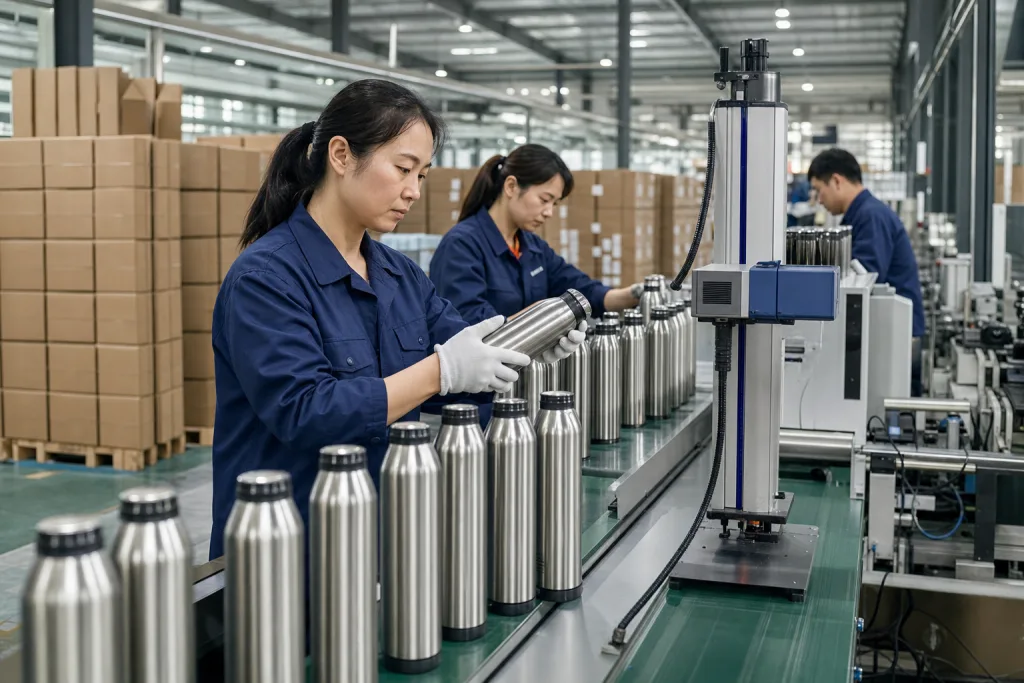
If you search for custom thermos flask deutschland, you probably do not want a glossy catalog first. You want straight answers on whether a China supplier can ship stainless bottles that German buyers will accept: clean laser marking, stable insulation after a 6-hour heat test, LFGB-ready contact materials, and export cartons that reach Hamburg without dented lids. We check lid fit with a 0.20 mm feeler gauge on the line. Small detail, big problem if missed.
At our Zhejiang factory, we speak with outdoor retailers, promo buyers, and thermos distributors who are testing samples from 3 or 4 suppliers at the same time. Their questions are practical: MOQ, logo wear after 30 dishwasher cycles, 304 versus 316 stainless steel, FOB Ningbo price, and whether the order ships in 28 days or slips to 40 days before leaving China. The buyer usually flags the same issue first: “Will this pass our German retail QC?” That is the right question. Cheap sample pricing alone is where we have seen projects go sideways.
What German buyers usually ask first
Most Germany-facing buyers open with the same question: can you make a stainless custom thermos that looks ready for retail and still takes outdoor abuse? Fair question. The better answer starts with the bottle body, not the word “customizable.” For a solid manufacturer thermos project, we usually run double-wall vacuum 18/8 stainless steel, 0.4 mm to 0.5 mm inner wall thickness, and a powder-coated or spray-painted outer surface. On the line, QC checks the body with a digital caliper before polishing; if the neck roundness is off by 0.3 mm, the lid fit will already feel cheap.
For outdoor retailers, I would not choose the thinnest factory thermos just to save USD 0.20. The math doesn't work. A 500 ml bottle that dents on the first warehouse drop costs more in returns than it saves in FOB price, and we have seen buyers flag this after a simple 1.2 m carton drop test. Promotional brands have a different call to make. If the product is for a 2-week campaign, you can accept a lighter wall and put more attention on logo position, carton labeling, and delivery date; last month one PO even had the Pantone code typed wrong, and that delayed artwork approval by 2 days.
Before asking thermos manufacturers for a final quote, ask these questions first:
- Capacity: 350 ml, 500 ml, 750 ml, and 1,000 ml are the easiest sizes to source in thermos bulk; for 500 ml, we usually have existing molds, so sampling is faster.
- Material: 304 stainless steel is standard; 316 is possible but increases cost by about 8-15%, so use it only when the buyer has a clear reason.
- Insulation: a normal 500 ml vacuum flask should hold hot water above 60°C after 6 hours in a 20°C room; we test this with a probe thermometer after vacuum inspection.
- Lid: screw cap is safer for leakage; push-button lids need tighter QC, including a 100% water leak check before packing.
- Compliance: Germany buyers should ask about LFGB, REACH, and migration test history; ask for the report date, not just a certificate photo.
A serious thermos supplier in Zhejiang should answer these points without hiding behind “we can do everything.” Nobody can do everything well at every price. If a supplier quotes a low price, short lead time, and full custom packaging in one breath, ask which part they are cutting; QC pulled enough samples for us to know where this goes sideways.
MOQ, price, and lead time reality
For a custom thermos flask deutschland order, MOQ is the first gate. At BottleForge Industrial in Hangzhou, Zhejiang, we run 1,000 pcs per color for standard stainless thermos models, and 3,000-5,000 pcs if you want a private mold lid, special shape, or non-standard Pantone coating. Monthly capacity is about 600,000 stainless drinkware units across thermos, travel tumbler, and sports bottle lines. On the coating line, one color change takes about 45 minutes and wastes 6-8 kg of powder, so splitting 1,000 pcs into 5 colors makes the math ugly.
FOB Ningbo pricing for a 500 ml customized thermos usually lands around USD 3.20-6.80 based on wall gauge, coating, lid type, packaging, and certification work. A basic single-color logo with white box is not the same product as a retail gift set with color box, instruction sheet, barcode sticker, and drop-test carton. We quote both on the same sheet sometimes; the buyer sees “500 ml thermos” twice and asks why one line is USD 1.40 higher. Look at the details: 0.4 mm body steel versus 0.5 mm, PP lid versus push-button lid, 1.2 m carton drop-test requirement versus no test.
Lead time is not one number. A clean repeat order may ship in 30-35 days after deposit. A new thermos custom project with color matching, pre-production sample, carton artwork, and inspection booking usually takes 40-50 days. Add 5-10 days if your team changes logo files after sample approval. QC pulled the sample last month because the buyer approved Pantone 2965C, then the PO showed 2955C; that one digit cost 3 days before mass production could start.
Checklist before you request a final quotation: confirm capacity in ml, color count by SKU, logo process with artwork size, packaging type with carton marks, delivery term, test requirements, and annual forecast. Without these, any supplier thermos quote is only a guess. Send the EAN code early too; a barcode typo on a PO is small on paper and painful when 80 cartons are already packed.
If a thermos vendor offers a much lower price, ask what has been removed. This is the wrong question to ask: “Can you match USD 2.95?” Ask for the steel thickness, vacuum test rate, lid plastic grade, AQL inspection plan, and carton spec. It may be thinner steel, weaker vacuum rate control, cheaper plastic in the lid, no AQL inspection, or cartons that fail long-distance shipping. Cheap is not automatically bad, but hidden cheap is dangerous; we have seen this go sideways when a container reached Hamburg with crushed export cartons and leaking lids.
Which logo process should you choose
For promotional thermos orders, the logo job often decides whether the buyer signs off. A buyer may accept a 2 mm difference in bottle height, but not a tilted brand mark across 5,000 pieces. We check this with a height gauge and a simple paper position jig before the line starts. Common choices are silkscreen printing, laser engraving, heat-transfer printing, UV printing, and full-wrap sublimation on selected coated surfaces.
Silkscreen is the sensible choice for one- or two-color logos on powder-coated bottles. It is cheap to run. It is fast too, as long as the ink mix, mesh, and curing tunnel temperature are under control. For 1,000 pcs, setup cost is usually modest, and unit logo cost may be around USD 0.08-0.20 depending on size and color count. On our line, QC pulled the sample after 30 minutes curing when one white logo still marked the glove.
Laser engraving gives the most durable result because it cuts through the coating and exposes stainless steel. It works well for outdoor retail, corporate gifts, and distributor thermos programs where the bottle will sit in a car, backpack, or office for several years. The weak point is color. Engraving is not full-color branding. If your brand guideline requires exact red, blue, or gradient artwork, laser is the wrong process to ask for; the math does not work. We usually confirm the engraving depth on a test piece before bulk, because a 304 stainless body with thick powder coating reacts differently from a thin coated promo bottle.
Heat transfer and UV printing handle richer artwork, but adhesion must be tested before the PO is locked. We normally suggest a tape test, cross-hatch test, and dishwasher simulation if the product will be sold as premium. For Germany, avoid promising “dishwasher safe” unless the coating, print, and lid have been tested together. We have seen this go sideways: one buyer approved the cup, then flagged lid fading after 12 dishwasher cycles because the test only covered the body.
Logo file checklist
- Vector artwork in AI, PDF, or EPS format
- Pantone code for body and logo colors
- Logo size in mm, not only “make it bigger”
- Position reference from bottle bottom or center line
- Approval of digital mockup before sample production
A good thermos manufacturer will ask for these details before sampling. It is not paperwork for fun; it prevents arguments after the cartons are sealed. We once had a PO typo showing 45 mm logo height while the approved mockup showed 54 mm, and the buyer flagged it only after packing photos.
Compliance for Germany is not optional
If you sell a customized thermos in Germany, do not leave compliance as a last-minute PDF hunt. Food-contact stainless steel, any inner coating, silicone seals, plastic lids, external paint, and logo inks can all trigger document requests from importers, retailers, or customs brokers. We usually ask the buyer to write “Germany / EU food contact” on the PO, not just “Europe,” because our document set changes. Small wording matters.
For stainless vacuum flasks, German and EU buyers often ask for LFGB food-contact test reports, EU 1935/2004 declarations, REACH information for coatings, and PAHs testing for rubberized parts. On a 500 ml powder-coated bottle last quarter, QC pulled the sample after the lid gasket smelled like rubber at 60°C water fill. Kids or family outdoor ranges get closer checks. If the bottle is positioned for children, discuss ASTM, CPSIA, or EN-related expectations based on the destination and product design.
Factory audits also matter. BSCI, ISO 9001, and Sedex do not prove the flask will pass leak testing, but they help larger retailers approve a thermos factory faster. We have seen a German promo client request a social audit for only 2,000 pcs, then push back when the available audit date was 19 days out. Ask early. During peak season, arranging a new audit while the line is running Christmas orders can take 3 to 4 weeks.
Quality inspection should be written into the purchase order. AQL 2.5 for major defects and AQL 4.0 for minor defects is common for drinkware, though some retailers set tighter limits. Inspection points should include vacuum performance, leakage, coating scratches, logo registration, lid fit, odor, barcode scan, carton drop condition, and quantity per carton. On our line, we run 95°C hot-water checks, 30-minute inverted leak tests, and random barcode scans with a handheld Zebra scanner before cartons are sealed.
The most common mistake I see from new thermos distributors is accepting an old test report for a different lid or coating. This is the wrong corner to cut. A 304 stainless body with a PP lid is not the same compliance file as the same body with a rubberized carry loop and soft-touch coating. The old report can support a first review, but it does not replace testing your final production specification. If the order matters, test the exact model, material, and decoration you will ship.
How to compare factory samples
Samples can fool you. We have seen 3 suppliers send showroom pieces polished by the senior bench team, then bulk goods came off the line with uneven coating and loose lids. This is the wrong question to ask: “Does the sample look premium?” Ask whether the factory can repeat it for 3,000 or 30,000 pcs. When you receive samples from several thermos manufacturers, check them like QC with a caliper, scale, and test sheet, not like a buyer opening a gift box.
Start with weight. Two 500 ml bottles that look identical can differ by 30-50 g because of wall thickness, lid material, or base structure. Heavier does not always mean better, but a 500 ml bottle landing at 235 g when the agreed sample was 285 g needs checking. Then check the mouth thread. Screw and unscrew the lid 20 times. If it feels gritty on the sample, it will not become smooth in bulk thermos production; last month QC pulled a sample where the thread burr measured 0.3 mm and the buyer flagged the noise on video.
Run a simple leakage test: fill with hot water, tighten the lid, place upside down for 30 minutes, then shake horizontally. It is not a laboratory test, but it catches weak lid designs before we ship cartons to Hamburg or Duisburg. For insulation, fill with 95°C water, measure after 6 hours, and keep room temperature stable, for example 22°C in the sample room. Ask the supplier for their own testing standard and compare results; if their sheet says “pass” with no starting temperature, no room temperature, and no bottle size, the math doesn't work.
Sample review checklist
- Measure capacity to the practical fill line with a measuring jug, not just brimful volume
- Check inner welding line, odor, and metal particles with a flashlight before rinsing
- Inspect coating under strong light for pinholes, dust, and orange-peel texture
- Rub the printed logo with a wet cloth for 30 strokes and then lift it with tape
- Confirm carton, polybag, manual, and barcode plan against the PO, including any EAN typo
If you are buying thermos promotional products for a 2-day event, sample appearance can carry more weight. If you are buying for an outdoor retail shelf, 12 months of lid opening, backpack rubbing, and dishwasher complaints matter more than the first photo. Tell your supplier the sales channel. A good China manufacturer thermos partner will change the recommendation instead of pushing one “best seller” for every buyer; we have seen that go sideways when a glossy gift bottle was placed into a sports retail channel with a 1,200 pcs reorder plan.
Packaging and shipping details matter
Packaging is where custom thermos projects lose margin quietly. The bottle passes vacuum testing, then QC pulled the sample and found a scuffed color box, a barcode that would not scan on our Zebra scanner, or a master carton crushed after the sea freight stack test. For Germany-bound distributor thermos orders, we normally recommend at least 5-ply export cartons, clear shipping marks on two sides, and carton weight under 15 kg when possible.
If you sell online or supply retailers with warehouse rules, confirm labeling before artwork is locked. You may need EAN, FNSKU, country of origin, recycling marks, batch code, warning text, and importer details, all placed with enough quiet zone for scanning. Last month a buyer flagged a 2 mm barcode shift after mass printing; fixing that after packing would have meant opening 640 cartons. A thermos distributor serving several clients may also need mixed SKU carton plans. Easy on paper. Painful after production.
For packaging options, white box is the lowest-cost choice and works for B2B promotional thermos campaigns. Color box adds retail value, but it needs tighter artwork control, CMYK proof approval, and usually 7-10 extra days for proofing if the design is new. Gift box or kraft tube packaging looks premium, but the math doesn't work for every order because volume goes up and loading quantity drops. Sometimes a USD 0.45 box adds USD 0.20-0.35 per unit in ocean freight impact because fewer pieces fit per CBM.
For Incoterms, FOB Ningbo or FOB Shanghai is common from Zhejiang, China. EXW looks cheaper on a PI, but your forwarder must arrange local pickup, customs declaration coordination, and port delivery, and one wrong pickup date can leave finished cartons sitting in our warehouse for 6 days. For first orders, FOB is usually cleaner. If you need DDP Germany, treat tax and compliance responsibilities seriously; we have seen this go sideways when DDP was handled like a simple freight quote instead of a regulated import service.
Before shipment, request production photos, packing list draft, carton dimensions, gross weight, and inspection report. We usually measure cartons with a tape after packing, not from the design file, because a 10 mm carton difference changes pallet planning. These small documents help your warehouse plan receiving and reduce arguments when the container arrives.
Buyer checklist before placing deposit
A stainless thermos order is easier when the spec reads like a production sheet, not a mood board. Before you pay a deposit to a thermos supplier or thermos vendor, put the price terms and factory requirements into one purchase file. We run into trouble when a buyer sends only a logo PDF and says “same as last time”; QC pulled one sample last month with a 1.8 mm logo shift because the PO had no approved position drawing.
- Product: model number, capacity, height and diameter in mm, weight tolerance, stainless grade, lid material, silicone grade, and color chip or Pantone reference.
- Branding: logo process, AI or PDF artwork file, Pantone colors, logo size, position drawing, and signed sample approval record with date.
- Packaging: inner packing, color box artwork, carton size, barcode type such as EAN-13, pallet request if any, and shipping marks exactly as they must appear.
- Compliance: LFGB, REACH, EU food-contact declaration, audit needs, and whether the buyer needs a fresh test report for this exact model and color.
- Quality: AQL level, inspection agency, defect definitions, insulation requirement in hours, leakage test method, and acceptable appearance limits for scratches, dents, and dust spots.
- Commercial: MOQ, unit price, tooling or setup charges, payment terms, Incoterm, port, lead time, and what happens if artwork approval is 3 days late.
For most new customized thermos programs, a 30% deposit and 70% balance before shipment is normal in China. If tooling is required, mold cost is often paid separately before CNC cutting starts. Pre-production samples normally take 7-12 days after artwork confirmation; mass production starts only after written sample approval. Do not ask the factory to “start first and adjust later.” That is the wrong question to ask, because the line needs confirmed artwork, confirmed silicone color, and a sealed PP sample before we book polishing and laser marking slots.
A strong buyer-supplier relationship is not built on blind trust. It is built on clear specs, fast replies, and fewer guesses. If you want a custom thermos flask deutschland program that can repeat every season, build the file properly from the first order. We have seen this go sideways when a German buyer approved the bottle but forgot the carton barcode; shipment waited 2 days while the warehouse re-stickered 68 cartons. Your second and third orders will move faster, with cleaner inspection reports and better room to negotiate.
Send your thermos specification for a factory quote
Share capacity, logo artwork, MOQ target, Germany compliance needs, and delivery date. We will return a practical FOB China quotation.
Frequently asked questions
What is the normal MOQ for a custom stainless thermos for Germany?
For standard stainless models, a realistic MOQ is 1,000 pcs per color. If you use an existing 500 ml or 750 ml mold with one logo, this is usually workable. For a special Pantone coating, private lid, or custom body shape, expect 3,000-5,000 pcs. Some suppliers thermos companies may quote 500 pcs, but the unit price rises and color control can be weaker because the coating line is not efficient at that volume.
How long does a custom thermos order take from China to shipment?
For a new thermos custom order, plan 40-50 days from deposit and final artwork approval to FOB shipment. Pre-production samples usually take 7-12 days. Mass production takes about 30-38 days, depending on coating, logo method, and packaging. Repeat orders can be faster, often 30-35 days. Sea freight to Germany is separate and commonly adds 30-40 days port to port, depending on route and season.
Which stainless steel is best for a customized thermos?
304 stainless steel, also called 18/8, is the normal choice for a bulk thermos order. It is food-contact suitable when properly sourced and tested, and it keeps cost reasonable. 316 stainless steel offers better corrosion resistance, but it may add 8-15% to the bottle cost and is not necessary for most coffee, tea, or water use. Focus also on lid quality, silicone seals, and vacuum performance, not only steel grade.
Can you supply LFGB documents for German retail buyers?
Yes, but the document must match the actual product. For Germany, buyers often request LFGB food-contact testing, EU 1935/2004 declaration support, and REACH information for coatings or inks. If you change the lid, silicone ring, coating, or printing process, old reports may not fully apply. For serious retail orders, budget for testing the final production specification. This is cheaper than dealing with blocked shipments or retailer rejection later.
What logo method is most durable for outdoor retail thermos bottles?
Laser engraving is usually the most durable because it cuts through the coating and cannot peel like ink. It is a strong choice for outdoor retailers and long-life corporate gifts. The trade-off is that it is not full color. If you need exact brand colors, use silkscreen or UV printing, but request adhesion testing. For 1,000 pcs, logo cost may range from about USD 0.08 to USD 0.50 per unit depending on method and size.