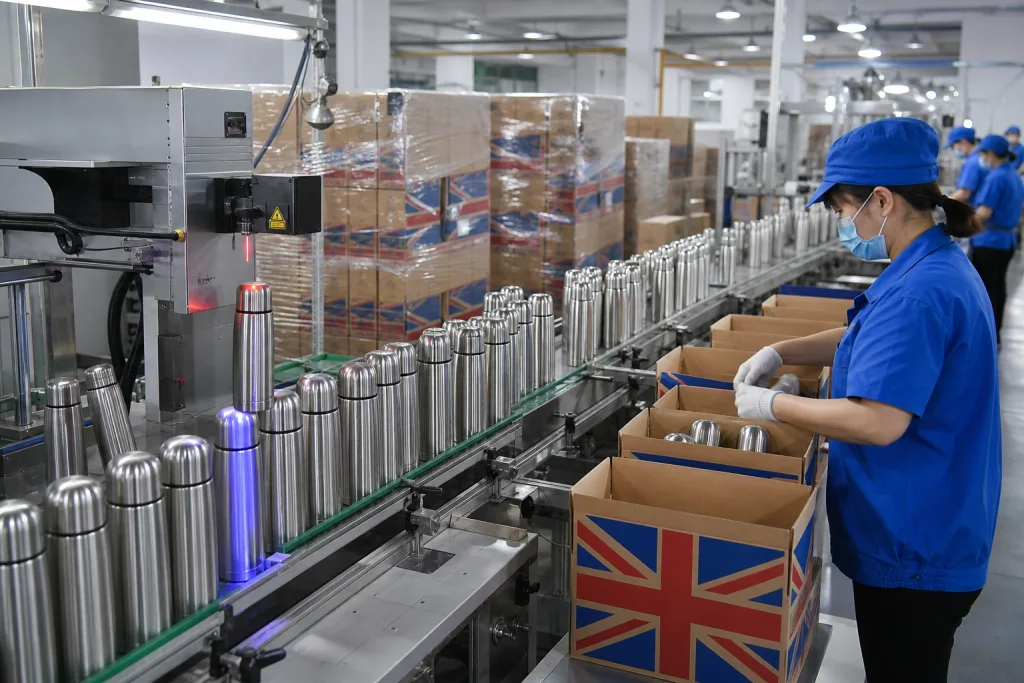
Key Takeaways
- For custom thermos flask Britain orders, 500 ml and 750 ml models usually balance retail price and freight best
- A practical MOQ is 1,000 units per colour for powder coating and 500 units for simple laser engraving
- Vacuum performance should be checked with a 6-hour and 12-hour temperature test, not only catalogue claims
- For UK promotional thermos projects, FOB China pricing often changes by USD 0.35-0.80 per unit based on lid and coating
If you sell outdoor gear or manage promotional drinkware in Britain, sourcing the flask is the easy part. Picking the right stainless model before you sign off 1,000 or 5,000 units is where buyers lose money. A 500 ml retail flask, a 750 ml hiking bottle, and a 1 L contractor flask can look near identical on a PDF, but once QC puts them on a scale and checks the mouth ID with a digital caliper, the differences show fast: grip, carton weight, shelf height, and return risk.
At our Zhejiang factory in China, we quote around 40 UK bulk thermos projects each month, and the brief often says “premium” while the target price says supermarket promo. That math does not always work. You need the trade-offs laid out early: steel grade, wall thickness, lid type, logo method, test standard, MOQ, and lead time you can plan around. We run this through the line before pricing, because a 0.4 mm body, a powder-coated finish, and a leakproof push-button lid do not behave the same in production or in a UK delivery carton.
Spec table before price talk
A UK buyer asking for a custom thermos flask Britain quote often starts with unit price. Too early. A manufacturer thermos price only means something after the spec is locked. We saw this last month on a 3,000 pcs enquiry: one thermos supplier quoted 201 stainless inner wall, one quoted 304 stainless, and one deleted the spare gasket and individual box from the PI. Same-looking flask. Different product.
Use the table below as a shop-floor starting point for outdoor retail and promotional orders. These are stainless vacuum flask types we run in Zhejiang, China, based on existing tooling and gauges checked with a digital caliper, not loose catalogue sketches.
| Model type | Best use | Typical capacity | Body diameter | Approx. FOB range |
|---|---|---|---|---|
| Compact retail flask | Gift sets, commuter outdoor shops | 350-500 ml | 65-72 mm | USD 3.20-4.60 |
| Hiking thermos bottle | Outdoor retailers, club merchandise | 600-750 ml | 72-80 mm | USD 4.10-6.20 |
| Heavy-duty work flask | Trade promos, construction, field teams | 1,000 ml | 85-95 mm | USD 5.80-8.50 |
| Travel tumbler thermos | Café retail, driving, office campaigns | 380-600 ml | 70-88 mm | USD 3.60-6.80 |
For thermos bulk projects, chasing the lowest number in this table is the wrong question to ask. Ask what the quote includes: 304 inner stainless, copper plating, powder coating, leakproof test, printed kraft box, instruction leaflet, and export carton strength rated for the carton weight. QC pulled a sample from one 1,000 ml work flask order and found the wall thickness down by 0.08 mm against the approved sample; the buyer only noticed after two cartons arrived dented in Manchester. A low quote can be real, but the math does not work if the factory thermos is lighter, thinner, or packed in a way that creates UK damage claims.
Retail flask versus promotional flask
A retail custom thermos and a promotional thermos are not the same flask with a different logo. Retail buyers judge it on the shelf: the weld line must be tidy under a 600-lux QC lamp, the powder coat cannot show orange peel, the thread should close without a gritty feel, and the inner bottle must pass a smell check after hot-water rinsing. The gift-box face also has to look believable at GBP 14.99-24.99 retail. Promotional buyers push us on other points: ship date, Pantone match, logo edge sharpness, and carton counts that do not confuse the fulfilment warehouse.
For outdoor retailers in Britain, the 500 ml and 750 ml stainless models are the safer core range. We run more repeat orders on 500 ml because it fits backpacks, day hikes, school trips, and winter commuting without making the bottle look cheap. A 750 ml thermos customized with a brand logo feels better for hiking and camping, while still avoiding the freight penalty of a full 1 L flask. The 1 L size has a place, but it eats shelf space fast; on one UK programme, the buyer flagged the carton CBM after seeing the 12-carton pallet layout.
For promotional brands, I start with 500 ml unless the campaign is clearly for outdoor trade, construction crews, utilities staff, or winter sports. At 500 ml, we can often keep carton weight under 15 kg and pack 24 units per master carton, depending on box style. That matters when your client wants delivery to 6 regional addresses or an event warehouse with a strict booking slot. Pushing 750 ml just because it “feels more premium” is the wrong question to ask; if freight jumps and the event date is fixed, the math doesn't work.
One practical rule: if the flask is sold, improve hand feel and packaging. If it is given away, protect the logo area and deadline first.
A distributor thermos programme may need both. In that case, keep the same body shape but change finish and packaging. We ship matte black with laser engraving for corporate gifting because it hides small handling marks, forest green powder coating for outdoor retail where the buyer wants shelf appeal, and a stainless brushed body when the distributors thermos line needs a lower unit cost. QC pulled one brushed sample last season because the grain direction changed between lid and body; small detail, but UK buyers notice it.
Steel, vacuum, and lid choices
Serious thermos manufacturers usually run 304 stainless steel on the inner wall because it handles tea, coffee, soups, and sports drinks better than cheaper 201 material. For the outer wall, 201 or 304 can both work, depending on price point and retail positioning. For a custom thermos flask Britain programme going into outdoor retailers, I’d specify 304 inner and 201 or 304 outer, then print the material clearly on the specification sheet. No guessing. We once had a buyer flag a carton label because the PO said “304 inner” but the artwork file only said “stainless steel”.
Wall thickness is where buyers miss the small print. A common stainless vacuum body uses about 0.4-0.5 mm sheet before forming, checked with a digital micrometer before the line starts. Go too thin and the body dents during domestic courier delivery. Go too thick and the thermos manufacturer cost climbs, while vacuum performance often stays the same. For hiking bottles, we prefer a balanced gauge instead of chasing the heaviest “premium” claim; the math doesn’t work if the buyer pays extra weight but gets no better heat result.
Lids cause more claims than bodies. A screw cup lid is simple, reliable, and familiar for Britain. A push-button stopper feels convenient, but it needs tighter gasket control and 100% leak testing on the pressure jig. A flip lid suits travel tumblers, though the hinge and drinking spout take more wear in daily use. If you are buying thermos promotional stock for an event, skip complicated lid mechanisms unless there is time for pre-production samples and a proper AQL inspection. We’ve seen this go sideways when an event date left only 12 days for sampling instead of the 18 days we asked for.
Vacuum performance should be checked with real test conditions, not brochure wording. A common target is hot water at 95°C, tested at room temperature around 20°C. After 6 hours, 9 out of 10 well-made flasks should stay above 65°C; after 12 hours, above 50°C is a useful benchmark depending on capacity. Smaller 350 ml bottles lose heat faster than 750 ml or 1 L models. Ask your thermos factory for production test records, not just catalogue figures. QC pulled one 500 ml sample last month that looked fine outside, but the infrared thermometer showed a warm base within 40 minutes, so the vacuum had failed.
Logo methods compared honestly
Decoration decides fast whether a supplier thermos feels like a retail gift or a cheap giveaway. On stainless flasks, we run five common options: laser engraving, silk screen printing, heat transfer, water transfer, and full powder coating with print. Same bottle, different risk. Last month QC pulled 32 random 500 ml samples from the line, and the logo method caused more comments than the steel grade.
Laser engraving is the safest choice for outdoor and corporate use. It will not peel, it suits small MOQs from 100-300 units, and it looks neat on black, navy, white, and raw stainless bodies. The catch is colour. The mark normally comes out silver, grey, or the base-metal tone, depending on coating thickness and laser power. For a customized thermos planned as long-term merchandise, this is the option I push first, unless the buyer insists on an exact red or blue logo. We set the fibre laser at the sample bench and check the mark depth with a 10x loupe before release.
Silk screen printing works well for one or two solid colours on a smooth cylindrical body. It is cost-effective for 1,000-3,000 units. The risk is adhesion when the coating and ink are not matched, and this is where jobs go sideways. We normally run a 3M tape test and a 500-cycle rub test before mass production. For UK promotional agencies, that matters because cartons get opened, checked, repacked, and handled by 3-4 people before the end user even sees the flask. The buyer flagged one matte-black batch because the white ink looked fine in photos but failed after a fingernail scratch test.
Heat transfer and full-wrap artwork suit lifestyle patterns, retail collections, and campaign graphics. They cost more and need clean artwork setup, not a low-resolution JPG dropped into a dieline. On tapered bodies, distortion is a real issue. Do not approve a flat artwork proof only; ask for a wrapped sample photo or a 360-degree video. This is the wrong question to ask: “Will the PDF look nice?” The better question is whether the 2 mm gap at the back seam still looks acceptable after shrinking and curing on the bottle.
For colour matching, Pantone references help, but powder coating on metal is not the same as ink on paper. A realistic tolerance is Delta E under 2.0-3.0 for controlled projects, but most promotional buyers we ship to accept a visual match under D65 light. If brand colour is legally sensitive, budget 5-7 days for a sprayed colour chip before the pre-production sample. The math does not work if the PO says “urgent delivery” and the brand team rejects the shade after 2,000 bodies are already coated.
MOQ, lead time, and costing
Our normal MOQ in Zhejiang is 1,000 units per colour for powder-coated custom thermos orders, 500 units for stainless body with laser engraving, and 3,000 units when you need a private mould or unusual lid colour. We run about 450,000 units per month across 350-750 ml standard bottles, travel tumblers with slider lids, and thermos flask lines with cup caps. Capacity is not the bottleneck. Last month QC pulled 42 samples because the buyer sent a 72 dpi logo and approved the Pantone only after we had already mixed the powder.
A realistic schedule for a custom thermos flask Britain order is 7-10 days for sampling, 25-35 days for mass production after deposit and artwork approval, then ocean freight to the UK often adds 30-40 days port to port. Air freight works for urgent promotional thermos orders, but it can add USD 1.50-4.00 per unit depending on weight and season. For a 1 L flask, the math does not work unless the campaign date is fixed and the gift value is high. We have seen this go sideways: the line finished on day 32, but the DHL pickup missed the Friday cutoff and the launch team blamed the factory.
FOB pricing usually moves for four reasons: steel grade and thickness, lid complexity such as push-button or cup cap, coating method, and packaging spec. A plain 500 ml stainless laser engraved thermos custom order might sit around USD 3.50-4.30 FOB China at 1,000-3,000 units. The same item with powder coating, colour print, premium box, and spare gasket may move to USD 4.50-5.80. At 750 ml, add roughly USD 0.50-1.20 depending on body shape and lid. We check the body with a digital caliper at the rolling station; a 0.05 mm change sounds small, but it changes weight, polishing time, and sometimes the carton loading.
For landed cost into Britain, count duty by HS code, VAT treatment by your import setup, customs clearance fees, inland delivery from port, and a damage allowance for dented cartons or crushed gift boxes. If you are a distributor thermos buyer reselling to retailers, do not calculate margin only from FOB. Carton size can hurt you. A small change from 24 pcs to 12 pcs per carton may protect gift boxes but increase handling and pallet count. One UK buyer flagged this after seeing 18 pallets instead of 12 on the packing list; the product price was right, but the warehouse charge ate the saving.
Compliance for the British market
For Britain and Europe, stainless drinkware buyers should not accept a factory’s plain “food grade” line on a quotation. Ask for food contact test reports that match the place you sell: LFGB or EU food contact testing for migration, REACH-related checks for coating and plastic parts, and UK-specific documents when a retailer asks for them. We had one UK buyer reject a batch file because the test report named the steel cup but not the PP lid. Small miss. Big delay. For children’s drinkware, buyers often request BPA-free declarations and small-parts checks, although most thermos flasks we ship to Britain are 500ml to 750ml adult items.
A good thermos supplier must control the line, not just pass paper to the buyer. ISO 9001 gives a basic management check. BSCI or a similar social audit is often needed for larger chains or public-sector promotional programmes. For inspection, use AQL instead of writing “check before shipping” on the PO; that sentence causes arguments. A common setting is AQL 2.5 for major defects and 4.0 for minor defects, with critical defects at 0. QC pulled a sample last month with a 0.6mm burr on the inner rim, and that sits in critical for us. Critical issues include leakage, sharp edges, contamination, wrong logo, and serious coating failure.
Packaging needs early work for UK distribution. If you sell online or supply outdoor retailers that ship direct to consumers, the individual box has to survive courier handling, not just look good in a showroom. We run 5-ply export cartons for most flask orders, add dividers for premium gift boxes, and set the drop test by carton weight; a 14kg carton does not behave like a 7kg carton. For Amazon-style fulfilment, labels, barcodes, FNSKU placement, and suffocation warnings on polybags must be fixed before production. After packing is too late. We have seen this go sideways when the buyer sent the FNSKU file 2 days before vessel closing.
China remains the strongest sourcing base for stainless vacuum drinkware because the supply chain is close together: steel forming, vacuum brazing, polishing, coating, printing, lids, gaskets, and packaging. In Hangzhou and nearby Zhejiang clusters, we can move a lid gasket issue from QC table to mould supplier within the same day. That saves time. The advantage is speed and flexibility; the risk is variation between thermos suppliers. Your specification and inspection plan need to be written in mm, colours, logo position, carton marks, and AQL terms, not guessed from a sample photo.
Which model fits your channel
If you are an outdoor retailer, choose the product by use case first. A 500 ml flask is the safe everyday line. A 750 ml bottle is the stronger hiking and camping product. A 1 L flask is useful for workwear, fishing, construction, and winter sports, but it should not be your only custom thermos option unless your audience clearly wants capacity over portability. On our line, QC pulls the 500 ml sample first because the 68 mm base fits standard cartons and handles less damage in transit.
If you are a promotional brand, choose by campaign risk. For a bank, university, or software client, a matte 500 ml laser engraved flask is low risk and looks professional. For an outdoor event, a 750 ml powder-coated customized thermos with a carry handle gives better perceived value. For trade counters and field teams, a 1 L screw-cup factory thermos is still the honest choice because it feels durable and practical. The buyer flagged glossy print as too loud on a recent 1,000 pcs order, and they were right.
If you are building a distributor range, avoid too many shapes at the start. Pick two bodies and three colours. For example: 500 ml and 750 ml, in black, white, and dark green. Use the same lid structure where possible. This reduces spare-part confusion and gives your thermos vendor better purchasing leverage on lids, gaskets, and packaging. We ran a 43 mm lid across both bodies for one UK account, and it cut one PO correction out of the 2,400 pcs run.
The best brief you can send to a thermos manufacturer is not “send your catalogue.” It is: capacity, target FOB or landed cost, market, logo method, colour, packaging, compliance requirement, order quantity, and delivery deadline. With that, a serious manufacturer thermos team can tell you quickly what is realistic. Without it, you will receive ten pretty quotations that cannot be compared properly. We ask for MOQ, target price, and pack style on the first call because the math does not work any other way.
Send your thermos brief for a grounded quote
Share capacity, quantity, logo method, target cost, and UK delivery date. We will return practical options, not a confusing catalogue dump.
Frequently asked questions
What is the best size for a custom thermos flask Britain retail range?
For most Britain-focused outdoor retailers, 500 ml and 750 ml are the strongest starting sizes. The 500 ml model works for commuting, day walks, school trips, and gifting, while 750 ml feels more credible for hiking and camping. A 1 L flask sells well for fishing, trade, and winter workwear, but it increases carton volume and shelf space. If you are launching a small range, start with 500 ml in 2 colours and 750 ml in 1 colour. At 1,000 units per colour, that gives enough volume for stable powder coating and sensible FOB pricing without overloading inventory.
Can I order a low MOQ customized thermos with my logo?
Yes, but the decoration method matters. For a stainless body with laser engraving, 500 units is usually workable because there is no custom coating batch. For powder-coated custom thermos orders, 1,000 units per colour is a more realistic MOQ. If you need Pantone coating, printed box, and colour-matched lid parts, expect 1,000-3,000 units. Very low MOQs such as 100-200 units are possible only from stock, and the unit price will be higher because the thermos supplier is not running a dedicated production batch.
How long does production take for thermos bulk orders from China?
For standard stainless thermos bulk orders, plan 7-10 days for sample preparation and 25-35 days for mass production after deposit, artwork approval, and sample confirmation. Sea freight from China to the UK often adds 30-40 days port to port, plus customs clearance and inland delivery. If your promotional event is fixed, do not work backwards from the event date only. Add at least 7 days for inspection, carton marking corrections, or shipping document checks. For urgent orders, air freight is possible, but it can add USD 1.50-4.00 per unit.
Which logo method lasts longest on a promotional thermos?
Laser engraving is usually the most durable because it removes or marks the surface rather than adding ink on top. It is a good choice for corporate gifts, outdoor merchandise, and distributor thermos ranges that may stay in use for years. Silk screen printing is fine for one or two colours if the ink and coating pass adhesion tests, including a 3M tape test and rub test. Full-colour heat transfer gives more design freedom but has more variables. If your client values long-term use over colourful artwork, choose laser engraving on powder coating or brushed stainless steel.
What tests should I request before shipping a thermos custom order?
At minimum, request leakage testing, vacuum temperature testing, visual inspection under AQL, logo adhesion checks, coating rub tests, and carton drop testing. For food contact, ask for LFGB, EU food contact, or relevant migration reports depending on your sales channel. A practical inspection setting is AQL 2.5 for major defects and 4.0 for minor defects, with critical defects at 0. For vacuum performance, ask for a 6-hour and 12-hour hot water test using a defined starting temperature, such as 95°C, rather than accepting a vague “keeps hot 12 hours” claim.