Key Takeaways
- A realistic stainless custom thermos MOQ starts at 1,000 pcs for standard molds and 3,000 pcs for new colors
- Vacuum retention should be checked at 95°C fill temperature after 6 and 12 hours, not judged by hand feel
- Logo method changes cost by about USD 0.12-0.85 per unit depending on print, laser, or powder coating
- AQL inspection, carton drop testing, and lid leak tests should be locked before paying the 70% balance
You need a custom thermos flask American customers will keep, not a thin giveaway that leaks in the trunk after 14 days. The RFQ looks simple: 20 oz stainless thermos, logo, retail box, delivered before the fall outdoor season. Then the quotes arrive. Same photo, same “304 stainless” claim, different wall thickness, lid gasket material, 5-ply carton strength, and AQL 2.5 inspection line buried in the fine print. QC pulled one sample last month that looked fine until the torque tester showed the lid slipping at 0.6 N·m.
This is the practical walkthrough we use at BottleForge Industrial in Hangzhou, Zhejiang when an outdoor retailer or promotional brand asks us to take one order from RFQ to shipment. China has roughly 200 active thermos factories quoting export orders, but the catalog is the wrong place to start. A clean order comes from locked specs, sealed samples, and boring QC paperwork: capacity checked by scale, logo position measured in mm, carton drop test recorded, PO typo caught before mass production. We ship fewer headaches that way.
Start with the retail use case
The first mistake is asking for a custom thermos without telling us the sales channel. Wrong starting point. An outdoor retailer and a promotional thermos buyer do not carry the same risk. Retail buyers watch shelf appeal, barcode scans, color matching, and warranty claims. Promo brands push us on logo position, event date, and landed cost. Last month QC pulled 12 retail samples because the printed UPC was 1.5 mm too close to the box fold; a promo buyer would probably never flag that, but a US chain buyer will.
For a custom thermos flask American order, we start with four commercial numbers: target retail price, target FOB price, first-order quantity, and delivery deadline. If you want a 20 oz double-wall stainless bottle retailing at USD 24.99-34.99, the FOB China target is usually USD 4.20-7.80 depending on lid complexity, coating, packaging, and inspection level. A simple bulk thermos for corporate gifting can sit lower. A retail-ready customized thermos with color box, spare gasket, insert card, and carton drop-test requirement costs more. The math does not work if the buyer asks for a USD 4.50 FOB item with soft-touch coating, leakproof push-button lid, 4C box, and AQL 2.5 inspection.
At our Zhejiang factory network, standard mold MOQ is usually 1,000 pcs per model and 500 pcs per color if we can combine production. For a new powder-coat color, expect 3,000 pcs to keep the coating line efficient; below that, the spray booth changeover eats the margin. BottleForge Industrial can coordinate around 450,000 stainless drinkware units/month across approved production lines in China, but capacity is not priority. We run the line by confirmed files. Orders with approved artwork, deposit, and signed pre-production sample get scheduled first, not the PO with “logo TBD” typed in red on page 2.
Define the order like this: 20 oz or 32 oz, intended use, retail or promotional channel, logo method, packaging type, compliance market, and ship date. Give us those details before quoting. A vague thermos custom request becomes a factory thermos project only when purchasing, engineering, and QC can lock the spec sheet, measure the lid fit with a caliper, and check the carton mark against the shipping plan.
Lock the bottle specification early
Most quote confusion starts when buyers compare bottles that share the same 20 oz name but not the same body. A tall, narrow bottle, a short wide one, a cup-holder fit, and a handle-lid version all pull different steel weights, lid parts, and carton sizes. We had one PO typo where 20 oz was written as 12 oz, and QC pulled three samples with a 6 mm height gap. Before you ask five thermos suppliers for price, lock the exact shape and lid stack-up. The math does not work otherwise.
For American outdoor retail, we usually run 304 stainless on both walls. If the program is a lower-cost promo piece, 201 stainless on the outer wall can work, but the inner wall should stay 304 for taste and corrosion resistance. Our line starts from 0.4-0.5 mm sheet before forming. After stretching and polishing, some spots come in thinner, so a gross-weight check alone will miss a weak wall. We saw this go sideways on a 500 ml test lot when the buyer accepted the weight and skipped a cut-section check.
Vacuum performance belongs in the PO, not in a sales email. For a 20 oz bottle, 95°C hot water, 20°C room temperature, and water above 60°C after 6 hours is a fair baseline. If the buyer wants retail grade, ask for 12-hour data and a controlled sample test from the same lot; we run that test on a bench rack with a 1°C probe. Cold claims sell, but they are a pain to compare unless you fix ice ratio, fill level, and ambient temperature. The wrong question is “can you keep it cold?” The better one is “under what test setup?”
Lid choice needs the same discipline. A screw lid is simple and cuts leak claims. A flip lid brings springs, pins, silicone plugs, and more leak-test points, so QC has more to chase. A straw lid can fit sports retail, but it changes ASTM and small-part review if the bottle might reach children. For a customizable thermos sold through outdoor retailers, we usually ship one leak-resistant screw lid on the first order, then add a second lid after sell-through tells us what the market wants. On the bench, a 0.8 mm gasket shift can turn a clean sample into a drip complaint.
Price the decoration honestly
Logo decoration is where about 6 out of 10 thermos manufacturer quotes start to drift. One supplier thermos price may cover one-color silkscreen on bare 304 stainless; another may cover powder coating plus laser engraving. Both write “logo included” on the quote sheet. The math doesn't work the same. Last month QC pulled the sample tray and found one quote had no coating cost, no setup charge, and no mention of logo size in mm.
For a thermos promotional order, one-color silkscreen is the cheapest practical option, often adding USD 0.12-0.25 per unit on standard surfaces. Good for simple marks. It can scratch faster in rough outdoor use if the ink, mesh, and curing tunnel temperature are not controlled; we run tape tests after curing, not before. Laser engraving looks cleaner on stainless or powder-coated bottles and usually adds USD 0.25-0.55 per unit depending on logo size and cycle time. A 35 mm logo is not the same as an 85 mm logo on the laser table. Full-wrap heat transfer or UV print can look strong on shelf, but it needs cleaner AI artwork and a higher reject allowance.
Powder coating is popular with American outdoor buyers because the hand-feel sells. The cost difference against plain stainless can be USD 0.55-1.20 per unit, depending on color, line quantity, and surface finish. Matte black and white are easier. Special Pantone colors need lab matching, and we have seen two or three spray trials before the buyer signs off. If your brand color must match a retail display or apparel line, approve the color under D65 light and keep a signed color plaque at the factory. Do not approve it from a phone photo; we've seen this go sideways when the buyer flagged “green looks blue” after 3,000 pcs were already coated.
Artwork files should be AI, PDF, or EPS, not a JPG copied from a website. The purchase order should state logo size in mm, position from base or rim, print color, acceptable deviation, and whether the factory can adjust artwork for curvature. A good manufacturer thermos partner will push back here. If the logo sits too close to a taper or seam, it may pass on a flat proof but fail on the real bottle. We once had a PO typo showing 18 mm from the rim instead of 8 mm, and the line stopped until the buyer confirmed the drawing.
Build the sample approval chain
Do not jump from quote sheet to mass production based on catalog photos. For a customized thermos order, we need at least one physical pre-production sample on the desk; retail programs often need two rounds. Round one checks the structure, lid fit, 304 stainless finish, and real capacity with a measuring cylinder. Round two checks the coating, logo position, packaging, barcode, and carton marks. Photos hide problems. QC once pulled a sample where the lid looked correct online, but the silicone gasket sat 0.8 mm too loose.
A normal sampling timeline from Zhejiang is 7-10 days for an existing mold with standard color and 12-18 days for custom coating or complex print. If new lid tooling is involved, add 25-40 days before you see usable samples. Sample freight to North America by courier often costs USD 45-95 for several bottles and packaging pieces. Pay it. The math does not work if you save USD 70 on samples and then argue over 3,000 pcs with the wrong logo height or a coating that fails the cross-cut tape test.
Your approval email should read like an inspection checklist. “Sample approved” is too vague. Approve the bottle body, lid function, coating color, logo placement, retail box dieline, instruction sheet, barcode scan, and master carton layout as separate lines. If one item is still pending, say it clearly, for example: “Body and lid approved; barcode scan pending.” We have seen this go sideways when a buyer approved the bottle but forgot the UPC typo on the PO, then the warehouse flagged every carton.
For distributor thermos programs, we also suggest a golden sample system. Keep one approved sample with you, one with the factory QC team, and one with the production line supervisor. Mark each with date, PO number, and version. During mass production, inspectors should compare random units against that sample using AQL 2.5 or your agreed standard. Simple system. It stops quiet substitutions, such as a different lid gasket, a lower-gloss coating, or a box board changed from 350 gsm to 300 gsm. Those changes look small on the line in Hangzhou and turn into warranty emails in the American market.
Control production before it ships
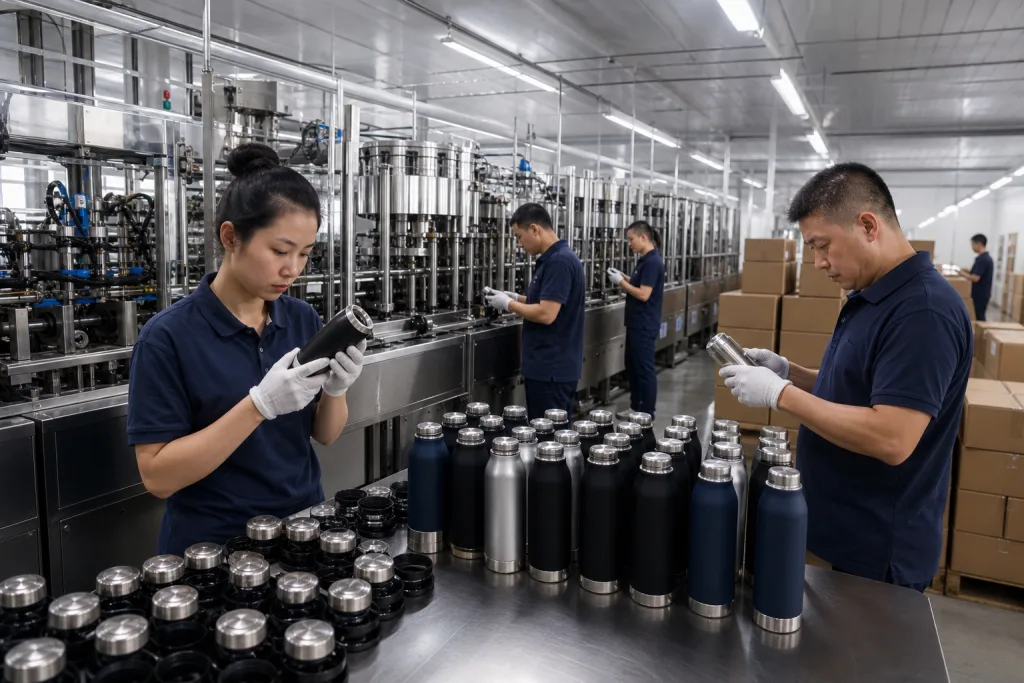
Stainless thermos production breaks in predictable places: metal forming, welding, vacuuming, polishing, coating, printing, assembly, and packing. Final inspection alone is too late. We run checks at the hydraulic press, laser welding station, vacuum furnace, powder coating line, and pad-printing table, then QC pulled the sample before the cartons were sealed. A serious thermos supplier should send production photos or a short QC note when 20%, 50%, and 80% of the order is finished, not after the buyer flags scratches in Los Angeles.
For mass production, our normal lead time is 30-45 days after deposit and final sample approval for standard molds. Peak season before Q4 can stretch to 50-60 days. Payment terms are commonly 30% deposit and 70% before shipment after inspection. FOB Ningbo or FOB Shanghai are both workable from Zhejiang; Ningbo is often the smoother route for drinkware export because the truck from Hangzhou-area factories to Ningbo Port is usually about 3 hours, while Shanghai can lose half a day at the gate during a busy week. We ship both. If the PO says “mat black” instead of “matte black,” we confirm it before coating, because one typo can put 3,000 bottles on the wrong color rack.
QC should be written into the proforma invoice or purchase order, not argued about after defects show up. We recommend AQL Level II for final inspection, with critical defects at 0, major at 2.5, and minor at 4.0 for most retail orders. Critical defects include sharp edges, broken vacuum, serious leakage, wrong material contact surface, and unsafe lid parts. Major defects include coating scratches over 5 mm, logo position off by more than 2 mm from the approved artwork, non-scanning barcode, and carton quantity errors. The wrong question is “Can we inspect at the end?” The right question is who signs off each station before the line keeps moving.
Leak testing is not optional. A practical line test is filling bottles, closing lids, inverting for 30 minutes, and checking gasket areas. Vacuum testing should include temperature retention sampling or vacuum detector checks depending on production setup. Carton drop testing matters too. A 12 kg export carton should survive a basic ISTA-style drop sequence better than a light carton designed only for domestic China logistics. We have seen this go sideways: the bottle passed, but the master carton crushed at one corner, the distributor scanned 18 cartons with damage photos, and the buyer asked for a credit. If you sell through distributors thermos channels, a crushed master carton can create chargebacks even when the bottle is fine.
Prepare compliance and shipping details
American buyers often ask, “Is it FDA approved?” This is the wrong question to ask. For stainless thermos products, ask for food-contact files by material: 304 stainless steel body and inner liner, silicone sealing ring, PP or Tritan lid parts, powder coating if it can touch the lip, and any ink printed near the drinking area. For North America, our buyers usually request FDA food-contact conformity, and about 4 out of 10 also ask for California Proposition 65 review. For Europe, REACH and LFGB can apply. If children will use the bottle, ASTM F963 and CPSIA questions come up fast. QC pulled one 20 oz sample last month because the straw tip material on the BOM said “silicone,” while the supplier invoice said “TPR.” Small mismatch. Big delay.
Factory audits matter for larger retail and promotional programs. BSCI, Sedex, ISO 9001, or a customer audit can reduce sourcing risk, but none of them replace product testing. An audited factory thermos line can still make a bad batch if the spec is vague or the lid gasket changes from 2.3 mm to 2.0 mm without approval. We have seen this go sideways. The audit report looked clean, but the leak test failed at 6 units out of 80 after the line changed gasket tooling on the night shift.
Shipping terms should be fixed before carton artwork is printed. If you ship to an American 3PL, show SKU, PO, carton quantity, gross weight, net weight, and country of origin on the carton mark. If you sell on marketplaces, each unit may need FNSKU labeling, and master cartons may need labels in the exact size and position the platform requires. For wholesale retail, UPC or EAN barcodes must scan on the color box and sometimes on the hangtag. We run barcode checks with a Datalogic scanner before packing; one buyer flagged a PO where “matte black” was typed as “mate black,” and that typo followed into 1,200 color boxes.
FOB is the cleanest term for experienced importers. DDP works for a first order, but compare it line by line because cheap DDP quotes often hide weak customs handling. The math does not work if the forwarder cannot explain duty, bond, and final-mile charges. A 3,000 pc thermos bulk order of 20 oz bottles may occupy around 6-9 CBM depending on packaging. Air freight hurts on stainless steel because the chargeable weight climbs fast; use it for samples or emergency replenishment only. Ocean freight with a buffer is the better plan: 12 days production slip plus 18 days on water can still beat paying air on 2,400 kg of finished bottles.
Run the first order conservatively
The smartest first order is not always the lowest unit price. If you are testing a custom thermos flask American retail program, we would start with one proven mold, 2 colors, and one lid system. Keep the first PO at 1,000-3,000 pcs unless distributors have sent written commitments. Small first, clean data. On one 40 oz program, the buyer pushed for 6 colors at launch; the line changeover added 2.5 hours per color and the math did not work. You can negotiate better thermos bulk pricing on the reorder after you have warranty data, sell-through, and actual carton damage records.
For outdoor retailers, color mix matters. Black, white, navy, forest green, and stone gray usually sell with fewer surprises than test colors. Promotional brands can take more color risk when the item is tied to one campaign date and one logo. A distributor thermos buyer often prefers neutral colors because one inventory lot can serve 12 clients instead of sitting under 3 seasonal logo plans. We have seen this go sideways when a PO says “sand beige” but the approved Pantone chip was closer to warm gray; QC pulled the sample, and the buyer flagged it before packing.
You should decide how much packaging to buy before the artwork team starts. Retail color boxes improve shelf value but raise cost and carton volume. A plain white box with barcode label works for some promotional thermos orders. For a premium customized thermos, consider a 350 gsm color box, molded pulp or paper insert, and a simple instruction card. Avoid excessive foam unless your channel demands it; buyers in Europe and North America now question packaging waste during vendor review. On our packing table, a 500 ml bottle in a color box can move from 24 pcs per master carton to 18 pcs once the insert and manual are added, so freight changes fast.
After shipment, track defects by category: leakage, coating scratch, dent, lid breakage, heat retention complaint, barcode issue, and missing accessory. Share the data with your thermos manufacturer before the reorder. A good China supplier thermos partner will use that feedback to adjust gasket hardness, carton strength, coating process, or packing method. One practical example: if 9 complaints out of 2,400 pcs mention lid seepage, we check the silicone gasket with a Shore A durometer and run a 45° tilt test before mass packing. That is how a one-time sourcing project becomes a stable manufacturer thermos program instead of a yearly search for new thermos vendors.
Send your thermos spec before you request quotes
Share capacity, lid, logo, packaging, MOQ, and deadline. We will reply with a practical FOB quote and sampling route.
Frequently asked questions
What MOQ should I expect for a custom stainless thermos order?
For an existing stainless thermos mold, a practical MOQ is 1,000 pcs per model. If you need multiple colors, many China thermos manufacturers ask for 500 pcs per color, although 1,000 pcs per color gives better coating stability and pricing. For a new Pantone powder coat, expect around 3,000 pcs because the coating line needs setup, powder purchase, and color matching. New lid tooling or a fully private mold can push the first run to 5,000-10,000 pcs. If a thermos vendor offers 100 pcs with full customization at factory pricing, check whether it is actually stock decoration, not true production.
How much does a custom thermos usually cost FOB China?
For a 20 oz double-wall stainless custom thermos, realistic FOB China pricing often ranges from USD 4.20 to USD 7.80 per unit. The lower end usually means a standard screw lid, simple coating or bare stainless, basic logo, and plain packaging. The higher end may include powder coating, laser engraving, retail color box, better lid construction, and stricter QC. A 32 oz bottle can move into the USD 6.50-10.50 range depending on steel weight and lid type. Always compare quotes using the same steel grade, lid, packaging, carton quantity, and inspection requirement.
Which logo method is best for outdoor retail thermos bottles?
For outdoor retail, laser engraving on powder coating is usually the safest balance of durability and appearance. It does not peel like poor ink and it handles rough use better. Cost is commonly USD 0.25-0.55 per unit depending on logo size and engraving time. Silkscreen is cheaper, often USD 0.12-0.25 per unit, and works for simple promotional thermos projects, but it needs good ink adhesion testing. Full-color UV or heat transfer is useful for complex art, but you should approve real bottle samples and allow a higher reject rate. For curved bottles, keep the logo away from heavy taper areas.
What quality tests should I require before shipment?
At minimum, require AQL final inspection, leak testing, visual coating inspection, barcode scan check, carton quantity check, and heat retention sampling. A practical AQL plan is General Inspection Level II, critical defects 0, major 2.5, minor 4.0. For leak testing, random bottles should be filled, closed, inverted, and checked for 30 minutes. Heat retention can be checked with 95°C water at 20°C room temperature, then measured after 6 or 12 hours. For retail cartons, add drop testing and confirm gross weight, carton size, country-of-origin marking, and SKU labels before paying the 70% balance.
How long does production and shipping take to the United States?
For standard molds, production usually takes 30-45 days after deposit and approved pre-production sample. During peak season in China, especially before Q4, plan 50-60 days. Ocean freight to the U.S. West Coast may take about 18-28 days port to port, while East Coast routing can take 30-45 days depending on service and congestion. Add time for customs, trucking, and 3PL receiving. If your retail launch date is fixed, start the project at least 90-120 days ahead. Samples by courier are much faster, usually 4-7 days after they leave Zhejiang.