Key Takeaways
- For most custom thermos orders, practical MOQ starts at 1,000 units per color and 3,000 units for new mold work
- 304 stainless steel is standard for food-contact inner walls; 316 is possible but usually adds 8-15% cost
- A good 500-750 ml vacuum flask should hold hot water above 55°C after 12 hours under controlled testing
- FOB China lead time is usually 35-45 days after artwork, deposit, and pre-production sample approval
If you sell outdoor gear or promotional drinkware in America, the risk is not the glossy bottle photo. The risk is approving a custom thermos that passes on a desk sample, then leaks at the lid thread, dents at the shoulder, smells metallic after hot-water testing, or gets flagged for label copy when 3,000 cartons land. We have seen this go sideways. QC pulled a 750 ml sample last month with a 0.35 mm burr inside the mouth rim; the photo looked perfect, but the buyer would have rejected the shipment.
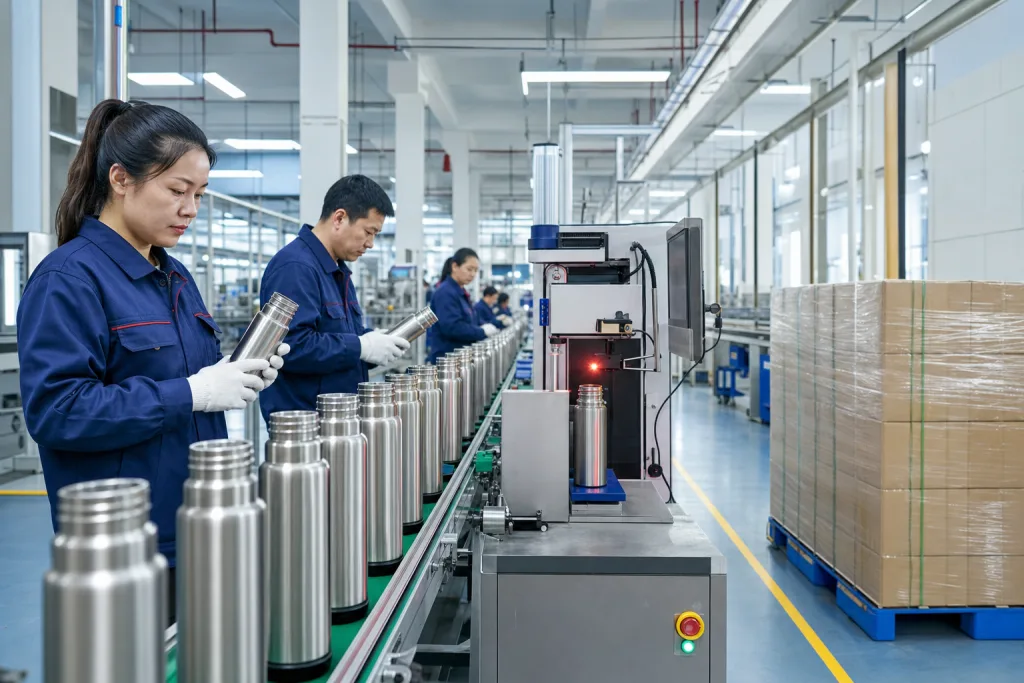
We manufacture stainless drinkware in Zhejiang, China, and 8 out of 10 buyer problems start with loose spec sheets. A custom thermos flask America program needs hard numbers: steel grade, vacuum performance, coating thickness, logo method, carton drop standard, MOQ, and inspection level. Ask for proof, not promises. Below is the spec-sheet view I would use with a serious outdoor retailer or promotional brand before we run tooling, print the logo film, or pack the first master carton on the line.
Capacity is not just volume
Capacity looks like the easiest line on a custom thermos flask America spec sheet, but it decides the cost stack after that. A 500 ml flask works for commuter gifts and promotional thermos runs. A 750 ml or 1,000 ml model fits outdoor retailers, work crews, hunting, camping, and winter sports buyers. Bigger bottles mean more 304 stainless, larger cartons, higher ocean freight, and more shelf space. Simple math. On our line in Hangzhou, a 1,000 ml body can add 70–110 g of steel versus a 750 ml body, depending on wall shape and base thickness.
For American retail, we usually see 18 oz, 20 oz, 24 oz, 32 oz, and 40 oz equivalents requested. If your sales channel uses imperial sizing, print both oz and ml on the packaging and product page. Do not let the factory thermos drawing show only metric volume if your customer service team sells in ounces. We had one PO where the buyer wrote “20 oz” in the item name, the artwork showed 600 ml, and QC pulled the sample because the hangtag confused two buyers during pre-shipment review.
Wall geometry also matters. A tall 750 ml bottle can fit backpack side pockets but feel shaky in a cup holder. A short, wide 750 ml flask feels rugged but takes more shelf width and makes inner carton packing weaker. For distributor thermos orders, that turns into pallet count and warehouse cost. We run carton trials with a 5-layer export carton and a tape measure, not guesswork; a 6 mm diameter change can push a 24 pcs carton into a worse cube rate.
Our practical advice from Zhejiang production: keep your first bulk thermos range to two capacities sharing the same lid thread if possible. For example, 20 oz and 32 oz with one lid family. This keeps spare parts, replacement lids, silicone gaskets, and QC fixtures under control. A customizable thermos range with six sizes sounds attractive in a catalog, but the math does not work if your MOQ is 1,000 units per color per size. We have seen this go sideways: 6 sizes x 4 colors becomes 24 SKUs before the buyer has sold one carton.
Steel grade and wall thickness
The inner wall should be 304 stainless steel for normal custom thermos use. We run this grade on most US orders because it is food-contact safe, easy to source in Zhejiang, and stable with coffee, tea, water, and most sports drinks. 316 stainless steel gives better corrosion resistance, but the math does not work for a promotional thermos unless your sales story is marine use, medical gifting, or premium survival gear. QC pulled one cut-open sample last month where the buyer asked for 316; after seeing the cost add-on at USD 0.42 per 500 ml flask, they moved back to 304.
Most manufacturer thermos specifications use 304 inner and 201 or 304 outer. For a cleaner premium story, write 304 inner and 304 outer on the PO and carton spec. For thermos bulk promotions, 304 inner and 201 outer can work, but do not bury that detail in the compliance file. Your importer record should match the material declaration. We have seen this go sideways when a buyer’s PO said “full 304” and the factory PI showed “304/201”; the buyer flagged it during document review, not after shipment.
Wall thickness is where cheap bottles show up fast. For standard vacuum flasks, we commonly work with 0.4-0.5 mm stainless sheet before forming. Thin outer shells dent during sea freight and outdoor use; one 20GP order had 37 dented bodies after a corner-drop test because the outer wall was shaved too far. Thick walls feel solid in hand, but they add grams, carton weight, and freight cost. Balance the shelf feel against the landed price.
Ask your thermos supplier for a material certificate and keep one production sample cut open if this is a long-term SKU. Not paranoia. It is vendor control. A serious thermos manufacturer should state steel grade, silicone type, PP or Tritan plastic parts, and coating chemistry without hiding behind “food grade.” If a thermos vendor answers only that way, push for the actual material line and test report. American buyers get judged by recalls and 1-star reviews, not factory promises; our QC bench uses a caliper, magnet check, and salt-spray log before we release repeat SKUs.
Vacuum performance needs a test method
Every supplier’s thermos catalog says “keeps hot for 12 hours” or “keeps cold for 24 hours.” That claim means little unless the test condition is written on the spec sheet. For a custom thermos flask America project, define the starting water temperature, room temperature, fill level, lid torque, and measurement time. We run a fair hot test with 95°C water, 20°C ambient room, full bottle, lid closed, then check at 6 and 12 hours with a probe thermometer inserted 30 mm below the water surface.
For a decent 500-750 ml stainless vacuum flask, we normally expect hot water to stay above 55°C after 12 hours. Bigger bodies usually hold heat better because the water volume is higher against the exposed surface area. Small 350 ml models are where the claim gets risky; we have seen buyers ask for 12-hour heat retention on a slim pocket flask, and the math does not work. Cold testing is easier to pass, but ice retention claims get messy when the lab uses 40 mm ice blocks and never opens the lid.
Vacuum performance comes down to weld quality, vacuum sealing, copper lining or coating options, lid insulation, and mouth diameter. The line checks the base weld after polishing because one pinhole can kill the vacuum on an otherwise good 304 stainless body. A wide-mouth custom thermos is easier to clean and easier to fill with ice, but it loses heat faster than a narrow-mouth design. Outdoor retailers usually accept that trade-off. Promotional brands often want a cleaner drink-through lid or cup lid for office bags and car cup holders.
Insist on a batch test record, not just a golden sample result. At our Zhejiang facility, QC pulled the sample from each production lot for leak testing and thermal retention checks before packing, with failed vacuum pieces marked in red pen on the inspection sheet. Our stainless thermos line can produce about 180,000 units per month, but that number is useless if the inspection routine misses vacuum failures before export. For America, one failed review saying “coffee was cold by lunch” can hurt the whole SKU.
Lid design decides complaints
Lids cause more after-sales claims than the stainless body. We see it on warranty sheets every season. A thermos customized with the wrong lid can pass the sample meeting, then come back as 3% returns after the first retail shipment. For outdoor use, I trust screw caps with silicone seals more than push-button lids with springs, pins, and small sliders. Promotional buyers ask for one-hand flip lids because the catalog photo looks easy, but every extra part adds a tolerance point. Last month QC pulled 20 flip-lid samples from the line and found 2 with weak rebound after 300 open-close cycles.
Write the lid spec clearly: gasket material, gasket hardness if the supplier can measure it, spare gasket quantity, and the exact claim, leakproof or spill-resistant. They are not the same. Leakproof means the closed flask can lie sideways in a backpack during normal handling without dripping. Spill-resistant only reduces splash when the bottle stays upright. If your product page says leakproof but the lid was built for spill resistance, your customer service team will pay for that sentence. We had one buyer flag this after a 5,000 pcs order because the Amazon copywriter used “leakproof” without checking the lid drawing.
Thread fit is the quiet problem. Stainless forming variation changes the mouth opening by tenths of a millimeter, while plastic lid size depends on injection mold temperature and shrink rate. A good thermos factory checks torque feel and seal compression during assembly with a torque meter, not just by hand. Too loose, it leaks. Too tight, consumers cross-thread the lid or crank it down until the gasket deforms. We run this check on the first 50 pcs after line start, because one warm mold can make yesterday’s good lid feel wrong today.
For distributor thermos programs, I prefer one lid system across two body capacities, sometimes three if the mouth diameter is shared. It cuts inventory pain and makes spare parts worth ordering. Ask for 1-2% spare lids or gaskets on large programs, especially retail channels with warranty pressure. The math does not work if you need 300 replacement lids later but the factory only accepts a full bottle MOQ. If you are buying from thermos manufacturers in China, confirm whether replacement parts can be ordered later at 500 or 1,000 pieces, and put that line on the PO. We once saw a PO typo list “spare gasket: 0.5%” instead of “5%,” and nobody caught it until packing.
Finish, logo, and retail appearance
The finish line on the spec sheet is where brand teams get excited and procurement should slow down. Powder coating gives the best scratch resistance for outdoor retail; spray painting keeps giveaway projects cheaper, but the defect rate climbs when buyers ask for glossy dark colors. Polished steel and brushed steel show fingerprints differently. Matte texture and rubberized coating feel better in hand, but the line needs cleaner hooks and slower handling after curing. Gradient color looks good in a sales deck, then QC pulls 32 samples and finds shade drift from top to bottom. We have seen this go sideways. For a custom thermos flask America order headed to outdoor retail, powder coating is the safer call than standard paint.
Logo method should match order size and brand positioning. Laser engraving is durable and clean on powder-coated or bare stainless surfaces; it cuts through to the metal underneath, so it will not reproduce full-color artwork. Silk screen works well for one or two colors on thermos promotional orders, as long as the artwork is not wrapping too far around the curve. Heat transfer handles complex graphics, but it needs tighter surface control and raises scrap risk. On the factory floor, our logo operator checks the first 10 pieces against a positioning jig before the line keeps running. If the buyer flagged a 1.5 mm logo shift on the last PO, we write that tolerance into the new artwork approval.
For a custom thermos, ask for a logo positioning drawing with dimensions from the base and seam. Do not approve artwork based only on a flat PDF. Cylindrical products distort large logos visually, especially near the curve. This is the wrong place to save 3 days. If you sell through outdoor retailers, ask for a physical pre-production sample with final coating and logo before bulk production. Digital mockups help sales teams, not final QC. We once caught a seam-side logo placement issue on a pre-production sample because the caliper reading from base to logo bottom was 68 mm, while the approved drawing said 72 mm.
Color tolerance should be written. Pantone matching on powder coating is never exact; the practical way is to approve a physical swatch, then use that swatch at incoming coating inspection. For customized thermos colors, MOQ rises because coating lines need setup, powder changeover, and gun cleaning. Our usual MOQ is 1,000 units per color for standard bottles, while special coating or new color development can require 2,000-3,000 units depending on the finish. A buyer once wrote “Panton 7499C” on the PO, missing the “e,” and the merchandiser still had to confirm the chip before we ran the first tray. Small typo. Expensive mistake if nobody checks it.
Compliance, packing, and landed cost
For America, compliance is not optional paperwork. Food-contact materials need FDA-related declarations in the supplier thermos file, not a promise in an email. In our last 10 US programs, 6 buyers also asked for LFGB, REACH, or California Proposition 65 screening because their retailers required it. If the flask is for children, ASTM and CPSIA questions come up fast, mostly on coating adhesion, straw tips, and small parts. Adult stainless thermos programs are easier, but we still prepare 304 stainless material declarations, test reports, and factory audit documents such as BSCI or ISO 9001 when available. QC pulled one sample last month because the silicone gasket color on the test report did not match the mass production BOM. Small mismatch. Big delay.
Packing needs its own spec line on the PO. A standard retail pack we run is one unit in a polybag or paper wrap, then one color box, then 24 pieces per export carton. Heavy 32 oz or 40 oz flasks often move better at 12 pieces per carton, because a 19 kg carton gets rejected less often than a 27 kg carton at the warehouse door. Carton drop testing should match your sales channel. For e-commerce or FBA-style routing, inner protection matters more because cartons get split and handled one by one. Confirm FNSKU labeling, suffocation warnings, country-of-origin marking, and barcode placement before printing; we have seen a buyer flag a 3 mm barcode shift after 8,000 color boxes were already made.
FOB pricing for a stainless factory thermos moves by spec, but a normal 20-32 oz custom thermos with powder coating and one logo often sits around USD 4.20-7.80 FOB China at 3,000 units, depending on steel grade and lid structure, then finish and packaging. A quote 12% below the next factory is not magic. The math doesn't work. Cheap quotes usually cut wall thickness, coating pretreatment, inspection time, or carton strength. You may not see the saving until the product dents in transit; we measured one low-cost sample at 0.37 mm outer wall where the approved sample was 0.45 mm.
Lead time from China is usually 35-45 days after deposit and approved pre-production sample for repeat molds. Add 7-12 days for new artwork sampling, and allow more time if you need a new lid mold. A reliable thermos suppliers conversation should cover Incoterms with the named port, payment terms with deposit ratio, AQL 2.5 inspection level if that is your standard, carton dimensions in cm, net weight and gross weight in kg, and HS code before the line starts. We ship cleaner when these details are locked early. One PO typo from “matte black” to “metal black” cost a US buyer 12 days vs 18 days because the sample had to be remade and re-approved.
Send your thermos spec sheet for a factory quote
Share capacity, logo, color, target price, and launch date. We will reply with MOQ, FOB pricing, sampling plan, and lead time.
Frequently asked questions
What MOQ should I expect for a custom thermos flask America order?
For an existing stainless thermos body, a realistic MOQ is 1,000 units per color with one logo. Some factories may quote 500 units, but the unit price, color options, and production priority usually suffer. For new mold work, plan on 3,000-5,000 units minimum because tooling, fixtures, and trial production need to be absorbed. If you are testing a promotional thermos program, start with one size and two colors rather than five small color lots. That keeps inspection, carton marking, and inventory cleaner.
Can you make a thermos customized for outdoor retailers instead of giveaways?
Yes, but the spec should be tougher than a giveaway item. For outdoor retail, we usually recommend 304 inner steel, 304 or strong 201 outer steel, powder coating, a screw lid or proven leakproof lid, and carton packing designed for heavier handling. A 24 oz or 32 oz capacity is common. Ask for thermal testing at 6 and 12 hours, leak testing, coating adhesion checks, and AQL inspection before shipment. The FOB cost may be USD 0.60-1.20 higher than a basic promotional model, but the return rate is usually lower.
Which logo method is best for a customizable thermos?
Laser engraving is the safest for durability, especially on powder-coated stainless bottles, because the mark does not peel or wash off. Silk screen is better when you need a one-color or two-color logo at a lower cost. Heat transfer works for full-color artwork but needs more surface control and has a higher defect risk on curved bodies. For bulk thermos orders above 3,000 units, we suggest approving a real pre-production sample, not only a rendering. Logo size, seam position, and curvature affect the final look.
How long does production and shipping to America take?
For repeat models, production is usually 35-45 days after deposit, artwork approval, and pre-production sample approval. New colors, special lids, or new molds can add 10-25 days. Ocean freight to the U.S. often takes about 18-35 days port to port depending on routing, plus customs and inland delivery. Air freight is possible for urgent promotional thermos deadlines, but it can cost more than the bottle itself. Give your thermos supplier your event date or retail launch date before quoting.
How do I compare two thermos manufacturers fairly?
Compare the same spec line by line: capacity, steel grade, wall thickness, coating type, lid material, thermal test method, logo method, packaging, carton quantity, AQL level, compliance reports, and Incoterms. A USD 0.40 cheaper quote may use thinner steel, weaker cartons, or a cheaper lid seal. Ask each thermos manufacturer for FOB price, sample cost, MOQ, lead time, carton size, gross weight, and available audit documents. If the answers are vague, the risk has not disappeared; it has just moved to your warehouse.