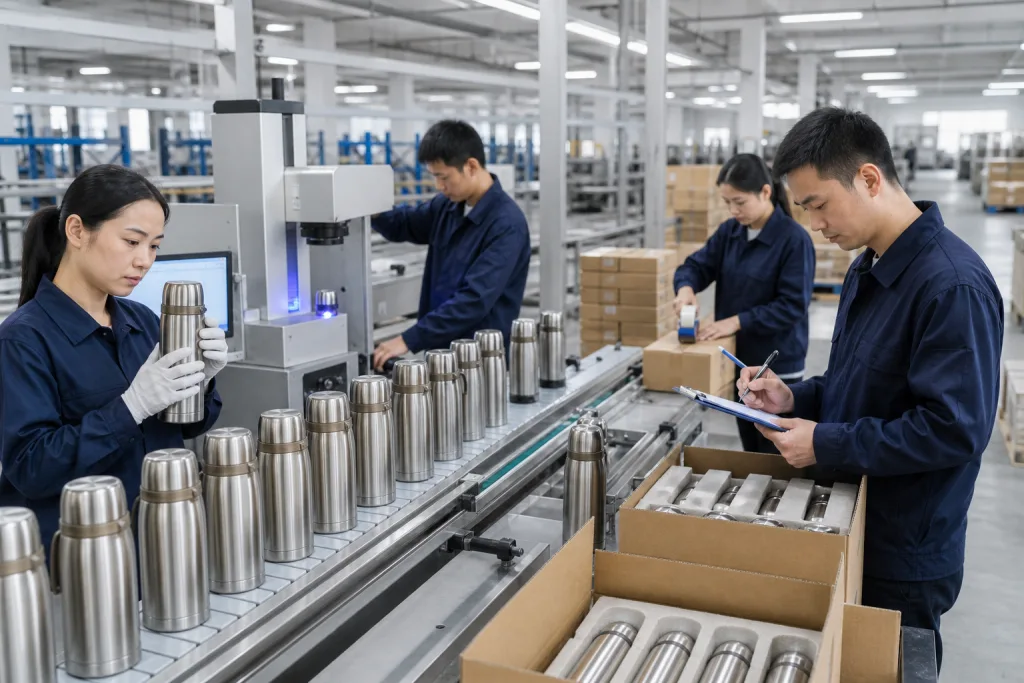
Key Takeaways
- A useful RFQ should state capacity, steel grade, decoration method, MOQ, target FOB price, and 12-24 hour insulation requirement
- Typical custom thermos MOQ is 1,000 units per colour for standard moulds and 3,000-5,000 units for new colour development
- Pre-production samples normally take 7-12 days; bulk production is usually 30-45 days after artwork and deposit approval
- UK-focused orders should check LFGB or REACH materials, AQL inspection terms, carton drop strength, and barcode/FNSKU rules before PO
If you are buying a custom thermos for Britain, supplier search is not the hard part. The hard part is making sure the same 500 ml bottle signed off in the sample room lands across 3,000 cartons with no leaking lids, no faint laser marks, no wrong retail barcodes, and no insulation claim your team cannot defend. QC pulled a random lid sample last month and found a 0.35 mm gasket mismatch. That is where orders go sideways.
Outdoor retailers and promotional brands often start with a logo file, a target landed cost, and a launch date. Too thin. A stainless vacuum flask is a technical product: steel grade, wall thickness, vacuum performance, coating, cap structure, packaging, and AQL level all change the risk on the line. From our factory in Hangzhou, Zhejiang, we see the strongest UK projects start with a tight RFQ, not a pretty mockup; if the PO has one typo in the barcode or colour code, the math does not work.
Start with a buying brief
For a custom thermos Britain project, do not start with a purchase order. Start with a one-page buying brief. It should tell the thermos supplier what you need to sell, not just what bottle shape you like. We see this go sideways when a buyer sends “500 ml flask, logo print” and the line later finds the carton size will not fit the UK pallet plan. Outdoor retailers and promotional brands buy for different reasons, so split retail requirements from campaign requirements from day one.
For retail, include the shelf price, target landed cost, packaging style, barcode format, and whether the flask must fit car cup holders or rucksack side pockets. For promotional thermos work, state the event date, logo size, print colours, gift box requirement, and whether you need individual polybags or plastic-free packing. Be specific. A 500 ml powder coated stainless bottle with a screw cup lid is not the same build as a 750 ml hiking flask with a handle cap and retail swing tag, and QC pulled one sample last month where the buyer wanted a 72 mm cup-holder base after approving a 78 mm body drawing.
Your RFQ line items should be boring and precise:
- Capacity: 350 ml, 500 ml, 750 ml, or 1,000 ml measured to brim or usable fill.
- Material: SUS304 inner and outer body, or SUS316 inner if acidic drinks are a selling point.
- Construction: double-wall vacuum, copper plating optional, 0.4-0.5 mm typical stainless wall thickness.
- Finish: powder coating, spray paint, electro-polish, or raw brushed stainless.
- Decoration: laser engraving, silk screen, heat transfer, UV print, or full wrap.
- Packaging: white box, kraft box, colour box, PDQ, or mailer box.
- Order target: 1,000, 3,000, 5,000, or 10,000 units.
At BottleForge Industrial in Zhejiang, China, we can quote 1,000 units per colour on standard stainless thermos moulds we run every month, but a new lid mould or exact Pantone coating can push the practical MOQ to 3,000 units. That is where the math breaks. If your brief hides that detail, every manufacturer thermos quote you receive will look cheaper than the real order, and the buyer will flag it after our coating master checks the Pantone card under a D65 light box.
Turn the RFQ into comparable quotes
Bad sourcing calls usually start with 3 prices that are not for the same bottle. One thermos factory quotes a 201 stainless outer wall, one quotes 304 stainless throughout, and one leaves the colour box out of the price. We see this on RFQs every week. QC pulled a 500 ml sample last month where the buyer thought the USD 0.40 saving came from better production efficiency; the sample tag showed thinner outer steel and no retail insert.
Make every thermos manufacturer quote in the same format. For custom thermos Britain orders, the RFQ table should show product code, capacity, finish, logo method, packaging, carton quantity, MOQ, sample cost, sample lead time, bulk lead time, FOB port, payment terms, and validity period. For UK cargo shipped from China, FOB Ningbo and FOB Shanghai are the usual ports. From our Hangzhou, Zhejiang line, Ningbo is often 1-2 days quicker for drinkware exports when we run palletized cartons for mixed retail orders; Shanghai can still make sense if the forwarder has a better sailing that week.
Ask what the unit price covers. Don’t guess. A realistic 500 ml custom thermos in bulk may sit around USD 3.20-5.80 FOB depending on lid, finish, and packaging. Laser engraving might add USD 0.08-0.25 per unit. A full-colour retail box may add USD 0.18-0.45. A premium carry handle lid can add USD 0.35-0.80 compared with a basic screw cap. At 10,000 units, that “small” lid change is USD 3,500-8,000, before you count the bigger 58 x 42 x 36 cm master carton and higher gross weight.
Useful PO or RFQ line items at this step include:
- FOB unit price for 1,000 / 3,000 / 5,000 units, with the same bottle body, lid, and finish on each tier.
- Tooling cost if a new lid, silicone part, or custom shape is requested, including the mould lead time in days.
- Artwork setup charge and one-time plate charge for silk screen, with the logo size in mm and Pantone number written on the file.
- Spare parts price for caps, gaskets, straws, and brushes, packed either in bulk polybags or inside each retail box.
- Carton dimensions, gross weight, and units per master carton, because UK buyers often flag this when warehouse intake fees are calculated per carton.
If a thermos vendor will not put these details in writing, do not treat the quote as final. This is the wrong question to ask: “Can you match this cheaper price?” Ask which specification changed. We once saw a PO typo list 304 stainless in the header and 201 stainless in the item note; catching that before the first sample saved 12 days versus remaking samples after approval.
Approve samples like production parts
A sample is not a souvenir. It is the physical contract for your customized thermos order. For UK outdoor retailers, the sample has to prove hand feel, lid function, insulation performance, coating adhesion, and shelf-ready packaging. For promotional brands, it also has to lock logo position, colour accuracy, and whether the line can repeat the same result across a thermos bulk run. QC pulled one matte black sample last month because the lid thread felt gritty after 20 open-close cycles.
We usually split samples into three types. A blank stock sample is often ready in 3-5 days; use it to check capacity, grip, mouth size, and lid structure. A decorated sample normally takes 7-12 days; use it to approve the logo, colour, and retail pack. A pre-production sample uses bulk materials and should be signed before mass production starts. Skipping that third sample saves a week on paper, but we have seen it go sideways when the buyer flagged a 2 mm logo shift after the goods were already in cartons.
For a custom thermos Britain programme, test the sample against the claim you plan to print. If you say “keeps drinks hot for 12 hours,” fill it with 95°C water, record the temperature at 6 and 12 hours, and write down the room temperature. If you claim cold retention for outdoor use, test with 4°C water and measure after 12 or 24 hours. We still get around 8 buyers a quarter asking for “excellent insulation” with no target number. That is the wrong question to ask. It gives every thermos suppliers team too much space to make its own call, and the math does not work when the marketing copy is already printed.
Your sample approval sheet should include:
- Approved Pantone or RAL colour, with tolerance checked under D65 lighting if possible.
- Logo size in mm, position from base or seam, plus the exact decoration method used on the sample.
- Cap opening torque, gasket material, and leak test result after the bottle is inverted for 30 minutes.
- Sample weight, body diameter, height, and mouth diameter measured with a digital caliper.
- Retail box artwork, barcode, recycling marks, and country of origin wording as shown on the final PO.
For Britain, most of the 40-plus importers we ship to each year prefer “Made in China” printed on the retail box and master carton. Some also need UKCA-related documentation for special electronic lids, but standard stainless vacuum bottles normally focus on food contact compliance, packaging rules, and chemical restrictions. One small detail: if the PO says “Made in P.R.C.” while the artwork says “Made in China,” our document team will stop the file before plate making.
Lock compliance before deposit
Compliance costs less before the deposit. After we book 304 stainless coil, powder coating, silicone gaskets, and colour box paper, a material change hits the line hard. We had one UK buyer flag a missing silicone grade after the PO was signed; the gasket mould was already cut at 0.3 mm tolerance. Bad timing. A serious thermos manufacturer should explain which tests apply to your exact lid, body, coating, and packaging, not forward an old PDF with another customer’s logo blurred out.
For a stainless custom thermos aimed at Britain, the usual checks include LFGB food contact testing for stainless steel, silicone, and plastic parts; REACH for coating or external materials; and BPA-free statements for plastic contact components. If the product is for children, ask for a tighter review under relevant child-use standards and avoid small detachable parts that create clear choking risk. This is the wrong place to save £80. If the flask includes a straw, list the straw tube and spout materials separately on the BOM, not hidden under “PP + silicone.” QC pulled one sample last season where the straw was Tritan, the lid was PP, and the PO still said “plastic lid.”
AQL inspection terms belong in the PO, not in a late email three days before loading. 7 out of 10 B2B drinkware buyers we work with use AQL 2.5 for major defects and 4.0 for minor defects. Critical defects such as leakage, sharp edges, wrong material, or mould contamination should stay at zero tolerance. For a 5,000-unit distributor thermos order, a third-party inspection at the Hangzhou or Ningbo warehouse usually costs less than one UK customer return wave. The math is simple.
Write the compliance line items clearly:
- Food contact test report requirement: LFGB or EU 1935/2004-related migration testing, depending on your importer policy and the exact contact parts on the approved sample.
- REACH declaration for coating, print, silicone, and plastic components, with colour codes matched to the signed sample, not just “black coating.”
- Stainless steel grade confirmation, normally 304 inner liner for retail quality, checked against the material declaration before bulk production.
- AQL level, inspection location, and who pays for re-inspection after failure, written into the PO before we run mass production.
- Carton drop test, barcode scan test, and packaging rub test for retail orders, especially when the buyer supplies EAN labels or gift box artwork.
China factories vary a lot on document discipline. A professional suppliers thermos partner in Zhejiang should treat test reports, material declarations, and inspection booking as normal export work, not as a favour after shipment. We ship cleaner orders when the compliance file is locked before deposit; we have seen this go sideways when a buyer sends “please add LFGB” after the goods are packed on 10 pallets.
Write the PO without gaps
The purchase order is the point where a customisable thermos job stops being a chat thread and becomes enforceable. Do not send a PO that says “500 ml bottle, blue, logo, 3,000 pcs.” We have seen that line turn into 4 arguments before the first carton is sealed. The PO should repeat the approved specifications and attach the signed artwork, sample photos, packaging dieline, and inspection standard. QC pulled one pre-production sample last March where the PO said “navy” and the approved Pantone chip was 2965C; production read it as dark blue coating from stock. Wrong start.
At BottleForge Industrial, our standard production capacity for stainless drinkware is about 450,000 units per month across bottles, tumblers, and thermos lines, but capacity does not save a loose PO. If your launch date is fixed, write the dates down: deposit date, artwork approval date, pre-production sample approval date, material purchase date, inline inspection window, final inspection window, and ETD from Ningbo or Shanghai. For normal custom thermos production, 30-45 days after deposit and final artwork approval is realistic. Large Q4 promotional thermos orders should be booked earlier because coating and printing lines fill quickly; in September, one UV printer can lose 2 days just changing from matte black to 3 spot-colour logo work.
Include commercial terms that match how you sell. If you are an outdoor retailer shipping to your own warehouse, master carton marking may be enough. If you are supplying marketplaces or fulfilment centres, specify FNSKU labels, carton labels, carton weight limits, and suffocation warning wording where used. For thermos distributors, mixed SKU carton plans can cut warehouse handling, but they make inspection sampling harder. Decide before production starts. We had a UK buyer flag a 19.6 kg carton because their fulfilment centre capped intake at 15 kg; the math did not work once 24 units and colour boxes were packed.
Strong PO line items include:
- Model number, capacity, approved sample reference, and finish code, including the exact colour reference used on the signed sample tag.
- Quantity by colour and decoration version, not just total quantity; 1,000 black with laser logo and 2,000 white with 1-colour print are not the same job on the line.
- FOB price, currency, payment terms, and bank charges, with the beneficiary name copied exactly from the proforma invoice.
- Packaging components: polybag, instruction sheet, box, insert, carton, pallet if required, plus carton size in mm if your warehouse books by cube.
- Inspection standard: AQL, defect list, test method, and photo evidence, so the inspector is not guessing whether a 0.5 mm coating dot is major or minor.
- Shipping marks, barcode files, carton labels, and pallet height limit, including FNSKU placement if the goods go straight to fulfilment.
A detailed PO is not office paperwork. It is how you stop a custom thermos order becoming 3 different versions across sales, production, and QC. We ship what the PO controls, not what someone meant in a WhatsApp message.
Manage bulk production in stages
Bulk production has a rhythm. Stainless coils or tubes are formed, welded where needed, shaped, cleaned, vacuumed, leak tested, coated, printed, assembled, packed, and inspected. Each step carries its own risk. Catch a weak vacuum before powder coating, not after the colour is baked at 180°C. Catch a wrong logo before 10,000 bodies go through the pad-printing jig. Simple math.
Ask your manufacturer thermos contact for three production updates with photos or video. First, raw material and component confirmation: steel body, caps, gaskets, boxes, and colour chips, with the Pantone card placed beside the sprayed sample. Second, inline production after 10-20% completion: coating finish, logo placement measured from the base in mm, assembly fit, and insulation spot test. Third, packing status before final inspection: retail box, carton marks, barcode scans, and random packed units. We run this because buyers often flag the same issue late: “logo looks 3 mm too high.”
For thermos customized orders, the most common bulk defects are not dramatic. They are small coating scratches, dust under paint, inconsistent laser depth, lid gasket not seated, wrong instruction sheet, weak carton glue, and barcode mismatch. Boring problems. They are also the problems that create £0.35-£0.80 per unit rework in a UK warehouse when staff have to relabel cartons or swap leaflets by hand.
Your production checklist should ask for:
- Vacuum performance spot test records by batch, with sample numbers written on the test sheet.
- Leak test method, usually inverted test after filling and closing.
- Coating adhesion check, such as cross-hatch tape test on painted samples.
- Logo rub test for screen print or UV print, using the same artwork file named on the PO.
- Carton compression and drop-test confirmation for export packing.
If you are buying bulk thermos units for a seasonal outdoor launch, do not wait until final inspection to ask whether production is on time. This is the wrong question to ask at the end of the line. A 7-day delay in coating can become a 21-day delay if you miss the vessel cut-off. China export logistics work well when space is booked early; rescue shipping is where the margin disappears, especially when the buyer’s PO has one wrong postcode digit and the carton marks already went to print.
Ship with retail reality in mind
The last step is not “send goods.” It is making sure the goods land in Britain ready for your warehouse rack, retailer intake, or campaign pick-and-pack table without repacking. We have seen this go sideways when a buyer approved the bottle but forgot the outer carton label format. Shipping choices hit damage rate, cash flow, and the delivery date you promised.
For a 500 ml stainless thermos, a common carton pack might be 24 units per master carton, roughly 12-16 kg gross weight depending on bottle and box. We run a carton drop check on packed samples before mass shipment, because a 2 mm gap inside the color box can turn into scratched powder coating after 9,000 km. Air freight can work for 300 urgent promotional units. For 3,000-10,000 units, sea freight is usually the sensible route; the math does not work by air unless the campaign date is fixed and painful to miss. Many UK buyers ship FOB from China, then use their own forwarder for ocean freight, customs clearance, and inland delivery. If you prefer DDP quoting, make sure VAT, duty, and delivery postcode assumptions are clear; vague DDP prices often hide exclusions.
Before shipment, review the packing list against your PO. Check SKU count, carton count, net and gross weight, carton dimensions, HS code, commercial invoice value, and country of origin. QC pulled one sample last year where the PO said “matte black” but the carton mark file said “matt black,” and the retailer system rejected the upload. Ask for photos of pallet loading if pallets are used. For retailer deliveries, confirm outer carton labels face outward and barcodes scan after packing with a handheld scanner, not just from the PDF. For promotional thermos deliveries split across multiple UK addresses, prepare the split-shipment instruction before goods leave Zhejiang, not after the container arrives.
A good thermos distributors shipment file should contain the signed PI, PO, artwork, inspection report, packing list, invoice, bill of lading draft, test reports, and carton label files. Keep these documents together for at least the product selling season. Boring work. Still necessary. If a customer asks about food contact materials or a warehouse flags a barcode, you do not want six email threads open while the lorry is waiting at the gate.
The right factory thermos partner will push you to decide these details early. That feels slower at RFQ stage, especially when procurement only wants a unit price, but it is faster than fixing labels, cartons, or compliance documents after the stock is already in Britain. We ship better when the line knows the retail rules before packing starts.
Send your thermos RFQ for a factory review
Share capacity, quantity, logo method, and UK delivery date. We will return a practical FOB quote, sample plan, and production timeline.
Frequently asked questions
What MOQ should I expect for custom thermos Britain orders?
For standard stainless thermos moulds, expect an MOQ around 1,000 units per colour for laser engraving or one-colour printing. If you need a custom Pantone powder coating, full-wrap print, special cap colour, or retail colour box, 3,000 units is more realistic. New moulds or private lid structures usually start around 5,000 units and include tooling cost. For mixed colours, some factories in China will accept 500 units per colour if the total order reaches 2,000-3,000 units, but the unit price will be higher because coating setup and QC time increase.
How long does a customized thermos order take from sample to shipment?
A normal timeline is 3-5 days for a blank stock sample, 7-12 days for a logo or packaging sample, and 30-45 days for bulk production after deposit and final artwork approval. Add 3-5 days for final inspection and booking if your forwarder needs documents early. Sea freight from China to Britain often takes several weeks depending on port, route, and customs timing. For seasonal outdoor retail launches, start the RFQ at least 12-16 weeks before the warehouse delivery date, not before the shelf date.
Which decoration method is best for a promotional thermos?
For long-life outdoor use, laser engraving is the safest because it removes coating and does not rub off. It is good for single-colour logos and costs roughly USD 0.08-0.25 per unit depending on size. Silk screen works well for simple logos on smooth bodies, usually 1-3 colours. UV print or heat transfer is better for full-colour artwork, but you should test adhesion and scratch resistance before bulk. If the thermos promotional campaign is short-term, printing may be fine. If it represents a premium outdoor brand, choose durability over colour complexity.
What quality checks matter most for bulk thermos production?
Focus on leakage, vacuum performance, coating defects, lid fit, logo accuracy, and packaging. Use AQL 2.5 for major defects and 4.0 for minor defects, with zero tolerance for critical defects such as sharp edges, leakage, contamination, or wrong material. Ask the thermos factory to run hot-water insulation tests by batch and an inverted leak test after assembly. For retail, also scan every barcode type before shipment and inspect carton strength. A USD 250-350 third-party inspection is usually cheap compared with reworking 3,000 units in a UK warehouse.
Should I buy from a trading company or thermos manufacturer?
Both can work, but you need to know who controls production. A direct thermos manufacturer is useful when you need technical changes, stable repeat orders, or strict QC documentation. A trading company may help if you are consolidating many product categories, but it can add a communication layer when defects appear. Ask who owns the mould, where production happens, and whether you can receive factory audit documents such as BSCI or ISO-related records. For a custom thermos Britain order above 3,000 units, direct factory communication usually reduces sampling and production mistakes.