Key Takeaways
- A realistic custom thermos bottle MOQ starts at 1,000-3,000 pcs per color for standard tooling
- 304 stainless inner walls at 0.4-0.5 mm are common for retail-grade vacuum thermos orders
- Plan 7-10 days for samples and 30-45 days for mass production after artwork approval
- Use AQL 2.5/4.0 inspection with vacuum, leak, coating, barcode, and carton drop checks
You have a 3,000-piece outdoor retail launch or a 10,000-piece promotional thermos program, and the buyer wants it to sound easy: one bottle, one logo, one ship date. On the factory floor, it is not easy. Capacity tolerance, 304 stainless steel thickness, lid thread fit, powder-coating adhesion, 5-layer carton drop strength, barcode position, and AQL inspection decide whether we ship clean or spend 18 days arguing over a claim. QC pulled one sample last month because the silicone ring sat 0.8 mm proud after assembly. Small miss. Big problem.
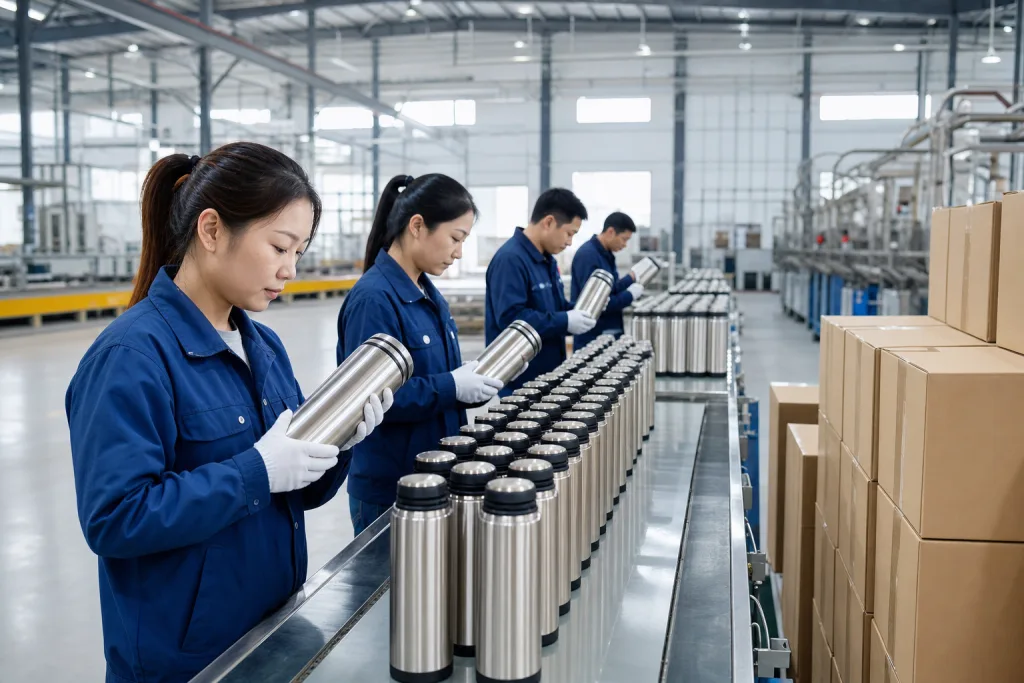
At our Zhejiang, China production base, a normal stainless thermos line can run about 300,000 units/month across standard models, but custom orders still go sideways when the spec sheet says only “same as sample.” That is the wrong way to buy. If you are sourcing a custom thermos bottle for retail shelves, corporate gifts, outdoor kits, or distributor programs, treat it like an engineered drinking product with drawings, material callouts, logo files, carton marks, and test standards locked before deposit. We run bottles, not guesses.
Start with the selling environment
Start with the sales channel and the abuse level. That is the first question. An outdoor retailer usually needs a thicker customized thermos than a conference giveaway. A distributor thermos going into ski shops, camping stores, or farm supply channels gets tossed in truck cabs, washed hard, and judged against shelf stock. A promotion piece for a bank or university is a different job: faster delivery, clean print, and a box that survives a 1.2 m drop test.
For a buyer scenario, assume you are ordering 5,000 pcs of a 500 ml custom thermos bottle for an outdoor membership campaign, with 3,000 pcs matte black and 2,000 pcs forest green. You want vacuum insulation, one-color logo, individual kraft box, master carton labeling, and shipment by FOB Ningbo. That sounds complete, but it is still short of what the line needs to quote cleanly. On our last 500 ml run, QC pulled the sample because the PO said “forest green” but gave no Pantone, and the paint room had to stop and ask twice.
You should specify the drinking style first: screw cap, push-button lid, cup lid, straw lid, or wide-mouth food-style opening. On the assembly table, a push-button lid means 8 to 12 more parts than a cup lid, and one spring can slow the line. For hiking and winter sports, a cup lid with a leakproof inner stopper is still the safer option. For commuter retail, a one-hand push lid sells well, but if the bottle will go into backpacks, ask for 100% leak testing in production, not only random inspection. If the buyer says random checks are enough, we have seen that go sideways after one zipper leak.
A good thermos supplier in China will also ask about the compliance market. Europe often needs LFGB or EU food-contact declarations plus REACH attention for coatings and silicone. North America may require FDA food-contact confirmation, California Proposition 65 review, and sometimes CPSIA if the product is positioned near children. This is the wrong question to ask: “Can you print first and test later?” We ship faster when the test plan is tied to the sales channel before carton art goes to print, because a wrong claim on the box is harder to fix than a failed sample.
Choose the bottle before the artwork
Most custom thermos bottle problems start when a buyer picks the shape from a photo. Two 500 ml bottles can look the same on Alibaba, then run differently on the line because one is 72 mm wide and the other is 68 mm with a taller shoulder. Ask for a specification sheet, not just a catalog image. The sheet should list capacity, outer diameter, height, mouth diameter, net weight, inner and outer steel grade, wall thickness, lid material, seal material, and estimated insulation performance. We also ask QC to check the drawing with calipers before quoting artwork area, because a 3 mm curve near the shoulder can break a full-wrap logo.
For retail-grade stainless thermos bulk orders, 304 stainless steel is standard for the inner wall. The outer wall may be 201 or 304 depending on price point, but outdoor retailers prefer 304/304 because it is easier to explain on shelf labels and gives better corrosion resistance. Typical wall thickness is 0.4-0.5 mm for the inner liner and 0.5 mm for the outer shell, though some lightweight models go thinner. Thin is not a defect by itself. The issue is dent resistance; we have seen buyers save USD 0.18 per piece on a thinner shell, then reject cartons after a 60 cm drop test left flat spots near the base.
Vacuum performance needs a test condition. A claim like “keeps hot 12 hours” is weak unless tied to water temperature, room temperature, fill volume, and test duration. A practical benchmark for a 500 ml stainless vacuum bottle is hot water at 95°C, ambient at 20°C, and remaining temperature measured after 6 and 12 hours. For standard straight-wall models we run, 6-hour retention above 60°C is achievable; 12-hour results depend on shape, mouth size, and lid structure. QC pulled one wide-mouth sample last month that passed at 6 hours but dropped 8°C lower than the narrow-mouth version at 12 hours, using the same 20°C test room.
If you are evaluating thermos manufacturers, ask whether the model is existing mold or new tooling. Existing mold is faster and cheaper. New tooling can take 35-60 days before sample approval and requires a higher MOQ, often 10,000 pcs or more. For a first order, use a proven manufacturer thermos body and customize color, logo, lid color, packaging, and insert card. This is where the math often goes wrong: a buyer wants a private shape for 2,000 pcs, but the tooling cost and sample rounds eat the margin before we ship the first carton.
- Standard MOQ: 1,000-3,000 pcs per color for stock molds.
- New PMS coating: 2,000-3,000 pcs per color to control setup waste and spray-line loss.
- Private mold: often 10,000 pcs+ with tooling charges quoted separately.
Lock the decoration method early
Artwork approval is where brands lose 7 days. A custom thermos can be decorated in a few ways, and each one changes cost, appearance, and scrap risk. On our powder-coating line, laser engraving is the cleanest option because the beam strips the coating and leaves the stainless tone underneath. It holds up well for outdoor brands that want a permanent mark. Color is the trade-off. Laser usually gives you silver or steel tone, not a Pantone match.
Silkscreen printing still sells fast for a promotional thermos because it stays economical and handles one or two solid colors without drama. On a curved bottle, the print area has to stay honest. An 80 mm logo may fit on a 73 mm diameter bottle, but a wraparound graphic needs a special jig and more tolerance, and the math does not work if the buyer wants full bleed. UV printing can take multicolor art, but adhesion testing matters more, especially on textured powder coat. QC pulled a cross-hatch on one batch and the tape lifted at the edge.
For premium retail, we often run matte powder coating with a laser logo and a small bottom print for regulatory marks. For thermos promotional orders, a one-color silkscreen logo plus kraft box usually gives the best cost balance. If the bottle is a customizable thermos for corporate portals, variable names or small-batch personalization also come up. That is doable, but it changes the line setup. We keep a separate name-print station, and a 500-name order is not the same job as normal mass printing.
Ask your thermos vendor for an artwork proof that shows exact logo size, position from the bottom, print color code, and whether the logo faces the drink opening or the opposite side. Sounds small. It is not. Orientation complaints come back all the time, and we have seen a buyer flag it after the first carton because the mark faced the wrong way. For retail packaging, confirm barcode placement and minimum scan size. If you sell online, FNSKU or warehouse labels may need to be applied at the factory in Zhejiang before the export cartons are sealed. Our Zebra label printer runs those jobs before packing.
Do not approve mass production from a flat PDF only. Approve a physical pre-production sample or at least a production-line sample with the real coating and decoration method. QC should pull it from the line before the order goes to full run.
Price the order without guessing
A supplier thermos quotation should break out the bottle body, logo work, packaging, testing, and shipping terms line by line. One lump-sum price is a trap. You cannot compare two offers if one factory includes AQL 2.5 inspection time and another only priced bare bottles in a white box. For a 500 ml stainless custom thermos bottle in a standard mold, FOB China pricing commonly sits around USD 3.20-5.80, based on steel grade, lid structure, coating, logo process, packaging, and order quantity. If a quote comes in at USD 2.75, ask what was removed. We have seen it go sideways: 0.38 mm outer steel instead of 0.45 mm, a loose PP lid thread, powder coat failing the 3M tape test, or QC given 2 hours to check 80 cartons.
For the 5,000 pcs buyer scenario, a workable quote might include 304 inner and outer stainless steel, double-wall vacuum, matte powder coat in two colors, laser engraving on one side, individual kraft box, 24 pcs per master carton, and FOB Ningbo. Sample fee might be USD 80-150 per design, often refundable after mass order. Production lead time usually runs 30-45 days after deposit, sample approval, and final artwork confirmation. The clock starts after clean files arrive, not after a WhatsApp screenshot. Last April, QC pulled the sample because the buyer’s PO said Pantone 426C, but the artwork file showed black C; that typo cost 2 days before the line could release the coating batch. During peak season in China, especially before September holiday schedules and year-end export rush, add 7-14 days of buffer.
Be careful with payment terms. About 8 out of 10 thermos suppliers in China ask for 30% deposit and 70% before shipment on first orders. If you need credit terms, ask after one or two clean shipments, not on the first RFQ. For distributors thermos programs with repeated releases, a 3-month forecast helps the factory reserve 304 stainless coils, lids, and coating capacity. A blanket order split into 3 shipments can reduce stock pressure, but the factory still needs firm color and logo commitments. We run material planning by SKU, so “mixed colors later” is not a plan; the math does not work once the powder room has booked 6 colors for other buyers.
Ask what is included in the carton. Is there a polybag, tissue wrap, instruction leaflet, silica gel, spare gasket, retail hang tag, or divider? Outdoor retail buyers often need shelf packaging that survives handling, while promotional buyers usually care more about landed cost. A stronger 5-layer export carton costs more than a weak 3-layer carton, but it cuts crushed boxes and warehouse rework. Small cost, real pain. On one 5,000 bottle sea shipment, our warehouse team found corner crush on 17 master cartons during loading checks because the buyer chose a thin carton to save USD 0.06 per unit. Carton compression and drop resistance matter when 5,000 bottles move through sea freight, truck unloading, and distributor handling.
Build QC into the timeline
Quality control cannot start when the inspector walks through the gate. For a customized thermos order, build checkpoints into material confirmation, pre-production sample approval, in-process production, and final random inspection. We run golden samples and signed color chips beside the line, usually in a clear PP sleeve with the PO number written on it. If your approved matte green comes from a screen image instead of a physical chip under a D65 light box, you are asking for trouble.
Use AQL for final inspection. For drinkware, 7 out of 10 export buyers we deal with use AQL 2.5 for major defects and 4.0 for minor defects. Critical defects should be zero tolerance. Major defects include leakage, vacuum failure, broken lid function, sharp edges, incorrect logo, wrong barcode, serious dent, or poor coating adhesion. Minor defects include small dust points, light scratches seen only inside a 30 cm viewing distance, or slight carton scuffing. The buyer sometimes asks us to “just pass small issues,” but the math doesn't work when one bad barcode blocks 1,200 cartons at an Amazon warehouse.
The inspection checklist should include shop-floor tests, not just a clean-looking report. Fill samples with hot water and check external wall heating after 5-10 minutes; a failed vacuum bottle gets warm fast. Perform leak testing with the bottle inverted and shaken for at least 30 seconds. Check lid torque and gasket fit. Run a cross-hatch adhesion test on coating or printing when suitable. Scan every barcode type on the retail box and master carton, especially if the order goes to large warehouses or online fulfillment centers. QC pulled one sample last month where the bottle passed leakage, but the silicone gasket sat 1.5 mm proud and rubbed against the lid thread.
For thermos bulk shipments, carton checks are not optional. Confirm gross weight, carton dimensions, packing quantity, carton marks, and whether the carton can survive a drop test. If your sales channel requires FNSKU, suffocation warning on bags, country-of-origin marking, or bilingual instructions, inspect them before the container leaves China. Fixing a missing label in a North American warehouse can cost more than the original factory labeling. We've seen this go sideways over a simple PO typo: “Made in PRC” approved on artwork, “Made in China” printed on the carton, and the buyer flagged it during DC receiving.
At BottleForge Industrial in Hangzhou, Zhejiang, we normally recommend final inspection when goods are 100% produced and at least 80% packed. That timing gives the inspector enough packed cartons to check while still leaving room for factory rework if a problem is found. For a 10,000 pcs thermos order, that means around 8,000 pcs already sealed in master cartons, with the remaining 2,000 pcs still accessible for sorting or repacking if QC finds leakage, color drift, or a carton-mark mistake.
Plan logistics and reorder control
Once the first order passes QC, logistics is the next place margin leaks. A 500 ml stainless thermos is light in the hand, but gift boxes eat container space fast. On our packing bench, a 24 pcs master carton with foam dividers can jump from 0.055 CBM to 0.072 CBM after the buyer changes to a window color box. For 5,000 pcs, that often lands around 12-18 CBM, depending on bottle shape and gift box size. Sea freight fits planned retail launches. Air freight is for urgent samples, partial replenishment, or a fixed promotional event where missing the date costs more than the freight bill.
FOB Ningbo or FOB Shanghai is common for Zhejiang factories. If you are new to importing, ask the thermos manufacturer early for carton dimensions, gross weight, HS code suggestion, and packing list format. Your forwarder needs those figures to quote freight, duty, and warehouse receiving without guessing. We measure cartons with a tape rule after final packing, not from the box supplier’s drawing, because a 15 mm bulge on each side changes the CBM. For EU buyers, confirm EORI details and importer responsibilities. For US buyers, confirm customs bond, tariff classification, and any customer labeling rules before the goods leave Hangzhou.
Reorders should be easier, but only if you control the files. Keep the approved specification sheet, PMS color, logo vector file, packaging dieline, barcode data, inspection report, and carton marks in one folder. Simple rule. No folder, no repeat order. When you reorder the same customized thermos six months later, ask the factory to confirm in writing whether any component has changed. Lid molds, silicone gasket suppliers, coating powder batches, and carton board can change quietly. QC pulled one reorder sample last year where the gasket was 0.4 mm thinner than the first lot; the buyer flagged leakage after drop testing, and the math did not work for air rework.
For outdoor retailers and promotional brands, the best thermos custom program is not the fanciest bottle. It is the bottle you can reorder without surprises. If your first shipment sells through, you may want 8,000 pcs in two colors with a 35-day delivery window. That only works when the original order was specified, sampled, priced, inspected, and documented from the start. We ship smoother when the PO repeats the same item code, carton mark, barcode, and PMS number; one typo in a PO color line can stop the line for half a day.
Send your thermos specification before you request pricing
Share capacity, quantity, logo method, market, packaging, and deadline. We will respond with practical MOQ, lead time, and FOB options.
Frequently asked questions
What MOQ should I expect for a custom thermos bottle?
For an existing stainless thermos mold, expect 1,000-3,000 pcs per color as a realistic MOQ. Laser engraving on a standard color can sometimes start at 500-1,000 pcs, but custom powder coating usually needs higher volume because the coating line has setup loss. If you want a private mold, special lid, or fully customized thermos body, 10,000 pcs is a more realistic starting point. For first-time outdoor retail or promotional thermos orders, we usually recommend using a proven 350 ml, 500 ml, or 750 ml factory thermos model and customizing color, logo, packaging, and insert card.
How long does a customized thermos order take from China?
A normal schedule is 7-10 days for a decorated sample, then 30-45 days for mass production after sample approval, deposit, and final artwork. If you require third-party testing such as LFGB, REACH screening, or FDA food-contact documentation review, add 5-12 working days depending on the lab and test scope. Sea freight to Europe or North America may add 25-45 days port to port. Peak season in China can stretch timelines, so outdoor retailers should place autumn and holiday thermos bulk orders at least 90 days before the required warehouse date.
Which logo method is best for outdoor retail thermos bottles?
For outdoor retail, laser engraving on powder-coated stainless steel is usually the safest long-term choice. It resists washing, abrasion, and normal field use better than many printed logos. The tradeoff is that the logo appears as exposed stainless steel rather than a Pantone color. For promotional thermos programs, one-color silkscreen printing is often more economical and works well for simple logos. UV printing is useful for multicolor artwork, but you should require adhesion testing on the actual coating. Always approve a physical sample before mass production, especially if the logo wraps around the bottle.
What QC tests should I require before shipment?
At minimum, require AQL final inspection with major and minor defect limits, usually AQL 2.5/4.0. The checklist should include visual defects, logo position, color match, capacity check, leak test, vacuum performance spot check, lid function, gasket fit, barcode scan, carton markings, and packing quantity. For coating or print, include an adhesion check such as cross-hatch testing where suitable. For export cartons, confirm 5-layer board if the shipment is heavy or retail boxes must stay clean. Inspection should happen when goods are 100% produced and at least 80% packed.
Can one thermos supplier handle retail packaging and warehouse labels?
Yes, but you need to provide exact files and requirements early. A capable thermos supplier in Zhejiang or other China manufacturing areas can handle kraft boxes, color boxes, instruction leaflets, hang tags, UPC labels, FNSKU labels, master carton marks, and pallet labels. The risk is not production ability; it is data control. Send barcode numbers in a locked file, confirm scan size, and include label placement in the packaging proof. For online fulfillment, ask for a pre-shipment photo set showing unit box, carton label, and packed carton before final inspection.