Key Takeaways
- A realistic MOQ for custom stainless thermos projects is 1,000-3,000 units per color depending on lid and finish
- 304 stainless steel inner walls at 0.4-0.5 mm are the normal export baseline for USA retail programs
- Laser engraving is slower but more durable than silkscreen for outdoor retail thermos custom projects
- Plan 35-55 days production after artwork approval, plus sea freight time from Ningbo or Shanghai
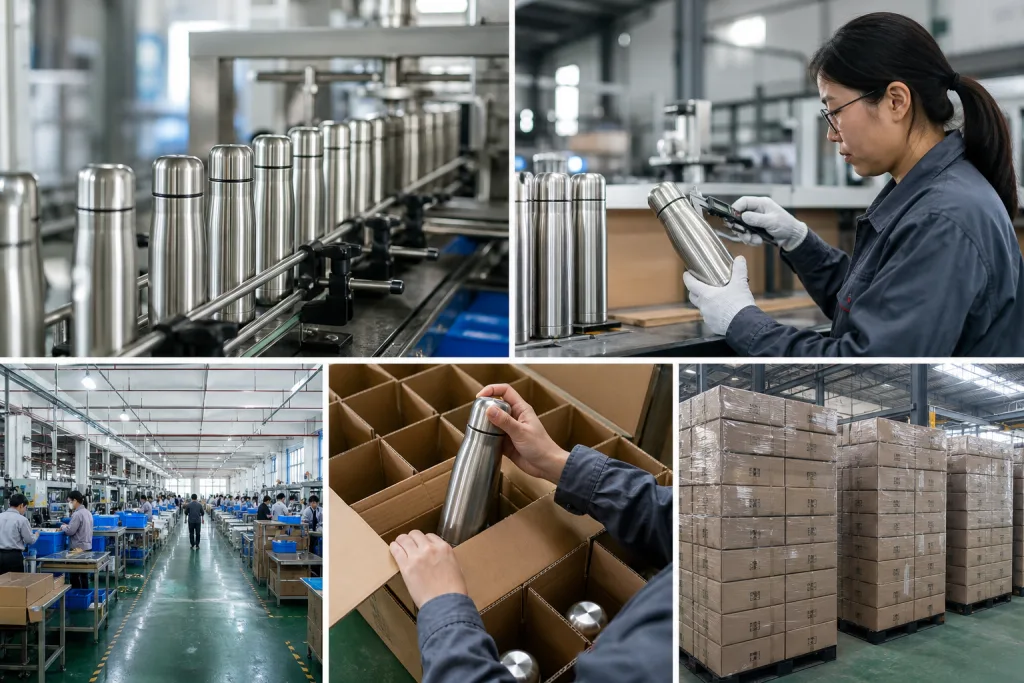
If you sell to hikers, construction crews, campus stores, event buyers, or corporate gift programs in the USA, a custom thermos bottle has to do more than look clean in a render. We run drop tests from 1.2 m on the line, check lid torque, and watch for dents after transit because a launch date will not wait for a replacement shipment.
The buyer usually sees three quotes and thinks they are the same. They are not. Steel grade, vacuum retention, lid seal, carton crush strength, MOQ, and print method change the landed cost fast. The wrong question is “which quote is lowest?” BottleForge Industrial in Zhejiang, China, makes stainless vacuum drinkware for export buyers who need straight answers before they place a thermos bulk order.
The real USA buying comparison
Search volume around custom thermos bottle usa is messy because buyers are asking for different products under the same keyword. An outdoor retailer usually needs a retail-ready stainless thermos with UPC, hangtag, color box, drop resistance, and a low complaint rate after shelf launch. A promotional brand cares more about fast logo decoration, clean PMS matching within Delta E 1.5-2.0, and carton labels that match the kitting sheet. A distributor thermos buyer often needs both: factory thermos pricing that survives rebids and enough flexibility to sell into 2 or 3 channels. Last month the buyer flagged one PO because “matte black” was typed as “mate black,” and QC pulled the sample before the line printed 1,000 lids wrong.
Here is the head-to-head comparison we use when a USA buyer asks whether they should choose a stock stainless vacuum model, a semi-custom model, or a full customized thermos project. Ask this early. The wrong question is “what is your cheapest 20 oz bottle?” because the answer changes once you add powder coating thickness, logo method, carton drop test, and whether the buyer wants 304 stainless on both inner and outer walls.
| Option | Best fit | Typical MOQ | Lead time | FOB reference |
|---|---|---|---|---|
| Stock body + logo | Promotional thermos orders, events, quick distributor programs. We run these on existing bodies, usually laser or 1-color print. | 500-1,000 pcs | 18-30 days | USD 4.20-7.80 |
| Stock mold + custom color | Outdoor retailers, Amazon-style bundles, seasonal collections. Best when the buyer needs a custom look without opening tooling. | 1,000-3,000 pcs/color | 35-45 days | USD 5.10-9.60 |
| New mold or custom lid | Brand-owned product lines and exclusive retail programs. Use this when lid shape, handle feel, or drinking flow must be owned by the brand. | 5,000-10,000 pcs | 60-90 days | Tooling quoted separately |
If your buyer only says “I need a customizable thermos,” push for channel details before asking for a price. A thermos promotional order for a 10-day event should not use the same spec as a mountain retail bottle expected to sit beside premium gear for 18 months. Cheap quotes hide in boring places. The lowest supplier thermos quote often removes cost from parts you cannot judge in a photo: 0.42 mm outer shell instead of 0.50 mm, powder coating that fails a 3M tape pull, loose lid tolerance, cheaper gasket compound, or a 5-ply carton changed to a weaker 3-ply carton. We’ve seen this go sideways when a buyer saved USD 0.28 per piece and then paid more on replacement claims.
Body size versus use case
Capacity is the first visible choice, but it is not just a marketing call. For the USA outdoor market, 500 ml, 750 ml, 1,000 ml, and 1,200 ml cover most orders. A 500 ml custom thermos is easy to carry and works for corporate gifting, commuting, and retail checkout displays. A 750 ml bottle is the safer outdoor retailer size because it fits most side pockets and gives enough volume for half-day hiking. A 1,000 ml or 1,200 ml bottle is a camp, jobsite, hunting, or winter sports product. On our rack, the 750 ml sample at 285 mm tall passed the first fit check, then the buyer flagged the lid height for cup-holder clearance.
The head-to-head tradeoff is weight against shelf appeal. A 750 ml stainless thermos with 304 inner steel, 201 or 304 outer steel, double-wall vacuum insulation, and powder coating often lands around 390-480 g depending on diameter and lid. Move to 1,000 ml and you may add 100-160 g. That extra weight lifts the perceived grade, but backpackers feel it after a full day. QC pulled a 432 g sample from the line, and the math does not work if the customer wants a light pack and a big bottle.
For a bulk thermos program, we normally suggest one hero size instead of four sizes on the first order. Too many SKUs push MOQ pressure up and make color forecasting messy. If you order 3 colors across 4 capacities, even a modest 1,000 pcs MOQ per SKU becomes 12,000 units. Many USA promotional brands miss that number and then ask us to split production below the batch we run cleanly. This is the wrong question to ask. On our powder-coat line, each color change eats 18 minutes, so the unit price climbs fast.
For outdoor retail, 750 ml in matte powder coat is the best starting point. For corporate promotional thermos campaigns, 500 ml or 600 ml is easier to ship and cheaper to decorate. For a distributor thermos catalog, keep one compact model and one larger camp model, then let decoration and packaging create the range. We caught a PO typo once that turned 600 ml into 60 ml. Ugly day. A 500 ml ship carton usually packs 24 pcs, so the freight math is easier than people expect.
Steel, vacuum, and insulation specs
A serious custom thermos spec should state the steel grade and wall thickness, not just “stainless steel.” For USA export, we normally quote 304 stainless steel for the inner wall, with 304 or 201 stainless steel for the outer wall depending on the target shelf price. Inner wall thickness is usually 0.4-0.5 mm. Outer wall thickness is commonly 0.5-0.6 mm for a durable outdoor bottle. QC checks this with a digital thickness gauge after cutting the first article sample. If a thermos supplier will not confirm these numbers, you are not pricing the same bottle.
Vacuum performance comes from weld quality, the evacuation process, copper lining if used, and the lid seal design. We run the basic heat test by filling the bottle with 95°C water, closing it, and recording temperature after 6, 12, and 24 hours at room temperature. A well-made 750 ml manufacturer thermos can hold roughly 68-75°C after 6 hours and 42-55°C after 24 hours, depending on mouth width and lid design. Wide-mouth bottles are easier to clean and load with ice, but they usually lose heat faster than narrow-mouth versions. The buyer flagged this once on a 58 mm mouth design; the math didn’t work against the catalog claim.
Cold retention claims need rules. “Keeps cold 24 hours” means little unless the spec defines starting water temperature, ice ratio, ambient temperature, and measurement method. For outdoor retailers, we prefer conservative print claims because returns cost more than a stronger marketing line. For a thermos custom project sold into the USA, overclaiming insulation performance can do more damage than saving USD 0.20 on the bottle. We have seen this go sideways when a PO said “24H cold” but the approved sample test sheet used 50% ice at 20°C ambient.
In Zhejiang, China, our line capacity for stainless vacuum drinkware is about 420,000 units per month across standard bottle and tumbler formats. That capacity only matters if the vacuum check is controlled. It is not decoration. We use 100% vacuum testing for production lots, then final inspection under AQL, commonly AQL 2.5 for major defects and AQL 4.0 for minor defects unless the buyer requires a stricter plan. On the line, QC pulled one sample last month with a weak base weld mark, and that carton stayed in hold area until the vacuum tester and water bath results matched.
Decoration methods compared honestly
Logo decoration is where a plain thermos turns into your SKU, and each method has hard limits. On our line, silkscreen is the cheap route for a one-color logo on a smooth body, and it works well when the order is big, simple, and the ship date is tight. Pad printing handles curved or uneven spots better, but the print area stays small. Laser engraving burns through the powder coat and shows the bare metal below; it looks clean, does not peel, and outdoor buyers ask for it a lot. QC pulled a sample after 300 pcs once and the tiny text held up, so the buyer kept the laser spec.
Powder coating is tougher than standard spray paint for outdoor use, but it is not magic. Dark matte colors show hand oil fast. Light colors pick up dirt after hard use. Metallic colors move around more from batch to batch. If you need tight brand color matching, send a physical Pantone chip or an approved sample, not only a PDF. For custom thermos bottle usa programs, USA buyers often ask for PMS matching, but the stainless substrate, coating thickness, curing temperature, and gloss level all change the final look. We run a gloss meter on every batch, and this is the wrong question to ask if you only want a screen file.
Here is the practical split: silkscreen may add USD 0.08-0.25 per unit for a simple logo, laser engraving may add USD 0.15-0.50 depending on size, and full-wrap heat transfer can add USD 0.60-1.50. A wrap looks strong on shelf, but it needs cleaner artwork and more pre-production sampling. The buyer flagged it before when the file had a 2 mm logo shift, and we had to rerun the fixture. If you are testing a new retail concept, do not start with the hardest decoration unless your margin can absorb rejects. The math does not work.
A thermos manufacturer should send a pre-production sample before mass production. For a new color or logo, expect 7-12 days for sampling after artwork confirmation. For repeat orders, a good thermos factory can move faster because the screens, fixtures, and color history are already on file. We keep the screen room tied to the press schedule, so once a PO typo on the logo code is fixed, the line does not sit idle.
Compliance and USA retail paperwork
USA buyers should ask for compliance documents before paying the deposit, not after the goods are finished. For stainless steel drinkware, we normally prepare FDA food-contact paperwork for 304 stainless contact parts, LFGB if the same SKU will ship to Europe, and California Proposition 65 review based on the sales channel. If the bottle is for children, ASTM and CPSIA-related requirements may apply for coatings, accessible parts, and packaging warnings. Ask early. We once had QC pull a painted straw-lid sample because the buyer’s PO said “adult bottle,” while the artwork clearly used a kids’ cartoon bear.
For outdoor retailers, packaging matters as much as the bottle. A color box needs to survive export handling, warehouse sorting, and the last domestic leg without crushed corners. We run 350 gsm or stronger paperboard for most retail boxes, with a 5-ply corrugated master carton for heavier thermos bulk shipments. Carton drop testing from 60-80 cm is a fair baseline. If your USA warehouse has strict receiving rules, give us carton size, gross weight limit, pallet pattern, and barcode placement before mass packing starts; changing a 14 kg carton limit to 12 kg after sealing means opening cartons on the line, not just editing a file.
Promotional brands and distributors thermos buyers often ask about Amazon FBA or 3PL labels. We can apply FNSKU, carton labels, suffocation warnings for polybags where needed, and mixed carton marks, but these items must sit inside the packing instruction before we print cartons. A factory thermos line runs clean when the instruction is locked. Last-minute relabeling after goods are packed can add 3-7 days and extra labor cost. We have seen this go sideways: one buyer sent the FNSKU after 480 cartons were taped, and the math did not work once labor, retaping, and warehouse cutoff time were counted.
Audits are another point. BSCI, ISO 9001, and factory social compliance documents help procurement teams approve a China supplier thermos partner. Not every project needs a full custom audit, but if you sell through national retail chains, ask early. Zhejiang factories handle export documentation every week, but each retailer has its own portal, file name rules, and timing. Missing one document can delay shipment even when the goods are physically ready; last season a buyer flagged a one-letter typo in the factory address, and the container sat 2 days while the portal record was corrected.
Pricing that actually means something
A thermos vendor quote without Incoterms, packing, decoration, and inspection assumptions is not a quote; it is a placeholder. For USA buyers sourcing from China, FOB Ningbo or FOB Shanghai is common. EXW looks lower on the first line, then the buyer carries local trucking, export handling, warehouse handover, and the 3 emails needed when a driver shows up without the release paper. DDP works for a 300 pc promotional thermos trial, but for repeat bulk thermos imports, your own freight forwarder usually gives cleaner control over sailing date, AMS filing, and carton mark checks.
For a standard 750 ml stainless customized thermos with powder coating, one-color logo, individual box, and export carton, a realistic FOB range is often USD 5.50-9.50 depending on steel, lid complexity, finish, order quantity, and testing requirements. A 500 ml model may be USD 4.20-7.50. A 1,200 ml heavy outdoor bottle may run USD 8.00-13.50. These are not promises. They are guardrails. Last month QC pulled the sample from line 3 because the buyer approved a 0.18 mm thicker silicone gasket, and that small change moved the lid cost and packing fit at the same time.
MOQ is linked to coating batch, component purchasing, and decoration setup. For stock colors and simple logos, 500-1,000 units may work. For custom powder colors, expect 1,000-3,000 units per color, since the coating room does not want to clean the spray gun and reclaim powder system for a 200 pc run. For new lids, handles, molds, or exclusive body shapes, 5,000 units is a more honest starting point. The wrong question is “Can you do lower MOQ?” Ask what cost gets cut if the MOQ drops, because we have seen this go sideways through thinner gift boxes, looser lid color matching, or a production slot pushed from 12 days to 18 days.
Payment terms for first orders are usually 30% deposit and 70% balance before shipment after inspection. Established buyers may negotiate different terms after 3-5 clean orders with no chargeback, no late artwork, and no PO typo like “750 mm” instead of “750 ml.” If you are comparing thermos suppliers, ask each one to quote the same spec sheet, including 304 stainless, powder coating code, logo size in mm, carton quantity, and inspection level. Otherwise you are comparing a retail-ready outdoor bottle against a bare promotional bottle and calling both “custom thermos.” The math does not work.
A clean buying path
The cleanest jobs start with a brief that leaves no guessing. Send the thermos team your sales channel, capacity, FOB target, logo method, color count, pack format, compliance market, and ship date. If you have a retail target, send that too. On our floor, QC pulled a 12 oz sample with a laser logo last week, and the buyer flagged the carton art because the UPC sat too close to the fold. That happens. A good China supplier will tell you where to spend and where to cut.
For a USA outdoor retailer, we usually run 2-3 days to lock the spec, 7-12 days for a decorated sample, 2-4 days for courier transit, 3-5 days for sign-off and purchase order, then 35-55 days for mass production depending on quantity and season. Ocean freight sits outside that clock. Before Chinese New Year, add buffer. We had a PO with one typo on the lid art code, and it burned four days before the line could start. This is the wrong question to ask if the plan ignores artwork approval. A 40-day plan breaks fast when one proof slips by a week.
Promotional work is a different game. Pick an existing body, hold the color to one standard, keep the logo on one side, and skip custom packaging unless the budget can carry it. For distributor programs, we build repeat SKUs with parts the line can source again next quarter. We ship more profit from a steady reorder than from a clever one-off bottle that cannot be repeated. On a 4-color wrap, the pad printer slows and scrap climbs; a 1-color silk screen moves clean. The math does not work otherwise.
BottleForge Industrial is in Hangzhou, Zhejiang, next to mature stainless drinkware suppliers and export ports. That cuts some friction on cap sourcing, carton timing, and vessel booking, but it does not replace a tight spec sheet. We run the same way every week: sample room, QC check, then loading plan. QC also checks a 0.8 mm lid gap before packing, because that tiny miss turns into a buyer complaint later. For the USA market, start with the use case, then shape the bottle around it. We have seen this go sideways when a buyer asks for the design first and the job second.
Send your thermos brief for a factory quote
Share capacity, quantity, logo, target price, and USA delivery date. We will return practical specs, MOQ, lead time, and FOB options.
Frequently asked questions
What is the normal MOQ for a custom thermos bottle USA order?
For a stock stainless body with logo decoration, 500-1,000 units is often workable. If you need a custom powder-coated color, plan on 1,000-3,000 units per color because coating lines and component purchasing need batch efficiency. A new mold, new lid, or exclusive handle design usually starts around 5,000-10,000 units. Some suppliers thermos factories may accept lower quantities, but the unit price rises and production priority can suffer. For a first USA retail test, we usually suggest one size, two colors, and one decoration method to keep MOQ and inventory risk under control.
How long does production take after we approve the sample?
For a standard custom thermos using an existing mold, normal production is 35-55 days after artwork, color, packaging, and deposit are confirmed. A simple promotional thermos with stock color and one-color logo may ship in 18-30 days if components are available. A customized thermos with new tooling, new lid structure, or special packaging can take 60-90 days including mold trials and corrections. Add freight time separately: ocean freight from China to the USA often needs 25-45 days port to port, depending on destination and season.
Which decoration is best for outdoor retail bottles?
For outdoor retail, laser engraving is usually the safest long-term logo method because it does not peel and handles abrasion better than ink. It costs more than silkscreen, often around USD 0.15-0.50 per unit depending on logo size, but it fits a durable product story. Silkscreen is still fine for simple promotional thermos orders, especially one-color logos on smooth powder coating. For full lifestyle graphics, heat transfer or full-wrap printing can work, but sampling is essential. Ask for tape tests, abrasion checks, and dishwasher guidance before approving mass production.
Can you ship directly to our USA warehouse or 3PL?
Yes, but define the logistics model early. FOB Ningbo or FOB Shanghai is common for buyers with their own forwarder. We can also support carton labels, FNSKU labels, pallet requirements, and packing lists for USA 3PL receiving. If you need DDP service for smaller thermos bulk shipments, it can be arranged, but the freight cost should be quoted separately from the product cost. Provide warehouse routing guides before production packing starts. Relabeling finished cartons can add 3-7 days and extra labor charges.
What compliance documents should I request for USA sales?
At minimum, ask for food-contact documentation suitable for stainless steel drinkware, coating safety information, and a test plan for the specific product. FDA food-contact expectations are common for the USA. If you sell in California, review Proposition 65 exposure risk. For children’s bottles, CPSIA and ASTM-related requirements may apply depending on design and age grading. For national retailers, factory audits such as BSCI or ISO 9001 may also be requested. Do not wait until final inspection to discuss compliance; build testing time and cost into the first quotation.