Key Takeaways
- A practical US retail MOQ for a custom thermos is usually 1,000-3,000 pcs per color, with 45-60 days production after sample approval
- 304 stainless steel at 0.45-0.55 mm body thickness is the normal starting point for outdoor retail bottles
- Powder coating costs more than spray painting but usually gives better scratch resistance for promotional thermos programs
- AQL 2.5 major / 4.0 minor plus vacuum heat-retention testing should be agreed before mass production
A US outdoor retailer asks for a 24 oz stainless vacuum bottle with a powder-coated finish, retail box, barcode, and a 5,000-piece launch order before fall. Sounds simple. Then the line engineer asks for lid torque in N·m, the carton spec for a 76 cm drop test, California Prop 65 wording, logo rub-test standard, and the heat-retention result after 32 days on the water.
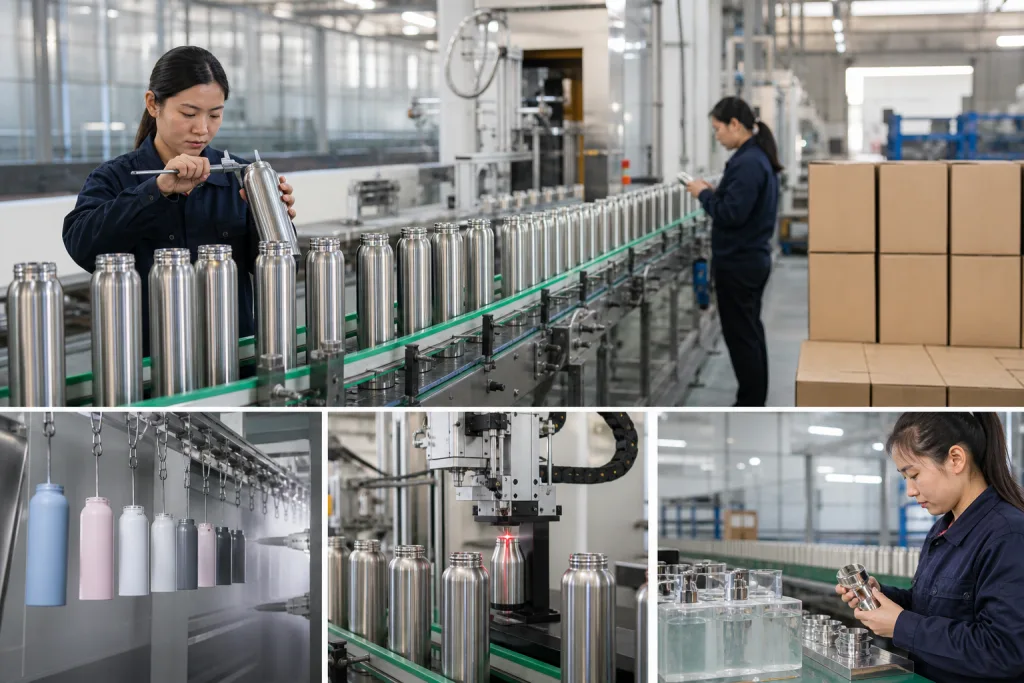
At our Zhejiang, China factory, we quote this type of custom thermos bottle US project about 6 times a week. Finding a thermos supplier is the easy part. The wrong question is “how fast can you ship?” The real work is freezing the spec early enough that your bulk thermos order ships on time, passes AQL inspection, and avoids returns after the first cold weekend in Colorado or Maine. We’ve seen this go sideways when a PO says “matte black” but the approved sample was Pantone 426C powder coat.
Start with the retail use case
Let’s use a buyer case we see every quarter. You sell outdoor gear in the US and need a customized thermos for hikers, anglers, and field crews. Marketing asks for a premium hand feel. Finance puts the target at FOB Ningbo below USD 5.20. The warehouse wants cartons that scan cleanly and inner packs that do not crush after 3 pallet moves. End users will throw the bottle into a truck bed. They always do.
So the first specification is not the logo. It is the use case. For outdoor retail, I would start with 18/8 304 stainless steel for both inner and outer walls, not 201 stainless, unless the buyer accepts a lower-positioned item. A 24 oz or 32 oz capacity fits the US market better than 500 ml because shelf tags, FNSKU data, and product copy are usually written in ounces. On the line, a 24 oz model usually comes out around 700-780 g depending on lid design, coating thickness, and wall gauge; QC pulled one sample last month at 742 g with a powder coat and carry handle lid.
For a custom thermos bottle US order, lock these items before asking five thermos suppliers for quotes:
- Capacity: 20 oz, 24 oz, 32 oz, or 40 oz, with actual fill volume tolerance of about ±3%. Ask the factory to confirm tested water volume, not just the mold name.
- Opening: wide mouth around 50-58 mm if users add ice cubes. We check this with a caliper because “wide mouth” on a quote sheet means nothing.
- Lid: screw cap, cup lid, straw lid, or dual-lid set. The lid changes cost, carton height, and leak-test failure rate.
- Finish: powder coat, spray paint, raw stainless, or rubberized coating. Powder coat hides handling marks better, but the buyer may flag orange peel if the sample is rushed.
- Packaging: brown box, printed retail box, gift box, or e-commerce mailer. For Amazon-style shipping, a thin 250 g retail box is the wrong choice.
A factory thermos quote without these choices is only a placeholder. Cheap on day one. Painful later. We have seen the final price move USD 0.40-1.20 per unit after the buyer corrected the coating, changed the lid, and added a stronger mailer; at that point, the math does not work for the original FOB Ningbo target.
Turn the idea into a factory spec
Once the product direction is clear, the thermos supplier should turn it into a written spec sheet. This is where 3 out of 10 US buyers lose control. A trade-show booth photo is not a production standard. We run the first check with a caliper and scale on the sample table: steel grade, body diameter, height, gross weight, lid material, gasket material, coating process, logo method, carton size, and test requirements all need to be written down.
For the body, we normally quote 304 stainless steel with inner wall thickness around 0.45 mm and outer wall around 0.50 mm for mid-range outdoor bottles. Some budget promotional thermos projects use thinner material, but dent resistance drops fast below about 0.38 mm. QC pulled a 500 ml sample last month after a drop test left a flat spot near the base ring. If your customers are outdoor retailers, not one-time event attendees, do not chase the last USD 0.15 here. The math doesn’t work.
For food-contact parts, ask your China thermos manufacturer to confirm LFGB or FDA-grade silicone gaskets and PP lid components. For Europe you may need LFGB and REACH documentation; for the US you will usually ask for FDA food-contact compliance, California Prop 65 review, and sometimes ASTM-related physical testing depending on the sales channel. We check the report against the actual gasket color and material code on the BOM, not just the supplier’s certificate folder. If a thermos vendor says “all certificates available” but cannot match reports to the exact material and color masterbatch, that job is not finished.
Color needs discipline. If you specify Pantone 5605 C, ask for a physical powder-coated color chip or pre-production sample. Laptop color lies. For a customizable thermos program with six colors, lock every color before opening the purchase order. We’ve seen this go sideways when a PO typo changed “5605 C” to “560 C,” and the buyer flagged it only after 2,400 retail cartons were printed. Changing powder color after production starts can waste 7-10 days and create mismatched retail cartons.
Good sourcing is boring on purpose. The more exact the spec sheet, the fewer arguments you have at final inspection.
Choose logo and surface process
A custom thermos gets judged by the logo before the buyer pours hot water into it. For outdoor retail, we usually run laser engraving over powder coating. Safe choice. The laser head cuts through the coating and shows the 304 stainless underneath, so the mark will not peel like ink after a few weeks in a backpack side pocket. Color is the catch: you get a clean stainless logo, not Pantone red or a full-color mountain graphic.
For promotional brands, silkscreen still earns its place. If your promotional thermos needs a one-color white logo on 3,000 bottles for a corporate gift, the math works. A one-color silkscreen setup may cost USD 40-80 per artwork, and the unit printing cost can be below USD 0.10 depending on logo size. Multi-color artwork means extra screens and registration checks; last month QC pulled a 500 ml sample because the second color shifted about 0.7 mm on the curve. Fine text under 5 pt is where we see logos blur or break.
UV printing gives full-color graphics, gradients, and more room for brand artwork. Use it when the thermos promotional campaign needs shelf impact more than trail abuse. The weak point is abrasion resistance. If the bottle sits in a gift box or retail sleeve, UV can pass cleanly. If the buyer says it will be clipped to packs and scraped against rocks, this is the wrong place to save USD 0.20. I would steer you back to laser engraving.
For coating, powder coat is usually a better call than spray paint for outdoor channels. It costs more and the pre-treatment must be right, but adhesion and scratch resistance are stronger. Our Zhejiang production line typically runs 120,000-180,000 stainless bottles per month depending on model mix, with powder coating as the bottleneck when color variety is high. If your order includes eight SKUs at 1,000 pcs each, expect more scheduling pressure than one SKU at 8,000 pcs; the line loses time on gun cleaning, color change, and oven balance.
Ask your thermos factory for a cross-hatch adhesion test, 3M tape pull test, and a basic abrasion check. These are cheap checks. We run them with a 1 mm cross-cut knife and standard 3M tape before mass packing, because one failed coating batch can turn into 2,000 embarrassing shelf returns.
Price the order without fooling yourself
US buyers often start with FOB unit cost. Fine, but that number by itself tells you almost nothing. A realistic 24 oz stainless vacuum bottle with 304 steel, powder coating, laser logo, printed retail box, and export carton can sit around USD 4.60-6.20 FOB Ningbo or Shanghai at 3,000-5,000 pcs. We run those orders every week, and the first question is not “how low can you go?” It is whether the wall, lid, coating, and packout match the target. A 0.3 mm wall and a 0.4 mm wall do not leave the same margin on the line.
MOQ changes with the build. For an existing mold and standard lid, 1,000 pcs per color is usually workable. For custom powder color, 2,000-3,000 pcs per color is the safer number because powder changeover burns time and material. A new mold normally needs USD 2,000-8,000 in tooling, depending on lid complexity and body shape, plus 25-40 days for tooling and first samples. QC pulled a sample last month after 32 days, and the buyer flagged the cap threads on the first shot. That is normal shop-floor life.
For thermos bulk costing, split the quote into lines:
- Bottle base cost: steel, vacuum process, lid, gasket, and assembly on the line.
- Surface finish: powder coat, spray paint, plating, or raw polish, with color-change loss counted in.
- Branding: laser, silkscreen, UV print, decal, or embossing, depending on the logo area and cycle time.
- Packaging: insert, manual, retail box, barcode label, master carton, and the carton size in mm.
- Compliance and inspection: lab testing, pre-shipment inspection, and sample freight, plus rework if a mark fails.
If you sell through retail distributors, thermos margins disappear fast. A USD 0.35 lid upgrade can be the right move if it cuts leak complaints by 1%. A USD 0.20 cheaper coating is the wrong saving if cartons rub through in transit. We have seen that go sideways more than once. Your landed cost model needs duty, ocean freight, drayage, warehouse handling, and defect allowance, not just the FOB China price. One PO typo on carton count can add a full rework day, and that hits the margin harder than the unit cost difference.
Sample approval is not decoration
For a custom thermos bottle US program, we ask buyers to approve two samples, not one. Round one is the factory sample: structure, capacity, lid torque, mouth diameter, and the overall look on the desk. Round two is the pre-production sample made with the real 304 stainless, final powder coat, logo process, retail box, barcode label, and carton mark. Approving only the first sample is the wrong shortcut. That piece may be hand-polished at the sample bench, while the line will later run 1,000-3,000 pcs per shift.
Typical timing from our China factory is 7-10 days for a stock-shape sample with logo, or 15-20 days if custom color powder and printed packaging are included. International courier to the US usually adds 3-5 working days. If your buyer presentation is on March 1, do not start sampling on February 20 and expect a clean result. We have seen this go sideways: one PO had “matte sage” typed as “mate sage,” and QC pulled the sample only after the Pantone card did not match the buyer’s artwork.
Use the sample approval stage to test the boring details. Fill the bottle with boiling water and check the outside wall temperature after 5 minutes with an IR thermometer. A failed vacuum bottle gets warm fast. Open and close the lid 20 times, then check the thread for grinding marks or cross-threading. Put water inside, invert it for 30 minutes, and shake it over white paper. Weigh the bottle on a digital scale and compare it with the spec. Measure the retail box in mm, not by eye, and confirm it fits your shelf slot or fulfillment system.
For FBA or direct-to-consumer programs, confirm FNSKU placement and scannability with a handheld scanner, not just a PDF proof. For outdoor retail, check hang tags, warnings, country of origin marking, and carton labels. “Made in China” must be visible where required. If your distributor thermos order crosses into Canada, bilingual packaging may be needed. These details are not glamorous, but the math does not work if you catch them after 5,000 units are packed and the buyer flagged the barcode on arrival.
QC the run before it leaves Zhejiang
Agree the mass production QC plan before you wire the deposit. We usually see 30% deposit, 70% balance after final inspection and before shipment. For a first thermos order with a new supplier, use third-party inspection or send your China agent to the factory. Do it once. Use AQL 2.5 for major defects and 4.0 for minor defects unless your retailer sets a tighter table. On our line, QC marks samples with a red pen and caliper checks mouth diameter in mm before the cartons are sealed.
For stainless vacuum bottles, inspection should cover appearance, logo placement, coating defects, lid fit, leakage, odor, carton markings, barcode scanning, and heat retention. The leak test is simple: fill, close, invert, and leave the bottle on white tissue for 10 minutes. A practical heat test is to fill bottles with 95°C water, close lids, and measure temperature after 6 hours. Exact pass criteria depend on capacity and design, but a 24 oz bottle on a normal double-wall line should stay above 60°C after 6 hours at room temperature. If you print premium claims like 12 hours hot or 24 hours cold, run formal lab testing and keep the report tied to that exact model, lid, and capacity. We have seen this go sideways when the buyer tested a sport lid while the report was for a screw lid.
Carton testing matters because ocean freight is rough. A normal export carton may use 5-ply corrugated board, with 24 pcs per carton for smaller bottles or 12 pcs for larger 32 oz models. Ask for carton gross weight under 15-18 kg if your warehouse team handles cartons by hand. Drop testing from 76 cm on corners, edges, and faces is common for packaged consumer goods. QC pulled one sample last season where the retail box looked fine on the table, but the corner split after the third edge drop. If your retail box corners crush, the customer will blame your brand, not the thermos manufacturers.
Before shipment, confirm booking details, HS code, commercial invoice, packing list, and whether you buy FOB, CIF, or DDP. A lot of US buyers still prefer FOB Ningbo or Shanghai because they control freight and insurance. If you ask thermos suppliers for DDP, check that duty, Section 301 tariff exposure, customs bond handling, and delivery appointment fees are written into the quote. “DDP included” in an email is not enough. The math does not work if the supplier quoted freight on 1 CBM but your final packing list shows 1.8 CBM because the PO had the wrong carton size.
Plan the reorder from day one
The first order proves the product. The reorder proves whether the supplier can keep up. If your customized thermos sells through, you need fast repeat production and the same color on shelf, not “close enough.” Talk about this before the first container leaves Ningbo port. We have seen a buyer come back 9 months later asking for the same navy blue, but the PO only said “dark blue” and the line had changed powder suppliers.
Keep one golden sample in your office and one sealed at the factory. Label both with Pantone numbers, powder batch, logo file version, barcode data, carton layout, and inspection standard. We write these on a sample card and tape it inside a PE bag with the bottle. For repeat production, this can cut approval from 18 days to 7 days. Without it, the second run can drift 1-2 mm on logo position, use a lighter box paper weight, or show a shade difference under the D65 light box.
For outdoor retailers and promotional brands, I would stock spare lids at 1-2% of order quantity. Lids get lost in store backrooms, crack after a drop test, or get crushed when a warehouse stacks cartons too high. The stainless body is usually not the weak point. If you order 5,000 bottles, adding 50-100 spare lids is cheap insurance. Ask whether the lid mold is shared across models and whether the silicone ring size stays fixed. QC pulled a sample last year where the lid looked the same, but the gasket was 0.4 mm thinner and leaked after the inverted test. We do not like that kind of surprise.
If you are a thermos distributor serving multiple accounts, build a small core range instead of changing shapes every order: one 20 oz travel size with a cup holder base, one 24 oz outdoor bottle with a carry loop, one 32 oz wide-mouth bottle for ice cubes, and one premium gift set with color box and sleeve. This improves forecasting and gives your manufacturers thermos partner better production rhythm. In Zhejiang, stable repeat orders get better line priority than scattered one-off projects. That is not a sales trick; it is how the scheduler fills welding, polishing, powder coating, and packing slots on the weekly board.
The best supplier is not the one who says yes to every change. It is the one who tells you when a change will add USD 0.50, delay shipment by 12 days, or raise defect risk. A cheaper first quote means little if the reorder needs new artwork approval, a new lid mold, and another pre-production sample. The math does not work. Honest pushback saves money.
Send your thermos spec and target landed cost
We will review capacity, finish, logo, MOQ, packaging, and QC plan before quoting your stainless thermos order.
Frequently asked questions
What MOQ should I expect for a custom thermos bottle US order?
For an existing stainless bottle shape, expect 1,000 pcs per color for laser logo or simple silkscreen. If you need custom powder coating, 2,000-3,000 pcs per color is more realistic because coating setup and color change loss affect cost. For a new lid or body mold, MOQ often moves to 5,000-10,000 pcs, plus tooling of roughly USD 2,000-8,000. Smaller trial orders are possible, but the unit price may rise by USD 0.50-1.50.
How long does production take after I approve the sample?
A normal custom thermos order takes 45-60 days after pre-production sample approval and deposit. Add 7-20 days before that for samples, depending on logo, color, and packaging. Ocean freight from China to the US West Coast can add about 18-28 days port to port, while East Coast routing is longer. If you need goods for a fixed retail launch, work backward from the delivery date and leave at least 10 days for inspection, booking, and customs documents.
Which logo method is best for outdoor retail bottles?
For outdoor use, laser engraving on powder coating is usually the safest choice. It resists peeling and looks premium, though it cannot print full-color artwork. Silkscreen is good for one-color promotional thermos orders and is cheaper at volume. UV printing works for detailed graphics but is less ideal for hard abrasion. If your bottle will be used in backpacks, trucks, campsites, and job sites, I would choose laser even if it costs USD 0.10-0.25 more per unit.
What quality tests should I require before shipment?
Use AQL inspection, commonly 2.5 for major defects and 4.0 for minor defects. Check leakage, vacuum performance, lid torque, coating adhesion, logo position, odor, barcode scanning, carton marks, and retail packaging. For heat retention, fill selected bottles with 95°C water and measure after 6 hours. For packaging, use a carton drop test from about 76 cm if the order is retail-packed. Put these standards on the purchase order, not only in emails.
Can one thermos supplier handle both retail and promotional orders?
Yes, but only if the supplier understands both packaging and schedule requirements. Retail orders need stronger carton specs, barcode control, compliance documents, and consistent shelf appearance. Promotional thermos orders often focus on logo deadline, event date, and lower unit cost. A good thermos vendor can manage both, but you should separate the specs. Do not use a cheap event-giveaway standard for an outdoor retail SKU that will face customer reviews and returns.