Key Takeaways
- A realistic custom thermos MOQ starts at 1,000 pcs per color for powder-coated stainless models
- 304 stainless steel inner and outer walls are the normal baseline for UK outdoor retail
- Sampling usually takes 7-12 days; bulk production is typically 30-45 days after deposit and approval
- AQL 2.5/4.0 inspection should be written into the PO before production starts
If you sell outdoor kit or run promotional drinkware campaigns in the UK, a stainless thermos looks simple until the RFQ hits our desk. Capacity, lid style, powder coating, logo method, carton drop test, REACH file, and delivery term all move the price. Last month one buyer sent “500 ml, black, logo” and missed the lid drawing by 6 mm. That quote was useless. A loose request for a custom thermos gets loose pricing.
From our factory in Zhejiang, we see this every week: buyers ask for “500 ml flask, logo, good quality,” then spend 14 days comparing offers built on different steel gauges, stoppers, cartons, and test standards. The math does not work. A better custom thermos bottle UK project follows a tight buying sequence: RFQ, engineering sample, pre-production sample, bulk PO, inspection, and shipment. On the line, QC pulled one sample after the buyer’s PO spelled “matte” as “mate,” and that tiny typo changed the coating finish.
Start with a usable RFQ
A good RFQ for a custom thermos bottle UK order should let a factory quote from the same spec sheet, not from guesswork. No, you do not need a full engineering drawing for every job. You do need fixed commercial and technical lines: capacity, body diameter, lid type, coating, logo method, packing, test standard. If you ask three thermos suppliers for “a premium 500 ml flask,” one may quote 0.4 mm wall thickness, another 0.5 mm, and another a lighter PP lid assembly with a thinner silicone ring. QC will treat those as three different products, and so will your buyer when the sample lands on their desk.
Your first RFQ should state the target buyer: outdoor retailer, corporate gift distributor, festival merchandise, school program, or staff onboarding kit. The use matters. A promotional thermos can live with a simpler white box and a ±1 mm logo position tolerance; a retail shelf product usually needs barcode artwork, care leaflet, drop-testable gift box, and cleaner powder-coat control around the shoulder. For UK distributors thermos projects, this also changes carton marks, Amazon-style outer label placement, and pallet height. We have seen a buyer flag a carton because the PO said “UKCA label on gift box” but the artwork file only showed it on the manual.
Use clear PO-style lines before you issue the PO. Short lines save days. Our merchandiser should be able to copy the RFQ into the costing sheet without asking whether “matte black” means PMS Black 6C powder coating or a soft-touch spray paint that scratches in the 3M tape test:
- Product: double-wall vacuum stainless thermos, 500 ml or 750 ml, with body diameter and lid style stated
- Steel: 304 stainless inner, 304 or 201 outer depending on budget, with wall thickness confirmed if price comparison matters
- Finish: powder coating, spray paint, brushed steel, or full-color wrap, plus Pantone or approved sample reference
- Logo: laser engraving, 1-color silkscreen, or UV print, with artwork size in mm and position from the base
- MOQ: 1,000 pcs per color, with price breaks at 3,000 and 5,000 pcs
- Incoterm: FOB Ningbo or Shanghai; DDP UK only if freight and VAT handling are agreed
- Compliance: LFGB, REACH, food-contact declaration, BSCI audit if required
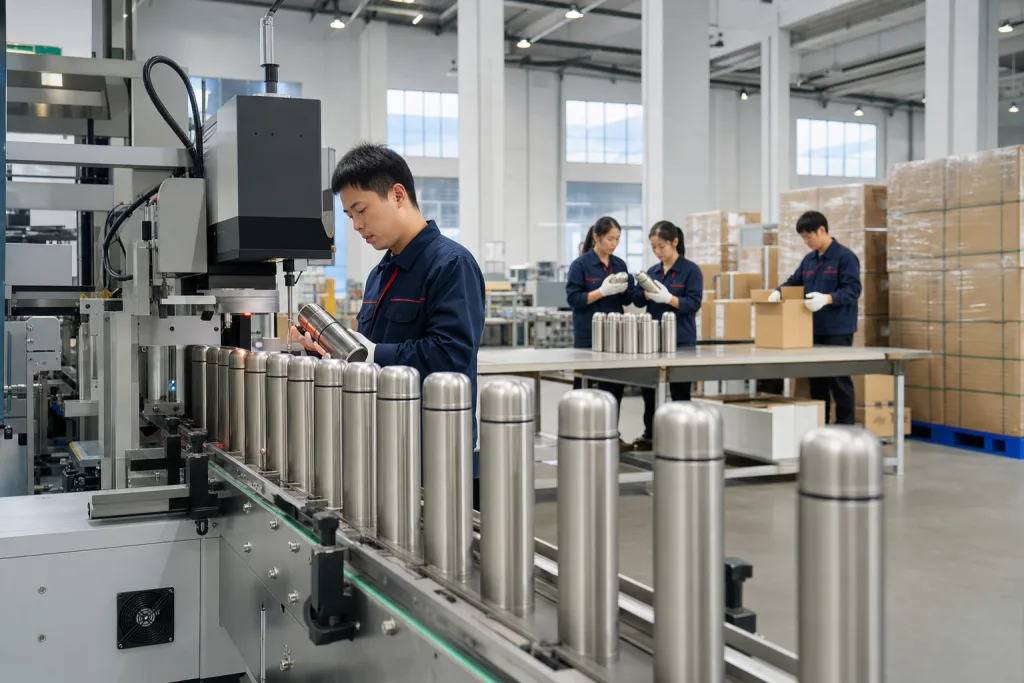
At BottleForge in Zhejiang, China, a standard manufacturer thermos line can produce around 300,000 stainless vacuum units per month across bottles, tumblers, and food jars. That number sounds useful, but capacity is the wrong question to ask if the RFQ is loose. We run separate schedules for tube cutting, vacuum welding, powder coating, logo, and packing; one missing line can push approval from 12 days to 18 days. Give us the spec early, and we can reserve the right tooling, coating line, and packing labor before the peak-season queue fills up.
Lock the physical specification
The physical build decides whether your customized thermos feels like outdoor retail merchandise or a disposable promo item with a metal shell. For UK outdoor retailers, we usually spec 304 stainless steel on both inner and outer walls for 500 ml, 750 ml, and 1,000 ml bottles. Some buyers ask for 201 stainless on the outer wall to save about USD 0.15-0.35 per unit. The math doesn't work if the bottle is going into wet camping, marine, or winter sports channels; we have seen rust complaints start around the base ring after salt-spray exposure and poor drying.
Wall thickness is not a marketing detail. A standard vacuum thermos body starts from 0.4-0.5 mm stainless sheet before the drawing machine forms the shell. Go thinner and you cut weight and price, but dent resistance drops fast. For a distributor thermos program aimed at hikers, tradespeople, or cycling clubs, ask the factory thermos team to confirm body gauge, base construction, and whether the bottom is welded, crimped, or fitted with an anti-slip pad. QC pulled one 750 ml sample last month with a 0.32 mm outer wall; it looked fine on the desk, then dented after a 1 m carton-drop test.
Capacity tolerance also matters. A “500 ml” bottle may hold 510-530 ml to the brim, while practical fill volume is lower. If your label claims 500 ml, ask for measured capacity and confirm the test method. We run this with a digital scale, room-temperature water, and a brim-fill record in grams, then convert it. For insulation, many suppliers thermos quotes mention 12 or 24 hours, but the useful metric is temperature after 6 hours under a defined starting temperature. A common internal test is 95°C water, 20°C room temperature, measured at 6 and 12 hours.
Put lid details into the spec. Screw caps, cup lids, push-button stoppers, carry handles, and tea infusers all change leak performance and unit cost, so do not leave them as “standard lid” on the PO. For a thermos custom order with a drinking cup lid, check the plastic grade, silicone seal hardness, and whether spare gaskets are available. We have had a buyer flag a one-letter typo between PP and PC on a lid material line; that single line held the sample approval for 4 days. A good thermos manufacturer should be able to send exploded lid photos, material declarations, and leak-test video before you pay for samples.
Choose branding before sampling
Branding is where about 4 out of 10 custom thermos projects get messy. The body shape gets signed off, QC pulled the sample, then the buyer changes laser to UV print and asks why the unit price moved. Choose the decoration route before you request your first sample. This is the wrong question to ask after the sample lands.
Laser engraving is the safest choice for outdoor retail and workwear channels. It does not peel, the setup cost is low, and the finish looks clean on powder coating or bare stainless steel. On our line, a 40 mm logo on a rotary laser fixture is a simple job. Color is the limit. Engraving exposes the base material or undercoat, so it is not the right fit for multi-color campaign graphics. For a promotional thermos with event artwork, silkscreen or UV printing is usually better. Silkscreen handles solid one- or two-color logos well. UV printing can reproduce gradients, but it needs a smooth body and artwork checked at 300 dpi, with no tiny 0.2 mm strokes that fill in during printing.
If you need a customizable thermos range with several UK customer logos, ask for a shared blank-body program. The thermos factory produces one approved bottle in black, navy, white, or olive, then decorates in smaller logo batches. We run this for distributors thermos orders where one end client takes 250 pcs and another takes 500 pcs, but the blank color MOQ may still be 1,000-3,000 pcs. The math doesn't work if every 250 pcs order needs its own powder-coating run.
Your RFQ should include artwork file format, logo size, position, Pantone references, and packing mark rules. For retail, specify EAN or UPC barcode placement. For Amazon or marketplace fulfillment, include FNSKU label size and whether labels go on the unit box or outer carton. These jobs look small on the PO, but in China they are quoted as labor. We have seen a 35 x 25 mm FNSKU label written as 53 x 25 mm on a buyer’s PO, and the packing line had to stop while sales confirmed it. If you add these tasks after PO release, the supplier thermos price can change or the lead time can slip by 3-5 days.
Sample in two controlled rounds
Do not sign off one sample as final approval. For a custom thermos bottle UK program, we run two controlled rounds: an engineering sample first, then a pre-production sample. The engineering sample checks the cup body drawing, lid fit, powder coating hand-feel, and insulation result on a 95°C hot-water test. The pre-production sample checks the real logo size in mm, Pantone color, gift box artwork, warning label, EAN barcode, and outer carton marks. One sample is the wrong shortcut; we have seen UK buyers flag a 2 mm logo shift after the bulk cartons were already sealed.
A typical sample line should look like this:
- Engineering sample: 1-3 pcs from existing stock body, USD 30-80 sample fee, 3-7 days if no custom coating
- Custom coated sample: 2-5 pcs, USD 80-180 depending on color and logo, 7-12 days
- Pre-production sample: made with final materials and artwork, approved before bulk line start
For a thermos manufacturer in Zhejiang, sample speed sits on the coating schedule. Standard black, white, silver, navy, and army green move faster because we keep these powders near the spray booth. Custom Pantone powder coating needs supplier matching and a small trial batch, so plan 12 days instead of 7 days if you are strict on color. QC pulled one sample last month because the Pantone 7499C looked fine indoors but failed under the D65 light box.
When the sample arrives, test it like a buyer, not like a fan of your own logo. Fill it with hot water, invert it for 30 minutes, shake it over A4 paper, check the lid thread, smell the silicone ring, scratch the print with a fingernail, and leave coffee inside overnight. Use a digital scale. If the sample weighs 285 g and the bulk production later averages 255 g, something changed on the line, usually steel thickness, inner liner spec, or lid material.
Write the approved sample weight, logo size, coating color, and lid structure into the PO. “Same as sample” is useful, but it is not enough on its own.
Build the bulk PO line by line
The bulk PO is where the project gets protected. A friendly email is not a production contract. Your purchase order should be boring, specific, and easy for our merchandiser to key into the order sheet without guessing. We have seen this go sideways over one missing Pantone code; QC pulled the sample on day 12, the buyer flagged the shade, and the line sat waiting for written approval. This matters more when you are buying thermos bulk for 6 outdoor retail doors or a seasonal promotional campaign with a fixed event date.
For a standard customized thermos order, put these line items on the PO:
- Item code and description: 750 ml double-wall vacuum stainless thermos with cup lid
- Material: 304 stainless inner and outer, food-grade PP lid, silicone seal
- Color: Pantone or factory color reference, with approved sample date
- Decoration: laser engraving 45 x 28 mm on front center, artwork file name and revision
- Quantity: 3,000 pcs, tolerance 0/+3% only if accepted
- Unit price: for example USD 4.20 FOB Ningbo, excluding UK duty and VAT
- Packaging: individual kraft box, 24 pcs per export carton, carton drop test required
- Lead time: 35 days after deposit and written sample approval
- Payment: 30% deposit, 70% against copy BL or after passed inspection
- Inspection: AQL 2.5 major, 4.0 minor, critical defects not accepted
Prices move with steel, exchange rate, coating yield, and order quantity. No magic here. As a rough China factory range, a 500 ml stainless custom thermos may sit around USD 3.20-5.50 FOB depending on lid, finish, and packaging. A 1,000 ml outdoor flask can run USD 5.20-8.50 FOB. If a thermos vendor quotes far below that, this is the wrong question to ask: “Can you match the price?” Ask what got cut from the material, wall thickness, vacuum performance, or inspection standard. On our line, a 0.38 mm inner wall and a 0.32 mm inner wall do not cost the same, and the vacuum test table will show the difference after 6 hours.
Inspect before the cartons leave China
Inspection is cheaper than explaining defects to UK retailers. For a 5,000-piece thermos order, we run final random inspection when at least 80% of goods are packed and 100% are finished. If the order is new, high value, or for a strict retail chain, add an inline inspection at 20-30% production. It catches coating color drift, logo misalignment, and lid assembly issues before the full run is packed. On our line, one missed lid spring can turn into 300 angry emails.
Your inspection checklist should include appearance, logo position, color consistency, capacity, weight, leak test, vacuum performance sampling, lid torque, barcode scan, carton marks, and drop test. For vacuum performance, an inspector cannot test all units for 12 hours, so we pull a sample, run it through the vacuum tester, and compare it with the factory’s records. QC also checks the hot-water retention data from the batch log. Automatic vacuum detection helps, but the sample still has to pass in real conditions.
Use clear defect definitions. A tiny dust point on a powder-coated bottle may be minor. A scratch through the coating on the front logo area is major. A leaking lid is critical. A wrong barcode is major or critical depending on your sales channel. AQL 2.5/4.0 is a common baseline, but for premium outdoor retail you may tighten appearance criteria. This is the wrong question to ask: “Does it look fine from two meters away?” We’ve seen that go sideways fast.
Ask your thermos supplier to keep golden samples at the factory and send sealed samples to your office. In Zhejiang, China, our QC team labels approved samples by PO number, customer, revision date, and coating batch. The label printer on the packing desk catches a lot of trouble before it ships. This avoids arguments when a buyer says “the finish feels different” six weeks later. Sometimes the buyer is right. Sometimes the approved sample was a different coating than the one remembered by the marketing team, or the PO had a typo in the color code.
Plan UK freight and aftersales
Inspection is not the finish line. Plan UK delivery at RFQ stage, before the carton size gets locked. Stainless thermos bottles take space before they take weight. A 500 ml bottle in a retail gift box may pack 24 pcs per carton, roughly 47 x 32 x 55 cm, depending on shape. Last month our packing desk measured a tall-cup carton with a steel tape and gained 11% cube after the buyer changed to a thicker insert. That carton cube changes sea freight, warehouse intake, and courier costs for promotional drops. The math doesn't work if freight is checked after logo approval.
FOB Ningbo or FOB Shanghai is usually the cleanest term for experienced importers. Your forwarder controls the vessel booking, UK customs entry, duty, VAT, and final delivery. DDP works for smaller promotional thermos runs, say 500-1,000 pcs, but ask who is importer of record and who answers if customs requests food-contact documents. We have seen this go sideways when the PO said “mugs” and the packing list said “vacuum flasks.” For UK buyers, keep LFGB or EU food-contact test reports, REACH declarations for coatings, and the final packing list in one shipment folder before the goods leave Ningbo.
Write aftersales terms before bulk production. Not later. For a distributor thermos range, ask for 0.5-1% spare lids or gaskets if the lid is unique. QC pulled the sample on one sports lid and found the silicone ring was 0.6 mm thinner than the approved part; without spares, every complaint became a replacement bottle. If you sell to outdoor retailers, spare parts cut returns and make the product feel trade-ready. For promotional brands, extra lids may not be needed, but you still need a clear process for transit damage and carton shortages, plus photo rules for logo defects.
A reliable thermos manufacturers relationship is built through data, not charm. Track defect rate, on-time shipment, sample approval cycles, and customer complaints by PO number. We run a simple sheet with AQL 2.5 findings, carton drop-test notes, and the date the buyer signed the PP sample. If one customized thermos model sells well, reuse the approved body and change color or logo for the next season. China sourcing gets efficient when the line can repeat the same specification without drama, not when the buyer chases a USD 0.08 saving and restarts the whole approval cycle.
Send your thermos RFQ for a factory quote
Share capacity, quantity, logo method, UK delivery date, and packaging needs. We will return a practical FOB quote and sample plan.
Frequently asked questions
What MOQ should I expect for a custom thermos bottle UK order?
For stainless vacuum bottles, 1,000 pcs per color is the practical MOQ for most custom thermos projects. If you choose standard body colors and laser engraving, some factories may accept 500 pcs, but the unit price and local setup charges usually rise. For custom Pantone powder coating, expect 1,000-3,000 pcs because the coating line needs minimum batch efficiency. For thermos bulk retail programs, price breaks normally become more useful at 3,000, 5,000, and 10,000 pcs. If you need 250 pcs for a corporate campaign, ask for a stock-color promotional thermos with simple engraving rather than a fully custom body.
How long does sampling and bulk production take from China?
A stock engineering sample can usually leave Zhejiang, China in 3-7 days. A custom coated and branded sample normally takes 7-12 days, longer if Pantone powder matching is required. Bulk production is typically 30-45 days after deposit and written pre-production sample approval. Add 3-5 days for third-party inspection booking and any rework. Sea freight to the UK often needs 30-40 days port to port, plus customs and inland delivery. For a retail launch, you should work backward at least 12-14 weeks from the required warehouse date.
Which logo method is best for outdoor retail thermos bottles?
Laser engraving is usually the best choice for outdoor retail because it is durable, clean, and resistant to rubbing. It works especially well on powder-coated stainless bottles and has low setup cost. Silkscreen is better when you need a solid color logo, but it can scratch if the coating and ink are not matched correctly. UV print is useful for full-color promotional artwork, but it needs careful abrasion testing. For a premium custom thermos, we normally suggest laser engraving up to about 50 x 35 mm, then testing print adhesion if you need larger graphics.
What compliance documents should a UK buyer request?
Ask for food-contact test reports for the stainless steel and plastic lid components, plus LFGB or EU food-contact declarations where relevant. REACH documentation is important for coatings, inks, and certain plastic parts. If your customer requires social compliance, ask for BSCI, Sedex, or factory audit records before sampling, not after PO placement. For kids or school campaigns, additional safety standards may apply depending on the design and market claim. Your thermos supplier should also provide material declarations, packing list, commercial invoice, and HS code support for customs clearance.
How do I compare quotes from different thermos suppliers fairly?
Create a comparison sheet with the same capacity, steel grade, wall thickness, lid design, finish, logo method, packaging, MOQ, lead time, Incoterm, and inspection terms. A USD 3.60 FOB quote and a USD 4.20 FOB quote may not be comparable if one uses 201 outer steel, thinner gauge, no retail box, and no AQL inspection. Ask each thermos manufacturer to confirm weight, capacity tolerance, insulation test result, and sample lead time. If a quote is more than 15% below the group, assume a specification difference until proven otherwise.