Key Takeaways
- Start RFQs with 304 stainless steel, 500 ml or 750 ml capacity, decoration method, carton marks, and target MOQ of 1,000 pcs
- Sampling normally takes 7-12 days for existing molds and 25-35 days if a new lid or body mold is required
- For Germany, request REACH, LFGB food-contact test options, AQL 2.5/4.0 inspection, and BSCI or ISO factory records
- Bulk thermos pricing should separate FOB unit cost, logo cost, packaging cost, and spare parts instead of hiding all charges
If you sell outdoor gear or run promotional drinkware programs in Germany, supplier search is the easy part. The quote has to survive sampling, LFGB/REACH review, freight recalculation, and the delivery date your customer already printed in the campaign plan. We have seen €0.18 saved on a lid turn into 3% leakage during a 24-hour inverted test, then the buyer flags the whole batch. Cheap is cheap. It does not matter if the powder coat scratches after one trade show or the carton label barcode will not scan at the Hamburg warehouse.
We manufacture stainless vacuum drinkware in Zhejiang, China, and we see the same sourcing mistake on 7 out of 10 first inquiries: buyers ask for “500 ml thermos with logo” and expect comparable offers. That is the wrong question to ask. A custom thermos bottle Germany project needs tight PO line items from day one: 304 stainless steel inner wall, capacity tolerance in ml, logo method, packaging spec, AQL level, REACH documents, and Incoterms. On the line, QC checks mouth diameter with a digital caliper before the logo jig is even set, because a 0.6 mm mismatch can make the lid feel loose.
Start the RFQ with usable specifications
A usable RFQ for a custom thermos bottle Germany order should read like a buying spec, not a mood board. Reference photos are fine, but the factory thermos team still needs numbers before we price it. For outdoor retail, 500 ml, 750 ml, and 1,000 ml are the sizes we quote most often. For promotional thermos programs, 350 ml and 500 ml usually move faster because they stay under courier weight limits and fit office gift cartons. We see this weekly: the buyer sends a nice lifestyle photo, then QC asks for the caliper size and nobody has it.
Your first RFQ line should state the body material. Most stainless vacuum bottles use SUS304 inside and outside, usually 0.4-0.5 mm wall thickness before forming. Some low-cost suppliers thermos offers may use 201 stainless on the outer wall. It can pass a quick visual check, but the math doesn't work for humid warehouses or retail stock held for 9-12 months. If your brand sells in Germany, specify 304/304 unless you have a documented reason not to. On our line, a PMI gun check on incoming coils catches this before deep drawing, not after 3,000 pieces are packed.
Then define the structure: screw cap, push-button lid, cup lid, handle lid, tea infuser, silicone boot, or carry strap. Each part changes leakage risk and tooling cost. A thermos custom project with a simple screw lid is easier to validate than a sports lid with five plastic and silicone components, especially when the buyer wants 100% leak-free testing at 60°C. Simple is safer. We have seen this go sideways when a PO said “sports cap” but the artwork file showed a cup lid; the sample room lost 2 days before anyone flagged it.
Practical RFQ line items should include capacity in ml, finished height and diameter if shelf fit matters, color Pantone or RAL code, logo size in mm, packaging style, target order quantity, destination port or warehouse, required certificates, and incoterm. Add the carton limit too if your German warehouse has a 15 kg handling rule. If you send those details to a thermos manufacturer in China, you should get a clean quote within 24-48 hours instead of three rounds of vague emails. We run faster when the RFQ says “logo 38 mm wide, laser engraving, Hamburg warehouse, DDP not FOB” on the first pass.
Translate branding into production methods
Customizable thermos does not mean every decoration method belongs on every bottle. For German outdoor retailers, we usually run powder coating plus laser engraving; it survives pack rubbing, winter car boots, and dishwasher cycles better than single-color screen printing. It costs more. The math still works when the bottle is meant to stay on shelf for 2-3 years, not one promo season. For short promotional thermos campaigns, silk screen or heat-transfer printing is often enough, especially when the buyer cares more about campaign budget than a logo surviving 500 rub tests.
Ask your manufacturer thermos contact to quote decoration as a separate PO line. A normal laser logo may add USD 0.15-0.35 per piece depending on logo size. One-color silk screen often sits around USD 0.08-0.18 per piece. Full-wrap heat transfer can add USD 0.45-0.90 per piece and has a higher rejection risk if the bottle wall is tapered. QC pulled one 500 ml sample last month because the wrap climbed 3 mm at the seam on a tapered body. These are factory-side ranges from Zhejiang, not retail decoration pricing in Europe.
For artwork, do not send only a PNG. Send AI, EPS, or PDF vector files with Pantone references and logo placement drawings. Your PO should say, for example: “Logo: laser engraving, front center, 38 mm wide, 55 mm below shoulder line.” Lock the placement. We have seen this go sideways: the sample looks correct, then the bulk customized thermos logo shifts by 10 mm because the PO only said “front logo” and the buyer flagged it after carton packing.
Packaging is part of branding too. A plain white box is cheap and fast. A full-color retail box needs dielines, barcode checks, print proof approval, and stronger carton planning, usually adding 5-7 days before mass printing if the EAN or recycling mark is revised twice. If the product is for distributors thermos channels, add outer carton side marks, SKU, EAN, quantity per carton, gross weight, and country-of-origin wording. For Germany, at least 8 out of 10 buyers we ship to ask for German-language care instructions and recycling marks before mass printing; missing “spülmaschinengeeignet” or the wrong Triman-style mark can stop the line for a day.
Build the sample PO properly
The sample stage is where a supplier thermos relationship becomes real. For an existing mold, a blank stainless thermos sample can usually ship in 3-5 days. A decorated sample with custom color and logo normally takes 7-12 days after artwork approval, counted from the day our print room receives vector AI or CDR files, not a low-res JPG from WhatsApp. If you need a private lid mold, different capacity, or unusual body shape, plan 25-35 days before you see a reliable sample. The CNC room needs time. Rushing this part is where we have seen projects go sideways.
Your sample PO should not simply say “custom thermos sample.” That is the wrong question to ask the factory. It should include the same line items you expect in bulk: model number, capacity, steel grade, lid material, silicone grade, coating color, logo method, packaging, and test requirements. Better yet, write them in separate rows, the way your bulk PO will look when we run 3,000 pcs on the line. If the sample includes substitutions, write them down. For example, “sample uses stock black lid; bulk requires Pantone 426C lid.” Without that note, the thermos factory may treat the sample as final, and QC will have no basis to stop the wrong lid at pre-production.
For Germany-bound stainless thermos bottles, check the basics before discussing beauty. Fill the bottle with boiling water, close it for 10 minutes, and check whether the outer wall heats up. Turn it upside down for 30 minutes for leakage. We also recommend a simple temperature retention check: 95°C water, 20°C room temperature, measure at 6 hours and 12 hours. A typical 500 ml vacuum bottle should still be above roughly 55-65°C after 6 hours, depending on opening diameter and lid structure. Use a probe thermometer with a thin tip, not the warehouse wall thermometer; last winter QC pulled the sample because the buyer’s reading was 7°C lower than ours due to a loose cap during testing.
Approve the sample with photos and a signed sample approval sheet. Include acceptable deviations: capacity ±5%, color delta if you use lab-dip approval, and logo position tolerance such as ±2 mm. This is not bureaucracy. It gives your thermos manufacturers a production target and gives you a written basis if bulk goods drift away from the approved standard. We ship against paper. One PO typo, such as “426U” instead of “426C,” can turn into 20 cartons of sample cartons nobody wants to sign off.
Price the bulk order without tricks
Bulk thermos pricing needs a clean breakdown. If a supplier sends one blended number, you cannot see the cost impact when the buyer changes the logo size, gift box, carton packing, or order volume. For a typical 500 ml double-wall stainless vacuum bottle from China, FOB Ningbo or Shanghai pricing might range from USD 3.20-5.80 depending on lid complexity, coating, decoration, and packaging. A 750 ml bottle often lands around USD 4.20-7.20. Cheap quotes have a cost hiding somewhere. We have seen USD 0.18 saved by thinning the body wall from 0.50 mm to 0.42 mm, then QC pulled the sample after a drop test dented the shoulder too easily.
For outdoor retailers and promotional brands, the practical MOQ is usually 1,000 pcs per model and 500 pcs per color when using existing molds. Some thermos suppliers will accept 300 pcs, but unit cost rises and the line will not get the best production slot. Small orders wait. For new tooling, 3,000-5,000 pcs is more realistic because the mold cost and setup time need to be recovered. A buyer in Hamburg once pushed for 800 pcs on a new lid mold; the math did not work after CNC setup, silicone gasket trials, and 2 rounds of leak testing.
Your bulk PO should separate these lines: bottle unit cost, decoration cost, retail box cost, instruction leaflet, spare lids or gaskets, inner carton, master carton, inspection cost if paid by factory, and FOB port. Also state payment terms. A standard China export order is 30% deposit and 70% balance before shipment after passed inspection. Larger buyers sometimes negotiate balance against bill of lading, but new customers should not expect open account terms. Put every line in the PI too; we once had a PO typo showing “spare kids” instead of spare lids, and accounting held the order for half a day.
Lead time depends on season. Our Zhejiang plant can produce about 450,000 stainless vacuum units per month, but Q3 promotional demand fills capacity quickly. For repeat colors and existing molds, plan 30-40 days after deposit and artwork approval. For custom color, retail box, and mixed SKUs, 45-55 days is safer. If your German customer has a fixed campaign date, put the required ship date and penalty terms in the PO before deposit, not after. We run the schedule from approved artwork, not from the first email; one missing Pantone code can turn a 35-day order into 43 days.
Lock compliance before production starts
Germany is not the market for casual compliance. Before bulk production, ask which documents are already valid and which tests need a fresh sample from the line. For stainless thermos bottles, German buyers usually ask for LFGB food-contact testing, REACH screening for coating and plastic parts, BPA-free declaration for lids, and PAHs testing when black PP, TPR, or rubber is used. If the bottle is sold to children, add small parts and sharp edge review; QC once pulled a kids’ cap sample because a 0.4 mm burr was left on the drinking spout after trimming.
Do not accept a certificate screenshot with no model link. The report should show the tested material or product, test standard, lab name, issue date, and result pages. If your order uses a new powder coating, a different silicone gasket hardness, or a new plastic lid color, an old report may not cover it. We’ve seen this go sideways: one buyer approved a black lid based on a clear-lid report, then their German customer flagged the PAHs gap 3 days before ETD.
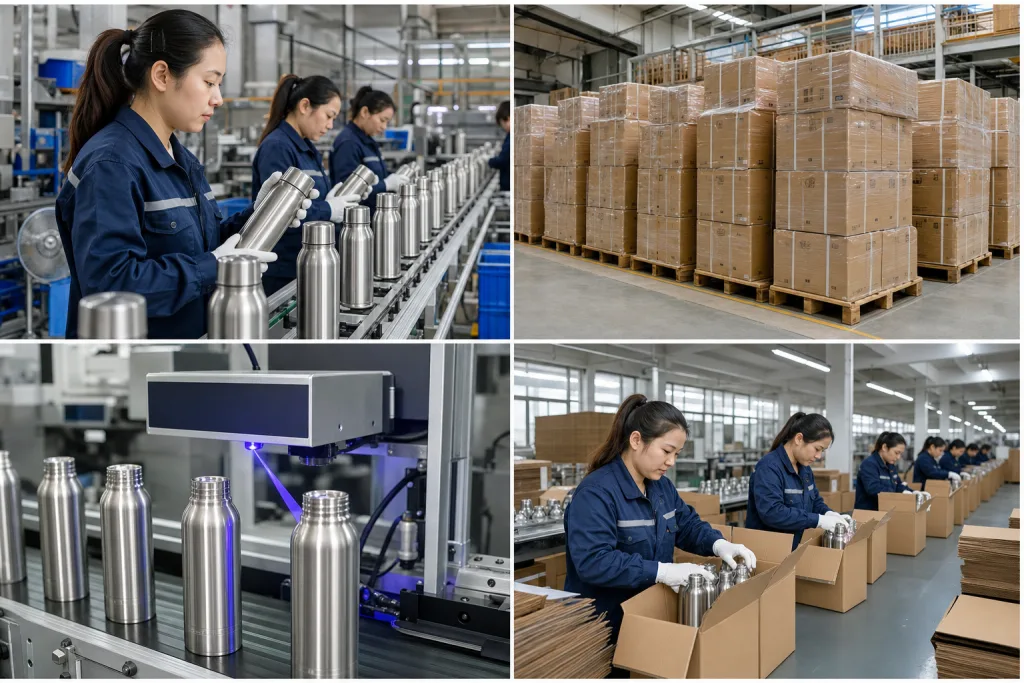
Factory audits matter too, especially for distributor thermos programs supplied to chain retailers. BSCI, Sedex, ISO 9001, or internal audit records help your customer’s compliance team move faster. They do not guarantee product quality. They show whether the factory keeps batch traceability, signed labor files, complaint records, and process-control logs. In China, 200 drinkware factories can assemble bottles; far fewer can keep stable documentation from 304 stainless coil receiving, polishing, vacuum testing, coating, packing, and final inspection. On our floor, the vacuum leak tester records each batch before cartons move to the packing table.
Add compliance items directly into the PO: “Supplier to provide REACH declaration, LFGB test report for food-contact components, and material composition declaration before shipment.” If new testing is required, clarify who pays and how many days it adds. LFGB testing can take 7-10 working days. Ask early. Waiting until cargo is ready is the wrong question to ask; the math does not work when 36 cartons are sealed, the forwarder is booked, and your customer is still waiting for paperwork.
Control inspection and shipment details
Final inspection is where 1 bad pallet can turn a custom thermos bottle Germany order into a debit note instead of a repeat PO. Do not write “check quality” on the QC brief. Use AQL. We run AQL 2.5 for major defects and 4.0 for minor defects on most drinkware shipments, with critical defects set to zero tolerance. Critical defects mean leakage, broken glass or metal contamination, unsafe sharp edges, wrong material, or severe odor. Major defects mean the buyer’s logo is off-position by 2 mm, coating adhesion fails, the body is dented, the vacuum test fails, or the retail box is packed against the approved artwork. QC pulled the sample, not the sales team.
For vacuum performance, factories should test 100% during production with hot water, air pressure, or vacuum equipment according to the process. On our line, the worker usually checks the inner bottle after welding, then QC records failed pieces on the inspection sheet before packing starts. Final random inspection should still include leakage and temperature checks. For coating, use a cross-hatch adhesion test on retained samples if you are dealing with powder coating or spray paint. For cartons, check drop-test logic, carton weight in kg, barcode readability, and FNSKU or EAN placement if the shipment goes to a fulfillment center. We have seen this go sideways when the carton mark said “black lid” but packing used white lids.
Shipment terms should match how much control you want after the goods leave Hangzhou. FOB Ningbo or FOB Shanghai is common for Zhejiang factories and gives your forwarder control after loading. DDP Germany works for small promotional thermos shipments, but the math does not work if HS code, VAT, duty, or delivery responsibility are vague. For sea freight, allow 30-40 days port-to-port to Northern Europe, plus booking time, customs clearance, and inland delivery. Rail can arrive sooner, then lose 7 days in peak season. Air only makes sense for samples, urgent top-up orders, or high-margin campaigns where the buyer accepts the freight cost per bottle.
Your shipping PO line should include carton dimensions, units per carton, gross and net weight, pallet requirement, carton marks, required documents, and latest cargo ready date. Be exact. A 54×38×42 cm carton and a 13.6 kg gross weight help the forwarder book space without guessing. For a customized thermos order, also request 2-3 production photos during assembly and packing. Photos do not replace inspection, but they catch obvious issues early, such as the wrong color lid, a missing instruction sheet, or a typo on the PO copied into the carton mark.
Plan reorders like a distributor
The first order proves the product. The second order proves the supply chain. If you act as a thermos distributor, lock the reorder file from day one: model number, mold code, Pantone or RAL color, logo file version, packaging dieline, barcode, test report reference, and inspection result. We run this in one master sheet because one buyer once approved RAL 9016 on the sample, then sent “same white” on the repeat PO; QC pulled the sample and the lid color was 1.5 shades off under the light box. Email history is not a control system.
For distributors thermos programs in Germany, build a seasonal forecast before the first container lands. If your retail season starts in September, place the PO in May or June, not August. Stainless drinkware factories in Zhejiang and other parts of China fill up before back-to-school, Christmas gifting, and corporate promotion seasons; on our line, a 5,000 pcs reorder usually needs 30-35 days for production after deposit and artwork confirmation. A reorder placed 60 days before required delivery is safe. A reorder placed 25 days before delivery turns into air-freight math, and the math usually does not work.
Plan spare parts too. Silicone gaskets, lids, straps, and infusers cost little but save customer-service time. Add 1-2% spare gaskets or lids to the PO, especially for outdoor bottles. For retail, we ship them in a separate labeled carton, for example “Spare Lid / Model T500 / Black / 80 pcs,” so your warehouse does not cut open saleable units to fix returns.
If you want a long-term thermos vendor, share sales feedback without polishing it. Tell the factory which lid customers liked, which color moved slowly, and which packaging arrived crushed. We have seen this go sideways when the buyer only says “quality is okay,” then repeats the same carton and gets corner dents again after a 22 kg master carton drop. A good manufacturers thermos partner will adjust wall thickness, carton strength, coating texture, or gasket hardness before the next run. That is how a custom thermos program becomes a controlled product line instead of a one-time import risk.
Send a thermos RFQ with real production details
Share capacity, quantity, logo method, packaging, and Germany compliance needs. We will return a practical FOB quote and sampling plan.
Frequently asked questions
What MOQ should I expect for a custom thermos bottle Germany order?
For existing stainless thermos molds, a realistic MOQ is 1,000 pcs per model and usually 500 pcs per color. Some suppliers thermos offers may accept 300 pcs, but expect a higher unit price, fewer color options, and lower production priority. If you need a new mold, private lid, or unusual capacity, 3,000-5,000 pcs is more normal. For promotional thermos orders with simple logo printing, 1,000 pcs is usually enough to get stable FOB pricing and proper QC. For outdoor retail with retail boxes, barcodes, and German-language instructions, I would not advise going too small because fixed setup costs become inefficient.
How long does sampling and bulk production take from China to Germany?
For an existing factory thermos model, a blank sample usually takes 3-5 days. A decorated sample with custom color and logo takes about 7-12 days after artwork approval. If you require a new mold, add 25-35 days. Bulk production normally takes 30-40 days after deposit for standard colors and existing packaging. With powder coating, retail boxes, multiple SKUs, or peak-season capacity pressure, 45-55 days is safer. Sea freight from Ningbo or Shanghai to Northern Europe often needs 30-40 days port-to-port, plus customs and inland trucking. For Germany, plan the whole project at least 90 days before your delivery deadline.
Which logo method is best for outdoor retail thermos bottles?
For outdoor retail, powder coating plus laser engraving is usually the most durable choice. The logo will not peel because the laser removes part of the coating surface rather than adding ink. It is suitable for stainless thermos bottles that face backpacks, gloves, and repeated washing. Silk screen printing is cheaper, often USD 0.08-0.18 per unit, and works well for simple promotional thermos campaigns. Heat transfer or full-wrap graphics give more color but can cost USD 0.45-0.90 per unit and need tighter inspection. If your customized thermos will be sold at retail for several seasons, avoid choosing decoration based only on the lowest price.
What compliance documents do German buyers usually request?
German buyers commonly ask for LFGB food-contact testing, REACH compliance for coatings and plastic parts, BPA-free declarations for lids, and material composition declarations for stainless steel and silicone. If the product is for children, expect extra review for small parts, sharp edges, and age labeling. Distributor thermos programs may also request BSCI, Sedex, or ISO 9001 factory documents. The important point is model relevance. A report for a different lid, coating, or plastic color may not cover your order. Ask for full PDF reports, not screenshots, and confirm whether new testing is needed before paying the deposit.
Should I buy FOB China or DDP Germany for thermos bulk orders?
FOB Ningbo or FOB Shanghai is better if you have your own forwarder or need control over freight cost, customs documents, and delivery scheduling. It is common for thermos manufacturer exports from Zhejiang. DDP Germany can be convenient for small promotional orders or first-time buyers, but you must confirm what is included: duty, VAT, customs clearance, delivery address type, and responsibility if customs asks questions. For thermos bulk orders above 1,000-2,000 pcs, FOB often gives clearer cost control. For urgent samples or 100-300 replacement units, courier or air DDP may be practical despite the higher per-unit freight cost.