Key Takeaways
- A practical stainless thermos MOQ starts at 1,000 pcs for laser logo and 3,000 pcs for custom powder coating
- For Germany, plan 35-45 days production after sample approval and 30-38 days sea freight to Hamburg
- Specify 304 inner steel, 201 or 304 outer steel, 0.45-0.55 mm wall thickness, and REACH-compliant coatings
- Use AQL 2.5/4.0 inspection plus 100% vacuum retention sampling before releasing balance payment
A German outdoor retailer does not buy a custom thermos the same way it buys a catalog mug. You have a €14.99 shelf target, an October winter promo slot, REACH paperwork, EAN barcode cartons, and a brand manager asking whether the laser logo passes 50 dishwasher cycles. Small miss, big pain. If the color chip is approved under office lighting instead of a D65 light box, 5,000 bottles can turn into slow-moving stock.
Let’s walk through a real custom thermos bottle deutschland order from brief to shipment. BottleForge Industrial builds stainless vacuum bottles in Zhejiang, China, so I’ll say what the factory can control, what needs your signed approval, and where buyers usually lose 20 days for no good reason. We’ve seen this go sideways when a PO says “black” but the artwork file names Pantone 426C; QC pulled the sample, the line stopped, and the math did not work for the ship date.
The German order brief
Picture the order: a mid-size outdoor retailer in Germany wants a 750 ml custom thermos for autumn hiking promotions. Target landed cost is under USD 7.20, retail price is EUR 24.95, and the first delivery must reach the warehouse near Dortmund before September. The buyer asks for matte forest green, laser logo, individual kraft box, EAN barcode, and German care instructions. We would also check the carton mark early, because one PO typo in “Dortmund” can hold a booking for a full day.
This is a normal custom thermos bottle deutschland project, but the small choices already move price and lead time. A laser logo on a stock color can run fast. A new powder-coated Pantone color means color matching, a coating adhesion test, and a higher MOQ; our line usually checks powder thickness around 60–80 μm before packing. If you also want a custom cap mold, you are not buying a promotional thermos anymore. You are starting product development, and the math often does not work for a first 1,000 pcs order.
For a clean first order, I would specify the brief like this before we cut the sample ticket:
- Capacity: 750 ml, tall narrow body for backpack side pockets, with the body diameter checked against a 75 mm pocket gauge.
- Material: SUS304 inner liner, SUS304 or SUS201 outer shell depending on price target and the buyer’s margin pressure.
- Insulation: 12 hours above 55°C starting from 95°C water at 20°C room temperature, tested after QC pulled the sample from the cooling rack.
- Surface: matte powder coating, REACH and LFGB contact expectations checked before the green shade is approved.
- Logo: laser engraving or one-color screen print on the first run, because mixing both creates more rejection points around the logo area.
- MOQ: 1,000 pcs for stock color laser, 3,000 pcs for custom coating.
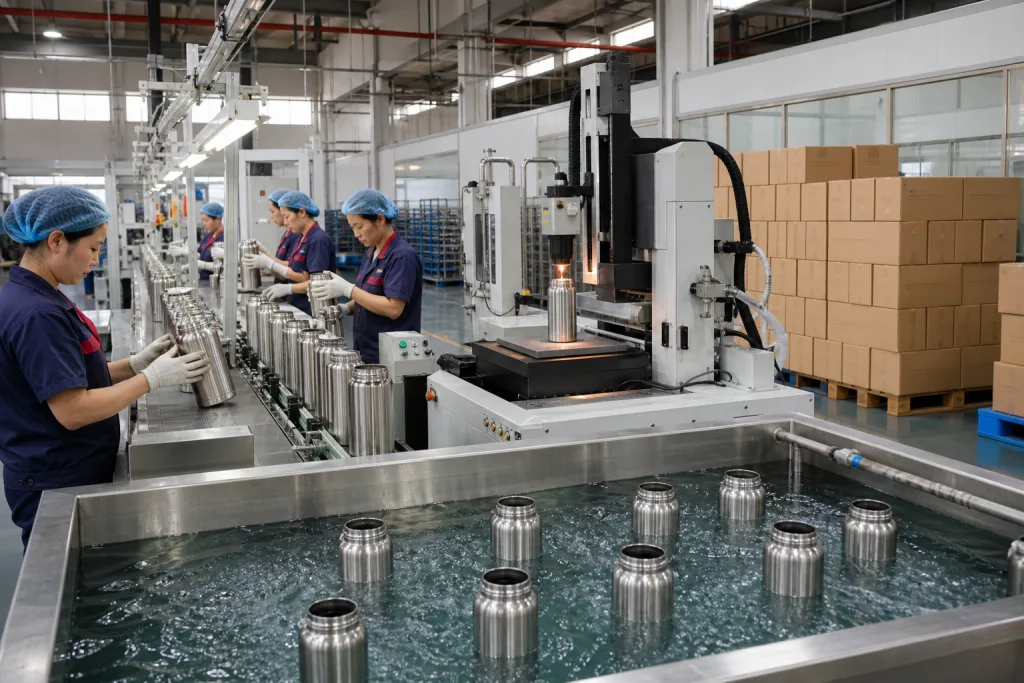
At our Zhejiang facility, a standard stainless thermos line can output about 180,000 units/month across bottle sizes. That does not mean your order ships tomorrow. Production slot, coating color, packaging print, and QC booking set the real schedule in China; for this type of order, we usually plan 12 days for stock color laser work versus about 18 days once custom coating and printed kraft boxes enter the line. We have seen this go sideways when the buyer approves the bottle sample but forgets the EAN barcode artwork.
Lock the bottle specification first
Lock the physical bottle before anyone spends time on logo artwork. We still see buyers spend 7 days arguing over a 28 mm logo, then leave steel grade and lid structure blank on the PO. Wrong order. The bottle drives claims, returns, and those painful one-star reviews after DHL parcel handling.
For a distributor thermos program in Germany, 304 stainless steel should be the default for the inner liner. It resists corrosion better than 201 and is accepted for food-contact drinkware. The outer wall can be 201 when the target price is tight and the powder coating passes cross-cut tape testing, but for outdoor retail I usually push for 304 outer as well. The cost increase on a 750 ml bottle may be USD 0.35-0.60, and the math works if the buyer wants a stronger product story instead of a race-to-the-bottom listing.
Ask your thermos manufacturer to confirm body wall thickness, not just send a nice render. A common range is 0.45-0.55 mm for stainless vacuum bottles, measured with a digital thickness gauge after the body is drawn. Below that, dents show up faster during parcel drops. Above that, cost and weight rise. For a 750 ml hiking model, 420-480 g net weight is realistic. If your product page promises ultralight, put that in the quotation request before the tool is chosen.
Lid design matters more than buyers expect. A screw cap with silicone gasket is robust and cheap, and QC can pressure-test it quickly on the line. A push-button lid feels convenient, but it has more leak-risk points around the spring, button seal, and drinking outlet. We have seen this go sideways on corporate gift orders when the buyer only tested one desk sample. For promotional brands ordering thermos bulk for corporate gifts, simple lids cut complaints. For outdoor retailers, a cup-lid design can sell better because German customers expect hot tea and soup use in winter.
Do not approve a supplier thermos quote unless the spec sheet states capacity, steel grade, coating type, gasket material, leak test method, and heat retention condition.
Branding without creating trouble
A customizable thermos gives you a few branding routes: laser engraving, silk screen printing, heat transfer, full-wrap print, or embossing on a custom part. For a first German order, I’d choose laser engraving on powder coating. Clean result. Permanent mark. Fewer arguments about ink adhesion after the 3M tape test. The trade-off is color: laser burns through the coating and shows the steel or base layer, so nobody should expect a Pantone-matched logo.
Silk screen printing works for one or two colors when the artwork is simple and the logo area is not fighting the bottle curve. On curved bottles, text under 6 pt and lines under 0.25 mm often break; QC pulled a 500 ml sample last month where the slogan looked fine in the PDF but filled in after printing. If you need a full-color mountain scene, use heat transfer or water transfer, but budget for extra setup and tighter inspection. A thermos promotional order for a trade show can live with small visual variation. Retail shelf stock under bright store lighting cannot.
For the German market, keep the branding layout practical. A front logo at 45-60 mm wide usually looks balanced on a 750 ml cylinder. Add a small compliance line or URL on the back only if it does not crowd the design; we’ve seen this go sideways when a buyer tried to fit 4 icons, a QR code, and 3 languages into a 32 mm panel. If the bottle is sold through marketplaces, packaging should reserve space for EAN, FNSKU if needed, country of origin, and recycling marks.
Here is where buyers waste time: they send a JPG logo pulled from a website. That is the wrong file. A factory thermos vendor needs vector artwork, usually AI, PDF, EPS, or SVG, with fonts outlined and logo size marked in mm. If your brand color matters, provide Pantone C code and approve a physical color chip; we run coating checks against real swatches on the line, not your laptop screen. Digital screens are not enough.
Sampling: approve the right things
Sampling is not a beauty shot for the sales deck. It is the contract turned into 304 stainless steel, powder coating, lid fit, logo position, and the retail box your customer will touch. For a customized thermos order, we run two sample stages when the calendar allows: first, a pre-production sample in an available color or stock body to confirm the structure; second, a final PP sample with the correct coating, logo, insert, and box. On our floor, QC checks the mouth diameter with a digital caliper before anyone argues about artwork.
A normal sample timeline from Zhejiang is 7-10 days for stock color laser logo and 12-18 days for custom powder coating. International courier to Germany adds 3-5 working days. If the sample must sit on the table before a buying committee meeting in Hamburg or Munich, put those courier days into the plan. We have seen this go sideways: the buyer flagged “urgent sample,” then the DHL pickup missed the Friday cutoff and the line slot was already gone.
When the sample arrives, test it like a buyer, not like someone proud of a fresh logo. Fill it with boiling water, close the lid, invert for 30 minutes, and check for leaks on a dry paper towel. Measure the temperature after 6 and 12 hours with the same probe thermometer, not by feeling the shell. Check if the coating scratches under normal fingernail and key contact. Put the bottle into the intended retail box and drop the packed unit from 80 cm on one corner, one edge, and one face. This is not a full ISTA lab test, but it exposes weak packaging fast.
Send written approval with photos and measurable comments. “Looks good” is the wrong approval. Say: logo position approved at 82 mm from base, box barcode approved, coating color approved against Pantone 5605C, lid torque acceptable. A serious thermos supplier will attach this approval to the production file, and QC should pull that file before mass production starts. We once had a PO typo on Pantone 560C versus 5605C; the sample approval saved the shipment.
Price, MOQ, and shipping math
Most outdoor retailers and promotional brands ask us for the lowest FOB price first. Fair question, but it is the wrong question to ask before the trade term is fixed. FOB Ningbo or Shanghai, EXW Zhejiang, DDP Germany, and CIF Hamburg are four different calculations. Last month a buyer compared our FOB Ningbo sheet with another supplier’s DDP Germany offer and thought we were USD 0.42 higher; the freight line was the difference. If you compare suppliers thermos quotes without matching Incoterms, you are not comparing factories. You are comparing freight assumptions.
As a working reference, a 750 ml double-wall stainless bottle with 304 inner, 201 outer, powder coating, laser logo, and individual color box may sit around USD 4.20-5.60 FOB China at 3,000 pcs, depending on lid, steel market, and packaging. Full 304 construction may add USD 0.35-0.60. Custom color coating may add USD 0.15-0.35. A more complex lid can add USD 0.30-0.90. On the line, QC pulled one sample where the silicone ring was 1.2 mm off-spec, and that lid needed a different mold insert; small part, real cost. These are not promises. They are the ranges we expect to see in a manufacturer thermos quotation when the spec sheet is clear.
MOQ matters because coating, printing, and packaging all create setup loss before the first sellable carton comes off the line. For BottleForge Industrial, typical MOQ is 1,000 pcs for laser logo on existing models and colors, 3,000 pcs for custom powder coating, and 5,000 pcs or more for special lid components. For a distributors thermos program with several regional clients, combine colors with care. Five colors at 600 pcs each usually cost more and run slower than two colors at 1,500 pcs each, because the coating booth needs cleaning, the Pantone card must be checked again, and the carton label file often changes by market. We have seen this go sideways when a PO had “mat black” instead of “matte black.” One typo held packing for 2 days.
Sea freight from Ningbo to Hamburg often takes 30-38 days port to port, plus trucking and clearance. Production after PP sample approval is usually 35-45 days in normal season. We run faster on repeat SKUs, but new artwork, a new lid, or a German retail barcode check can eat 3-5 days before mass production starts. If your autumn campaign launches in September, approve the PP sample by late June, not mid-August. The math does not work otherwise.
QC before the balance payment
QC on a custom thermos order should not mean 6 nice photos taken beside the packing table. Agree the inspection plan before we cut steel or print the logo. For Germany and wider EU sales, check material grade, weld finish, coating, logo position, carton marks, EAN labels, and basic heat performance. If you use a third-party inspector, book them when production is 80% complete and goods are at least 100% packed. We had one buyer in Hamburg try to inspect at 45% packed; the line was still changing lids, so the report was almost useless.
A common inspection standard is ANSI/ASQ Z1.4 with AQL 2.5 for major defects and 4.0 for minor defects. Critical defects should be zero. No debate there. Major defects include leakage, wrong logo, exposed sharp edges, serious dents, failed lid function, incorrect barcode, or wrong capacity. Minor defects include small coating specks, slight box scuffs, or tiny print variation within approved limits. QC pulled 200 samples last month and found 7 cartons with a PO typo in the side mark; not dangerous, but German retail warehouses will flag that fast.
For vacuum bottles, I like to add performance checks beyond cosmetic AQL. Pull random units and run leak testing, lid fit testing, and heat retention testing. We run 3 upside-down leak checks at room temperature, then check lid torque by hand and with a simple torque meter if the cap design is new. A factory may also perform 100% air pressure or vacuum process checks during production, but final random testing still matters. Ask for the QC record with date, operator name, pressure value, and failed quantity, not just “all passed” in a WeChat message.
Compliance documentation should be collected before shipment, not while the container is already at Ningbo port. For Europe, buyers usually ask about LFGB food-contact testing, REACH for coatings and components, and sometimes BSCI or ISO 9001 factory documents. If the bottle is for children, extra requirements can apply. Do not assume one old test report covers a new coating, new gasket, or new lid material; this is the wrong shortcut, and we have seen it go sideways during customs review. China suppliers can provide solid documentation, but send the exact material list early, down to 304 stainless, PP lid, silicone ring, powder coating color code, and logo ink.
Receiving and reordering smarter
Once the goods land in Germany, open the first 5 cartons before anything goes to stores or clients. Check carton marks against the PO, scan 10 barcodes with a handheld Zebra scanner, confirm German packaging text, and pull random bottles for dents, coating dust, crooked logos, or lid scratches. Do it day one. If there is damage, photograph the master carton, inner box, pallet corner, container floor, and seal number. Claims get paid faster when the evidence is clean and dated.
For a thermos distributor or outdoor retailer, the second order is where margins start to improve. You already paid the learning cost: bottle shape, coating color, packaging dieline, barcode position, QC checklist. If 304 stainless shells and lids are in stock, reorder production often runs 30-40 days, not 55 days for a fresh project, unless the line is full before Christmas. We run into this every October. Use the reorder to fix carton packing, add mixed pallet labels, or include 1% spare lids based on actual return notes, not a buyer’s guess.
Track the complaints in a simple sheet. If 0.3% of customers report lid leakage, the channel may accept it, though QC should still cut open 3 returned lids and check the silicone gasket fit in mm. If 2% report coating chips near the base, the math does not work. Change the powder coating process, add a silicone boot, or raise box protection from thin E-flute to stronger insert support. Guessing burns margin.
The best thermos manufacturers are not just cheap exporters. They reduce uncertainty order by order. A good thermos factory in Zhejiang should tell you when a requested feature is worth paying for and when it will make the product harder to control on the line. We have seen matte gradient coating look great in a sample room and fail AQL 2.5 after pallet rubbing. That honesty is worth more than a USD 0.08 saving on the first quote.
Send your German thermos brief for factory review
Share capacity, logo, MOQ, target price, and delivery month. We will check the spec before you commit budget.
Frequently asked questions
What MOQ should I expect for a custom thermos bottle deutschland order?
For most stainless models, expect 1,000 pcs MOQ if you use an existing bottle shape, existing coating color, and laser engraving. If you need a custom Pantone powder coating, 3,000 pcs is more realistic because the coating line has setup loss and color change cleaning. Special lids, molded silicone parts, or exclusive body tooling can push MOQ to 5,000-10,000 pcs. If you are testing the German market, start with one 500-750 ml model in two colors instead of five small color splits.
Is 304 stainless steel necessary for a promotional thermos?
For the inner liner, yes, I strongly recommend SUS304 for Germany and the EU. It is the normal food-contact choice for quality stainless drinkware and reduces corrosion complaints. For the outer shell, SUS201 can be acceptable on price-driven promotional thermos projects if coating quality is controlled. Outdoor retail products usually justify 304 outer steel too, adding roughly USD 0.35-0.60 on a 750 ml bottle. If your brand claims premium or long service life, full 304 construction is easier to defend.
How long does production and shipping from China to Germany take?
A safe schedule is 7-18 days for samples, 35-45 days for mass production after PP sample approval, and 30-38 days sea freight from Ningbo or Shanghai to Hamburg. Add time for customs clearance, trucking, and your warehouse receiving process. Air freight can move in 5-8 days but is usually too expensive for thermos bulk orders unless you are shipping a small urgent batch. For a September retail campaign, approve final samples by late June.
Which logo method is best for a customized thermos?
Laser engraving is the safest for durability, especially on powder-coated stainless bottles. It does not peel, and it handles outdoor use well. Silk screen printing is cheaper for simple one-color logos but needs adhesion testing and good artwork. Heat transfer works for full-color designs, but QC must control alignment, scratches, and wrap edges. For first orders, I advise one logo method only. Combining laser, print, and sleeve packaging increases approval steps and defect risk.
What QC checks should I require before shipment?
Use AQL inspection, commonly 2.5 for major defects and 4.0 for minor defects, with zero tolerance for critical safety defects. Check logo position, coating defects, dents, lid function, leakage, barcode scanning, carton marks, and packaging language. Add thermos-specific tests: random heat retention checks at 6 and 12 hours, inverted leak test for 30 minutes, and lid torque review. Ask the manufacturer thermos supplier for material declarations and relevant LFGB or REACH reports before you pay the balance.