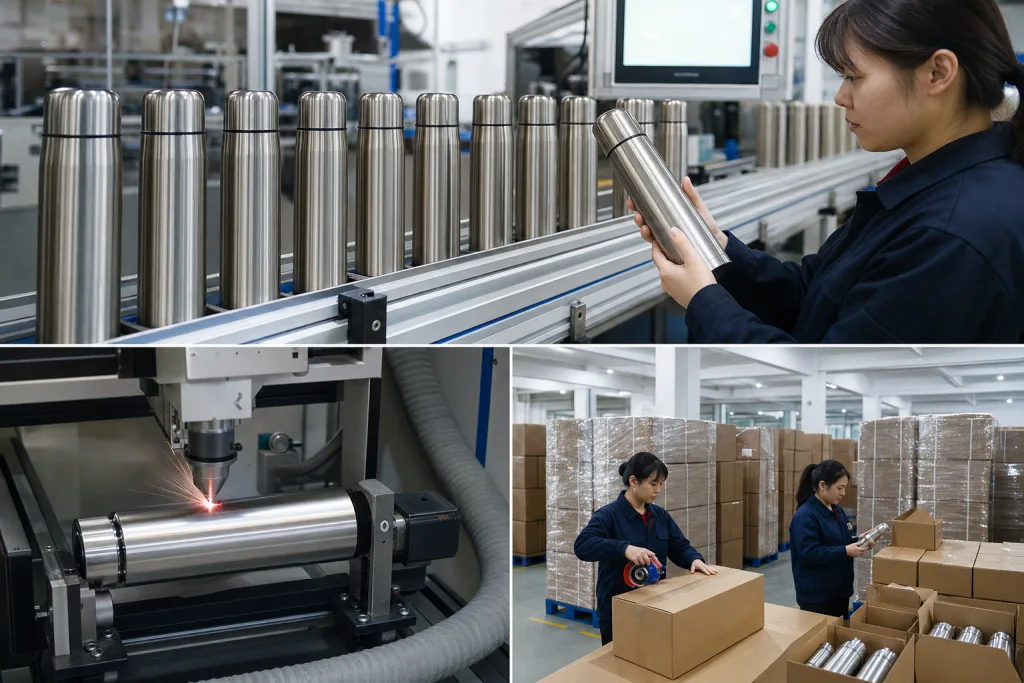
Key Takeaways
- A practical custom thermos bottle Britain order usually starts at 1,000 pcs per colour for OEM finishing
- 304 stainless steel at 0.45-0.55 mm wall thickness fits most retail and promotional thermos projects
- Laser engraving lasts longer than print on powder coating, but adds about USD 0.18-0.45 per unit
- UK buyers should request LFGB/REACH support, AQL inspection, carton drop testing, and GS1-ready barcodes
If you sell outdoor gear in Britain or buy promo stock for UK clients, a custom thermos looks easy until the quote sheet hits your inbox. We see this every week: two bottles both marked 500 ml, 304 stainless steel, vacuum insulated, matte black, yet one passes retail intake and the other gets rejected for a lid leak at 0.6 bar, coating rub-off, or a logo that chips after 21 days in use.
From our factory in Hangzhou, Zhejiang, we quote stainless thermos projects for Europe and North America every week. “Cheap versus premium” is the wrong question to ask. The real choice is capacity tolerance, steel grade, lid thread design, powder coating thickness, logo method, MOQ, testing standard, and delivery risk; last month QC pulled a sample with a 1.8 mm lid gap after the buyer had already approved the artwork. China can build each level, but the level must be written down before the price means anything.
The buyer decision matrix
For a custom thermos bottle Britain project, we usually see 4 buying paths on the RFQ: promotional giveaway, outdoor retail, distributor thermos range, or corporate gift programme. Same bottle shape on the screen. Different spec on the line.
| Use case | Typical capacity | Best finish | Logo method | Target FOB China |
|---|---|---|---|---|
| Promotional thermos | 350-500 ml | Spray paint or powder coat | Silkscreen | USD 3.20-5.10 |
| Outdoor retail | 500-750 ml | Powder coat | Laser or 1-colour print | USD 5.40-8.80 |
| Distributor thermos line | 500 ml, 750 ml, 1 L | Shared colour range | Laser + box label | USD 5.00-9.60 |
| Premium gift | 500 ml | Fine powder coat | Laser or UV print | USD 6.20-10.50 |
A promotional brand often wants the lowest compliant customized thermos that still looks clean for a 6-week campaign. An outdoor retailer needs repeatable insulation performance, coating adhesion, shelf-ready packaging, and fewer returns once winter stock lands. Distributor thermos buyers talk less about one hero bottle and more about SKU control: one body shape, three sizes, six colours, same carton format, same barcode position. We had one UK PO where the buyer wrote “750ml” in the item name but “500 ml” in the carton mark column; QC pulled the sample before mass carton printing, which saved a messy relabel job.
Our Zhejiang production line runs around 650,000 stainless drinkware units per month across bottles, tumblers, and food jars. That output helps when a thermos bulk order needs 4 split colours under one shipment, but the math doesn’t work if the buyer cuts the lid spec too far. A cheaper lid with 1 silicone sealing point may pass a 10-minute bench leak test and still leak after courier handling. A glossy coating can photograph well and fail a 1 mm cross-hatch adhesion test after dishwasher misuse. Check the sample after 24 hours of real use, not just against catalogue images.
Capacity versus real outdoor use
Capacity is the first visible choice, and it is where UK buyers often order the wrong bottle. We see it on repeat: 5,000 pcs booked for a promo brief, then the buyer flags that the bottle feels too small for outdoor use. A 350 ml custom thermos is easy to hand out at trade shows and fits office bags. Fine for desks. Poor for hill walking or 10-hour shifts outside. A 1 L bottle works for camping, fishing, and job sites, but it feels heavy in the hand and pushes up landed cost by carton weight. For outdoor retailers, 500 ml and 750 ml are the safer first run; this is usually where the maths works after we check the sample on a 0.1 g scale and pack it into a 24 pcs master carton.
Head-to-head, the 500 ml bottle wins on portability and retail price. It normally weighs 280-340 g depending on wall thickness, cap construction, and powder coating. The 750 ml version weighs around 390-470 g and needs a stronger carton insert because dents cost more once the outer wall has been powder coated. QC pulled one 750 ml sample last season with a 1.2 mm corner dent after a drop test, and the buyer rejected the whole insert design. A 1 L manufacturer thermos can be a strong winter SKU, but it is the wrong choice for mass promotional thermos campaigns unless the client has budget for a higher perceived-value gift.
For insulation, ask the thermos factory to quote a test condition, not just “keeps hot 12 hours.” That line causes arguments. A fair factory thermos benchmark is boiling water at 95°C, room temperature at 20°C, and measurement after 6 or 12 hours with the lid closed and the probe inserted only at the test point. A good 500 ml double-wall vacuum bottle should still read around 58-68°C after 6 hours, depending on mouth diameter and lid design. Wide-mouth bottles lose heat faster, but buyers like them for ice cubes and cleaning; we usually check the mouth ID with a vernier caliper before confirming the mould drawing.
If your brand sells to hikers, cyclists, and van-life customers in Britain, do not ignore glove-friendly lids. A narrow twist cap may look clean on a CAD file, but it is irritating in cold rain. We have seen this go sideways. A loop cap or carry handle can add USD 0.25-0.70 FOB, yet it reduces return risk and gives the shelf sample a better hand feel when the buyer picks it up at the stand.
Steel, coating, and lid trade-offs
Most custom thermos supplier quotes will mention “304 stainless steel.” That is a starting point, not a full spec. On our line, QC pulled the sample and checked the weld seam with a 10x loupe before we signed off the drawing. You need the inner steel, outer steel, wall gauge, coating, and lid material written down. For food contact, 304 stainless steel inside is the usual pick for Europe. Some suppliers use 201 stainless steel outside to cut cost; it can work in dry storage, but for Britain’s wet outdoor market, 304 outside is the safer call unless the buyer is chasing a hard price target.
A practical wall thickness is 0.45-0.55 mm before forming. Go thinner and the bottle dents easier in sea freight or on a shop floor. Go thicker and you pay for steel, forming, and extra freight weight. We ran a 0.5 mm shell through a carton drop test last month, and the 0.4 mm sample showed a flat spot on the shoulder. The thickest body is the wrong question to ask. You want a stable body with clean welding, smooth inner polishing, and steady vacuum hold, not just a heavy tube.
Coating is another straight trade-off. Spray paint is cheaper and fits short-run promotional thermos orders, especially when the buyer is pushing a tight landing price. Powder coating costs more but gives better grip and a more retail-grade feel. On the line, QC runs the 3M cross-hatch after cure; if the tape lifts a corner, the batch stays put. For outdoor brands, powder coating with a 3M cross-hatch adhesion test is worth writing into the PO. It cuts the risk of edge peeling at the base and shoulder, and that is where complaints usually start.
Lids cause more trouble than the steel body. A simple screw cap is rugged and cheaper. A push-button lid is handy, but it has more failure points and needs leakage, odour, and cleaning access tests. Silicone seals should be food-grade, removable if possible, and checked after heat cycling. We saw one cap with a 1.5 mm mould line hold tea smell after a 55°C soak, so do not trust the pretty sample alone. We have seen UK buyers save USD 0.15 on a lid and then spend more than that on complaint handling. If your supplier thermos quote looks too low, open the lid drawing first.
Branding methods compared clearly
Logo choice changes how a bottle looks and how often it gets rejected on the line. For a thermos custom order, we run five main methods: silkscreen printing, pad printing, laser engraving, UV printing, and full-wrap heat transfer. They do different jobs. Treat them as interchangeable and the math does not work.
| Method | Best for | Typical MOQ | Durability | Cost impact |
|---|---|---|---|---|
| Silkscreen | 1-2 colour logos, clean spot branding | 500-1,000 pcs | Medium | USD 0.08-0.25 |
| Laser engraving | Outdoor retail, corporate gifts, powder-coated bodies | 300-1,000 pcs | High | USD 0.18-0.45 |
| UV print | Colourful artwork, small-run retail designs | 500-1,000 pcs | Medium-high | USD 0.25-0.80 |
| Heat transfer | Full wrap graphics, seasonal artwork | 1,000-3,000 pcs | Varies | USD 0.50-1.20 |
For outdoor retailers, laser engraving on powder coating is often the cleanest call. It handles abrasion better than surface ink, and the finish looks more technical. We check it with a 10x loupe after the first sample run, because one shallow mark will show up later on a gift shelf. The limit is colour. Laser removes or changes the coating surface, so it will not give you a true Pantone logo. For promo brands with a simple mark and a tight ship date, silkscreen still wins.
If you need a customisable thermos range for several end clients, use one standard bottle body and decorate late. We can keep blank coated stock ready, then print after purchase orders are confirmed. That works when the colour, carton size, and lid stay fixed. We tried the opposite once on a 600-piece order: new shape, new moulded lid, new gift box. Lead time blew out by 12 days, and the buyer flagged it fast.
Send vector artwork, Pantone references, and logo size in millimetres. “Large logo on front” is not enough. On a 500 ml bottle, 35-55 mm wide suits a discreet retail mark, while 70-90 mm works for promo visibility. One PO came through with “35 cm” typed in the notes. We caught it before the pad printer made the plate, which saved a scrap run.
Compliance for Britain and Europe
Britain has left the EU, but UK buyers still ask for EU-style paperwork because the same stock often moves through Amazon UK, EU distributors, and promo agencies. For a custom thermos bottle Britain order, ask your thermos manufacturer for food contact support, material declarations, and chemical test scope before mass production. Do it at sample approval stage. Last month, QC pulled one 500 ml sample with a PP lid marked “BPA free” on the artwork, but the PO had no BPA-free statement listed. Do not wait until goods are already on the water.
For stainless drinkware, ask for LFGB or EU food contact test reports covering 304 stainless steel, silicone gaskets, straws, and plastic lid components; REACH screening for powder coating; BPA-free statements for plastic parts; and heavy metal migration results where applicable. If children may use the product, discuss age grading and extra safety standards before tooling the lid. A kids bottle is a different risk profile from a 750 ml hiking flask. We have seen this go sideways when a buyer chose the same flip lid for adult gym bottles and school bottles, then flagged the 6 mm vent hole during inspection.
Factory audits also matter. BSCI or Sedex is often requested by British promotional agencies and larger retailers. ISO 9001 is useful, but it does not replace product testing. An audited factory thermos supplier can still ship a poor product if the purchase order leaves color tolerance, logo size, and test reports open. Write the test requirements into the proforma invoice or quality agreement. We run this on the line as a checklist: material grade, coating code, lid material, gasket color, carton mark, then the inspector signs beside each item.
Inspection should use AQL, usually General Inspection Level II with critical defects at 0, major defects at 2.5, and minor defects at 4.0. Critical defects include leakage, sharp edges, contamination, wrong material, or unsafe packaging. Major defects include visible dents, wrong logo position, poor coating, and carton errors. For a 3,000 pc thermos bulk order, a third-party pre-shipment inspection in China may cost USD 250-350. Cheap insurance. The math doesn't work if you save USD 300, then pay UK labour to open cartons, replace lids, and relabel 126 outer boxes in a warehouse near Birmingham.
MOQ, pricing, and lead times
MOQ is where about 4 out of 10 new UK buyers push back first. A thermos vendor in China may advertise 100 pcs, but that usually means shelf stock with a one-position logo, often pad print or laser on an existing colour. For a proper custom thermos with matched Pantone coating, buyer-approved packaging, and logo placement checked against a 1:1 artwork file, 1,000 pcs per colour is the honest starting point. New moulds, special lids, or full custom colour coating can push MOQ to 3,000-5,000 pcs. The math doesn't work at 300 pcs if the line has to wash the powder booth and reset the fixture.
Typical lead time from our Zhejiang facility is 7-10 days for sampling after artwork approval and 30-45 days for mass production after deposit and signed pre-production sample. We run the pre-production sample through leak testing, coating thickness check, and a 3M tape pull before the buyer signs off. Peak season before autumn and Christmas can add 10-15 days, especially for powder coating and gift box lines. Sea freight to the UK is commonly 35-45 days port to port, while rail or air costs more but can save an urgent promotional launch when the event date is fixed.
Pricing should be compared on the same Incoterm. FOB Ningbo or FOB Shanghai is common for China stainless thermos exports. EXW prices look lower, then the buyer gets hit with local truck cost, export clearance, and port charges. We have seen this go sideways when a PO said “FOB” but the buyer’s sheet calculated from an EXW quote. For a 500 ml powder-coated manufacturer thermos with laser logo and retail box, a realistic FOB range is USD 5.80-8.20 depending on lid design, steel grade, coating system, carton strength, and order volume. A simpler 350 ml promotional thermos may fall near USD 3.20-4.60 FOB.
For distributors thermos programmes, ask for a tiered quote: 1,000 pcs, 3,000 pcs, 5,000 pcs, and 10,000 pcs. The price drop is not a straight line. Steel, labour, and packaging do not disappear at scale, but coating setup, printing setup, and carton purchasing get cleaner once the line runs without changeovers. QC pulled one 5,000 pc sample lot last month because the carton ECT was under spec, so carton strength still belongs in the quote, not as an afterthought. A 5,000 pc order may save 6-12% versus 1,000 pcs if the spec is locked before deposit.
Packing and retail readiness
A stainless thermos is retail-ready only after the pack style, barcode position, and carton build are fixed on the PO. In our Hangzhou sample room, 8 out of 10 first quotes still default to a plain white box because it keeps the unit price low and avoids print risk. Fine for B2B giveaways. UK outdoor retailers ask for more: branded colour boxes with a locked dieline, hang tags with punched holes, instruction leaflets in the right pack, recycling marks on the bottom panel, and barcode labels that scan on a Zebra DS2208. If you sell through marketplace fulfilment, add FNSKU labels and carton limits before we cut the carton order.
For Britain, we push master cartons under 15 kg where possible because warehouse teams complain when a carton hits 17 kg on the scale. A common layout for 500 ml bottles is 24 pcs per carton, around 12-14 kg gross weight depending on packaging. For 750 ml or 1 L bottles, 12 pcs per carton is safer in transit and easier for one person to lift. We run carton drop testing from 60-80 cm on corners, edges, and faces; QC pulled one sample last season where the bottle survived but 6 gift boxes had crushed corners. Dented bases and crushed gift boxes are frequent problems when the inner tray, paper sleeve, or carton flute is left vague.
Retail packaging needs a dieline approved before mass printing, not after the print shop has made plates. Check barcode size against the scanner, legal address line by line, capacity marking in ml, care instructions that match the coating, material claims for 304 stainless, and country of origin. “Made in China” should be printed clearly if required by your sales channel. We have seen this go sideways over one PO typo: “500ML” on the box, “550 ml” on the Amazon listing. If sustainability claims are used, keep them factual: recycled paper box with stated paper grade, plastic-free inner bag if the PE bag is removed, or reusable stainless steel bottle without vague green wording your compliance team cannot defend.
The best head-to-head choice for 7 in 10 UK outdoor retail programs is not the most expensive box. That is the wrong question to ask. We ship cleaner with a strong 350 gsm colour box, an internal paper sleeve or pulp tray sized to the bottle base within 2 mm, a scannable EAN-13 barcode, and an export carton with clear SKU marks on two sides. That pack moves through distributor warehouses cleanly and cuts picking errors when mixed colours sit on the same pallet.
Send your thermos spec for a factory quote
Share capacity, logo method, target MOQ, and UK delivery date. We will return a practical FOB China quotation with production risks flagged.
Frequently asked questions
What MOQ should I expect for a custom thermos bottle Britain order?
For existing stainless bodies with your logo, 500 pcs can be possible, but 1,000 pcs per colour is the more reliable MOQ for a custom thermos with selected coating and packaging. If you need a special Pantone powder coat, full-wrap artwork, or a new lid colour, expect 3,000 pcs. A new moulded cap or exclusive bottle shape usually starts around 5,000-10,000 pcs because tooling, testing, and setup costs must be spread over enough units.
Which size sells best for outdoor retailers in Britain?
For outdoor retail, 500 ml and 750 ml are the safest first choices. A 500 ml customized thermos is light enough for commuting, day hiking, and gifting, while 750 ml gives better value for camping, fishing, and winter use. A 1 L bottle works well for job sites and longer trips but takes more shelf space and costs more to ship. If you are building a distributor thermos range, start with 500 ml and 750 ml in three colours before adding larger sizes.
Is laser engraving better than printed logos?
Laser engraving is usually better for outdoor use because it does not sit as a surface ink layer. On powder-coated stainless steel, it creates a clean, durable mark that resists scratching better than basic silkscreen. It normally adds USD 0.18-0.45 per unit depending on logo size and production speed. Silkscreen is still useful for promotional thermos orders with simple one-colour artwork and tight budgets. For multi-colour brand graphics, UV print may be better, but it needs stronger abrasion testing.
What test reports do UK buyers usually request?
Most British buyers ask for food contact documentation for stainless steel, silicone seals, and plastic lid parts. LFGB or EU food contact reports are commonly accepted across many European supply chains. REACH screening for coatings is also sensible, especially for coloured powder coating. For larger retailers or agencies, BSCI or Sedex audit status may be requested. You should also require leakage testing, coating adhesion checks, vacuum insulation testing, and AQL pre-shipment inspection before the bulk thermos order leaves China.
How long does a thermos bulk order take from China to the UK?
A normal timeline is 7-10 days for sample preparation after artwork approval, then 30-45 days for mass production after deposit and sample sign-off. Sea freight from Ningbo or Shanghai to the UK often takes about 35-45 days port to port, excluding customs clearance and inland delivery. For urgent promotional launches, air freight can move goods in 5-8 days, but the cost may damage your margin. Plan 90-110 days from first approved sample to UK warehouse for safer retail scheduling.