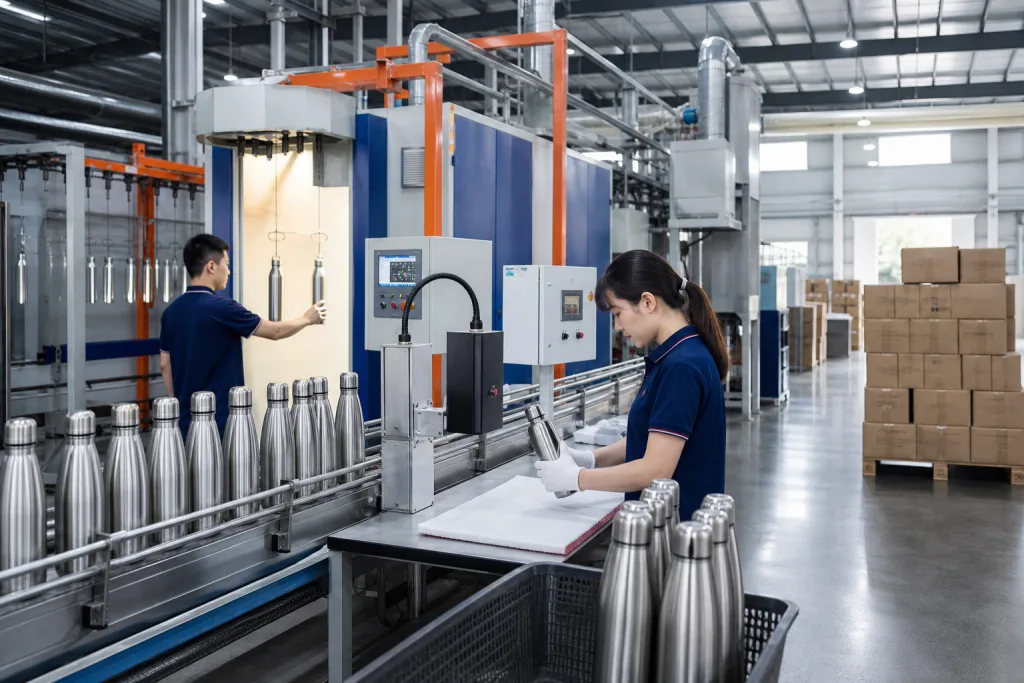
Key Takeaways
- A realistic custom thermos MOQ is 500-1,000 pcs per color for standard models
- FOB China pricing for 500 ml stainless thermos bottles often lands around USD 3.20-6.80 depending on lid and finish
- Allow 25-35 days for mass production after approved PP sample and deposit
- Use AQL 2.5/4.0 inspection and test 100% of samples for vacuum performance
If you sell outdoor gear or manage promotional drinkware programs in America, finding a custom thermos is not the hard part. The real risk is approving a supplier thermos program that leaks at the lid, ships 12 days late, or fails compliance review after the PO is paid. We have seen this go sideways from one 0.3 mm gasket mismatch.
We manufacture stainless vacuum bottles in Zhejiang, China, and most failures are decided before sampling: the buyer picks the wrong lid, artwork arrives as a low-res JPG, the MOQ math does not work, or nobody writes an AQL plan. QC pulled one sample last month because the logo sat 4 mm off-center. Use this as a practical Q&A and checklist before you place bulk thermos orders with any thermos factory.
Start with the buying use case
A custom thermos bottle America program for an outdoor retailer is not the same job as a one-week trade show giveaway. Retail buyers ask about repeat purchase, shelf tray fit, lid failure rate after drop testing, and whether the bottle still opens with gloves in a cold Minnesota parking lot. Promotional brands push us on logo edge clarity, carton labels, event delivery dates, and a landed cost that stays under the client’s budget. We have seen buyers flag a 0.3 mm logo shift on a pre-production sample.
Before asking a thermos supplier for a quote, write the use case in one paragraph. Is it a 750 ml bottle for hiking? A 500 ml commuter flask? A 1 L insulated bottle for hunting, fishing, or work trucks? This is the wrong question to leave open, because that choice sets the steel thickness, cap structure, carton size, and freight cost. On the line, a 1 L bottle may need a taller neck forming tool and a different inner carton, not just a bigger body.
For North America, our most common customized thermos sizes are 500 ml, 750 ml, and 1,000 ml. Outdoor retail buyers usually pick 750 ml or 1,000 ml because the bottle feels serious in the hand and looks right on a peg or shelf. Promotional thermos projects often land on 500 ml, since it is easier to hit a price target and cheaper to ship by air if the deadline slips from 12 days to 18 days. We run carton drop checks on the packed sample before mass packing, because crushed corner labels create arguments at receiving.
Do not start with the logo. Start with the user, the fill volume, and how the lid opens, seals, and cleans. A beautiful logo on a leaking lid is still a rejected shipment.
At BottleForge Industrial in Hangzhou, Zhejiang, our monthly capacity for stainless drinkware is about 600,000 units across vacuum bottles, tumblers, and sports bottles. That number only matters when your specification is clear. A factory thermos line can move fast, but it cannot fix an unclear brief after cartons are printed. QC pulled one sample last year because the PO said “matte black” while the artwork file said “satin black”; that small typo stopped packing for 6 hours.
What specification should you request?
Ask for a written specification sheet before you compare prices between thermos manufacturers. A quote that says “500 ml stainless bottle with logo” is too thin for costing. We see two bottles look the same in a PDF, then the price moves by USD 1.20 because the inner steel is different, the outer wall is lighter, the lid has one less silicone ring, or the carton spec changed from 5-ply to 3-ply. QC pulled one sample last month where the PO said matte black, but the approved sample tag said BK-03 texture black. That became a 2-day argument.
For a serious custom thermos program, your RFQ should include:
- Capacity: 350 ml, 500 ml, 750 ml, or 1,000 ml, measured to brim or usable fill line. Tell the factory which one you use on your Amazon listing.
- Material: 304 stainless steel inner wall; 201 or 304 outer wall depending on target price and corrosion needs. For coastal U.S. orders, buyers push back harder on rust complaints.
- Construction: double-wall vacuum insulation, copper plating optional for higher heat retention. Ask for the test result at 6 hours and 12 hours, not just a nice sentence.
- Wall thickness: commonly 0.4-0.5 mm per wall for standard stainless bottles. The line checks this with a micrometer before forming.
- Lid: screw cap, cup cap, straw lid, push-button lid, or wide-mouth outdoor cap. Confirm silicone hardness and spare gasket packing if you sell replacements.
- Finish: powder coating, spray paint, matte, gloss, brushed steel, or full-color print. Put the Pantone code on the PO, not only in the email thread.
- Packaging: white box, kraft box, retail color box, gift box, or master carton only. A 24 pcs master carton and a 48 pcs master carton do not ship the same after drop tests.
If your brand sells through outdoor retailers, choose powder coating over low-cost spray paint for most bottles. Powder coating costs more, but it gives better scratch resistance during warehouse handling and store display. We run tape tests, cross-hatch adhesion, and 500 g rub checks before mass production approval. For a distributor thermos program where price drives the order, spray paint can pass, but skipping the test is the wrong question to ask; one scratched display rack can cost more than the coating savings.
A good thermos manufacturer should also confirm the mouth diameter. A 44 mm mouth works for coffee and hot tea. A 54-58 mm wide mouth fits ice cubes and outdoor use. Small detail. Big review impact. We have seen buyers flag this after receiving 2,000 pcs because their lifestyle photos showed ice cubes, but the sample mouth was too narrow for standard U.S. freezer ice.
How pricing actually moves
About 7 out of 10 buyers start with the cheapest thermos bulk price. Fair question. It is also the wrong question to ask first. FOB China unit price is only one line in landed cost. Carton volume, duty, inland trucking, FBA prep, and inspection can move your real cost more than a few cents on the bottle; last month our packing table changed from 24 pcs/carton to 20 pcs/carton after a drop test, and the buyer flagged the freight jump before the unit price changed.
As a practical reference, a 500 ml stainless custom thermos from China may quote around USD 3.20-4.50 FOB for a standard model with one-color logo and plain box at 1,000 pcs. A heavier 750 ml outdoor bottle with powder coating, retail color box, and better cap may land around USD 5.20-6.80 FOB. Small runs, special Pantone colors, laser engraving, full-wrap print, or molded silicone parts will push the price up. We run laser logo pricing by logo size in mm, not by guesswork, because a 28 mm logo and a 90 mm vertical logo do not take the same machine time.
MOQ is another place where buyers get surprised. For our standard manufacturer thermos models, MOQ is usually 500 pcs for stock color with logo and 1,000 pcs per custom Pantone color. New mold development can require 3,000-5,000 pcs for the first order, plus tooling charges. If a thermos vendor promises 100 pcs with custom color, retail box, and low FOB price, check whether they are reselling stock, mixing production, or skipping QC. We have seen this go sideways: QC pulled the sample, the Pantone looked right under office light, then the coating booth sample was off by one shade under D65.
Payment terms for new buyers are commonly 30% deposit and 70% before shipment after inspection. For repeat distributors thermos programs with stable volume, terms can improve after 2-3 clean orders, but most China factories will not start raw material purchase without a deposit. Steel is cash. Be cautious with quotes that hide packaging cost, logo setup, or inland freight to Ningbo or Shanghai port; one PO we received even typed “Shanghai” in the item note and “Ningbo” in the shipping line, which changes the trucking bill.
Your checklist should compare unit price, carton dimensions, gross weight, MOQ, sample cost, sample lead time, production lead time, and inspection standard. If one supplier thermos quote is 8% cheaper but uses a larger carton, the ocean freight difference may erase the saving. The math does not work if a 12 kg carton becomes 14.5 kg and the CBM rises from 0.055 to 0.071, so ask for the packing spec before you celebrate the lower bottle price.
Logo and decoration decisions
Decoration turns a customizable thermos into a branded SKU. It is also where schedules slip. On stainless bottles, we run silkscreen printing, laser engraving, heat transfer, water transfer, UV print, or full-wrap powder coating with masked logo windows. Each process prices differently and fails in a different place; last month QC pulled 32 samples because a 0.3 mm logo stroke filled in during silkscreen.
For outdoor retail, laser engraving is the safest choice. It does not peel, and it looks sharp on powder-coated bottles. The trade-off is color: the laser exposes the metal or underlayer, so multi-color brand artwork is the wrong fit. Silkscreen works for one or two colors on promotional thermos orders, especially when the logo sits on a straight wall. Full-color artwork usually means heat transfer or UV print, and we ask for abrasion testing if the bottle will ride in cup holders, backpacks, or retail demo bins. We use a 3M tape test and a 500-cycle rub test before we call it ready.
Artwork files should be vector AI, EPS, or PDF, with Pantone references. A JPEG pulled from a website is not production artwork. We see this go sideways when a buyer sends a 600 px web logo and asks us to print it 85 mm wide; the edges break before the first sample. If you need a customized thermos with retail packaging, send dielines early. Color boxes usually need 7-10 extra days for printing and approval compared with plain white boxes, and one typo on a PO barcode can stop the line for half a day.
Buyer checklist before approving artwork
- Confirm logo size in millimeters, not “large” or “small.”
- Approve placement from the bottom and centerline of the bottle.
- Check whether the logo crosses a curve, seam, or taper.
- Request a pre-production sample, not only a digital mockup.
- Keep one signed golden sample for inspection comparison.
For Amazon or distributor thermos shipments, decide carton marks and retail labels before mass production starts. UPC, FNSKU, suffocation warning for polybags if used, and country-of-origin marking all need space on the layout. “Made in China” is not optional for U.S. import. Put it on the product, packaging, or both based on your customs broker’s advice. We ship mixed cartons every week, and the buyer flagged it once because the FNSKU label sat 6 mm too close to the carton seam.
Compliance for America is not optional
For a custom thermos bottle America order, talk compliance before we cut the first sample, not after the line has packed 120 cartons. Stainless vacuum bottles touch food and hot liquid, so your suppliers thermos shortlist must know food-contact rules, not just quote FOB Ningbo. For the U.S., buyers usually ask for FDA food-contact compliance on 304 stainless steel, PP lid parts, silicone seals, and any straw component. For Canada, check food-contact and bilingual labeling expectations before artwork approval; we have seen a PO blocked over one missing French warning line. If the product is for children, the bar moves up.
For kids’ bottles or products marketed to children under 12, ask about CPSIA, lead, phthalates, and relevant ASTM requirements. If you sell into California, Proposition 65 review may be needed, and the buyer will ask for the warning decision in writing. For Europe, buyers often ask for LFGB, REACH, and sometimes EU 1935/2004 declarations. Even if your current program is for America, 3 out of 10 promotional brands we handle later reuse the same customized thermos design for EU campaigns, so choosing compliant materials from day one saves rework on lids, coatings, and silicone rings.
Factory audits also matter. BSCI, Sedex, ISO 9001, or similar documentation does not make a bottle perfect, but it proves someone looked beyond the sales PDF. Our Hangzhou team works with audited partner workshops in Zhejiang and nearby China supply clusters for powder coating, silk-screen printing, laser marking, and packaging. QC pulled the sample last month because the PMS 286C blue shifted after curing at 180°C; a nearby coating line fixed it in 2 days instead of waiting 12 days for a remote subcontractor.
Ask for recent test reports, then read the dates and model scope line by line. A three-year-old report for a different lid material is weak evidence, even if the cover page looks official. For large thermos promotional programs above 5,000 pcs, budget for third-party lab testing on your exact production materials: bottle body, lid, gasket, straw, coating, and ink if printed near the mouth area. The math doesn't work if you save USD 300 on testing and later face a container hold, a retailer chargeback, or a recall.
Sampling and inspection plan
Sampling is not a formality. This is where cheap mistakes show up before they turn into rejected cartons. A normal custom thermos sample process takes 5-7 days for a stock bottle with logo, or 10-15 days if custom color, new packaging, or special decoration is needed. International courier to America usually adds 3-5 working days. On our line, a laser logo sample can pass in one afternoon, but a Pantone powder coating sample still needs a sprayed panel check under a D65 light box.
When the sample arrives, do not stop at the logo. That is the wrong question to ask. Fill it with hot water at around 95°C, close the lid, and test outer wall temperature after 10 minutes with an infrared thermometer. Then check heat retention after 6 hours and 12 hours. Turn the bottle upside down for 30 minutes on tissue paper to check leakage. Open and close the lid 50 times. Drop-test retail packaging from normal handling height if it will ship through parcel networks. We had one buyer flag a perfect logo, then QC pulled the sample and found the silicone gasket sitting 0.8 mm too loose.
For mass production, use AQL inspection. A common setup is AQL 2.5 for major defects and 4.0 for minor defects. Critical defects, such as sharp edges, severe leakage, wrong material, or unsafe contamination, should be zero tolerance. Inspection should cover vacuum performance, coating defects, logo position, lid fit, carton marks, barcode scan, and packaging count. We run the vacuum check before final packing because once 3,000 pcs are sealed in master cartons, the math does not work for re-sorting.
Production lead time is usually 25-35 days after deposit and approved pre-production sample for standard thermos custom projects. Add 7-15 days during China holiday peaks, especially before Chinese New Year. If your outdoor retail launch has a fixed delivery date, build a schedule backward from the required warehouse arrival date, not from your desired PO date. We have seen this go sideways when a PO says “matte black” but the approved sample tag reads “black sand texture,” and that one wording mismatch can cost 3 days.
For ocean freight to North America, allow roughly 25-40 days on water and port movement depending on destination and season. Air freight can save time but may add USD 1.00-3.00 per bottle depending on weight and volume. Heavy stainless bottles are not friendly to emergency freight. A 500 ml 304 stainless thermos packed 24 pcs per carton still creates bulky chargeable weight, so we ship air only when the buyer accepts the freight hit before production starts.
Questions to ask your supplier
Before you choose a thermos distributor, thermos manufacturer, or trading company, ask operational questions the factory can answer from a production sheet. Good suppliers answer with MOQ, lead time, steel grade, carton size, and test method. Weak suppliers say “no problem.” We see this during RFQ review in Hangzhou: if the sales reply cannot name 304 stainless for the inner wall or confirm a 0.5 mm wall spec, the buyer will pay for that gap later.
- What is your MOQ for stock color, custom Pantone color, and new mold?
- What is the exact stainless grade for inner and outer walls?
- Can you provide FDA, LFGB, REACH, or CPSIA reports for the same material family?
- What is the mass production lead time after PP sample approval?
- Do you perform 100% vacuum testing before packing?
- What AQL level do you accept for third-party inspection?
- Can you support FNSKU labeling, UPC cartons, and pallet requirements?
- Which port do you quote from: Ningbo, Shanghai, or another China port?
For outdoor retailers, ask whether the supplier keeps spare lids in the same gasket batch. Lid complaints are common in stainless drinkware, and 1-2% spare lids can save your customer service team from refunding a full bottle set over one cracked flip cap. QC pulled the sample on one 40 oz order because the silicone ring sat 0.8 mm high. For promotional brands, ask whether the factory can split cartons by event location or distributor thermos account. It adds packing labor, but it cuts domestic rework after arrival.
The best thermos suppliers will challenge your brief when the math does not work. If you request a dark matte coating, tiny silver logo, color box, and 12-day production at 300 pcs, an honest factory will push back. That is not bad service. It is the right answer. We have seen this go sideways when a buyer approved a 6 mm logo on black powder coating, then flagged low contrast during final inspection under a D65 light box.
If you need a reliable customized thermos line for America, send the capacity, target FOB price, logo file, order quantity, and required delivery date together. With those five details, a China factory can give you a quote tied to tooling, packing, and shipment date instead of a pretty PDF. We run the first check against the BOM and carton mark sheet; one wrong digit in a UPC or FNSKU label can hold a pallet at the warehouse.
Send your thermos brief for a factory quote
Share capacity, quantity, logo file, target FOB price, and delivery date. We will reply with practical options, not guesswork.
Frequently asked questions
What is the normal MOQ for a custom stainless thermos order?
For standard models, expect 500 pcs minimum for stock colors with a one-color logo and 1,000 pcs per color for custom Pantone powder coating. If you need a new bottle shape, new lid mold, or exclusive structure, the first order may need 3,000-5,000 pcs plus tooling. Some suppliers offer 100-300 pcs, but usually from existing inventory with limited decoration choices. For outdoor retail and promotional brands in America, 1,000 pcs is often the practical starting point because unit price, carton printing, and inspection cost become more reasonable.
How long does production take after I approve the sample?
For a normal custom thermos using an existing mold, mass production usually takes 25-35 days after deposit and approved pre-production sample. Add 5-10 days if you need retail color boxes, special coating, or multi-color decoration. Sampling normally takes 5-7 days for a stock color logo sample and 10-15 days for custom color or complex artwork. Before Chinese New Year, production queues in Zhejiang and other China factory areas can stretch by 10-20 days, so place spring promotional orders early.
Which logo method is best for outdoor thermos bottles?
For outdoor retail, laser engraving on powder coating is usually the safest choice because it does not peel and handles abrasion better than many printed logos. For promotional thermos programs where price matters, one-color silkscreen is cost-effective and clean on simple artwork. Full-color logos need heat transfer or UV print, but you should request rub testing and a pre-production sample. If the bottle has a tapered body, avoid oversized wrap logos unless the factory confirms distortion control. Always approve logo size in millimeters before production.
What tests should I require before shipping to America?
At minimum, request material confirmation, leak testing, vacuum performance testing, coating adhesion check, logo position check, and AQL inspection. A common inspection standard is AQL 2.5 for major defects and 4.0 for minor defects, with zero tolerance for critical safety issues. For food-contact items, ask for FDA-related documentation for stainless steel and plastic lid components. If the product is for children, review CPSIA, lead, phthalates, and applicable ASTM requirements. For orders above 5,000 pcs, third-party lab testing on production materials is sensible.
Should I buy from a factory or a trading company?
A direct thermos factory can give stronger control on production schedule, engineering details, and defect correction. A trading company may be useful if your order includes many categories besides bottles. For a focused custom thermos bottle America program, ask who owns the production line, who controls coating and printing, and who will handle inspection failures. If the supplier cannot answer material grade, MOQ, AQL level, or daily capacity, be careful. A good manufacturer thermos partner should provide clear specs, realistic lead times, and sample-based approval.