Key Takeaways
- Start with 500 ml, 750 ml, and 1,000 ml sizes; each changes carton weight, retail price, and real outdoor use
- For American retail, ask for 304 inner steel, 201 or 304 outer steel, LFGB or FDA food-contact tests, and REACH coating checks
- Laser engraving works well from 1,000 units; full-wrap powder coating and multi-color print usually need 3,000-5,000 units
- Plan 35-50 days for production after artwork approval, plus 25-40 days ocean transit to a US port
If you are buying a custom thermos American consumers will take camping, fishing, or to a tailgate, bottle shape is the easy part. The hard part is locking the construction, finish, logo process, compliance files, and carton spec before the PO commits you to 5,000 units that looked fine in a PDF but picked up lid complaints after the first shelf test. We have seen this go sideways. Last March, QC pulled a 32 oz sample with a 0.6 mm mouth-thread mismatch; the bottle passed the photo review, but the cap felt rough after five open-close cycles.
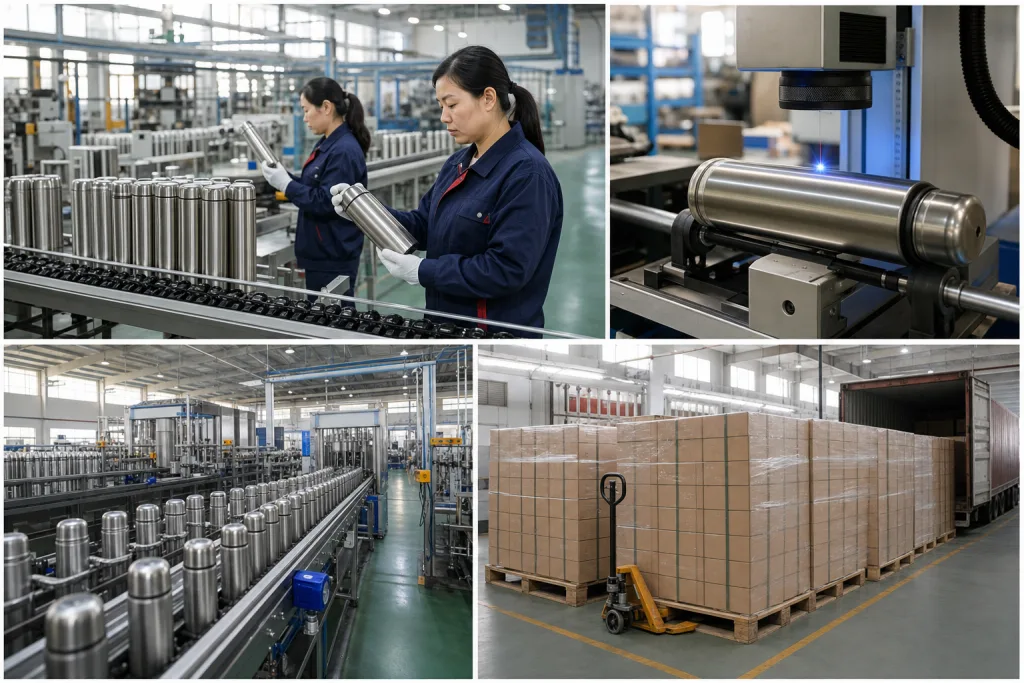
BottleForge Industrial is based in Hangzhou, Zhejiang, near the stainless drinkware supply chain we run every week. For outdoor retailers and promo buyers, we start with four buying decisions: capacity with lid system, insulation target, logo method, and import-ready carton packing. Our stainless thermos factory output is about 420,000 units/month, with typical MOQ from 1,000 units per color for proven models. On the line, that means checking vacuum loss, powder-coat thickness, barcode position, and master carton drop test before we ship, not after the buyer flagged it in a warehouse claim.
Start With the Use Case
A custom thermos American outdoor buyer can sell is not just a vacuum flask with a printed logo. It needs to fit the job: trail coffee at 6 a.m., a November hunting blind, a ski lodge retail wall, a corporate safety award, or a campground store add-on near the cashier. We see this on sample tables every week. Change the use case and the correct size, lid, coating, and target FOB price all move with it.
For outdoor retail, 500 ml and 750 ml models usually sell faster because they fit car cup holders, pack side pockets, and day packs. A 1,000 ml customized thermos gives stronger shelf value, but filled weight reaches roughly 1.3-1.5 kg, depending on wall thickness and cap design. The buyer often loves the big bottle until QC puts it on a digital scale. Promotional thermos programs often stay with 500 ml because a 24 pcs master carton has a better chance of staying under common parcel weight limits, and the unit cost is easier to defend in a bid sheet.
The first decision is capacity. The second is drinking behavior. A screw-cap cup lid looks traditional and holds heat well, but it is slow in a cold truck cab. A flip lid is convenient, but every silicone seal and hinge becomes a complaint risk if the mold is cheap. A push-button stopper feels premium, but ask for the test report after 3,000 open-close cycles and confirm spare stoppers can be ordered later. We have seen this go sideways when a PO says “black stopper” and the sample room fitted dark gray silicone.
If you are a distributor thermos buyer, do not approve a catalog model just because the sample feels heavy. That is the wrong question to ask. Ask for the net weight, inner wall thickness, outer wall thickness, and full carton gross weight before you sign the sample label. A common stainless vacuum thermos may use 0.4 mm inner steel and 0.5 mm outer steel. Thicker steel improves dent resistance, but it raises FOB cost and can make the bottle feel clumsy in smaller hands; our line checks this with a caliper and a drop test before we quote serious volume.
Choose Steel and Insulation Honestly
Most serious custom thermos programs use 304 stainless steel on the food-contact inner wall. For the outer wall, some buyers choose 201 stainless steel to pull cost down. Fair enough. It works for a budget promotional thermos if the cup spends most of its life on a desk, but we push back when the buyer sells to fishing, hunting, ski, or marine channels. Once a powder-coated body gets a 6 mm scratch and sits wet in a truck bed for a week, 201 is the part that gets blamed when rust spots show up.
At our Zhejiang facility, we normally quote three construction paths: 304 inner with 201 outer for cost-sensitive thermos promotional orders, 304 inner with 304 outer for stronger retail positioning, and higher-grade options only when the project truly needs them. For most American outdoor channels, 304/304 is the cleaner choice if the retail price allows another USD 0.35-0.80 FOB per unit. The math gets ugly when a distributor saves USD 0.42 and then eats returns from 2,400 units. We see this on the line when QC checks incoming coil thickness with a digital micrometer and the buyer later flags “rust” photos from end users, not from our lab.
Vacuum performance depends on welding, pumping, copper lining if used, and inspection discipline. A common 750 ml factory thermos should hold hot water above 55-60°C after 12 hours when tested from 95°C starting temperature in a 20°C room. Premium builds can do better, but printed 24-hour claims are cheap ink. Proof is harder. Ask your thermos supplier for the exact test method, not just the claim: fill volume, lid closed time, room temperature, probe position, and whether QC pulled the sample before or after packing. We run this with a calibrated thermometer, and a 3°C difference often starts an argument with the buyer’s lab.
Leak testing also matters. We run pressure and inversion checks during production, then sample again during final inspection under AQL. For a manufacturer thermos order, you should specify acceptable leakage as a critical defect. AQL 0 for critical defects, 2.5 for major, and 4.0 for minor is a practical starting point for retail and distributors thermos shipments. If you sell through specialty outdoor shops, tighten the visual standard on coating scratches and logo alignment. We once had a PO typo calling for a 22 mm logo height instead of 20 mm; the buyer flagged it during carton inspection, so now we lock the artwork size on the pre-production sample before mass printing.
Pick Branding Before Price
Eight out of ten buyers ask for a price before they choose the branding method. That is backwards. A plain stainless model, a one-color silk screen logo, a laser engraved logo, and a full-wrap gradient powder coat are four different jobs on our production board. Different jigs, different scrap. The thermos custom method changes the MOQ, the reject pile beside the line, the inner-box packing flow, the lead time, and the warranty exposure when coating or ink starts failing in the market.
Laser engraving is durable and fits outdoor brands because it does not peel after pack rub or trail abrasion. It works best on powder-coated bodies and brushed stainless finishes. The trade-off is color: laser gives contrast, not Pantone ink. On our 20W fiber laser station, QC usually checks a 50-piece first run before we release the full batch. For a clean custom thermos with a mountain logo, event mark, or outfitter name, engraving is the safer choice from 1,000 units.
Silk screen printing costs less for simple one- or two-color logos. It fits a promotional thermos when the buyer needs exact brand colors at close range, such as PMS 186C on a 70 mm front logo. The weak point is curved-surface registration, especially near tapered shoulders, where a 0.5 mm drift is easy to see. Heat-transfer or water-transfer printing gives more coverage, but the math does not work if the buyer expects the same defect allowance as laser; approval usually runs about 18 days instead of 12 days because we need film output, wrap testing, and one extra pre-production sample.
Powder coating is now the default for about 6 out of 10 American retail programs we quote. Matte black, forest green, sandstone, navy, and off-white sell well in outdoor channels, and a thermos customizable by color makes the line look private-label instead of stock. Still, every custom coating needs adhesion testing. We recommend cross-hatch adhesion with a 1 mm cutter, boiling water resistance, and dishwasher exposure if the product claim mentions dishwasher-safe use. Do not print dishwasher-safe unless your coating and logo process can survive the test; we have seen this go sideways after a buyer approved artwork but skipped coating validation.
For a customized thermos going into retail, we also recommend checking logo placement against the shelf view. Simple check. Put the sample, handle, barcode sticker, and hangtag on the QC table the way Target or an outdoor store will show it. A beautiful logo hidden by the cup handle, barcode sticker, or hangtag is a common rookie mistake, and the buyer usually flags it after the cartons are already packed.
Build the Landed Cost Model
FOB price is one line in the cost sheet, not the answer. A China thermos factory can quote USD 4.20 FOB Ningbo for a 500 ml model and USD 6.10 for a 750 ml model, but your landed cost moves with carton cube, duty rate, inland freight, inspection, testing, and retail packaging. We see this on real POs: a 48 x 36 x 32 cm carton that looks harmless in Excel can change the sea freight math once the forwarder bills by CBM. Outdoor retailers also need to budget for crushed cartons because stainless bottles are heavy for their volume. The math doesn’t work if you only chase FOB.
For a bulk thermos order, ask for master carton dimensions before you approve the product. A typical 750 ml stainless thermos packs 24 pieces per carton with a gross weight of 13-16 kg, and QC should weigh one sealed carton on the floor scale before shipment booking. Small add-ons matter. Individual color boxes, paper inserts, spare silicone rings, and thicker EPE sleeves all increase cube. Gift boxes for a promotional brand campaign add packing labor and raise carton failure risk, especially when the outer carton uses thin B-flute instead of stronger K=A board.
American buyers should separate factory MOQ from economic MOQ. A suppliers thermos quote may allow 1,000 units per color, but the freight cost per unit often looks weak until 3,000 or 5,000 units. For thermos bulk programs, 3,000 units is often where custom coating, logo setup, testing, and ocean freight start to make sense. We’ve had buyers flag this after seeing a USD 0.42 per-unit freight swing between 1,000 and 3,000 pieces. For a distributor thermos launch, 1,000 units for the first color can work if you plan a reorder after 60-90 days of sell-through data.
Payment terms also affect risk. New China projects usually run 30% deposit and 70% before shipment, with the balance paid after pre-shipment photos or a third-party inspection report. For repeat customers with stable volume, we can discuss staged shipment or credit insurance-backed terms. Do not push a supplier thermos partner to cut USD 0.15 by removing inspection or lowering steel grade. QC pulled the sample for a reason. That is not procurement skill; that is moving failure cost to your customer service desk.
Check Compliance Before Artwork
Check compliance before artwork approval, not after production. For the US market, stainless drinkware usually needs food-contact safety documents before we release the logo film. Depending on the item and the claim on the box, ask for FDA food-contact related testing, California Proposition 65 screening, lead and cadmium checks on coatings, plus CPSIA or ASTM review if the thermos is sold for children. For Canada, confirm bilingual labeling early. For Europe, REACH, LFGB, and sometimes national rules apply. We have seen this go sideways when a buyer approved a 4-color wrap first, then asked for Prop 65 data 6 days before shipment.
A thermos vendor should tell you exactly which parts touch liquid: inner steel, stopper plastic, silicone gasket, straw if included, cup interior. Each material needs traceability. If the lid uses PP, Tritan-type copolyester, silicone, or stainless parts, ask for material declarations and current test reports. Reports older than two years often get rejected by larger retailers. QC pulled one 500 ml sample last month where the silicone ring matched the drawing at 52 mm, but the supplier code on the gasket bag did not match the test report. Small issue. Big delay.
Factory audits are separate from product tests. BSCI, Sedex, ISO 9001, or retailer-specific audits show management systems and social compliance; they do not prove your coating passes migration testing. This is the wrong question to ask: “Do you have certificates?” Ask which certificate covers which material and which market. A good thermos factory in Zhejiang can support audits and coordinate product tests, but you still need to state the destination market and sales channel clearly. On our line, we mark the test sample tray by PO, SKU, and coating batch so the lab sample does not get mixed with mass production.
Packaging compliance is where buyers miss small details. If you sell a thermos customized for retail, the box may need country of origin, capacity in ounces and milliliters, care instructions, choking warnings for small parts if relevant, barcode, and importer information. For e-commerce, drop-test rules are not the same as palletized wholesale; a 1.2 m carton drop can beat up a nice gift box fast. If your promotional thermos ships directly to event sites, carton marks must be boringly clear: PO number, SKU, color, quantity, gross weight, and destination. We once had a PO typo where “navy” became “nary,” and the buyer flagged it during pre-shipment inspection.
Control Sampling and Production
A sample is not a promise unless it matches a written spec sheet with cup volume, 304 stainless grade, coating code, logo size in mm, lid material, and carton marks. For custom thermos American retail or promotional programs, we run three sample stages when the order size pays for it: a stock sample for hand feel and shape, a pre-production sample for coating, logo, lid, packaging label, and barcode scan, and a sealed golden sample signed across the lid and body bag. QC keeps that golden sample on the inspection table, not in a drawer.
Timing stays clean when approvals move fast. A stock sample can usually ship in 3-7 days. A custom color and logo sample takes 10-18 days after artwork and Pantone confirmation; if the buyer changes from PMS 186C to PMS 200C after spraying, the line starts again. Mass production for a normal thermos manufacturers order takes 35-50 days after deposit and sample approval. Peak season before Q4 can stretch that by 10-15 days, mainly at powder coating and retail box lines. We have seen a PO typo on “matte black” become “mate black.” Small word. Big delay.
Inspection should be locked before stainless sheet, lids, and cartons enter the line. For a thermos distributor order, we suggest incoming material checks with a wall-thickness gauge, in-process vacuum checks after welding, coating review under a light box, and final random inspection to AQL. Final inspection should cover capacity measurement by scale, lid fit with the actual gasket, 100% leak test for selected lots, vacuum retention sample test, coating defects over 0.5 mm, logo position tolerance, barcode scan, carton drop condition, and count verification. QC pulled the sample last month because the barcode scanned in our office but failed on the buyer’s Zebra scanner.
If you are comparing thermos suppliers, ask how they handle defect replacement. This is the wrong question to leave until after shipment. A professional supplier thermos agreement should state whether replacement units ship with the next order, whether credit notes are available, and what evidence is required. Photos are enough for obvious logo errors, but leakage complaints need batch number, use condition, and sometimes sample return. Batch coding is not glamorous, but the math does not work without it when 8,000 units are already in the American market.
Decide Your Launch Path
There are two sensible launch paths. The first is a cautious retail test: one proven 500 ml or 750 ml model, two colors, a laser logo checked by caliper for position, a color box, and MOQ around 1,000 units per color. We run this often for American buyers because it keeps inventory cash under control and gives clean sell-through data before you add sizes. The second is a stronger private-label launch: three capacities with shared lid parts, three outdoor colors matched to Pantone chips, packaging with one barcode system, and a thermos customizable program for wholesale accounts. That normally means 5,000-10,000 units across SKUs.
Outdoor retailers should avoid building a line that looks big on a spreadsheet but has weak stock behind each SKU. We have seen this go sideways. If every color has only 120 sellable units after sales-team allocations and Amazon reserve stock, stores get disappointed right when the product starts moving. Promotional brands fight a different problem: deadlines. A corporate gift campaign with a fixed event date should not depend on an untested lid mold or a new powder-coating color unless you have at least 90 days before delivery; last season QC pulled the sample because the flip lid leaked at the silicone plug after a 30-minute upside-down test.
A manufacturers thermos partner can steer you toward the safer path, but you need to share target retail price, order forecast, destination port, packaging rules, and warranty tolerance with numbers attached. “Make it premium but cheap” is the wrong brief. If you hide the budget, the factory guesses. If the factory guesses, you get a quote that looks fine in Excel but misses the channel, like a 0.5 mm thinner carton that saves cents and then fails a 12 kg stack test.
For most American outdoor and promotional buyers sourcing from China, the best first order is not the cheapest custom thermos. It is the order with a clear specification, realistic MOQ, tested materials, controlled decoration, and cartons that arrive clean enough to sell. We ship fewer arguments that way. One buyer once flagged a PO typo that changed “matte black” to “matt black”; small mistake, but on the line it still stopped artwork approval for 2 days.
Send your thermos spec before you request quotes
Share size, target price, logo method, market, and deadline. We will return a practical MOQ, FOB range, and production plan.
Frequently asked questions
What MOQ should I expect for a custom stainless thermos order?
For a proven stainless model, expect 1,000 units per color for laser engraving or simple one-color printing. If you need a custom powder coating color, full-wrap print, retail packaging, or mixed lid components, 3,000 units per color is more realistic. A new mold can require 10,000 units or more, plus tooling cost from roughly USD 3,000-12,000 depending on lid complexity and body shape. For a first American outdoor retail test, I usually recommend 1,000-2,000 units per color rather than overbuilding the line. You can use the first 60-90 days of sales data to decide whether to reorder, add colors, or move to a larger thermos bulk program.
How long does production take after I approve the sample?
For a normal custom thermos using an existing mold, plan 35-50 days of mass production after deposit and final sample approval. Stock samples can often leave China in 3-7 days, while custom color and logo samples usually take 10-18 days. Ocean transit to the US West Coast is often 25-35 days port-to-port, and East Coast routing may take 35-45 days. Add time for testing, inspection, customs clearance, and inland freight. If your promotional thermos order is tied to a fixed event, do not count backward using only factory production days. A safe calendar from artwork to warehouse delivery is usually 75-100 days.
Is 304 stainless steel necessary for an American outdoor thermos?
For the inner food-contact wall, yes, 304 stainless steel is the standard choice I would recommend. It is corrosion-resistant, widely accepted in food-contact testing, and familiar to retailers. For the outer wall, 201 stainless steel can be acceptable for budget promotional programs, but 304 outer steel is better for outdoor retail where the bottle may be scratched, wet, or exposed to road salt and cold weather. The FOB difference may be around USD 0.35-0.80 per unit depending on size and market pricing. If your brand sells durability, the 304/304 construction is usually easier to defend than saving a few cents.
Which logo method is best for outdoor retailers?
Laser engraving is the safest default for outdoor retail because it is permanent, clean, and resistant to abrasion. It works especially well on powder-coated bottles and brushed stainless bodies. Silk screen printing is better when you need exact Pantone colors or a large promotional logo, but it can scratch more easily and needs tighter process control on curved surfaces. Heat transfer and water transfer can create larger graphics, but MOQ, defect rate, and approval time increase. For a first custom thermos order of 1,000-3,000 units, I would usually choose laser engraving unless your brand guidelines require color. Always approve a pre-production sample, not only a digital mockup.
What tests should I request before shipping stainless thermos bulk orders?
At minimum, request food-contact testing for the destination market, leak testing, vacuum heat retention testing, coating adhesion checks, and final inspection under AQL. For US retail, many buyers also request California Proposition 65 screening for coatings and decorated areas. For Europe, REACH and LFGB may be needed. A practical final inspection plan includes AQL 0 for critical defects, 2.5 for major defects, and 4.0 for minor defects. The inspector should check capacity, lid function, leakage, coating scratches, logo alignment, barcode scanning, carton marks, and packing quantity. For larger orders above 5,000 units, in-process inspection is worth the extra cost.