Key Takeaways
- A normal custom thermos america order starts around 1,000 pcs per SKU for logo printing and 3,000 pcs for custom powder coating
- 304 stainless steel inner wall, 201 or 304 outer wall, and copper vacuum plating are the common cost drivers
- Plan 30-45 days production after deposit and artwork approval, plus ocean or air freight time to America
- Use AQL 2.5/4.0 inspection, FDA/LFGB contact material checks, and drop testing before shipment
If you sell outdoor gear or manage promotional drinkware programs in America, a custom thermos is not just a bottle with a logo. It must hold temperature, survive LCL or FCL freight, pass compliance review, and land before the campaign date. Sounds simple. The quotes start looking different once you compare 304 stainless thickness, lid gasket design, 5-ply carton strength, AQL terms, and print limits on a curved body. We once had a buyer flag a 0.8 mm logo stretch only after the pre-production sample arrived.
From our line in Zhejiang, China, we see the same 3 buying mistakes every month: choosing the lowest FOB price, approving artwork without checking curvature distortion, and forgetting that powder coating can add 5 to 7 days before assembly. The lowest price is often the wrong question to ask. A solid bulk thermos project starts with product engineering, sample control, and clear inspection terms, not a catalog PDF. QC pulled the sample first, not the sales team.
What America Buyers Usually Mean
A buyer searching for custom thermos america is usually asking two hard questions, plus one deadline question. Can we build a stainless vacuum flask that matches the brand spec on the artwork file? Can we handle U.S. carton marks, warning labels, barcode placement, and compliance documents without the buyer chasing us 6 times? Then comes the launch date. Last month QC pulled a pre-production sample because the logo was 1.5 mm lower than the approved PDF, and that small miss would have shown up on every retail shelf.
For outdoor retailers, the bottle has to look retail-grade on a peg wall or shelf, not just nice in a factory photo. Leak resistance means we test lids after torque tightening, not by shaking one sample over a sink. Powder coat durability needs a cross-hatch tape test, insulation performance needs a 6-hour temperature record, and replacement lids need the same thread fit on repeat orders. For promotional brands, the pressure is different. You may need 2,000 units for a corporate gift, 10,000 units for a loyalty program, or mixed cartons shipped to a 3PL with FNSKU labels. Both jobs are real, but quoting them the same way is the wrong question to ask. The math doesn't work.
A proper manufacturer thermos quote should show capacity, steel grade, lid material, decoration method, packing, Incoterms, sample timing, and inspection standard. We also like to state carton size, gross weight, and whether the logo is laser, silkscreen, or UV print, because freight and scrap rate change fast. Simple point. If a thermos vendor only sends a unit price and a product photo, you are missing the information that protects your margin. We've seen this go sideways when a PO says “matte black” but the artwork file says Pantone 426C, and nobody catches it before coating.
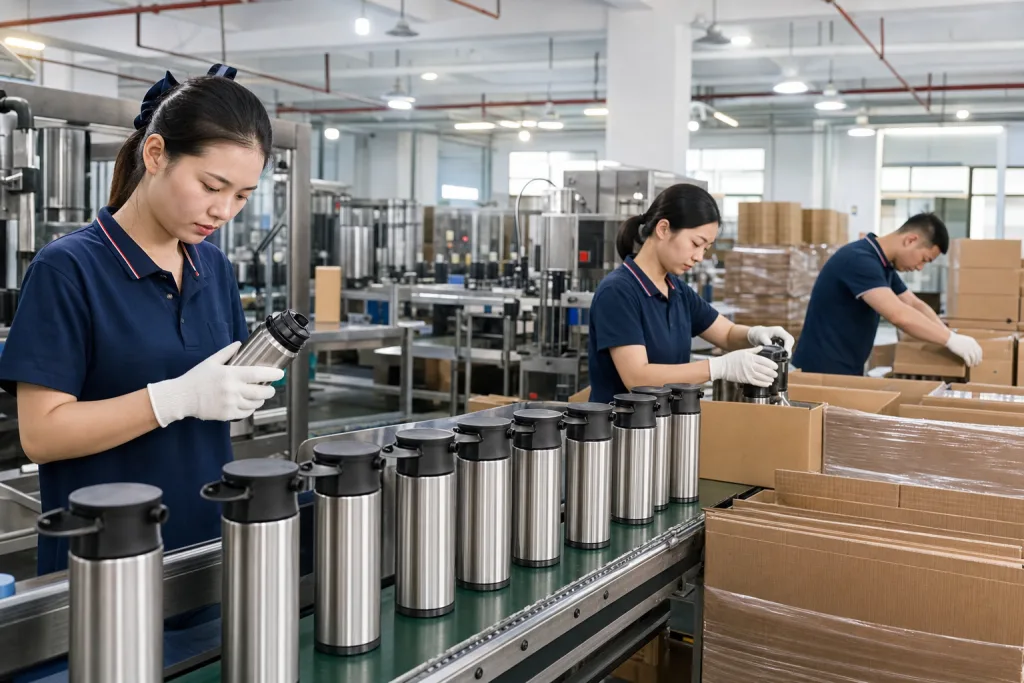
At BottleForge Industrial in Hangzhou, Zhejiang, we run stainless thermos lines with monthly capacity around 450,000-600,000 units depending on season and model mix. Standard MOQ is 1,000 pcs for laser engraving or one-color silkscreen on stock colors. A customized thermos with private color, molded lid detail, or retail gift box usually starts from 3,000-5,000 pcs. That gap matters. It is the difference between a fast promotional thermos job and a true retail product development project. On the line, a stock-color laser order can move after sample approval in about 12 days, while a new powder color with a gift box often needs 18 days before mass production can start.
Checklist Before You Request Pricing
Most price confusion starts with a weak RFQ. If you ask ten thermos factories for “500 ml bottle with logo,” you will get ten prices that do not sit on the same table. We see this every month. One quote uses 201 stainless outside, one uses 304 outside, one deletes copper plating, and one saves USD 0.18 by dropping from a 5-layer export carton to a thin retail carton. On paper, each looks like a 500 ml custom thermos. QC pulled a sample last quarter where the drawing said 500 ml, but the brim test with our graduated cylinder came out 472 ml. The buyer flagged it after pricing, which is the wrong time.
Use this checklist before asking for FOB China pricing:
- Capacity: 350 ml, 500 ml, 750 ml, 1 L, or 1.2 L. Do not rely only on “16 oz” because actual brim capacity and usable capacity can differ by 5-8%. Ask the factory to state both numbers.
- Steel: 304 inner wall is the normal baseline for America. 316 inner wall is possible but adds cost and is rarely needed unless your market demands it. We run 304 as the standard unless the PO says otherwise.
- Wall construction: double-wall vacuum, with copper plating or without it. Copper plating may improve heat retention by roughly 10-20% depending on shape. Ask for the heat test setting, such as 95°C water checked after 6 hours.
- Decoration: laser engraving, silkscreen, UV print, heat transfer, or full powder coat. Each has its own MOQ and scratch behavior. For powder coat, ask if the line uses tape test and 3M cross-hatch checks.
- Lid: PP, Tritan, silicone seal, carry handle, pour-through stopper, or cup lid. Ask whether spare gaskets are available. A USD 0.03 silicone ring can stop a much bigger after-sales problem.
- Packing: white box, kraft box, retail color box, master carton, pallet, Amazon-ready carton, or distributor thermos bulk packing. Confirm carton size, gross weight, and drop-test requirement before the artwork is locked.
- Compliance: FDA food contact, LFGB if also selling into Europe, REACH for coating, ASTM or CPSIA only when kids use is involved. Put the target market on the RFQ, not only on the final PO.
For a first project, do not customize every part. The math does not work. A stock body with clean logo placement often beats a mold-level custom thermos that adds 18 days to sampling and ties up cash before you know the reorder rate. We ship plenty of strong programs this way: existing body, approved lid, custom color, tight logo spec. Save custom tooling for repeat programs where you can amortize $1,500-$6,000 in mold or fixture costs over several orders. One buyer once sent a PO with “matte back” instead of “matte black,” and the line stopped for half a day while sales confirmed the color chip. Small details cost time.
Which Thermos Build Is Worth Paying For
A stainless thermos looks simple until QC cuts one open with a pipe cutter. Then the cost choices show. The inner wall touches coffee, tea, or soup, so 304 stainless steel should be your default. The outer wall can be 201 or 304. In our last 28 America thermos RFQs, retail buyers asking for outdoor or corporate gift sets usually pushed for 304/304. For a promotional thermos, 304 inner plus 201 outer is workable if the powder coating passes cross-cut tape testing and the quote does not pretend it is a premium retail build.
Wall thickness is where cheap quotes hide. Common stainless sheet thickness ranges from 0.4 mm to 0.5 mm for bottle bodies. The math gets ugly fast. Thinner sheet saves cost, but we see more dents after carton drop tests and courier parcel handling, especially when the buyer asks for single-piece mailer boxes. For rugged outdoor programs, we run 0.5 mm where the tooling allows it, especially on 750 ml and 1 L models. On one 1 L sample last year, QC pulled the sample after a 76 cm drop because the shoulder dented before the cap even leaked.
Vacuum performance comes from welding, evacuation, and sealing consistency. Ask for the test sheet, not the slogan. A reasonable test for a 500 ml stainless vacuum thermos is hot water at 95°C, measured after 6 hours and 12 hours under room temperature conditions. Exact numbers vary by shape, cap design, and fill level, but “keeps hot 24 hours” is the wrong question to ask unless the factory shows its internal test method, water fill volume, starting temperature, and room temperature. On our line, the vacuum test station logs each batch, and one weak weld usually shows up before packing, not after the buyer’s warehouse check.
Lid design causes the returns. A flip lid with a hidden vent feels convenient, but it needs solid hinge pins, stable silicone compression, and a cap mold that does not flash around the drinking port. A screw stopper with cup lid is slower, yet it holds up better for outdoor use. For a supplier thermos program going into hunting, camping, fishing, or workwear channels, simple and repairable often wins. We have seen this go sideways when a PO typo changed “extra gasket” to “extra carton,” and the buyer flagged missing seals after delivery. Ask your thermos supplier whether silicone gaskets are standard size and whether they can ship 1-2% extra gaskets with bulk thermos orders. That small detail saves a distributor from replacing whole units for a missing seal.
Logo, Color, And Packaging Decisions
Customization turns a stock bottle into your product, and this is where schedules slip. A thermos custom program with laser engraving on stock black, white, navy, or stainless can move fast because we run those bodies from standing inventory. Pre-production samples may take 5-7 days after vector artwork approval; if the AI file arrives with outlined fonts and a 0.2 mm minimum line, the laser room usually has no drama. Mass production may take 30-35 days in China during normal season. Artwork first. That is the bottleneck we see most often.
Powder coating beats ordinary spray painting when the spec is written clearly. For outdoor retailers, we usually recommend matte or semi-matte powder coat, then we check it with a cross-hatch cutter and basic abrasion rubs before packing. Pantone matching is possible, but allow tolerance: 304 stainless shape, coating thickness, oven temperature, and shop lighting can make a Pantone chip look different from coated metal. If your brand color is strict, approve a coated metal color chip before mass production. We have seen this go sideways when a buyer approved a PDF on Monday and rejected 3,000 pcs under showroom lights two weeks later.
Decoration options have tradeoffs:
- Laser engraving: clean and permanent, strong for premium custom thermos programs; the math does not work for multi-color artwork.
- Silkscreen: cost-effective for one or two colors; on curved bodies, a 90 mm wide logo can stretch at the edge if the fixture is not set right.
- UV print: works for full-color logos; QC should pull the sample and run adhesion validation on the coated surface before production.
- Heat transfer: good for wrap graphics; setup needs tighter inspection, especially around the seam and bottom radius.
Packaging should match the sales channel. A distributors thermos order may only need a kraft box and a 5-layer export carton. A retail buyer may require color box, barcode, warning text, insert card, and master carton markings; one PO typo in a UPC code can hold the shipment at the warehouse. Promotional brands shipping to America events may ask us to avoid individual polybags, use recycled paper claims, or pack 24 pcs per case. Tell the manufacturer thermos team early if the order is for retail shelves, warehouse distribution, or direct-to-3PL fulfillment. It changes carton dimensions, drop test risk, and labeling work.
Pricing, MOQ, And Real Lead Times
For custom thermos america projects, FOB pricing comes down to capacity, steel structure, lid parts, coating, logo process, and packing spec. As a working quote range, a 500 ml stainless vacuum thermos with 304 inner wall, 201 outer wall, stock powder coat, one-position logo, and white box may quote around USD 3.20-5.20 FOB China at 3,000 pcs. A heavier 750 ml outdoor model with 304/304 steel, premium coating, handle lid, retail box, and better carton packing may land around USD 5.80-8.50 FOB China. Not a promise. On our costing sheet, a 0.3 mm change in outer-wall thickness or a lid with 2 extra silicone rings can move the price enough for the buyer to flag it.
MOQ is where first-time buyers get caught. A thermos customizable with logo only can start at 1,000 pcs if we run existing colors and open molds. Custom color coating normally starts at 3,000 pcs per color because the coating line has setup loss, hanging rack waste, and leftover powder that cannot always be reused. Molded lid changes, exclusive body shape, or embossed metal details often need 5,000-10,000 pcs to make sense. Asking for 600 pcs in 6 Pantone colors is the wrong question to ask; the line will spend more time changing powder than spraying cups.
A fair production calendar looks like this:
- Artwork and specification confirmation: 2-4 days if your files are clean and the PO does not say “matte balck” in one place and “gloss black” in another.
- Logo sample or pre-production sample: 5-10 days, usually checked with a 3M tape test and a quick color match under the light box.
- Bulk production after deposit and sample approval: 30-45 days, assuming the vacuum test station and powder coating line are already booked.
- Third-party inspection and booking: 3-7 days; for America orders, we usually see buyers ask for AQL 2.5 on appearance and function.
- Ocean freight to America: often 25-40 days port-to-port, 38-55 days door-to-door if the truck appointment and customs entry are slow.
Peak season in Zhejiang and broader China usually tightens from August through November for holiday and Q1 retail replenishment. If you are planning thermos bulk for a spring outdoor launch, do not wait until January to approve samples. We have seen this go sideways: QC pulled the sample on January 12 for a lid leak, the buyer wanted a new silicone plug, and the vessel booking slipped by 18 days. You can still ship by air, but the math doesn't work on most stainless steel products because they are bulky and heavy.
Quality Checks That Actually Catch Problems
Quality control for a thermos manufacturer has to catch more than a logo sitting 2 mm off-center. The usual trouble list is vacuum failure, lid leakage, coating scratches, dents, rough welding polish, silicone odor, soft cartons, barcode errors, and mixed-color packing. Some defects show up under a 600-lux inspection lamp. Others only show after the line runs a 95°C hot-water leak test and QC pulls 32 samples from packed cartons.
For America programs, we use a written QC plan with AQL 2.5 for major defects and AQL 4.0 for minor defects, unless your retailer sets tighter terms. Inspection should cover capacity check with a calibrated scale, appearance, logo adhesion, coating adhesion, lid torque or fit, leak test, thermal retention sampling, carton drop, barcode scan, and carton mark verification. For a large distributor thermos order, pallet configuration and carton compression matter; we have seen 18 kg export cartons crush at the bottom when the buyer asked for 1.8 m warehouse stacking but approved only a single-wall carton. The math does not work.
Food contact compliance should be checked before mass production starts, not after 20,000 pcs are packed. Ask for material declarations and recent FDA or LFGB test reports for stainless steel, PP, Tritan, silicone, coating, and ink where applicable. If the product is marketed for children, add CPSIA, lead, phthalates, and age-grade review. If you make sustainability claims, be careful. “Recyclable stainless steel” is easier to defend than loose “eco-friendly” wording, and one US buyer flagged that exact phrase during artwork approval on a retail belly band.
BSCI or ISO-style factory management audits help, but they do not replace product testing. A clean audit does not prove a lid will not leak. The best suppliers thermos programs combine factory audit, golden sample, incoming material checks, in-process inspection, and final random inspection. Boring work. It is also how you avoid 3,000 units arriving in America with the wrong gasket hardness because the silicone supplier sent 55 Shore A instead of the approved 65 Shore A and nobody checked the durometer.
How To Work With A China Supplier
A good China thermos supplier will push for details before quoting. That is not bureaucracy; it is risk control. The fastest projects usually arrive with a target retail price, expected order quantity, required delivery date, packaging channel, artwork files, and compliance market. If you hide the target price, the factory may quote a double-wall structure, gift box, or coating you cannot sell. If you chase only the lowest price, the factory may delete the copper lining, reduce the steel gauge by 0.1 mm, or switch the lid seal material. We have seen this go sideways. Last month QC pulled a 500 ml sample where the buyer expected 12-hour heat retention, but the PO only said “premium thermos.”
For outdoor retailers, share the use case. A camp flask for hot coffee at 5 a.m. needs different priorities than a lightweight trail bottle clipped to a pack. For promotional brands, share the event date, carton routing, and shipping instructions up front. If FNSKU labels, mixed SKU cartons, or 3PL routing guides are needed, the thermos suppliers must price that labor into the plan. One Amazon buyer once sent a routing guide after mass packing; the line had to reopen 86 cartons and relabel each inner box with a Zebra printer. Nobody enjoyed that.
Payment terms for new overseas buyers are commonly 30% deposit and 70% before shipment after inspection. FOB Ningbo or FOB Shanghai is common from Zhejiang. EXW can look cheaper, but it pushes export handling and local trucking onto you. DDP is convenient on paper, but check who is importer of record and how duties are handled. For stainless vacuum bottles entering America, tariff classification should be confirmed by your customs broker, not guessed from an old invoice. The math does not work if a quote saves USD 0.18 per bottle but creates a customs delay of 12 days vs 18 days on a retail launch.
The best working rhythm is simple: lock the specification sheet, approve a physical sample, freeze artwork, confirm carton marks, pay deposit, inspect before balance, then ship. Short list. Follow it. If you change color, logo size, or packaging after production starts, expect cost and delay. A factory thermos line is not a print shop; stainless forming, welding, vacuuming, coating, and assembly are scheduled in batches. Once we run powder coating on 3,000 black bottles, changing to Pantone 186C red means cleaning the gun, checking film thickness at 60–80 μm, and pushing other orders back.
Send us your stainless thermos RFQ today
Share capacity, logo method, MOQ, delivery date, and packaging needs. We will return a practical factory quote and production plan.
Frequently asked questions
What MOQ should I expect for a custom stainless thermos for America?
For a logo-only custom thermos using an existing bottle shape and stock color, 1,000 pcs per SKU is a realistic starting point. If you need a private powder-coated Pantone color, expect 3,000 pcs per color because the coating line has setup loss and cleaning time. A molded lid change or exclusive body shape usually needs 5,000-10,000 pcs to justify tooling. For trial orders below 1,000 pcs, the unit price often rises sharply, and decoration choices become limited to laser engraving or simple silkscreen.
How long does a thermos bulk order take from China to America?
A normal bulk thermos order takes 30-45 days for mass production after deposit, final artwork, and sample approval. Add 5-10 days for pre-production sampling if you need a physical decorated sample. Ocean freight to America often takes 25-40 days port-to-port, and door delivery can add another 7-14 days depending on customs, rail, and warehouse appointment timing. If your retail launch date is fixed, work backward at least 90 days. Air freight is possible for urgent promotional thermos orders, but stainless products are heavy, so cost can be painful.
Is 304 stainless steel required for a customized thermos?
For the inner wall, 304 stainless steel is the practical baseline for America because it contacts the drink and is widely accepted for food-grade applications. The outer wall can be 201 or 304 depending on price point and positioning. A premium outdoor customized thermos usually uses 304 inner and 304 outer, while a cost-sensitive promotional product may use 304 inner and 201 outer. Ask for material test reports and keep the construction written in the purchase order. Do not accept vague wording like “stainless steel” without grade.
Which logo method is best for outdoor retail thermos products?
Laser engraving is the safest choice for long-term outdoor use because it does not peel and handles abrasion well. It works best for single-color metal-reveal branding on powder-coated bottles. Silkscreen is cheaper for larger one-color logos but should be tested for adhesion and curvature distortion. UV print supports full-color artwork, but it needs surface compatibility testing. For a retail thermos custom program, approve a decorated physical sample, then run tape adhesion and rub tests before mass production. Logo method should match the product’s expected abuse, not just the artwork file.
What should I inspect before paying the shipment balance?
Use final random inspection before paying the 70% balance. Check appearance, dents, coating scratches, logo position, barcode scan, carton marks, capacity, lid fit, silicone odor, leakage, and thermal retention sampling. AQL 2.5 for major defects and AQL 4.0 for minor defects is a common starting point. For America retail or distributor thermos orders, add carton drop testing and master carton weight checks. If the order uses mixed colors or FNSKU labels, verify assortment and scan accuracy. Most expensive problems are easier to fix in Zhejiang than after arrival at your U.S. warehouse.