Key Takeaways
- Set vacuum retention targets such as 6 hours above 55°C after filling at 95°C
- For custom thermal bottle orders, confirm 304 or 316 stainless steel, not just “food grade”
- Logo defects often come from curved surfaces; approve a real pre-production sample, not only a PDF
- Use AQL 2.5 for major defects and 4.0 for minor defects on export drinkware
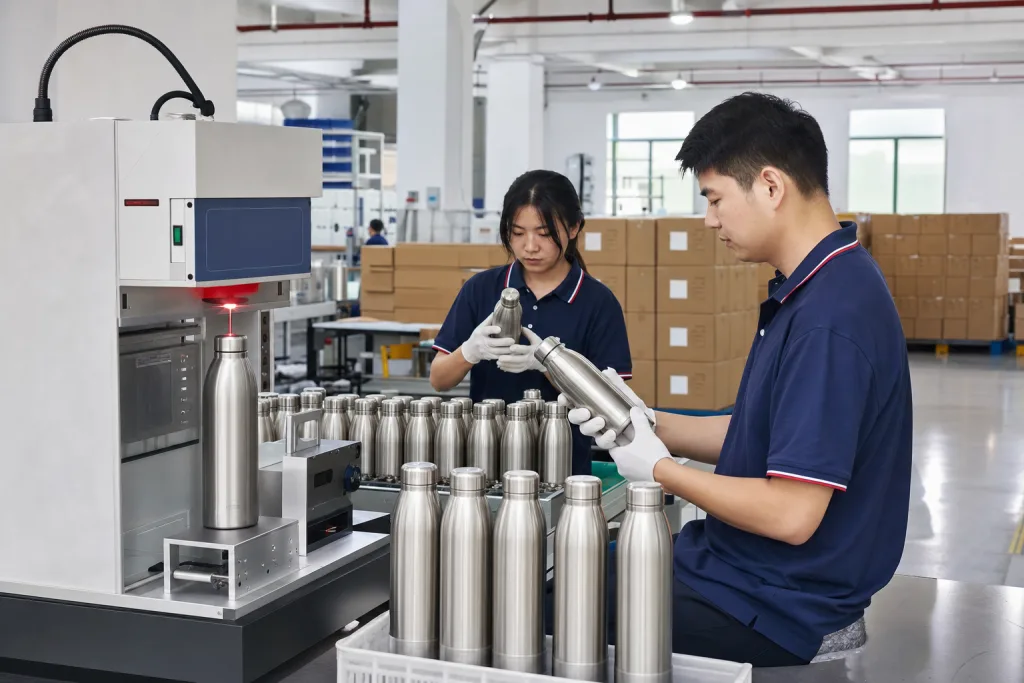
A custom thermal bottle order usually fails in boring ways: lids seep at the silicone ring, powder coating chips after a cross-cut tape test, laser logos come out grey instead of clean white, cartons crush on the bottom layer, or the PP sample cap feels tighter than mass production. Small stuff. At quotation stage, none of it looks dramatic. It shows up after artwork approval, the 30% deposit, and a freight booking the buyer no longer wants to move.
If you are buying custom drinkware from China, the wrong question is “who has the lowest FOB price?” The better job is writing a spec that a canteen factory in Zhejiang can repeat 20,000 times without guessing: 304 stainless, body diameter in mm, lid leak test method, carton K=A or K=K, logo size, Pantone code, and AQL 2.5 if that is your standard. BottleForge Industrial in Hangzhou, Zhejiang runs stainless bottle, tumbler, and growler programs for B2B buyers with typical MOQs from 1,000 units and production capacity around 450,000 units/month; on the line, QC pulled the sample more than once because a PO said “mat black” while the approved artwork said “matt black.”
Vacuum performance fails quietly
The costliest failure in a custom thermal bottle is not always the dent QC can catch under the LED light table. It is the bottle that looks fine, passes carton drop, then loses heat because the vacuum layer is weak, dirty, or burned during the mouth-welding step. Buyers write “keeps hot 12 hours” on the inquiry and expect every canteen manufacturer to test it the same way. We do not. Last month QC pulled 32 pcs from a 3,000 pcs run, and 5 looked perfect but dropped temperature too fast.
Thermal performance comes from several matched details: inner wall material and outer wall thickness must suit the drawing, the vacuum process must be stable, and copper plating only pays off if the plating coverage is even. Neck design and lid sealing matter too. So does fill volume during testing. A wide-mouth custom growler will not hold heat like a slim 500 ml bottle with a narrow neck. If you compare FOB prices without matching the test method, the math does not work; one quote may include copper plating and a 0.5 mm outer shell, while the cheaper one is running 0.38 mm with a loose cap gasket.
For B2B programs, write the test like a lab instruction, not a slogan. A practical standard is: fill bottle with 95°C water to rated capacity, close lid for 6 hours at 20°C room temperature, then measure water temperature. For a good 500 ml double-wall stainless bottle, you may require above 55°C after 6 hours. For 1,000 ml bottles, the number can be higher because larger volume holds heat better. For cold retention, state ice-water or 4°C water testing and the exact time. Simple wording wins. On our line, the inspector logs the start temperature with a probe thermometer, and one wrong “95°F” typo on a PO has caused a full round of email back-and-forth.
Ask your canteen supplier to record vacuum inspection data during production. About 7 out of 10 China factories we audit use a hot water test or temperature decay test, but the pass/fail threshold must be agreed before production. For retail or distributor drinkware programs, we run random sample testing during inline QC and again during final inspection under AQL 2.5 when the order calls for it. Do not wait until cartons arrive in Europe or North America to find poor retention. We have seen this go sideways: the buyer flagged the issue after warehouse receiving, and rework was impossible because the vacuum failure was inside the wall.
Spec around it: define capacity, test temperature, room temperature, test hours, minimum result, lid status, and sample size with the allowed fail count. If you are a canteen distributor selling to outdoor or corporate channels, this wording protects you better than any brochure claim, because it gives the factory a number to build to and gives QC a number to reject against.
Steel grade gets blurred
“Food grade stainless steel” is not a spec. It is a sales line. A custom thermal bottle should name the steel grade on the inner wall and, when it affects cost or corrosion risk, the outer wall too. We usually quote SUS 304 inside with SUS 201 or 304 outside; the material sheet on our 35-ton coil rack has to match that PO line. For premium programs or coastal retail, buyers sometimes ask for SUS 316 inside, and yes, the cost moves up.
The failure mode is boring but expensive: the quote says stainless steel, the approval sample looks clean, then bulk production comes in with a cheaper grade or a lighter gauge than the buyer expected. QC pulled one 750 ml sample last year with small rust spots around the mouth after a 24-hour salt spray check. That turns into rust complaints, weak dent resistance, and a cheap hand feel. If you push a canteen vendor to cut USD 0.20 while asking for wraparound print, gift box, and 18-day delivery, the math doesn't work.
Wall thickness matters. Most stainless bottles we run sit around 0.4 mm to 0.5 mm inner wall thickness and 0.5 mm outer wall thickness, depending on diameter and drawing depth. Our caliper check is simple: measure the cut rim before vacuum sealing, then compare it against the approved sample card. Thinner steel can save a few cents, but it dents faster and feels light in the buyer’s hand. For customized growler orders above 1 L, body strength matters more because the filled bottle is heavier and gets knocked around outdoors.
If your product goes into the EU, ask for LFGB or relevant food-contact test reports. For EU chemical review, REACH compliance may be requested by larger retailers. For the US, FDA food-contact expectations and California Proposition 65 review may apply depending on sales channel. A responsible canteen manufacturer in Zhejiang or elsewhere in China should be able to say which report covers the steel, powder coating, silicone ring, and plastic lid component. We’ve seen this go sideways when a buyer checked only the bottle body report, then the retailer flagged the black silicone gasket.
Spec around it: write the material stack in the PO: inner SUS 304, outer SUS 304 or 201, lid PP or Tritan where applicable, silicone seal ring, coating type, and required food-contact standard. Do not accept “same as sample” as the only material description. One PO typo, like “SUS 204” instead of “SUS 304,” can stall a 3,000 pcs run before the line even starts.
Lids leak after packaging approval
Leakage kills repeat orders faster than color fade or a crooked logo. A bottle can pass an upright fill test on the QC table, then leak in a kid’s backpack because the lid thread, silicone gasket, vent hole, straw part, or carry handle was never tested upside down or on its side. We see this often in canteen customized projects: the buyer signs off the Pantone chip and logo film, but treats the lid like a free standard accessory. Wrong place to save time.
Lid risk is not one thing. Screw lids cross-thread when the thread tolerance opens by 0.2 mm. Flip lids leak at the hinge pin or drinking spout if the silicone plug sits shallow. Straw lids add 3 to 5 extra parts, so there are more failure points on the line. Bamboo-top lids look better in photos, but they need proper sealing because wood movement and adhesive strength change with humidity. QC pulled one sample last season where the bamboo cap lifted after a 48-hour humidity check. A custom canteen for sports or school use should not be approved by appearance only.
For mass production, write a leak test the factory can run and your third-party inspector can repeat without guessing. A practical test is: fill with room-temperature water, close lid fully, invert for 30 minutes on absorbent paper, then shake for 30 seconds. We run this with white tissue under the cap because one drop shows fast. For stronger claims, add side-position testing and a pressure or vacuum check. Hot water leak testing needs control; pressure buildup can give false failures or create a safety issue when the inspector opens the lid.
Packaging creates another leak problem after approval. If the lid is packed with pressure on a flip button, silicone ring, or straw mouthpiece, it can deform during a 35-day sea shipment. For distributor canteen orders, we often recommend checking carton drop test results and opening packed samples after 24 to 48 hours to confirm lid parts rebound properly. We have seen this go sideways: the bottle passed before packing, then 6 out of 20 packed samples showed a pressed straw mouthpiece after the inner tray was tightened.
Spec around it: require lid material, gasket hardness if available, replacement gasket policy, leak test method, and spare part availability. Put these lines on the PO, not only in a WeChat message. If you are buying from multiple canteen suppliers, keep one approved lid design per capacity where possible. Too many lid variants make after-sales service messy, and the math does not work when a $0.08 gasket issue turns into 300 replacement parcels.
Decoration breaks the schedule
Customizable drinkware is where 6 out of 10 clean bottle projects start losing days. The bottle body is standard; the decoration is the moving part. A logo that looks fine on a flat mug can stretch on a tapered 750 ml thermal bottle, especially across the lower curve where we check with a 0.5 mm film ruler. A full-wrap design can miss at the seam by 1 to 2 mm if the artwork repeat is not built for the bottle diameter. A powder coated surface also needs different laser power from raw stainless steel. Simple issue. It still needs sampling time.
For custom thermal bottle programs, we usually run laser engraving, silk screen printing, heat transfer, water transfer, UV printing, and debossed or embossed accessories. Laser is clean and durable, but it shows the base material or underlayer, so contrast depends on the coating and the steel under it. Silk screen works for simple logos and often has setup fees around USD 40 to USD 80 per color, but fine gradients get messy fast. Heat transfer handles larger artwork, but we still do cross-hatch adhesion testing on the actual coating panel before we let the line proceed.
The usual failure is approving digital artwork instead of a physical pre-production sample. The buyer sees a nice PDF; QC pulled the sample and finds the white logo looks gray on matte navy, or the ink edge feathers under a 10x loupe. A PDF cannot show curve distortion, ink edge quality, coating texture, or how the logo sits beside the seam. For canteen promotional orders with fixed event dates, skipping the real sample is the wrong question to ask. The question is whether you can afford a 7-day rework after cartons are already booked.
Plan decoration lead time separately from bottle production. A realistic timeline is 3 to 7 days for artwork proofing, 7 to 12 days for pre-production samples, and 25 to 35 days for mass production after sample approval, depending on quantity and season. If you need 10,000 units before a trade show, lock the decoration method early. We have seen this go sideways when a PO says “laser logo” on page 1 and “one-color print” in the attachment. Changing from silk screen to laser after sample rejection can add another week.
Spec around it: send vector artwork, Pantone code, logo size in mm, position from base or lid, wrap limits, tolerance such as ±1.5 mm, and decoration durability test. For customized drinkware sold through retail, include tape test and rub test with the exact pass level, such as 3M tape pull after 24 hours or 500-cycle dry rub. Dishwasher claim should only go on the carton if the coating and logo have been tested for it; otherwise the math does not work when customer returns start coming back.
Coating defects are not random
Powder coating and spray painting make a custom thermal bottle look retail-ready, but they also bring 7 common defects we see on the line: pinholes, orange peel, dust, color drift, weak adhesion, scratches, and uneven gloss. Buyers often call them random factory problems. They are not random. Most come from pretreatment, spray room dust control, oven temperature, or weak final sorting under a 6500K inspection lamp.
The first risk is color approval. Pantone on paper does not match powder coating on a curved 304 stainless bottle. Matte black absorbs light differently from glossy black, and the same Pantone can look 1–2 shades off after baking at 180–200°C. Dark colors hide small weld shadows but show carton rubs fast. White and cream show dust, oil marks, and neck-area polishing lines. If your brand color is strict, approve a sprayed metal chip or one full bottle, not only a Pantone number typed on the PO.
The second risk is adhesion. A cheap coating can pass a quick visual check and still fail after rubbing, dishwashing, or carton friction during a 12-day sea shipment. For most export custom drinkware, we push hand-wash marking unless the buyer has paid for dishwasher testing. The math does not work if a “dishwasher-safe” claim creates 300 returns from a 5,000 pcs order. If you need that claim, define cycle count, detergent, temperature, and pass standard; QC should run a cross-hatch tape test and compare the result before packing.
Handling during production also matters. Bottles get scratched after coating during logo printing, lid assembly, or packing, especially near the shoulder and bottom edge. A canteen factory with tight line control will separate coated bodies, use PP trays or cardboard dividers, and reject visible scratches before logo printing. We run this check before silk screen because printing on a bad body just wastes ink and labor. If the factory is rushing a low-margin order, coated bodies may sit in bulk bins with no sleeves; we have seen that turn a small RMB 0.20 saving into a 6% defect rate.
Spec around it: define color sample approval, gloss level if it affects your brand look, coating thickness in µm if required, cross-hatch adhesion test, rub test, and visual defect limits. Use AQL 2.5 for major defects and 4.0 for minor defects at final inspection. A tiny dust speck under 0.3 mm is not the same as exposed metal or peeling paint, so your defect classification should say that clearly. Otherwise the buyer flags it during PSI, and the factory argues for two hours over one scratch.
Cartons fail before the product
22 canteen vendors can make an acceptable bottle and still ship it in a weak carton. Export cartons ride truck, container, warehouse conveyor, then sometimes UPS or DPD parcel legs. A carton that looks clean at our Hangzhou packing table can land crushed in Hamburg, Los Angeles, or Toronto if the K=A paper, insert gap, or pallet stack plan is wrong. We have seen this go sideways.
Packaging failure shows up in plain ways. Individual boxes scuff the coating because the bottle has 3 mm of play inside. Gift boxes collapse because the paperboard is 300 gsm when the order needed 400 gsm. Master cartons burst when gross weight creeps past 18 kg. Barcodes fail because the art team printed them at 28 mm wide or placed them across a carton edge; QC pulled one sample last year where the FNSKU wrapped onto the side seam. For Amazon or other marketplace programs, FNSKU, suffocation warning, carton limits, and drop-test expectations still matter even when the bottle passes inspection.
For B2B distributor growler or distributor drinkware orders, quote packaging as part of the product. Not later. A plain white box, color box, kraft box, egg-crate insert, molded pulp tray, or polybag each changes the unit cost and the damage rate. A color box may add USD 0.20 to USD 0.60 depending on size, paper, and print coverage. Stronger master cartons may add USD 0.03 to USD 0.08 per bottle, but the math works better than replacing 96 dented units after a warehouse claim.
Ask for a packaging drop test before shipment. ISTA-style testing is best for strict retail programs, but a basic 1-corner, 3-edge, 6-face drop test from 60 to 80 cm already tells us plenty. If the cap dents the color box after the second edge drop, the line needs a tighter insert or more headspace. For sea freight, carton compression matters too. If cartons are stacked 6 or 7 layers high, the bottom layer must survive humidity and load for 18 to 35 days, not just look good on the packing bench.
Spec around it: list inner box type, carton dimensions, units per carton, gross weight limit, barcode format, pallet requirement, and drop-test method. If you are a canteen distributor, standardize carton markings across suppliers; your warehouse should not spend 40 minutes sorting mixed SKUs because one PO said “matte black” and another carton mark says “BK powder.”
Price hides the real tradeoffs
A custom thermal bottle quote is never one number. It bundles steel grade, capacity tolerance, coating thickness, lid torque, logo method, carton spec, inspection level, lead time, and payment terms. On our line, QC can pull one sample and find a 0.3 mm wall gap or a loose cap thread in ten minutes. A USD 3.20 FOB Ningbo quote and a USD 3.85 quote can both be correct. The cheaper one may just leave out the parts your buyer will ask for later.
For reference, a typical 500 ml to 750 ml double-wall stainless bottle with basic powder coating and one-position logo may sit around USD 3.00 to USD 5.50 FOB China depending on quantity, lid, decoration, and packaging. A larger customized growler or customizable growler with handle lid and gift box may move higher. MOQ is often 1,000 units for standard shapes and 3,000 to 5,000 units for custom colors or more complex decoration. New mold development is a different job and can run several thousand USD depending on tooling complexity. We ship these orders every week, and the buyer who pushes for a 500 pcs custom color usually ends up paying more per unit anyway.
The clean way to buy is simple: send the same RFQ sheet to every canteen manufacturer. Put in capacity, size, material, lid, coating, logo method, packaging, compliance reports, target market, order quantity, delivery term, and inspection requirement. Ask what is included and what is excluded. If you need BSCI, ISO 9001, REACH documents, or retailer packaging compliance, say it before the quote, not after the deposit. One typo on the PO can slow the whole booking, and that is not a supplier problem.
BottleForge quotes from Zhejiang, China on the assumption that export buyers need repeatable production, not guesswork. We run the line with that in mind. If a design needs 35 days, we say 35 days. Promising 20 days and burning the last week on excuses helps nobody. On a new lid tool, the first trial alone can eat a full shift, and the buyer will remember the missed launch date long after they forget a USD 0.08 saving.
Spec around it: build a comparison table and force every canteen vendor to price the same product. Keep a signed golden sample, approved artwork, inspection checklist, and packaging file. We seal the golden sample with the batch number and store it by item code. That file becomes your control point for reorder quality.
Send us your custom thermal bottle RFQ
Share capacity, quantity, logo method, packaging, and target market. We will return a practical FOB quote and production-risk notes.
Frequently asked questions
What MOQ should I expect for a custom thermal bottle order?
For standard bottle shapes with your logo, a realistic MOQ is 1,000 units per SKU. If you need a custom powder color, full-wrap print, or mixed lid components, expect 3,000 units or more. For a new mold, MOQ can move to 5,000 to 10,000 units because tooling setup, trial runs, and material purchasing become heavier. At BottleForge in Zhejiang, many custom drinkware programs start at 1,000 units when the body and lid are existing models. The practical issue is not only factory willingness; it is unit cost. Below 1,000 units, setup fees, inland handling, export documents, and inspection costs make the landed cost unattractive for most B2B buyers.
How long does production take after sample approval?
For most custom thermal bottle orders, allow 25 to 35 days for mass production after pre-production sample approval and deposit. Add 7 to 12 days for sample making if you need custom color, laser positioning, silk screen printing, or gift packaging. Peak season in China, usually before major retail and holiday shipping windows, can add 5 to 10 days. Sea freight to North America or Europe may add 25 to 45 days depending on port and service. If you have an event date, work backward from warehouse arrival, not factory finish date. A canteen promotional order that ships one week late is often commercially useless.
Should I choose laser engraving or silk screen printing?
Choose laser engraving when you need durability, a clean premium look, and a logo with limited colors. It works well on powder coated stainless bottles because the laser removes the coating and reveals the base layer. Choose silk screen printing when you need solid color logos at lower cost, especially for simple artwork. Setup may run about USD 40 to USD 80 per color, depending on the factory and design. For curved custom canteen surfaces, always approve a physical sample. Fine text under 6 pt, gradients, and large wrap designs are more likely to fail or look uneven. The right method depends on artwork, surface finish, target price, and retail expectations.
What inspections should I require before shipment?
Use a pre-shipment inspection based on AQL, commonly 2.5 for major defects and 4.0 for minor defects. The checklist should include capacity, appearance, coating adhesion, logo position, leak test, lid function, thermal retention sample test, barcode scan, carton drop test, and carton marking verification. For higher-risk orders, add inline inspection when 20% to 30% of production is complete. That catches color drift, coating defects, and logo placement problems before all units are packed. If you are buying customized canteen products for retail, keep the approved golden sample at the factory and with your inspector. Inspectors need a physical reference, not only a purchase order.
Can one factory handle bottles, growlers, and promotional canteens?
Yes, if the factory has the right production network and QC system, but do not assume every canteen manufacturer is strong in every category. A 500 ml thermal bottle, 1.9 L custom growler, and budget canteen promotional item have different lid, welding, coating, and packaging risks. Ask for recent production photos, test reports, and capacity by product type. BottleForge in Hangzhou works across stainless thermal bottles, sports bottles, travel tumblers, kids bottles, and growlers, with export documentation for common EU and North American requirements. For distributor canteen programs, keeping related products under one supplier can simplify color matching, carton standards, and reorder control.