Key Takeaways
- A realistic custom thermal bottle USA MOQ starts around 1,000 pcs per color for powder coating
- Plan 7-10 days for samples and 30-40 days for mass production after approval
- 304 stainless steel inner wall at 0.4-0.5 mm is normal for mid-market vacuum bottles
- Use AQL 2.5/4.0 inspection and carton drop testing before paying the final balance
You are buying a custom thermal bottle USA program, not a stock bottle with a logo stamped on the side. Finding a canteen supplier in China is the easy part. The real work is locking the bottle spec, proving it with pre-production samples, then catching 0.3 mm lid-fit issues before they turn into 8,000 customer complaints. This is the wrong question to ask: “What’s your cheapest 24 oz bottle?” Ask what the line can hold steady after 3,000 pieces.
Let’s use a real order shape: a 24 oz vacuum insulated bottle for a U.S. outdoor retailer, packed for distributor drinkware channels and e-commerce. BottleForge Industrial is in Hangzhou, Zhejiang, and we would quote, sample, produce, inspect, and ship that order from China with the messy parts included: carton drop-test results, Pantone mismatch pushback, barcode placement on the PO, and QC pulling random samples before the goods leave the factory gate.
Start with the actual use case
The first mistake buyers make is asking for “a premium bottle” before saying where it will sell. Wrong question. A custom thermal bottle USA order for corporate gifting is built differently from a customized canteen for outdoor retail, and a distributor growler program for regional breweries needs its own lid, carton, and logo plan. Last month the buyer flagged a matte coating sample after our QC rubbed it 30 times with 3M tape and saw edge lift near the laser logo.
For our buyer scenario, assume you need 8,000 pcs of a 24 oz bottle for the U.S. market. Retail target price is USD 24.99-29.99. Your landed cost target is under USD 6.20 per unit before domestic fulfillment. You need one main body color, one accent color for the lid, and a printed retail box. That gives a canteen factory in Zhejiang enough to choose the body mold, powder coating line, logo process, inner tray, and 5-layer export carton. We would also check the PO for ounces versus milliliters; one typo there can turn a 24 oz program into a 750 ml label problem.
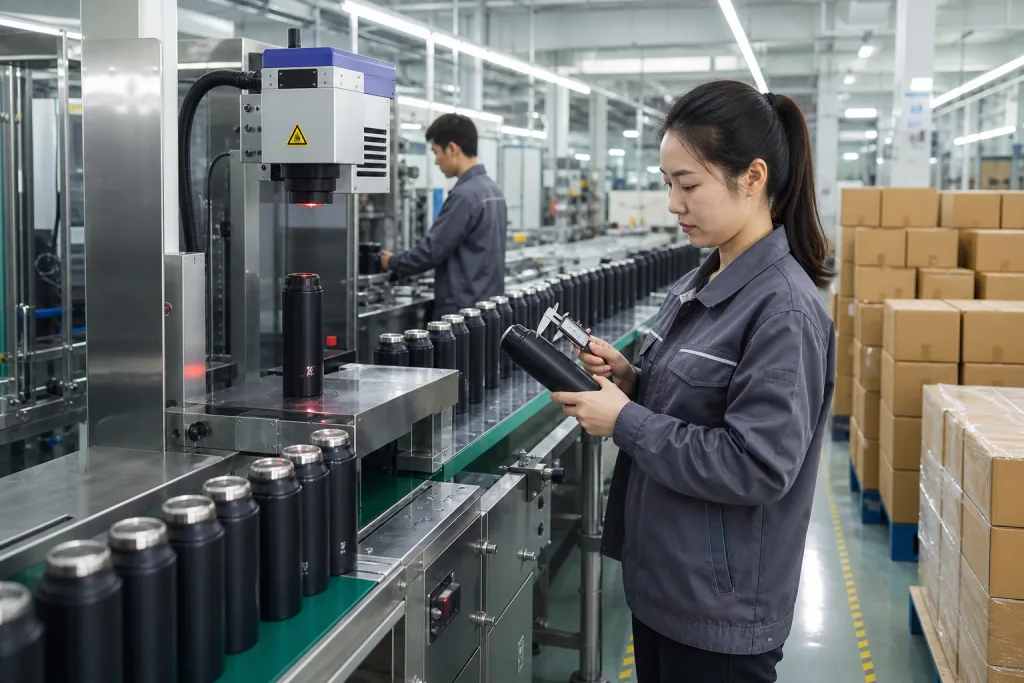
For a normal stainless vacuum bottle, we would start with 304 stainless steel inside and outside, 0.4-0.5 mm wall thickness, double-wall vacuum insulation, PP lid parts, and a silicone sealing ring. If you ask for 316 stainless steel inside, we can run it, but the math does not work on every USD 6.20 landed-cost target. For most custom drinkware programs, 304 stainless steel is the practical choice. On the line, QC pulled the sample and checked the mouth diameter with a digital caliper because a 0.3 mm mismatch can cause lid wobble.
Your intended channel matters. For a canteen distributor selling to outdoor stores, the finish needs better scratch resistance than a short-run promotional bottle. For Amazon or marketplace sales, carton strength, barcode placement, FNSKU labeling, and photo-real color consistency decide whether the warehouse accepts the shipment cleanly. For canteen promotional projects, speed and logo accuracy usually beat unusual lid designs. We have seen this go sideways: a buyer picked a flip lid with 4 small parts, then pushed for 18 days delivery when the assembly line needed 24 days vs 16 days for a standard screw lid.
Lock the bottle specification early
A loose RFQ gives you a loose price. Send the same blurry product photo to five canteen manufacturers and you can get five quotes that look close, but they are not quoting the same bottle. One supplier may price a 0.38 mm body wall, another may swap in a cheaper silicone gasket, and a third may leave out the retail color box. We see this on the line every month. The cheapest quote wins in the spreadsheet, then QC pulls the sample and the buyer asks why the lid feels different.
For this 24 oz custom canteen, lock the working specification before pricing: capacity, dimensions, weight, material grade, finish, lid type, logo method, packing, compliance requirements, and inspection standard. A clean RFQ line reads like this: 24 oz double-wall vacuum bottle, 304 stainless steel inner and outer, powder coated body, leakproof screw lid with carry handle, one-color logo, individual color box, U.S. barcode label, export carton 24 pcs, FOB Ningbo. Add drawing size if you have it, even a 72 mm body diameter note helps our engineer check the tooling shelf before we quote.
At BottleForge Industrial, a typical MOQ for powder-coated customizable drinkware is 1,000 pcs per color. For 8,000 pcs in one color, unit pricing usually beats four colors of 2,000 pcs because coating line setup, color change cleaning, and scrap control all hit the cost. The math does not work if every color needs a separate powder booth clean-down. For a mid-range 24 oz bottle, an FOB China price might land around USD 4.20-5.60 depending on lid complexity, coating quality, and packaging. We run the powder line with a first-piece check, then a tape adhesion test before bulk packing starts.
Do not ignore tolerances. Capacity can vary by a few milliliters, coating thickness shifts by process, and logo position should have an agreed tolerance, often within ±1.5 mm for normal bottle printing. If your brand needs exact Pantone matching, state whether you accept a Delta E range or a visual approval standard under D65 light. Short rule. Write it on the PO. We have seen this go sideways over one digit in a Pantone code, and color arguments after production are expensive and boring.
Choose decoration that survives retail
Decoration is where 7 out of 10 customized drinkware orders get over-designed. A wraparound logo can look clean on a PDF mockup, then break on a curved powder-coated body when the file has 0.2 mm reversed text or hairline strokes. We see it on press checks. The right decoration method comes down to order size, color count, surface finish, and how the bottle gets handled in retail cartons, shelf trays, and end-user washing.
For this custom thermal bottle USA order, the practical choices are laser engraving, silk screen printing, UV printing, or heat transfer. Laser engraving is durable and clean on powder coating, but it exposes the stainless steel or underlayer color, not a printed Pantone match; one buyer flagged this after expecting PMS 186C red from an engraving sample. Silk screen works well for one or two colors and an MOQ around 500 pcs per artwork. UV printing handles tighter color detail, but QC should pull the sample for adhesion testing before mass production. Heat transfer gives more graphic area, but the setup is touchier and the defect rate can jump if the jig pressure is off by 1-2 mm.
A canteen customized for outdoor retail should pass basic adhesion checks before the line runs full speed. We normally use cross-hatch tape testing on printed logos and abrasion checks on coating samples, with QC cutting a 1 mm grid before tape pull. For powder coating, check orange peel texture, pinholes, and color consistency between the bottle body and the approved sample. Small defects sell badly. If you sell through canteen distributors, returns usually start when the buyer sees a visible flaw under warehouse lighting, long before anyone tests insulation.
For a customized growler or custom growler, the logo area is larger, and the body diameter is wider. That changes fixture requirements and printing stability. A 64 oz growler is not just a bigger bottle; it needs different handling during coating, vacuuming, and packing, and the math does not work if the same print jig is forced onto both shapes. We have seen this go sideways. If your line includes a customizable growler and a 24 oz bottle, approve decoration on both shapes, not just one, and ask for photos from the actual fixture before bulk packing starts.
Sample approval is not a formality
A pre-production sample is cheap insurance. On our line, we usually ship one in 7-10 days after artwork and color are locked, as long as no new mold is needed. The sample has to use the real coating, real logo method, real lid parts, and the real box structure if you want an honest read. A white dummy box is fine for size checking, but it tells you nothing about retail print color. This is not the place to save one week.
Check the sample like a customer, not like a sourcing manager trying to close the file. Fill it with water, close the lid, invert it for 30 minutes, shake it, and leave it on paper towel overnight. QC pulled the sample on our bench with a thermometer probe and a stopwatch, then we checked heat retention with 95°C water at 6, 12, and 24 hours at room temperature. A 480 ml bottle and a 750 ml bottle do not behave the same, so the math does not work if you compare them as if they were identical.
For U.S. buyers, compliance should be on the table before the purchase order. Stainless steel drinkware often needs food contact material declarations, FDA-related material information, and sometimes California Proposition 65 review, depending on the parts and claims. If you sell children’s drinkware, ASTM and CPSIA move to the front of the file. For Europe, REACH and LFGB may be requested. We keep the test list in the sample room, and we can tell you which documents are ready and which third-party reports cost extra. Ask before you pay deposit. That is the right order.
We are based in Zhejiang, China, so we see both sides: buyers want fast approval, and factories want the production schedule to stay clean. Still, do not approve a sample with “small issues to fix later” unless every issue is written on the approval sheet. If the lid color is too dark, write it down. If the logo is 3 mm too high, write it down. A PO typo on the cap color can turn into 2,000 wrong lids, and we have seen that go sideways.
Production control during the run
Once the deposit lands, we run the order through material prep, forming, welding, vacuuming, polishing, coating, decoration, assembly, and packing. A typical lead time for an 8,000 pc custom thermal bottle order is 30-40 days after sample approval and deposit. For back-to-school and Q4 promo orders, add 7-14 days if the AI file, Pantone callout, or color box dieline arrives late; last October one PO had “matte navy” in the email and “gloss navy” on the artwork sheet, and the line sat for 2 days while the buyer confirmed it.
BottleForge Industrial’s drinkware lines can handle about 300,000 units per month across thermal bottles, travel tumblers, sports bottles, and related custom drinkware. That capacity only works when the order details are locked. Change the lid color after coating starts, or switch from plain carton packing to color boxes mid-run, and the math doesn’t work: we have to separate WIP trays, update the packing SOP, and recheck mixed-version cartons at the end of the line.
For a canteen supplier, the critical control points are spread through the run, not parked at final inspection. Incoming stainless steel should match the specified grade; QC checks the coil tag and thickness with a digital caliper before forming. Weld quality affects vacuum performance. Coating preparation affects adhesion. Decoration fixtures affect logo placement. Assembly workers must catch gasket problems before the bottle reaches the carton. If you only inspect finished cartons, you are paying to find defects after they have already become expensive.
Ask your canteen vendors for mid-production photos, but do not treat photos as inspection. Useful photos include raw material labels, coating color panels, logo print checks, assembled bottle trays, box packing, and carton marks. For distributor canteen orders, carton marks should match your warehouse receiving system: SKU, color, quantity, gross weight, net weight, carton dimensions, country of origin, and any routing labels required by the customer. We ship to US warehouses that will reject a pallet over a missing routing label, so QC pulled the sample carton and checked the mark against the PO before sealing the first 20 cartons.
Inspect before the balance payment
Run final inspection when at least 80% of goods are packed and the balance is finished, sitting by the line, not still waiting for coating or logo printing. For an 8,000 pc order, 7 out of 10 US buyers we ship use ANSI/ASQ Z1.4 with AQL 2.5 for major defects and AQL 4.0 for minor defects. Critical defects should be zero. If your retail customer has a stricter manual, send it before production starts; after packing, the math does not work. We once had a PO with “AQL2.5” typed in the remarks but no minor level, and QC had to stop the booking until the buyer confirmed it.
Major defects include leakage at the lid gasket, poor vacuum insulation after the hot-water hold test, loose lids, sharp edges on the mouth, wrong logo position, deep coating scratches, wrong carton quantity, or a barcode that will not scan. Minor defects include small dust points in coating, slight print feathering under a 6500K light box, or tiny cosmetic marks outside the main viewing area. Define what you accept. “Good quality” is not an inspection criterion. QC pulled the sample, caliper checked the logo at 0.5 mm off-center, and the buyer flagged it; that is how clear the standard needs to be.
For custom thermal bottle USA shipments, I push for carton drop testing, especially for e-commerce and distributor drinkware orders that get handled 8-12 times before the consumer opens the box. A common test is one corner, three edges, and six faces from a height based on carton weight. We run it on a flat plywood drop area, then open the color box and check the lid, coating, straw, and insert. If the color box crushes or the lid scuffs inside the box, improve the insert, add a polybag, or adjust carton strength before shipment. A thicker master carton adds USD 0.03-0.08 per unit, but one crushed Amazon carton claim costs more than that fast.
Check packaging details line by line. UPC codes must scan on a handheld scanner before cartons are sealed with 48 mm tape. FNSKU labels must be correct if the goods go into marketplace fulfillment. Country of origin marking should say China where required. If you use “designed in USA” wording, confirm your legal position. Your canteen manufacturer in China will print what you provide, but you own the claim in your market. We have seen this go sideways: the buyer sent one UPC for black and white bottles, then asked us to fix 96 master cartons after final inspection.
Price, freight, and reorder planning
FOB pricing is only one line in your landed cost sheet. For the scenario order, assume FOB Ningbo at USD 4.80 per pc, 8,000 pcs, packed 24 pcs per carton. You still need ocean freight, duty, customs brokerage, domestic trucking, insurance, inspection fees, and warehouse prep if your 3PL asks for it. Barcode work is easy to miss: on one U.S. order, the buyer flagged a carton label because the PO showed “matte black” and the artwork file said “matt black.” Fix it before mass packing, not after 334 cartons are sealed.
Air freight usually kills the margin on stainless thermal bottles unless the order is urgent and small. Sea freight is the normal choice. From Ningbo or Shanghai to a U.S. West Coast port, ocean transit runs around 16-25 days on the water, but port, rail, and warehouse timing can add another 7-20 days. A safe buying calendar for a custom thermal bottle USA launch is often 75-100 days from confirmed spec to warehouse receipt. We ship better when the buyer locks the artwork, lid color, and carton mark before the deposit hits; changing a Pantone after the spray line trial is where schedules slip.
Reorders are where planning saves real money. Keep the same approved sample, Pantone reference, packaging dieline, barcode files, and inspection report. If you expect a second run within 6 months, tell your canteen factory before the first run finishes. QC pulled the sample from our reference cabinet last month and found the new lid gasket was 0.6 mm thicker than the approved one, which looked small on paper but changed the closing feel. Special lids and custom color parts are easier to hold or reorder when we see the forecast early.
For brand owners working with canteen distributors, protect your margin by standardizing one or two bottle platforms instead of launching six shapes at once. Six molds sound exciting in a sales meeting; the math usually does not work once you add MOQ, spare lids, color matching, inserts, and replacement cartons. A custom canteen and a travel tumbler can share coating colors, logo rules, and packaging language, while a customized growler can follow the same carton style. That makes the line look cleaner and gives your canteen suppliers a better chance to hold quality from batch to batch.
Send your bottle spec before you request pricing
Share capacity, finish, logo, packing, MOQ target, and market. We will return a practical FOB quote and production timeline.
Frequently asked questions
What is a realistic MOQ for a custom thermal bottle USA order?
For stainless steel vacuum bottles, a practical MOQ is usually 1,000 pcs per color for powder coating and logo decoration. If you need a fully custom lid, special mold, or unusual finish, the MOQ can move to 3,000-5,000 pcs. For simple laser engraving on an existing bottle, some canteen vendors may accept 500 pcs, but the unit price is higher and color options are limited. For a U.S. retail or distributor drinkware program, 3,000-10,000 pcs gives you better FOB pricing, stronger production attention, and more packaging flexibility.
How long does production take after I approve the sample?
For an existing bottle mold with standard 304 stainless steel construction, plan 7-10 days for sampling and 30-40 days for mass production after sample approval and deposit. Add 5-10 days if the logo method is complex or packaging needs several proofing rounds. During peak season in China, especially before Q4 promotional shipments, lead time can stretch by 7-14 days. Ocean shipping to the USA can add 25-45 days including inland movement, so a safe full calendar is often 75-100 days.
Which logo method is best for a customized canteen?
For outdoor or retail custom canteen orders, laser engraving is usually the most durable because it does not rely on ink adhesion. Silk screen printing is good for one-color or two-color logos and keeps cost reasonable. UV printing is better for full-color artwork, but you should request adhesion testing before mass production. Heat transfer is useful for larger graphics but needs tighter process control. If your bottle has powder coating, ask for a decorated sample and run a cross-hatch tape test before approving the order.
What quality standard should I put on the purchase order?
Use ANSI/ASQ Z1.4 sampling with AQL 2.5 for major defects and AQL 4.0 for minor defects unless your customer requires stricter limits. Critical defects, such as leakage, unsafe sharp edges, wrong material, or contamination, should be zero. Define major and minor defects in writing before production. Also specify leak testing, insulation checks, coating appearance, logo position tolerance, barcode scan checks, and carton drop testing. A good canteen manufacturer can work to these standards, but you need them written into the PO.
Can one supplier handle bottles, growlers, and promotional canteens?
Yes, if the supplier has the right platforms and decoration capability. A canteen supplier may offer thermal bottles, sports bottles, travel tumblers, custom growler options, and canteen promotional items from existing molds. The advantage is consistent coating color, logo control, packaging style, and inspection process across your line. The risk is assuming every item has the same MOQ and lead time. A 24 oz bottle may start at 1,000 pcs per color, while a customized growler or special lid item may need 2,000-3,000 pcs.