Key Takeaways
- A 500 ml custom thermal bottle usually starts at 1,000 pcs per color for OEM logo work
- Growlers need stronger leak testing because 1.9 L liquid weight stresses the lid thread
- Laser engraving is slower but cleaner for stainless programs above USD 6.00 FOB
- US distributor drinkware orders should confirm carton drop test, Prop 65, and FNSKU needs before deposit
If you searched for custom thermal bottle us, you are not shopping for a retail bottle. You need a repeatable B2B program: insulation that passes the same 6-hour test after reorders, decoration that lines up on the rotary screen fixture, cartons that survive a 14 kg drop-test pack, and a supplier that understands US labeling, Amazon routing, and distributor margins.
From our factory base in Zhejiang, China, we see buyers mix up three product families on RFQs: thermal bottles, custom canteen projects, and customized growler orders. On a PDF quote they look close. On the line, they are not. The tooling, lid leakage risk, MOQ, and freight math change fast; last month QC pulled a 64 oz growler sample because the silicone gasket sat 0.8 mm proud after assembly. Picking the wrong body shape can add USD 0.40 to packaging, or 18 days to lead time. We have seen this go sideways when the buyer only compares FOB unit price.
The head-to-head spec table
A buyer asking for a custom thermal bottle us quote often sends one line: “500 ml, stainless, logo, 5,000 pcs.” Not enough. From that sentence, a China canteen manufacturer can price 3 different builds: a slim vacuum bottle for corporate gifts, a wide-mouth custom canteen for outdoor retail, or a small customizable growler style with a screw cap and carry handle. We run into this weekly; one PO even said “500ml growler bottle” and the buyer later flagged the handle cost after the sample was already tooled.
Use this table before you brief any canteen supplier or canteen vendor. It puts the buying questions on the table early, before our engineer checks the neck diameter with a 0.02 mm digital caliper and finds out the requested cap set does not match the body drawing.
| Spec point | Thermal bottle | Custom canteen | Custom growler |
|---|---|---|---|
| Typical capacity | 350-1,000 ml | 600-1,200 ml | 1.0-1.9 L |
| Common steel | 304 inner, 201 or 304 outer | 304 inner/outer preferred | 304 inner/outer, thicker neck |
| Wall thickness | 0.35-0.45 mm outer | 0.40-0.50 mm outer | 0.50-0.60 mm outer |
| MOQ for logo | 1,000 pcs/color | 1,000-2,000 pcs/color | 1,000 pcs, but cartons take more CBM |
| Good fit | Office gift programs and retail shelves | Outdoor kits, school orders, military-style gifting | Brewery merch, camping sets, premium gift boxes |
| Main risk | Paint scratches and vacuum insulation failure | Cap leakage and strap breakage | Thread leakage and freight cost that kills the math |
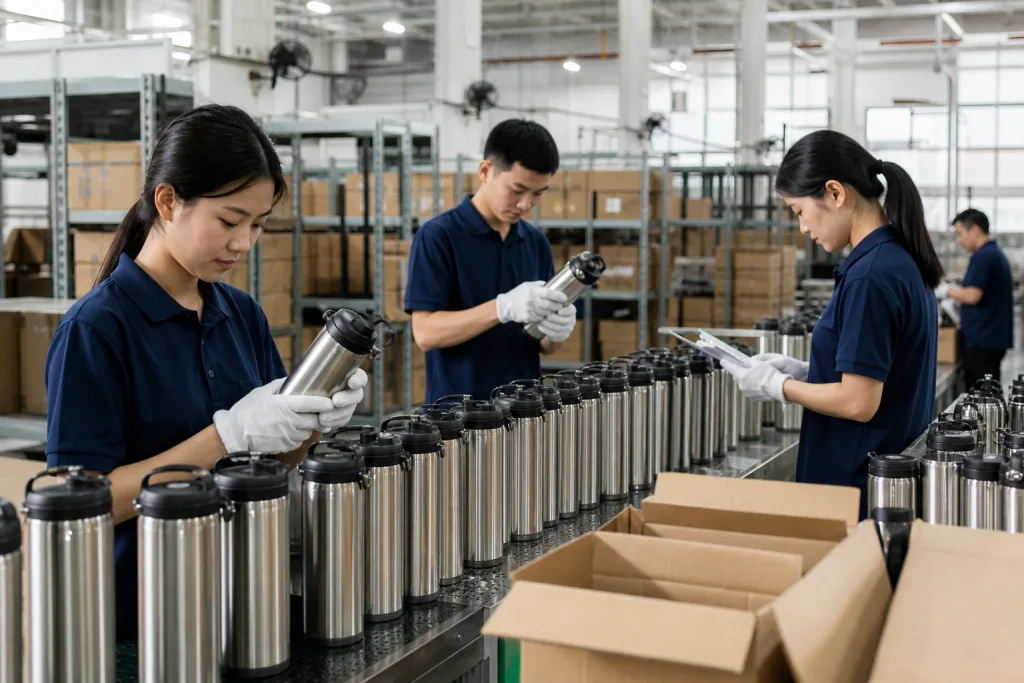
At BottleForge Industrial in Zhejiang, China, our standard monthly output is about 480,000 stainless drinkware units across bottles, tumblers, and canteens. For a normal customized drinkware order, sampling is 7-10 days after artwork approval, and mass production is usually 28-40 days after deposit and signed pre-production sample. QC pulled a 750 ml canteen sample last month because the powder coating was 18 μm on the shoulder instead of our 25-35 μm target; that is the kind of detail this spec table is meant to catch before the line starts.
When a thermal bottle wins
A straight vacuum thermal bottle is the safest pick for most US corporate gift jobs, retail programs, and distributor repeat orders. We run these molds every month, so the base tooling is stable, the carton cube is known, and decoration can change without touching the bottle body. For 500 ml and 750 ml sizes, FOB Ningbo or Shanghai can stay in a range that leaves margin for both the importer and the reseller. Last quarter a buyer flagged a 500 ml carton at 46 × 31 × 28 cm because their warehouse wanted under 15 kg gross weight. Easy fix.
For a mid-grade 500 ml stainless bottle, realistic FOB China pricing is often USD 3.20-5.20 based on steel grade, coating thickness, lid parts, packaging spec, and order volume. A fully 304 stainless construction with powder coating, laser logo, and gift box can push the price above USD 5.80. If a quote lands far below this, the math does not work. Ask whether the outer shell is 201 stainless, whether the lid has PP or Tritan contact parts, and what insulation test standard is used. On our floor, QC checks doubtful steel with an XRF gun before mass production, not after the buyer complains.
For the US market, we normally recommend these baseline specs. They are not fancy. They prevent claims.
- 304 stainless inner wall, not 201, because the liquid contact surface matters and FDA food-contact review starts there.
- Powder coating above 60 μm for better scratch resistance than thin spray paint; QC pulled one sample at 42 μm last year and we rejected the batch before packing.
- 6-hour heat retention test at 95°C filling temperature, with logged results by batch and bottle position on the test bench.
- AQL inspection at 2.5 for major defects and 4.0 for minor defects, unless your retail channel requires tighter limits.
A thermal bottle is easier for Amazon FBA because single-unit packaging, FNSKU labeling, and master carton limits are predictable. A 500 ml bottle often packs 24 pcs per carton, and we ship that format without much warehouse argument. A custom growler may only pack 6 or 12 pcs, which changes inland freight and storage costs fast. We have seen this go sideways when the PO said “24 pcs/ctn” but the approved artwork sheet showed a bulky handle lid.
Where canteen projects beat bottles
A custom canteen is not a bottle with a new label. Buyers usually ask for a wider body, outdoor look, loop cap, shoulder strap, carabiner, or military-style profile. That shape sells better for lifestyle retail, outdoor clubs, school stores, and canteen promo programs where the silhouette has to do part of the branding work. We see this at sample review: a 92 mm round canteen body gets more shelf attention than a slim 70 mm bottle, even before the logo goes on.
The catch is parts control. More parts, more chances to fail. A strap needs pull testing, and we usually run it at 15 kg before sending the pre-production sample. A loop cap needs torque testing with the digital torque meter, not a quick hand twist on the packing table. If the cap uses silicone, the material must be food-grade and stable after repeated washing. If the canteen has a textured powder coat, test the logo method on that texture before bulk approval; QC pulled one sample last year where the screen print looked sharp on smooth paint but broke on the sand-texture finish.
For a canteen distributor or distributor canteen buyer, “Can you make this shape?” is the wrong question to ask. Most canteen manufacturers can. Ask: “Which parts are standard, and which parts need tooling?” A standard lid in black, white, or grey may be free at 1,000 pcs. A custom-molded lid color or special handle can require USD 800-2,500 in tooling and 18-25 extra days. A new body mold costs more and does not make sense unless annual volume is above 30,000 pcs. We have seen this go sideways when the PO says “custom cap” but the approved artwork only shows PMS color, no 3D cap drawing.
For decoration, canteen customizable programs usually come down to laser engraving on powder coat, one-color silk screen, or full wrap heat transfer. Laser is clean and durable, but slow on large logos; one 60 mm logo can add 9-12 seconds per unit on the line. Silk screen is cheaper for simple marks, often USD 0.08-0.18 per position, but it needs a flatter print area. Heat transfer gives stronger shelf impact, though the math gets worse if the bottle curve is aggressive because film wrinkles push the rejection rate up during AQL 2.5 inspection.
Growlers are heavier commercial bets
A customized growler works when the buyer has a real channel behind it: breweries with taproom traffic, outdoor retailers with shelf space, premium corporate gift boxes, or camping distributors that already move bulky goods. It is the wrong answer for a lot of custom drinkware briefs. Bigger body, tighter lid demands, higher freight per sellable unit. On our line, QC checks the lid torque with a simple torque meter because a small seal miss on a 1.9 L unit turns into a wet carton fast.
A 1.9 L stainless growler may weigh 650-950 g before packaging. Add a color box, pulp insert, and master carton, and your sea freight cube becomes a real cost line; one recent 500-carton quote looked fine at FOB, then the buyer flagged the CBM after we packed the sample carton. If you compare a custom growler against a 750 ml thermal bottle only by FOB unit price, the math doesn't work. Compare landed cost per carton and retail price per unit instead.
For a customizable growler, we push buyers to test three things before mass production. First, thread engagement: the cap should close smoothly without cross-threading after 50 open-close cycles on the bench. Second, leak performance: invert the filled unit for at least 30 minutes, then run a shake test. Third, handle strength: a full growler is heavy, so a weak plastic handle becomes a warranty claim waiting to happen; we have seen handles crack at the pin after one bad resin batch.
A distributor growler program also needs packaging that matches the weight. Around 7 out of 10 buyers ask for kraft boxes because the outdoor look sells, but kraft board scuffs during ocean transit if the master carton is weak. For US shipments, we commonly specify 5-ply export cartons, edge crush test above 32 ECT, and a 76 cm drop test for retail packs where required. Not fancy. It is how we ship clean bottles without receiving photos of crushed boxes at the warehouse door.
Decoration choices change the price
Customizable drinkware buyers often choose the bottle shape first and leave the logo for the last email. For US orders, that is the wrong question to ask. Decoration changes unit cost, scrap rate, lead time, and how the bottle looks after 90 days in a warehouse or on a retail peg. Last month QC pulled 12 matte-black samples from the line; 3 had logo edge lifting after a 3M tape pull, although the bottle body was fine.
For stainless thermal bottles and custom canteen orders, the working choices are limited. Laser engraving cuts through the coating and shows the stainless steel underneath. It suits names, crests, date codes, and one-position logos, but the math does not work for a 90 mm filled graphic because machine time jumps fast. Silk screen printing works well for one or two colors on a smooth cylinder; we run it often for canteen promotional jobs with a tight target price. Heat transfer or water transfer covers larger artwork and complex graphics, but curved bodies need a trial on real shells, not only a flat film check. UV printing gives fine detail, but adhesion must be tested on the exact powder coating, down to the batch if the buyer cares about repeat orders.
A realistic pre-production process looks like this: digital artwork check, Pantone callout, sample on the real coating, tape adhesion test, then signed approval. Simple. Do not approve logo placement only from a 3D mockup. A 2 mm shift may not matter on a straight bottle, but it can look wrong on a tapered canteen or customized canteen with a shoulder curve. We have seen this go sideways when a PO said “logo centered,” while the artwork file had the logo 6 mm above the visual center.
For pricing, ask canteen suppliers to split the quote: blank bottle, coating, logo, packaging, inland China cost, and FOB port. If everything sits in one line, you cannot compare canteen vendors properly. Ask for the MOQ by decoration too; 500 pcs laser engraving and 3,000 pcs heat transfer are not the same production problem. A good canteen factory should show where the cost sits, even if it keeps its internal margin private.
Compliance and inspection for US buyers
For the US, drinkware compliance is not optional paperwork. Your supplier needs a working handle on food-contact materials, coating safety, labeling, and retailer test rules. For stainless drinkware, buyers often ask for LFGB or FDA food-contact documents, though the exact report depends on the material list and sales channel. If the bottle has a PP lid, Tritan straw, or silicone seal, test those parts as separate contact components. Do not test only the 304 stainless body and assume the lid is covered. QC pulled one pre-shipment sample last year where the body report was clean, but the black silicone ring had no batch record.
Some US retailers request Prop 65 review, CPSIA if the item is marketed to children, and ASTM-related checks for kids’ products. A kids bottle is a different compliance job from an adult thermal bottle. Treat it that way. If your design uses paint, ink, soft-touch coating, or colored plastic, confirm heavy metals, BPA, phthalates, and migration testing before the line starts. REACH is more common for Europe, but 6 out of 10 North American brand owners we deal with still ask for it because the same SKU sells into Canada, the US, and EU marketplaces. The buyer flagged this once after the PO already said “US only”; the math did not work after we had 18,000 coated lids finished.
Inspection should happen before the balance payment. At minimum, use AQL 2.5/4.0 with checks for vacuum performance, leakage, coating defects, logo placement, barcode scan, carton marks, and packaging count. We run a 24-hour hot water hold test on thermal samples and check leakage by turning the bottle upside down for 30 minutes after tightening to the agreed torque. For a 5,000 pc order, a third-party inspection in China often costs USD 250-350 per man-day. Cheap insurance. It is still better than finding 312 mixed lids in a US warehouse after the container has been unloaded.
Ask your canteen manufacturer for batch traceability: production date, line, coating batch, and inspection report. In Zhejiang, many export-focused factories already run ISO 9001 procedures or BSCI social audits, but you should verify the certificate scope and expiration date. A certificate from another facility does not protect your shipment. We ship from Hangzhou, and our carton label usually shows line number, inspection date, and outer carton count, such as 24 pcs/ctn, so a recall or claim does not turn into guesswork. We have seen this go sideways when a PO had one digit wrong in the item code and nobody matched it against the coating batch sheet.
How to brief the factory
The fastest way to get a usable quote is to send a structured brief. A vague request gives a vague price, and then both sides burn three days fixing assumptions. We see it on the line all the time: one missing lid spec and the sales desk has to go back to the vacuum sealer setup. Whether you work with a canteen supplier, canteen factory, or broader customized drinkware manufacturer in China, send the same commercial information to every bidder.
Your brief should include capacity, target FOB price, order quantity by color, steel grade, lid type, coating finish, logo method, packaging, shipping port, compliance needs, and delivery deadline. If you are a distributor drinkware buyer, say whether the goods go to your warehouse, Amazon FBA, a 3PL, or direct to retail DCs. FNSKU labels, carton labels, pallet height, and routing guides change labor cost and lead time. A PO that says “black” without a Pantone code usually comes back with a buyer flag on day two.
For a first order, do not customize every part. A standard body with custom coating, logo, and packaging is usually smarter than a new mold. You get market feedback faster, and you keep the first production run in a 35-45 day window instead of turning it into a 70-day development project. We have seen this go sideways when a buyer chases a special lid before the product has sold. After sales prove the item, then look at exclusive molds or a canteen customized lid.
A clean RFQ line might read: “750 ml vacuum custom thermal bottle, 304 inner/304 outer, powder coat black and white, 2,500 pcs per color, laser logo one side, individual kraft box, AQL inspection, FOB Ningbo, US Prop 65 review, delivery before August 15.” That gives a canteen vendor enough to quote honestly and gives you enough detail to compare offers without guessing. One typo on a PO, like 2,500 pcs written as 25,000 pcs, can waste a morning on the packing table, so this is the right place to be exact.
Send your bottle brief for a practical factory quote
Share capacity, quantity, logo, packaging, and US channel requirements. We will return a clear FOB quote and production timeline.
Frequently asked questions
What MOQ should I expect for a custom thermal bottle for the US market?
For a standard stainless body with your logo, 1,000 pcs per color is a normal MOQ in China. If you need a custom powder coat color, many factories prefer 2,000-3,000 pcs because coating line setup and paint loss are real costs. For a custom-molded lid or new canteen shape, expect tooling charges and a practical first run closer to 5,000 pcs. Smaller orders are possible, but the FOB price can rise by USD 0.30-0.80 per unit.
Is a custom canteen more expensive than a regular thermal bottle?
Usually yes, if the canteen has straps, loop caps, handles, or a wider body. A basic 750 ml thermal bottle may quote around USD 4.20-6.20 FOB China depending on finish. A comparable custom canteen can be USD 0.40-1.20 higher because of extra parts, thicker steel, and more complex packing. The canteen may still be better for outdoor retail or promotional campaigns because the shape has stronger shelf identity.
Which logo method is best for distributor drinkware programs?
For long-running distributor drinkware orders, laser engraving is the safest premium option because it does not peel and handles warehouse abrasion well. For budget canteen promotional jobs, one-color silk screen is cheaper and faster. If you need full-color art, test UV print or heat transfer on the exact bottle coating before approving mass production. Always require a tape adhesion test and a signed physical sample, not only a digital mockup.
How long does production take after I approve the sample?
For standard custom thermal bottles, plan 28-40 days after deposit and sample approval. Add 7-10 days for sampling before that. A custom canteen with special parts may need 45-60 days, especially if tooling or special silicone colors are involved. Ocean freight to the US West Coast is often 18-28 days port to port, while East Coast routing can be 30-40 days. Build in time for inspection and customs.
What should I check before paying the balance?
Do a pre-shipment inspection using AQL 2.5/4.0 or your retailer’s required standard. Check leakage, vacuum insulation, coating scratches, logo position, barcode scan, carton markings, packaging count, and gross weight. For a 5,000 pc order, third-party inspection in China is usually around USD 250-350 per man-day. Also confirm test reports match the final materials: stainless body, lid plastic, silicone gasket, coating, and ink.