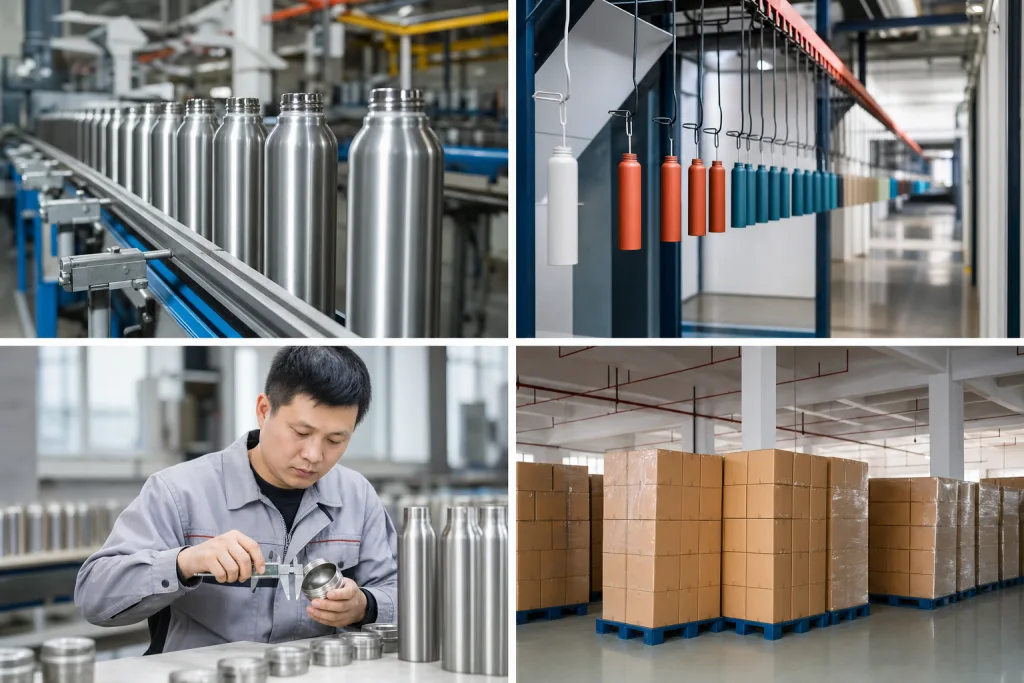
Key Takeaways
- A 500-1,000 pc stock-color custom thermal bottle usually lands around USD 3.20-6.80 FOB China depending on capacity and finish
- Private mold work can add USD 3,000-18,000 and 25-45 days before mass production starts
- Typical MOQ is 500 pcs for laser logo, 1,000 pcs for powder-coated custom color, and 3,000 pcs for deeper customization
- Plan 35-60 days for repeat orders and 70-100 days for new mold, retail packaging, and third-party testing
If you are buying a custom thermal bottle for U.S. retail, corporate gifts, outdoor kits, or a distributor program, the factory is not the hard part. The hard part is reading the quote. The wrong question is, “Can you do it cheapest?” We see buyers get caught on a $0.18 lid upgrade, a 10-day lead-time promise that was never real, or a carton spec that does not match the shipper’s file. On the line, one bad packaging call can stall a 20,000 pcs order.
From our Zhejiang plant, the same questions land on the desk every week: 500 pcs or 50,000 pcs, laser mark or powder coat, stock mold or private mold, FOB Ningbo or delivered duty paid. A standard 304 stainless vacuum bottle order usually runs 35-60 days, but only if the artwork file is clean, the drop test is approved, and the PO has the right carton count before QC pulls the sample. We have seen a buyer flag a typo on “Ningbo” and the booking slip came back twice. That is the real work.
Start With The Real Cost Stack
A custom thermal bottle American buyer often starts with unit price. Fair enough. That is also where the bad buys start. A USD 4.20 bottle and a USD 5.10 bottle can sit next to each other on a quote sheet, but the USD 5.10 version may include 304 stainless steel inner and outer walls, 0.5 mm body thickness checked by micrometer, powder coating, individual kraft box, drop test packaging, and a lid seal that passes our leak jig at 30 seconds inverted. The cheaper quote may be a thinner 201 outer wall, light spray paint, and a generic carton that QC can dent by hand.
For a standard 20 oz to 32 oz vacuum bottle, the cost stack breaks down like this on our line: stainless steel body 35-45%, lid and sealing parts 12-18%, surface treatment 8-18%, decoration 3-12%, packaging 5-15%, labor and overhead 10-18%, and inland logistics/export handling 2-5%. When you ask a canteen supplier for a lower price, one of these areas must move. No magic there. Last month a buyer pushed for USD 0.18 down on a 24 oz bottle, and the math only worked if we changed the box from 350 gsm kraft to 300 gsm white card.
At our Zhejiang factory, current capacity is about 850,000 stainless drinkware units per month across thermal bottles, tumblers, growlers, and kids bottles. That scale helps on repeat custom drinkware, but it does not cancel physics. A double-wall bottle still needs forming, welding, vacuuming, leak testing, polishing, coating, printing, packing, and inspection; QC pulled one sample this week because the vacuum reading drifted after the hot-water hold test. If someone quotes a complex customized drinkware project with 15-day mass production during peak season, ask what process is being skipped. We've seen this go sideways.
For North American programs, separate FOB cost from landed cost. FOB Ningbo or Shanghai does not include ocean freight, duty, customs clearance, domestic trucking, or warehouse receiving. A distributor drinkware buyer selling to U.S. retailers may care more about the landed carton cost and chargeable CBM than the ex-factory price, and one PO typo on carton size, such as 58 x 39 x 27 cm entered as 68 x 39 x 27 cm, can change the freight estimate fast.
MOQ Tiers That Actually Matter
MOQ is not a punishment. It is the point where steel purchasing, line setup, laser fixture adjustment, powder coating loss, and QC labor stop killing the order. We run this check on the cost sheet before quoting. A custom canteen with one laser logo can start much lower than a canteen customized with PMS powder coat, silicone boot, printed gift box, and insert card, because the line changeover is 35 minutes instead of half a day.
Useful MOQ tiers for planning:
- 300-500 pcs: possible for stock body, stock color, laser engraving, and simple neutral packaging. Unit price is usually high because logo setup, carton label printing, and AQL sampling are spread across fewer pieces.
- 1,000 pcs: the practical starting point for many canteen promotional orders with custom logo, standard box, and one carton mark. This is the tier most American corporate gift buyers should use for budgeting, unless they need 6 colors; then the math gets ugly.
- 3,000 pcs: better for custom powder color, silk screen artwork, sleeve, hangtag, and retail barcode label. Canteen distributors often start here because pricing holds steadier and QC can pull samples across color, print, and packing runs.
- 5,000-10,000 pcs: suitable for chain retail, distributor canteen programs, and seasonal outdoor promotions. Factories can push steel coil, lids, and color powder suppliers harder at this range, so the unit price has real room to move.
- 20,000 pcs and above: worth discussing dedicated color runs, lid tooling, exclusive packaging, and staged shipments. We ship these against a packing schedule, not one loose “ready date” on a PO.
For a custom growler or customizable growler, MOQ may sit higher because the body uses more steel, the cap structure costs more, and carton CBM is worse. A 64 oz customized growler program at 1,000 pcs is possible, but pricing improves much more clearly at 3,000 pcs. QC pulled one 64 oz sample last month with a 0.6 mm lip dent after drop testing, and that kind of rework hits harder on small runs.
If you are comparing canteen manufacturers in China, check whether the MOQ is by SKU, by color, or by order. This is the wrong question to leave vague. A quote saying “MOQ 1,000 pcs” may mean 1,000 pcs per color and per logo, and we have seen buyers flag this only after their PO listed 250 pcs each in 4 colors. That changes your assortment plan fast. Ask the canteen factory to write it plainly on the proforma invoice.
Decoration Choices Change Price Fast
Logo method moves cost and lead time faster than anything else on the spec sheet. We run a 50W fiber laser for this job, and for 500-3,000 pcs it is the safest call on a custom thermal bottle American order because there is no ink curing step and the artwork repeat is stable. QC pulled one sample after a 24-hour rub test and the mark stayed sharp. Expect about USD 0.15-0.45 per position, depending on logo size and machine time.
Silk screen printing fits larger solid graphics, simple one-color marks, or canteen promotional campaigns where the logo has to read from across the room. Setup cost is usually USD 30-80 per color, and unit cost sits around USD 0.08-0.25 per color per position. The buyer flagged a 0.22 mm line on a 73 mm bottle body last week, and it closed up after print. Smooth powder coating takes it well; curved bodies need artwork cleanup, and fine lines under 0.25 mm can fill in.
Full-wrap heat transfer or water transfer gives a more retail-looking customized canteen, but the reject rate is higher and the schedule stretches. Add 5-10 days for sampling and process confirmation. We had one PO where the customer approved the screen mockup and then the first wrap failed because the seam landed on the handle side. Ask for a pre-production sample, not just a digital mockup. A screen image and a curved bottle are not the same part.
Powder coating is stronger than wet paint for everyday custom drinkware, but it costs more and color control is tighter. A new PMS-like color normally needs 7-10 days for powder matching, and small batches create more waste at the line. Our spray booth keeps the drawdown cards beside the hopper, and the team checks the finish under a 6500K light. If you need a matte white bottle with a black logo, simple. If you need a soft-touch gradient coating, retail box, and three logo positions, this is a development job, not a quick canteen vendor order.
For American buyers, we lock decoration after one physical sample and one print proof. PDF approval is fine for reorder work. It is the wrong question on a first run. We have seen a PO typo on the Pantone code turn into a week of back-and-forth, so we check the actual bottle, the actual print, and the paperwork before release.
Materials, Testing, And Compliance Costs
Most serious canteen suppliers will quote 304 stainless steel for the inner wall. The outer wall is usually 304 or 201, depending on your target FOB and whether the buyer cares about magnet test results at receiving. For drink contact, the inner wall matters most, but premium retail programs usually call out 304 inside and outside on the spec sheet. Typical wall thickness ranges from 0.4 mm to 0.6 mm before forming. Go too thin and QC will see dents after the 76 cm drop test; go too thick and the carton weight jumps, so the math does not work for air shipment.
Vacuum performance needs numbers, not sales talk. A common 500 ml to 750 ml bottle may keep water above 60°C after 6 hours under controlled testing, but the result changes with lid design, capacity, mouth diameter, and starting temperature. We run the test with a digital probe thermometer, and QC records the room temperature beside each sample. Wide-mouth bottles lose heat faster than narrow-mouth bottles. A custom growler with a 58 mm cap opening will not behave like a slim commuter bottle with a small screw lid.
For the U.S. and Canada, buyers usually ask for FDA food-contact compliance, CPSIA if children may use it, and sometimes ASTM-related packaging or physical safety tests. For Europe, REACH and LFGB are common. A responsible canteen manufacturer in China should be able to arrange third-party testing through SGS, Intertek, TÜV, or BV. Budget USD 250-900 per test set depending on material scope and destination market. Last month, one buyer flagged a silicone gasket color change after we sent PP samples, and that one small change meant a fresh migration test.
Factory audits also matter if you sell to retailers. BSCI, Sedex/SMETA, ISO 9001, or customer-specific audits can decide whether your PO is accepted by the retailer system. Our Zhejiang export team keeps recent audit documents ready, but you should still confirm expiry dates and factory name spelling. We have seen this go sideways from one typo on a PO, where “Hangzhou” was written as “Hanzhou” and the compliance team held the booking. A valid test report from 2021 may not satisfy a 2026 retail compliance team.
Do not treat compliance as paperwork after production. If ink, coating, gasket, straw, or plastic lid parts change, your previous report may not cover the new SKU. Build testing time into the calendar before final shipment booking. For a normal SGS food-contact package, plan 7 to 10 working days after samples reach the lab, not the day the line finishes polishing.
A Practical Timeline From RFQ To Ship
A repeat order can move fast. A new custom thermal bottle American project should not be squeezed until the specs are locked. We run this timeline with U.S. distributor growler buyers, canteen distributor programs, and retail accounts, and the problems usually start at the same place: late artwork or packaging changes after the line has been booked.
Days 1-3: RFQ review. Send capacity, body shape, target price, logo file, packaging style, order quantity, destination, and compliance requirement in one email. The factory checks mold availability, decoration route, and rough carton data; our merchandiser will also weigh a similar bottle on the scale and estimate carton size before quoting ocean freight.
Days 4-10: sample preparation. A stock sample with laser logo can often ship within 5-7 days. Custom color, new lid, or printed packaging usually pushes sampling to 10-20 days because the coating line needs a Pantone spray panel first. International sample freight to the U.S. is often USD 45-120 depending on weight; last month a 2.8 kg sample box to Ohio billed at USD 68 by DHL.
Days 11-18: sample approval and PO. This is where 6 out of 10 new orders lose time. If sales, brand, and compliance approve artwork in separate email threads, the factory cannot hold line capacity forever. Give one final logo file, Pantone reference, barcode, FNSKU if needed, carton mark, and packaging text; QC pulled one pre-production sample last week because the PO said “mat black” while the artwork said matte black.
Days 19-50: mass production for standard orders. Stainless forming and welding finish first, then vacuuming, polishing, coating, printing, assembly, and packing usually take 25-35 days after deposit and final artwork. Peak season before Q4 may push this to 40-50 days. The buyer often asks for 20 days; the math does not work when vacuum testing alone needs overnight aging and the line still has to reject weak insulation pieces.
Days 51-60: inspection and export. AQL inspection normally uses ANSI/ASQ Z1.4 sampling. Common settings are AQL 2.5 for major defects and 4.0 for minor defects, though retail buyers may demand stricter levels. After inspection, allow 3-7 days for booking, trucking to port, customs, and vessel cut-off; our warehouse team checks carton drop damage, gross weight, and shipping marks before the truck leaves for Ningbo port.
Private mold work adds another 25-45 days before production. If your canteen customizable shape needs new tooling, do not promise a 45-day launch to your customer unless tooling has already been completed and approved. We have seen this go sideways when a lid mold needed a 0.3 mm gasket adjustment after the first trial shot.
Packaging And Logistics Are Not Small Details
Packaging changes cost and freight fast. A single-wall white box may cost USD 0.12-0.25. A printed retail color box may run USD 0.25-0.70. A premium rigid gift box can pass USD 1.20 quickly and add carton volume. We measure the packed bottle with a caliper and carton ruler on the line, because 6 mm extra height across 10,000 pcs can push the CBM up. For e-commerce, use a 1.2 m drop test plan, stronger corrugated board, corner protection, and barcode control.
For Amazon or marketplace prep, confirm FNSKU labels, suffocation warnings if polybags are used, master carton labels, and carton weight limits. About 7 out of 10 American warehouses we ship to ask for cartons under 15 kg, even when heavier cartons look cheaper on the ocean freight sheet. A 32 oz bottle packed 24 pcs per carton may work for wholesale, while 12 pcs per carton is easier for manual warehouse handling. QC pulled one sample carton last month because the FNSKU label was 3 mm too close to the carton seam. Small issue. Big delay.
FOB China terms are clean for experienced importers. If you are new, ask for both FOB Ningbo and DDP reference pricing, but do not treat DDP as a fixed magic number. The math does not work that way. DDP depends on duty, freight market, and delivery ZIP code, and we have seen a Los Angeles ZIP and a rural Ohio ZIP change the delivery line by more than USD 0.20 per bottle. Ocean freight can move sharply. A quote valid for 30 days on product cost may not protect freight cost for 60 days.
Canteen vendors sometimes understate carton size to make landed cost look better. Ask for actual carton dimensions, gross weight, net weight, and estimated CBM before you issue the PO. We run the final carton check with a tape measure after the inner box is packed, not from a drawing made before the foam insert was added. On a 10,000 pc customized canteen order, a small carton-volume mistake can change freight by hundreds or thousands of dollars. We have seen this go sideways.
If you are a canteen distributor serving multiple customers, staged shipments can protect cash flow. For example, ship 5,000 pcs first and 5,000 pcs three weeks later. Plan this before materials are purchased, especially for custom powder, printed boxes, and silicone accessories. Once the powder coating supplier mixes a custom Pantone batch in 25 kg drums, splitting the line later creates waste, color risk, and a new setup charge the buyer usually did not budget for.
How To Compare Factory Quotes
When you compare canteen manufacturers, don’t ask only “best price?” Ask for the quote structure. A workable quote should show steel grade, capacity, lid material, coating method, logo method, packaging, MOQ by SKU, sample charge, sample lead time, mass lead time, payment terms, FOB port, carton data, and test report availability. We run into this every month: one buyer’s RFQ says “20 oz bottle” but the reference photo measures 73 mm wide, closer to our 18 oz mold after caliper check.
For a stock 20 oz bottle with one laser logo at 1,000 pcs, a sensible FOB range from China might be USD 3.20-4.80 depending on finish and lid. For a 32 oz powder-coated bottle with retail box, expect closer to USD 4.80-7.50. For a 64 oz customized growler, USD 8.50-14.00 is more realistic. These are not promises; steel prices, exchange rate, and specs move. Use them as guardrails. If one quote is USD 2.65 and the others sit around USD 3.90, the math doesn’t work unless something changed: thinner 304 stainless, cheaper lid, no retail box, or no testing.
Check communication quality too. A good canteen supplier will challenge unclear specs. If you request “premium bottle, best quality, cheap price,” you should receive questions, not blind agreement. Serious canteen suppliers know that American programs fail when assumptions are left open. QC pulled a pre-production sample last quarter because the buyer wrote “matte black” on the PO, while the approved sample was Pantone Black 6C with a soft-touch powder coat.
Lowest unit price is useful only when the product, packaging, testing, inspection level, and delivery term are identical.
If you want a canteen customized for retail, send the buyer pack: technical drawing or reference photo, target capacity, logo AI/PDF file, Pantone colors, packaging dieline if available, compliance market, order forecast, and delivery deadline. With that, a Zhejiang drinkware factory can quote accurately in 24-48 hours. Without it, the quote is a guess dressed as a number. We’ve seen this go sideways when the buyer forgot the straw lid in the RFQ, then flagged the 12-carton shortage after packing was finished.
Send Your Bottle Specs For A Real Quote
Share quantity, logo, packaging, and delivery market. We will return MOQ, FOB price, sample timing, and production lead time clearly.
Frequently asked questions
What is a realistic MOQ for a custom thermal bottle American order?
For a stock bottle shape with one laser logo, 500 pcs is often workable, although 1,000 pcs gives better pricing. For custom powder color, plan 1,000 pcs per color. For a customized canteen with printed box, silicone boot, special lid color, or multiple logo positions, 3,000 pcs is a more realistic MOQ. Private mold projects usually need 5,000-10,000 pcs to make economic sense, plus tooling cost. Always confirm whether MOQ is per order, per SKU, or per color, because those three answers create very different buying plans.
How long does production take after I approve the sample?
For a repeat order using an existing bottle, standard mass production is usually 25-35 days after deposit and final artwork approval. Add 3-7 days for inspection, export customs, and port delivery. Custom color or complex decoration can push production to 40-50 days, especially from August to October. New tooling adds 25-45 days before mass production starts. If you also need third-party testing, retail packaging approval, or FNSKU labeling, plan the full project at 70-100 days from first RFQ to China port shipment.
What should I send to get an accurate factory quote?
Send capacity, reference shape, target quantity, number of colors, logo file in AI or PDF, decoration method if known, packaging requirement, destination country, compliance needs, and target delivery date. If you are a distributor drinkware buyer, include forecast quantities by quarter, not just the first PO. For a custom growler or custom canteen, mention lid type, handle requirement, mouth diameter, and whether it needs to fit cup holders. A complete RFQ lets the canteen manufacturer quote within 24-48 hours instead of guessing.
Can I use one test report for several bottle styles?
Sometimes, but do not assume it. If the stainless steel grade, coating, ink, gasket, straw, plastic lid, and supplier source are the same, a lab may accept a family testing approach. If you change from one lid material to another, add a painted logo, or switch gasket compound, the old report may not cover the new SKU. For U.S. and EU programs, budget USD 250-900 per test set and confirm the exact standard: FDA, LFGB, REACH, CPSIA, or customer-specific protocol.
Is FOB China or DDP better for American buyers?
FOB Ningbo or Shanghai is usually better if you already have a freight forwarder and import process. It keeps product cost transparent and lets you control ocean freight, duty, customs, and domestic delivery. DDP can be useful for smaller buyers who want a landed door price, but the quote depends on ZIP code, freight market, duty assumptions, and carton data. For orders above 3,000 pcs, most experienced canteen distributors prefer FOB China plus their own forwarder because it is easier to audit costs.