Key Takeaways
- A practical MOQ for a custom stainless steel tumbler is usually 1,000-3,000 pcs per color
- 304 stainless steel at 0.45-0.55 mm wall thickness is the common B2B baseline
- Powder coating needs adhesion, rub, and dishwasher-risk discussion before mass production
- AQL 2.5/4.0 inspection catches most cosmetic and functional defects before shipment
A custom stainless steel tumbler looks simple on a quote sheet: capacity, color, logo, price. Then two suppliers quote the same 20 oz tumbler, and one comes in USD 0.48 lower. We’ve seen this go sideways. That gap often means 0.4 mm body steel instead of 0.5 mm, a lighter PP lid, thin powder coating on the rim, a plain K=K carton, or a leak test done by shaking 3 samples by hand.
If you buy custom drinkware for retail, promo runs, or distributor programs, the spec sheet is your control tool. Our factory in Zhejiang, China produces up to 650,000 stainless units per month, and the buyers who get stable results define tolerances before sampling, not after shipment. QC pulled one sample last month because the logo was 2 mm off-center; small on paper, ugly on shelf.
Start with capacity and real use
Capacity is the first line on the spec sheet, and it should map to how the buyer will actually use the cup. A 20 oz custom stainless steel tumbler may hold 590 ml to the brim, but once the lid is on, the comfortable fill is usually 540-560 ml. We run that check at the line with a 250 ml measuring cup, because one loose spec can turn into a complaint after the first carton lands. For North America, 20 oz and 30 oz still sell best at retail. For Europe, 500 ml and 600 ml print cleaner on packaging and compliance files.
Pick the use case before you lock the size. Desk mug, car cup holder, stadium event, food service. A slim 18 oz tumbler that fits a 72-76 mm cup holder solves one job; a wide 30 oz model solves a different one, and the buyer flagged this on a PO before because the shelf photo looked strong while the cup holder test failed. For distributor canteen and distributor growler programs, the use pattern matters even more, since the same SKU may move through three channels.
If you are placing a custom canteen, customizable canteen, or custom growler beside a tumbler, do not force one spec across all of them. A canteen customized for outdoor use may need a carry loop, wider mouth, and thicker base. A customized growler may need a pressure-aware cap design and 64 oz capacity. A tumbler usually wins on daily convenience, but only when the diameter, lid style, and grip area are set with the buyer’s real use in mind. This is the wrong question to ask if you only chase a full carton count.
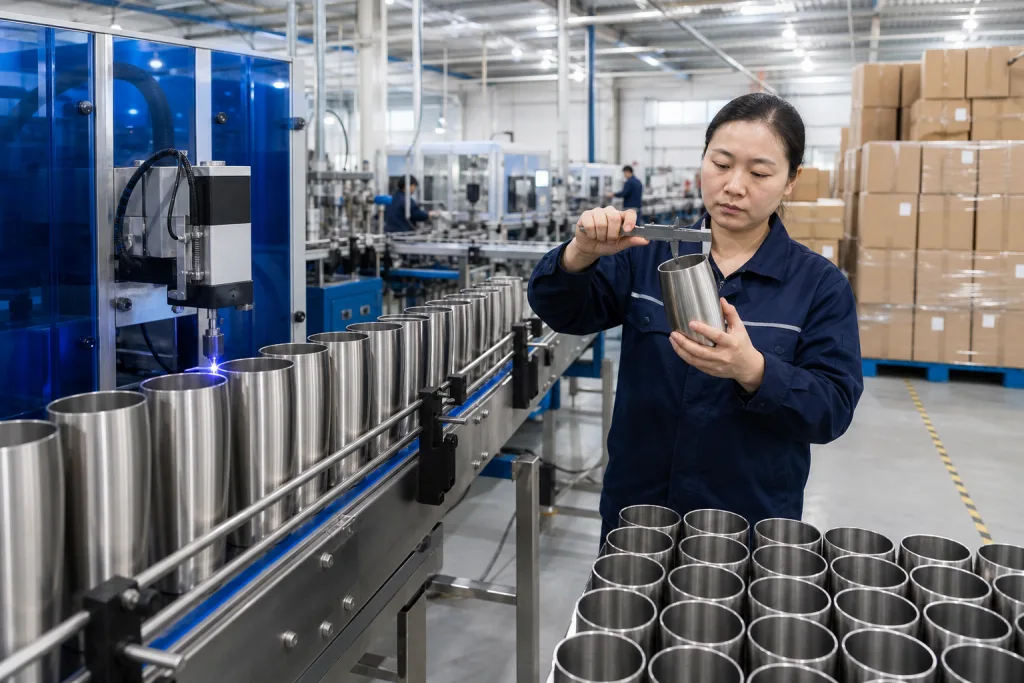
Ask your canteen supplier or tumbler factory for filled weight, empty weight, top diameter, bottom diameter, and height in millimeters. Those five numbers stop sampling surprises before they start. QC pulled the sample on a caliper reading once and found a 2 mm mismatch at the base, which was enough to change cup holder fit. That is the kind of detail that saves a rework.
Steel grade and wall thickness
For most B2B custom stainless steel tumbler projects, we quote food-contact 304 stainless steel for the inner wall, then offer 304 or 201 stainless steel for the outer wall as two separate lines on the PI. 304/304 costs more, but it holds up better against rust spots, especially for coastal retailers or end users who leave coffee in the cup overnight. 304 inner with 201 outer is workable for promo orders when the target price is tight. We run into this weekly: the buyer asks for “same quality, lower price,” but the math does not work unless the outer steel grade changes.
Wall thickness needs to be written on the spec sheet, not discussed on WeChat and forgotten. A common range is 0.45-0.55 mm for the inner and outer shell before forming, measured with a digital micrometer before the coil goes to the stretch-forming line. Thin material can cut about USD 0.15 per piece, but it dents faster in drop testing and carton compression. Cheap feel kills repeat orders.
Vacuum insulation needs test data, not sales talk. For a 20 oz double-wall tumbler, a fair benchmark is hot water at 95°C staying above 40°C after 6 hours under room temperature testing around 20°C. QC pulled the sample at 9:00, logged the reading with a probe thermometer, then checked again at 15:00; that is the kind of record a buyer should ask for. Cold retention changes a lot with lid structure, ice volume, and test method, so compare suppliers under the same conditions.
Factories in Zhejiang and other parts of China may list the same steel grades on paper, but forming quality, welding control, and vacuum rejection rates can be far apart. Ask for the normal vacuum failure rate during production before packing starts. A serious canteen manufacturer or tumbler supplier should know whether it is 1%, 3%, or higher before rework. We have seen this go sideways when a PO said “304” but did not state inner/outer, and the buyer flagged rust marks after the first 500 pcs arrived.
Lid design changes the complaint rate
The lid is where cheap quotes hide. We’ve seen a solid 304 stainless body lose the reorder because the slider rattled after one week in a sales sample kit. Common lid choices are sliding lids, flip lids, straw lids, and screw lids, but the wrong question is “which lid looks best?” The buyer should ask what complaint they are willing to handle: leakage, broken hinges, odor, or slow drinking.
- Sliding lid: good for office desks and cup holders; we usually mark it splash-resistant, not leakproof, because the 6 mm drink slot is still an open path.
- Flip lid: better for travel mugs, but QC should run hinge fatigue over 2,000-3,000 cycles before mass production.
- Straw lid: strong seller for cold drinks; straw material still needs food-contact approval, and the buyer often flags soft straws that deform in cartons.
- Screw lid: stronger seal and fewer leakage claims, though drinking is slower; it fits outdoor sets better than desk coffee programs.
If your brief says “leakproof tumbler,” define the test on the PO. We run a simple check: fill to 90%, close the lid, invert for 10 minutes, then shake 20 times over a white inspection tray. Clear enough. Not every tumbler should be sold as leakproof. A sliding lid with a drink opening is normally splash-resistant, not bag-safe, and we have seen this go sideways when a buyer used “leakproof” on Amazon images.
For canteen promotional projects, some buyers use the word canteen for any drink bottle. That wording is fine for the catalog, not for the engineering sheet. A canteen customizable with a screw cap can pass leak tests that a coffee tumbler lid cannot, because the gasket is compressed around the full thread. If you are a canteen distributor, make sure the product name does not promise more than the lid can pass; one sell sheet typo changed “spill-proof” to “leakproof” and cost 300 replacement units.
Confirm gasket material before artwork approval. Silicone is the standard choice, usually checked by Shore A hardness and odor after hot-water soaking. Low-cost TPE can work for some designs, but odor risk is higher if the canteen factory does not control material sourcing. Ask whether spare gaskets can be supplied at 1%-2% of order quantity for after-sales support, packed in a small PE bag with the SKU printed on it.
Finish, color, and logo tolerances
Surface finish changes both unit cost and how the shelf looks. We run five usual options: powder coating, spray painting, polishing, electroplating, and raw brushed stainless steel. Powder coating is the default for customized drinkware because the hand feel is matte, the grip is better, and small scuffs hide better than on glossy paint. For a standard 20 oz tumbler, powder coating may add USD 0.35-0.70 per piece depending on color, texture, and order size. On the line, our coating jig leaves about 3-5 mm contact points at the rim or base, so the buyer should confirm where those marks are acceptable before mass production.
Color matching should start with Pantone references, but stainless drinkware is not paper printing. A reasonable tolerance is usually Delta E under 2.0-3.0 for controlled colors, while bright orange, neon green, and fluorescent pink can give trouble after curing at 180-200°C. If your brand color is strict, approve a physical color chip and a pre-production sample, not just a screen image. Last month QC pulled the sample for a sports club order because the approved PDF looked correct, but the powder-coated cup measured Delta E 3.4 under the light box.
Logo methods carry different risks. Laser engraving is durable and clean, but it exposes the stainless color beneath the coating. Silk screen printing works for simple one- or two-color logos, usually with a lower setup cost and a faster screen change. Heat transfer and UV printing handle gradients, but scratch resistance must be tested with a 3M tape pull and a light rub test before shipment. For premium customizable drinkware, engraving or debossed metal badges may justify the cost. The math does not work if a buyer asks for a photo-grade UV logo on a low-cost giveaway cup and then expects zero scratches after loose carton packing.
A common mistake is placing a large logo across a curved taper without checking distortion. On a tapered tumbler, a 90 mm wide logo may look straight in artwork and slightly warped on the product. Ask your canteen vendor or tumbler supplier for a printable area drawing. For most 20 oz tumblers, a safe logo zone is around 50-70 mm high and 60-90 mm wide, depending on shape. We have seen this go sideways when the PO said “logo centered,” but the artwork file had the mark 6 mm closer to the bottom curve.
For customized canteen, customized growler, and tumbler programs sharing one campaign, keep logo size proportional. The same 80 mm mark can look too large on a 350 ml canteen and too small on a 64 oz growler. We usually ask the buyer to approve a size chart by SKU, then QC checks the first pieces with a steel ruler before the line prints the full MOQ.
Packaging, cartons, and freight math
Packaging is not just decoration; it changes landed cost. A plain white box may cost USD 0.12-0.22. A printed retail box can run USD 0.25-0.60 depending on paper gsm, matte or gloss coating, and order quantity. Gift tubes and magnetic boxes look good in a showroom, but the carton cube jumps fast. We measure it on the packing table with a 5 m tape before quoting FOB China, because that extra volume affects ocean freight and warehouse handling.
A typical 20 oz custom stainless steel tumbler packs 24 pcs per export carton. Carton dimensions might be around 50 x 34 x 28 cm, but this changes by body shape and box style. If you ship to Amazon FBA or a 3PL, you may need FNSKU labels on each unit, carton labels on two sides, suffocation warnings for polybags over the size limit, and packaging that can pass a basic drop test. Do not add these after production. The line slows down, QC pulled the sample twice, and the relabeling charge usually lands back on the buyer.
For distributors, master carton strength matters. We normally recommend 5-ply export cartons for North America and Europe, especially when the shipment may be handled 6-8 times before it reaches the shelf. A carton compression issue can crush lids and dent retail boxes even if the tumbler body survives. We have seen this go sideways after a 1.2 m stack test when the carton paper was downgraded to save USD 0.04.
If you work with several canteen suppliers or canteen vendors, compare quotes on the same packaging basis. One quote may include individual boxes and barcode labels; another may quote bulk packing only. That difference can be USD 0.30 per unit before freight. On 10,000 pcs, the math doesn't work if the buyer only checks the FOB line. Ask for a packing spec sheet, carton mark sample, and label position drawing before you approve the PO.
For mixed programs that include a custom growler, customizable growler, and tumbler, request a carton loading plan. Growlers are volume-heavy; tumblers are usually more container-efficient. Your freight cost per unit may be different even when the FOB price looks close. We run container estimates by CBM, not guesswork, and one 64 oz growler carton can eat the space of two slimmer tumbler cartons.
Compliance and inspection lines
For Europe, put LFGB, REACH, and food-contact documentation on the table before the PI is signed. For the United States, buyers usually ask for FDA food-contact conformity, and 2 out of 10 also ask us for California Proposition 65 screening, especially if the order ships to a retail chain. Kids products may trigger ASTM or CPSIA requirements, while adult tumblers usually sit on a simpler compliance route. Write the required tests into the sales contract, including who pays if SGS or Intertek fails the first sample. We have seen this go sideways when a buyer approved the price first, then flagged Prop 65 after the 304 stainless bodies were already coated on the line.
Do not trust old reports by default. A 2022 report for a PP lid does not prove your 2026 tumbler with a Tritan lid and silicone gasket is compliant. Ask whether the report covers each contact point: 304 stainless steel body, powder coating, silicone gasket, plastic lid, straw, and printing ink on the logo area. These are separate material risks, not one neat package. Last month QC pulled the sample and found the gasket material on the PO said “silicon” instead of “silicone”; small typo, real delay.
Inspection should be written with AQL levels. A practical standard is AQL 2.5 for major defects and 4.0 for minor defects, with critical defects not accepted. Major defects include leakage during the inverted water test, vacuum loss after the 95°C hot-water check, wrong logo position by more than 2 mm, sharp rim edges, unstable base, or coating peel after tape testing. Minor defects include small dust points, slight color variation within approved tolerance, or tiny carton scuffs. Simple rule: if the customer sees it in 3 seconds on shelf, treat it seriously.
At our Zhejiang, China facility, a normal lead time is 30-40 days after sample approval for 3,000-10,000 pcs, with MOQ usually starting at 1,000 pcs per color for standard molds. New mold development can add 25-45 days, depending on CNC time, lid fitting, and vacuum performance testing. We run pre-production checks with calipers, a torque tester for lids, and a 24-hour temperature retention record before mass production. A capable canteen manufacturer should give you these numbers before taking a deposit. If they only say “fast delivery,” the math doesn't work.
If you are sourcing from multiple canteen manufacturers, align the inspection checklist across all factories. Use the same leakage test, logo tolerance, carton drop height, barcode scan rule, and AQL 2.5 sampling plan for every SKU. Otherwise your distributor canteen program will carry different defect standards by SKU, and customers will compare them side by side. We ship mixed-model programs often; the buyer always flags the weakest item, not the average one.
Price lines you should challenge
A useful quote for a custom stainless steel tumbler is not one lonely FOB price. Ask the supplier to break it out line by line: body material, lid type, coating, logo method, packaging, test cost, sample cost, mold cost if any, and estimated lead time. The negotiation gets cleaner. If your target is USD 4.20 FOB instead of USD 4.60, decide whether to change the color box to a white box, switch powder coating to spray paint, or simplify the slider lid. Do not let the factory quietly shave 0.05 mm from the steel wall. QC will catch that with a micrometer, and the buyer will feel it in hand.
For a standard 20 oz double-wall tumbler in 304 inner stainless steel, typical FOB China pricing may sit around USD 3.20-5.80 depending on order size, lid, coating, and branding. A 30 oz version may be USD 4.20-7.20. These are working ranges, not promises. We have seen quotes come in USD 0.35 below the market, then the sample arrives with a loose PP lid, thin powder coating at the rim, and a carton that fails a 76 cm drop test.
Payment terms belong in the spec discussion too. Around 8 out of 10 factories we deal with use 30% deposit and 70% before shipment. For repeat buyers or larger annual programs, staged payment or shipment release terms can be negotiated after the first clean order. If you are a canteen distributor or distributor drinkware buyer planning quarterly replenishment, ask for a price valid for 60-90 days, because stainless steel and exchange rates can move. We run into this often: the PO says “matte black,” the artwork file says “black sand finish,” and nobody priced the extra coating loss before deposit.
The best canteen supplier is not always the cheapest canteen vendor. Cheapest is sometimes the wrong question to ask. You want a factory that pushes back when your spec conflicts with the end use, such as a gift-box insert that looks premium but cracks during ocean shipment. That pushback is how you avoid a beautiful sample that cannot be produced consistently at 20,000 pcs.
Send us your tumbler spec sheet for review
We will check material, lid, logo, MOQ, packaging, and lead time before you commit to sampling or a purchase order.
Frequently asked questions
What is the normal MOQ for a custom stainless steel tumbler?
For standard molds, a realistic MOQ is usually 1,000 pcs per color and 3,000 pcs for better pricing. If you need a custom powder-coated Pantone color, some factories ask for 2,000-3,000 pcs because coating setup loss is real. For a fully private mold, the MOQ may move to 5,000-10,000 pcs, plus mold cost. If a supplier accepts 300 pcs with full customization, check whether they are using stock goods with simple logo printing.
How long does production take after sample approval?
For a standard custom stainless steel tumbler, 30-40 days after sample approval is a normal lead time in China for 3,000-10,000 pcs. Add 7-12 days for pre-production samples if the logo and color are new. Add 25-45 days if a new mold is required. Sea freight to North America or Europe can add another 25-45 days depending on port and season, so a safe retail launch calendar is often 90-120 days.
Which logo method is best for tumblers?
Laser engraving is the safest long-term option for powder-coated stainless tumblers because it does not wash off and handles daily abrasion well. Silk screen printing is cheaper for simple logos and can work well for promotional orders above 1,000 pcs, but it needs rub testing. UV printing is useful for full-color artwork, though buyers should test scratch resistance. For premium retail, many buyers choose laser engraving plus a printed retail box for better perceived value.
Can one supplier make tumblers, canteens, and growlers together?
Yes, many stainless drinkware factories can supply tumblers, custom canteen styles, and custom growler products together, but you should check tooling and testing capability by category. A tumbler line does not automatically mean the factory has strong leakproof bottle caps or 64 oz growler experience. Ask for production photos, test reports, and previous shipment quantities. For distributor drinkware programs, keeping related SKUs in one factory can reduce color mismatch and packaging inconsistency.
What defects should I inspect before shipment?
Use AQL 2.5 for major defects and 4.0 for minor defects. Check vacuum performance, leakage, coating adhesion, logo position, color match, sharp edges, lid fit, odor, barcode accuracy, carton strength, and quantity. For insulation, test a sample group with 95°C water and record temperature after 6 hours. For leakage, invert and shake filled units. Do not inspect only appearance; functional failures create the most expensive claims after the goods reach your warehouse.