Key Takeaways
- Set leak testing at 100% for caps and AQL 2.5/4.0 for finished goods before mass production
- Specify 304 or 316 stainless steel, wall thickness, coating type, and food-contact compliance in writing
- Expect MOQ around 1,000-3,000 pcs per color for most custom drinkware flask programs
- Logo defects usually come from curved surfaces, low-resolution artwork, or untested coating adhesion
A custom stainless steel flask looks simple on a quotation sheet: capacity, color, logo, carton size, price. Then the line starts. Lids seep after 200 open-close cycles on the torque tester. Powder coating chips at the shoulder after a 60 cm drop test. A 750 ml body holds 710 ml when QC checks it with a graduated cylinder. Your distributor canteen program ships 12 days late because the artwork file was approved, but the laser position on the jig was never signed off.
We manufacture drinkware in Zhejiang, China, and we see these boring mistakes before they turn into claims. In 9 out of 10 problem orders we review, the root cause is not bad luck. It is a vague spec, a weak pre-production sample, skipped leak testing, or a supplier writing “standard quality” when the buyer needs AQL 2.5, coating thickness, logo tolerance, and carton drop requirements. For a custom stainless steel flask, price per piece is the wrong question to ask first. Buy the process, not just the bottle.
The capacity is not what you bought
Capacity disputes happen because the buyer and the factory are not always measuring the same thing. Some canteen manufacturers quote brimful capacity: filled to the lip on a digital scale, with zero room for the cap, stopper, ice, or walking around with hot tea. We have seen a flask sold as 750 ml hold only 700-720 ml in normal use. Retail buyers get returns. Promo buyers get the client asking why the sample and the catalog claim do not match.
Put the measuring method into the purchase order. We normally ask buyers to state both nominal capacity and usable capacity. For example: “750 ml nominal, minimum 720 ml usable when cap is closed without overflow.” Simple. Clear. If you sell into the US, check the fluid ounce wording on the color box; 25 oz and 750 ml are close, but one buyer once flagged a PO because the artwork said 26 oz and the bottom stamp said 750 ml.
Body shape changes the result more than buyers expect. A narrow-mouth custom canteen with a high shoulder can lose 35-50 ml of usable volume compared with a straight-wall flask of the same outside height. A custom growler or customized growler with a swing cap also needs headspace if the end user puts carbonated drinks inside. The 3D drawing is not enough. Ask your canteen supplier for a water-fill test report on the approved pre-production sample, taken after QC pulled the sample from the line and weighed it with water at room temperature.
For new tooling, we allow a dimensional tolerance such as ±2 mm on height and diameter, but capacity needs a tighter commercial tolerance, usually -0 ml / +30 ml for the declared usable volume. The math does not work if a supplier hides behind “normal production tolerance” and ships a 720 ml usable flask against a 750 ml usable claim. Ask how capacity is checked: measuring cup, scale weight, test temperature, and cap closed or open. If your canteen vendor cannot answer that, treat it as a warning sign.
Leaks start at the smallest parts
Most leakage failures do not start in the stainless body. They start in the lid set: cap thread, silicone gasket, straw port, stopper seat, or handle rivet boss. Looks can lie. A custom stainless steel flask may pass the shelf test and still leak after the silicone ring takes a compression set, the thread pitch is cut 0.2 mm too shallow, or the cap shrinks after dishwasher exposure. For a canteen promotional project, even a 1% leak rate is painful when the order is 10,000 pcs; that is 100 angry users and usually one buyer asking who pays the freight back.
Require the factory to define the leak test in writing. “Leak tested” means almost nothing on a PO. We run a practical check like this: fill with water at 20-25°C, close cap to normal torque with the same jig used on the line, invert for 30 minutes, shake 10 times, then check for visible drops on white tissue. For sports or travel use, add a 1.0 m drop test on three sides before repeating the leak test. For vacuum insulated flasks, check vacuum retention separately with a temperature hold record; a flask can be leakproof but still lose heat too fast.
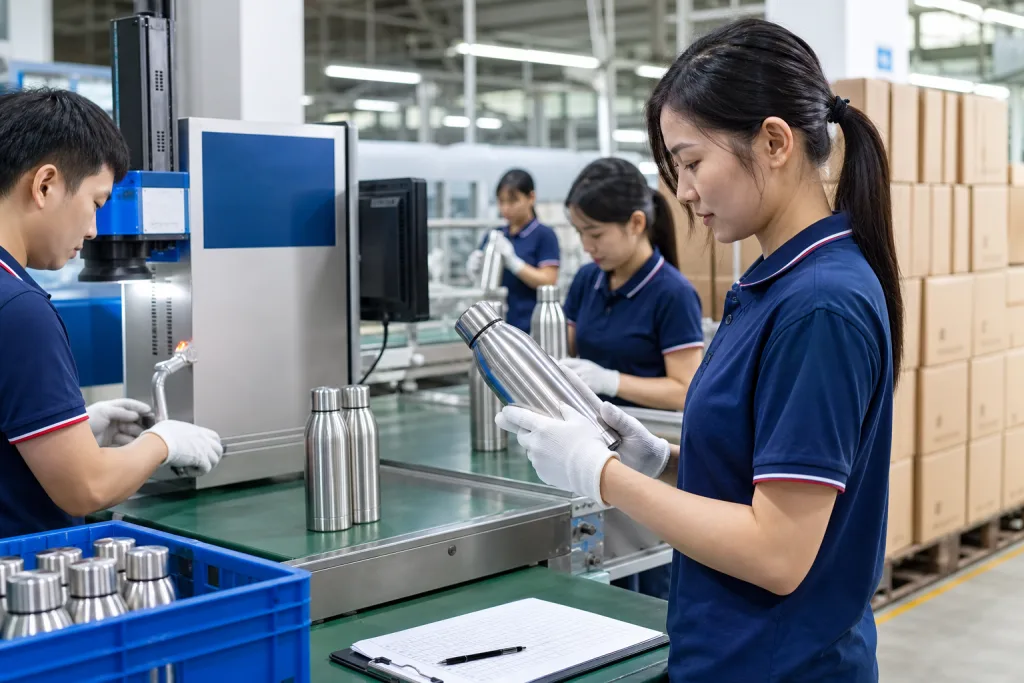
At our Zhejiang plant, normal monthly output is about 420,000 drinkware units, and cap assembly is where we slow the line deliberately. The math does not work if the lid design has two gaskets and the supplier only samples 20 pcs from a 10,000 pcs run. For customized drinkware orders, we use 100% cap fit and leak screening on models with complex lids, then final inspection under AQL. QC pulled one sample last season where the gasket looked seated, but the corner had rolled by 1 mm under the cap lip; sampling caps would have missed that random defect.
Ask for the spare gasket policy before mass production. For distributor drinkware, especially outdoor or worksite products, a replacement gasket extends product life and cuts returns. If you are working with canteen vendors in China, specify FDA/LFGB-grade silicone and keep the gasket color in the BOM. A black ring and a translucent ring may not have the same durometer or supplier; we have seen a PO list “clear gasket” while the approved sample used smoke-gray silicone, and the buyer flagged it during pre-shipment inspection.
Steel grade and wall thickness get blurred
“Stainless steel” is not a spec. A custom stainless steel flask should show the grade for the inner wall, outer wall, cap contact plate, and any infuser or strainer. For most custom drinkware, 304 stainless steel is the standard choice for food-contact surfaces; we run 304 inner coils on most flask orders unless the PO says otherwise. 316 fits buyers asking for stronger corrosion resistance, often for premium outdoor, marine, or acidic beverage use. 201 stainless steel costs less, but for direct food-contact premium flask programs, the math usually does not work after testing risk and brand complaints.
Wall thickness changes the whole feel of the bottle. A single-wall canteen customized for promotions may use 0.5-0.6 mm sheet. A double-wall vacuum flask may use 0.4-0.5 mm inner wall and 0.5-0.6 mm outer wall, depending on the shape and forming process. On the line, our forming tech checks the sheet with a digital micrometer before deep drawing; 0.05 mm off can show up later as soft shoulders or wavy polishing. If the sheet is too thin, you get dents, uneven welds, and deformation during polishing. Too thick, and the price and weight jump fast.
Ask your canteen manufacturer to list the steel grade and gauge in the quotation, not only in the sample invoice. Better, require a material certificate for the coil batch used in mass production; QC pulled one last month where the PO said 304 stainless but the supplier file had no heat number. For EU buyers, tie this to food contact and REACH expectations. For North America, ask about FDA food-contact compliance and whether painted or plastic components need separate testing. This is the wrong question to ask: “Is it stainless?” Ask: “Which grade touches the drink, and what thickness are you forming?”
One common failure is mixing sample-grade material with production-grade material. The sales sample feels solid, then the bulk order arrives lighter. We have seen this go sideways on a 3,000 pcs promo order when the buyer flagged a 14 g drop between the approved sample and bulk goods. Control it by setting a target unit weight with tolerance. Example: “Finished bottle with standard cap: 286 g ±8 g.” Weight is not perfect proof of quality, but it is a cheap way to catch silent material changes before shipment.
Decoration fails before the bottle does
Logo defects get blamed first because the end user sees the mark before they check capacity, insulation, or steel grade. A canteen customizable program might use silkscreen, laser engraving, heat-transfer print, UV print, powder coating, water transfer, or full-wrap artwork, but each process has a hard stop. A sharp rectangular logo that looked fine on a flat tumbler can stretch across a flask shoulder. A pale logo can vanish on brushed steel. A full-wrap print can split at the weld line. We have seen QC pull 32 samples from the line where the artwork was perfect on the AI file and ugly on the bottle.
For silkscreen on powder coating, lock the Pantone color, print size, print position tolerance, and adhesion test before the PO is released. Use the real bottle. A common test is 3M tape pull after 24 hours curing; for higher-risk orders, add cross-hatch adhesion testing with a 1 mm cutter. For laser engraving, ask for a sample on the actual coating color, not a different bottle from the showroom shelf. Some matte black coatings engrave cleanly; some turn brown or patchy gray after the laser head runs too hot.
Customizable growler and customized canteen projects often fail because the buyer approves only a digital mockup. Do not do that. This is the wrong place to save USD 45 on sample freight. Require a physical decorated pre-production sample, especially when the logo is larger than 60 mm, wraps more than 120 degrees, or crosses a curve. If you are a canteen distributor selling to multiple corporate accounts, keep an approved logo placement file with dimensions from the bottom, center line, and handle direction. Last month a buyer flagged a 4 mm drift toward the handle; the artwork file had no center-line reference, so the line had guessed.
Decoration cost also needs straight numbers. A one-color silkscreen logo may add USD 0.08-0.18 per unit. Laser engraving may add USD 0.15-0.45 depending on size and machine time. Full-color heat transfer can add USD 0.35-0.90. Low quotes often mean weaker ink, 8 hours curing instead of 24 hours, or no adhesion test at all. The math does not work when 5% of the logos scratch during carton rubbing, and we have seen this go sideways on a 3,000 pcs reorder packed with rough kraft dividers.
Coating and corrosion show up late
Powder coating sells because it feels premium and does not show fingerprints like mirror polish. It also gives you problems bare steel does not. We see chipping on the bottom rim, orange peel over curved shoulders, gloss mismatch between cap and body, and weak adhesion beside TIG-welded seams. A custom stainless steel flask with a handle or carabiner loop adds 2–4 rubbing points in the carton, and QC pulled samples last month where the loop had polished a shiny mark through the matte black coating before packing.
Spec the coating like an industrial part, not a gift item. Write down matte, satin, or gloss level; Pantone or RAL reference with a Delta E limit; and test requirements tied to real use. For outdoor drinkware, we suggest a 1.0 m drop test on plywood or concrete-like surface depending on product positioning, plus abrasion testing on handle joints, bottom edges, and cap contact areas. Salt spray testing matters for coastal, marine, or worksite custom canteen orders, but this is the wrong test to request blindly; 24 hours vs 48 hours changes both cost and lead time, and the pass/fail rule must say whether red rust, white stain, or edge blistering counts as failure.
Corrosion usually starts with poor passivation, dirty polishing wheels, low-grade accessories, or liquid trapped around seams and threads. Stainless steel resists rust. It is not magic. If your flask includes a carbon steel spring, a low-grade screw, or a plated accessory, that 3 mm part can stain the whole product after one week in a damp warehouse. Make the canteen factory confirm that all liquid-contact metal parts are stainless steel and that exterior accessories pass your corrosion requirement; we have seen a buyer approve 304 stainless steel body samples, then flag rust from a non-stainless rivet during AQL 2.5 inspection.
For China production, add a carton-rub check. Finished bottles can look perfect after coating, then arrive with scuff marks because units moved inside the carton for 35 days at sea. Specify polybag thickness, paper sleeve, divider, or egg-crate packing if the finish is delicate; 0.03 mm polybag works for plain steel, but matte coating often needs 0.05 mm plus a divider. Packaging protects the finish. Treat it like part of the product, because the math does not work if you save USD 0.04 on packing and lose 300 units to rub marks.
Inspection plans are too polite
Many buyers write “factory QC required” and think they are covered. They are not. You need an inspection plan with defect definitions, sampling level, and rejection rules. For most custom drinkware exports, we run AQL 2.5 for major defects and AQL 4.0 for minor defects under ANSI/ASQ Z1.4, general inspection level II. Critical defects stay at zero tolerance. On our line, QC pulls 32 pcs, checks logo placement with a steel ruler, and records the result before packing starts.
Define what counts as major. Leakage, wrong capacity, wrong logo, sharp burrs, unstable base, exposed rust, broken cap, failed barcode, and wrong carton mark should usually be major or critical. Minor defects may include tiny dust spots, slight color variation within the approved tolerance, or small scratches outside the logo viewing area. If you leave this to interpretation, your canteen supplier and your warehouse will argue later. We have seen a buyer flag a PO that said “500ml” on the carton while the approved sample was 750ml. The math does not work.
Timing matters. For a 3,000-5,000 pc order, do not wait until 100% packed if it is the first run. Use three checkpoints: pre-production sample approval, during-production inspection at 20-30% completion, and final random inspection when at least 80% is packed. On a 4,000 pc flask order, we caught cap-thread drift at 23% and stopped the line before the lid press was reset. For repeat orders with stable results, you can cut the middle step. For a new canteen manufacturer, keep it.
Test packaging and labels during inspection. Distributor canteen orders often fail because the product is fine but the carton mark, UPC, FNSKU, suffocation warning, or country-of-origin label is wrong. If you sell through Amazon FBA or retail distribution, a label miss can cost more than a cosmetic scratch. Put barcode scannability, carton drop test, and master carton weight limits into the QC checklist. QC pulled a sample carton last week and the barcode scanned on the second pass, which is too slow for a busy DC.
Price pressure creates hidden substitutions
A custom stainless steel flask has a few cost drivers that move the quote fast: steel grade and thickness, cap complexity, vacuum insulation, coating, logo method, packaging, testing, and order quantity. If a buyer pushes only for the lowest FOB Ningbo or FOB Shanghai price, the canteen suppliers still need to recover margin somewhere. This is where we have seen orders go sideways. On the line, a 0.38 mm outer shell becomes 0.32 mm, the silicone gasket changes to a cheaper TPE ring, powder coating loses 8-12 μm, the 5-layer carton becomes 3-layer, or QC inspection gets squeezed from a full AQL 2.5 check to a quick visual pass.
Use a costed specification. Do not ask five canteen distributors or canteen vendors for “your best price.” Send the same spec sheet to each one: capacity, steel grade, wall thickness, cap material, coating, logo size, packaging, compliance tests, inspection level, Incoterm, and target ship date. Then compare the same product. If one offer is USD 0.60 lower on a USD 4.20 flask, ask exactly where the saving comes from. We had one buyer flag this last year after QC pulled the sample and found the cap PP grade did not match the PO, even though the photo looked the same.
For reference, a mid-range double-wall stainless flask in 500-750 ml with one-color logo and color box often falls around USD 3.20-6.80 FOB China depending on structure, finish, and quantity. MOQ is commonly 1,000 pcs for simple logo customization, 3,000 pcs per color for custom coating, and 5,000-10,000 pcs for new mold or special cap development. Normal lead time is 30-45 days after deposit and sample approval, with another 25-38 days ocean transit to many North American and European ports. The math does not work when someone asks us to cut USD 0.40 and keep 304 stainless, 12-hour heat retention, laser logo, color box, and drop-test cartons; the only place left to cut is the product itself.
If you want a dependable canteen customized program, let the factory say no to unrealistic pricing. A serious canteen manufacturer in Zhejiang will protect the BOM because repeat orders matter more than winning one painful PO. Cheap only works when the flask still passes the tests you promised your customer. We ship repeat programs from Hangzhou every month, and the buyers who stay with us are usually the ones who ask for the BOM breakdown before they ask for the last USD 0.10.
Send your flask spec before you lock pricing
We will review capacity, coating, logo, packaging, MOQ, and QC risks before your custom stainless steel flask order moves into sampling.
Frequently asked questions
What MOQ should I expect for a custom stainless steel flask?
For an existing flask shape with one logo, MOQ is usually 1,000 pcs per design. If you need a custom powder coating color, many China factories ask for 3,000 pcs per color because coating line setup and powder loss are real costs. For a new cap, new body mold, or special customized growler structure, MOQ can move to 5,000-10,000 pcs. Smaller trial orders are sometimes possible at a higher unit price, especially if you accept stock colors and standard packaging.
How do I choose between 304 and 316 stainless steel?
304 stainless steel is the normal choice for most custom drinkware and custom canteen projects. It is food-safe, durable, and cost-effective for water, coffee, tea, and normal daily drinks. 316 stainless steel adds better corrosion resistance, especially around salt, acidic beverages, or premium outdoor positioning, but it increases cost. For most B2B flask programs, we suggest 304 inner wall and clear testing requirements. If your brand claims marine-grade or heavy outdoor use, then 316 may justify the extra cost.
Can I use the same logo method on every flask finish?
No. Silkscreen works well on many powder-coated bottles but needs adhesion testing. Laser engraving looks clean on many coatings, yet the final color depends on the coating chemistry. UV printing can show fine detail but may not suit high-abrasion outdoor use. For curved custom stainless steel flask bodies, always approve a physical decorated sample. A digital mockup cannot show distortion, gloss difference, tape-test performance, or whether the logo sits straight when the cap handle faces forward.
What quality tests should I require before shipment?
At minimum, require leak testing, capacity check, visual inspection, logo adhesion test, cap fit check, carton drop test, and barcode scan if retail labels are used. For insulated flasks, add heat retention testing, such as 95°C water measured after 6 or 12 hours. Final inspection can use AQL 2.5 for major defects and 4.0 for minor defects. For first orders above 3,000 pcs, add a during-production inspection at 20-30% completion to catch coating and assembly issues early.
What information should I send to get an accurate quote?
Send capacity, target dimensions, single-wall or double-wall structure, steel grade, cap style, coating color, logo method and size, packaging, compliance market, order quantity, Incoterm, and delivery deadline. If you are a canteen distributor or distributor growler buyer, include retail carton needs, UPC or FNSKU rules, and pallet limits. A clear spec sheet usually reduces quotation revisions from 5 rounds to 1-2 rounds and helps the factory protect the agreed BOM.