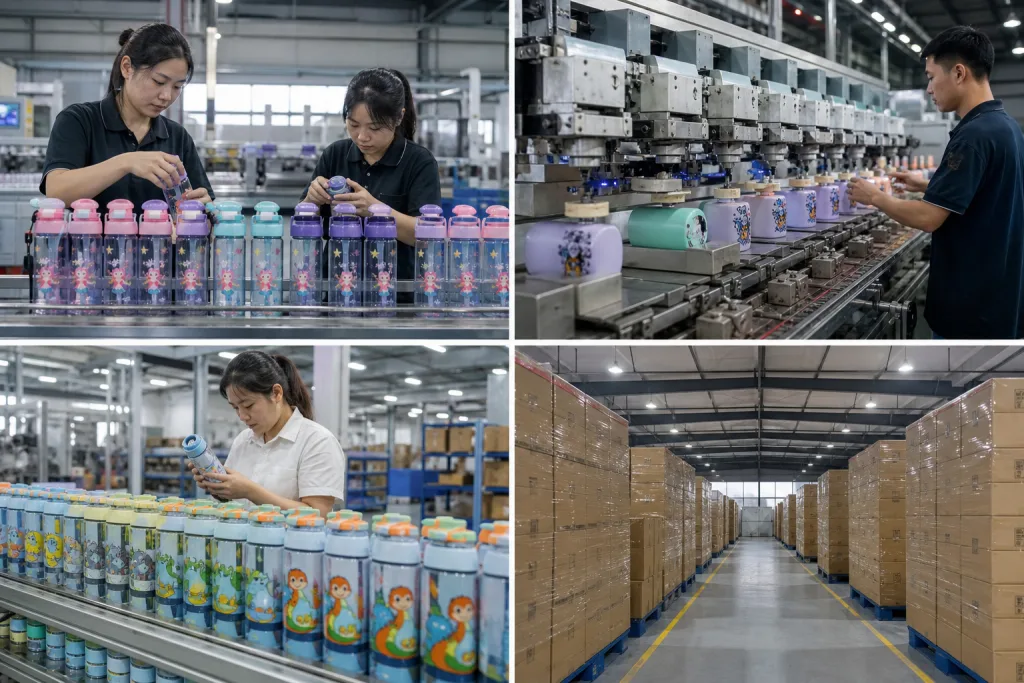
Key Takeaways
- Plan MOQ at 3,000 pieces per color for plastic and 1,000-2,000 pieces for stainless steel kids bottles
- For ages 5-12, 350 ml to 500 ml is usually easier to carry than 600 ml plus bottles
- Use CPSIA, FDA, LFGB, REACH, and ASTM checks based on destination market and material
- Expect 35-45 days production after artwork approval, plus 25-35 days ocean freight to North America
A custom school water bottle looks simple until you have to buy 5,000 pieces for a district program, retail launch, camp kit, or importer catalog. Then the cheap-looking details start costing money: a cap that seeps after the 3-minute inverted leak test, CPSIA label copy, 14 kg cartons that the warehouse rejects, logo ink that rubs off after tape testing, and spare straws nobody added to the PO.
From our factory base in Zhejiang, China, we usually ask buyers to settle four points first: material, capacity, lid system, and decoration method. Pick those before debating Pantone shades. We run samples on the line before quoting mass production, and QC pulled one 500 ml kids bottle last month because the flip lid opened after a 1.2 m drop on concrete. A bulk kids water bottle order is not just a giveaway. Children use it every school day, so the sourcing standard has to be higher.
Start with four buying decisions
Before you ask a children water bottle factory for a quote, lock four buying decisions first: material, capacity, lid design, and decoration. If you send only a logo and a target price, we have to guess the rest, and you get 6 supplier quotes built on 6 different specs. The buyer flagged this last April when one PO said “kids bottle” but the artwork file showed a straw lid, not the screw lid priced in the quote.
Material sets the product position. Tritan or PP works for a lightweight bulk school water bottle program, especially when the school wants a 3,000-10,000 pcs giveaway. Stainless steel is better for 18-24 months of use and a higher shelf value. Aluminum is light, but internal coating and denting risk need closer review; QC pulled samples with 2.5 mm side dents after a 1.2 m drop test. For younger children, glass is rarely the first choice unless you add a silicone sleeve and accept higher breakage risk. The math usually doesn’t work for school distribution.
Capacity should match the age group, not the adult buyer’s preference. For kindergarten and lower primary students, 350 ml to 420 ml is practical. For ages 8-12, 450 ml to 550 ml is more common. A 700 ml bottle sounds useful, but filled weight can exceed 800 g with stainless construction, and we’ve seen students leave it in the bag after day 3. On the line, we check filled-weight samples with a 1 kg bench scale because parents complain about weight faster than they complain about volume.
Lid design is where 7 out of 10 custom kids water bottle problems start. Flip straw lids sell well, but they add silicone parts, hinge pins, and cleaning concerns. Screw lids are simpler and cheaper, but younger students may not close them fully. Push-button lids need tighter QC because spring tension and locking feel vary by mold; our inspector checks 20 cycles per cavity before we release a new lid tool. Ask for the open/close video. It saves emails.
Decoration affects both price and durability. For a custom logo kids bottle, one-color screen printing may add USD 0.08-0.18 per piece. Laser engraving on stainless may add USD 0.12-0.30. Full-wrap heat transfer or UV print can look better for school mascots, but you should test abrasion and dishwasher claims before approving mass production. We run a simple 3M tape pull and 50-cycle dishwasher check on pre-production samples, because “dishwasher safe” on a sales sheet is not the same as a passed sample on the QC table.
Choose material by age and risk
For a custom school water bottle, choose material by age group, drop risk, and who cleans it, not by catalog photos. School district buyers usually ask us about safety, replacement rate, and whether a 9-year-old can rinse the lid without a parent picking out mold with a toothpick. Kids-product importers look at margin, retail packaging, and color repeatability from the first 3,000 pcs to the next shipment. QC checks this with a Pantone light box, and the buyer will flag it if “sky blue” shifts half a shade between cartons.
Tritan is a common choice for children water bottle wholesale programs because it is clear, tough, BPA-free, and lighter than stainless steel. A 450 ml Tritan bottle with a flip straw lid often lands in a middle FOB China price range of USD 1.80-3.20 depending on lid complexity, logo, and packaging. It fits camps, school stores, and retail sets where kids need to see the water level. We run Tritan bodies through visual inspection for black dots and flow marks; last month QC pulled the sample because one cavity had a 0.8 mm gate mark showing near the logo area.
PP is cheaper and flexible, but it looks more basic. It works for a children water bottle promotional project where the target FOB price is tight, sometimes USD 0.90-1.60 for simple single-wall designs. The trade-off is lower shelf appeal and weaker decoration effect, especially if the buyer wants a large mascot print on a curved body. The math doesn't work if the brief asks for a gift-box look at a giveaway budget; we ship PP for price-driven orders, not premium shelf display.
Stainless steel is stronger and better for a premium custom made kids bottle. For school programs, we usually suggest 304 stainless steel inside, 0.4 mm to 0.5 mm body wall thickness, and powder coating rather than a thin paint layer. A double-wall vacuum 350 ml to 500 ml kids bottle commonly runs USD 3.20-6.50 FOB Ningbo or Shanghai, depending on cap and print. On the line, we check vacuum performance after the oven and again after coating; one failed batch showed warm outer walls within 12 minutes, so it never reached packing.
As a children water bottle manufacturer in Zhejiang, China, we see fewer complaints when buyers avoid overcomplicated novelty shapes. Cute handles and ears may sell well, but each extra part creates another breakage point. If your order is for 20,000 students, a simple bottle that passes a 1.2 m drop test is better than a complex bottle that looks great only in a rendering. We’ve seen this go sideways: a PO once called for “bear ears” on the artwork, the mold drawing showed “deer ears,” and the buyer only caught it at pre-production sample stage.
Set safety and compliance first
Children’s products are not the place for fuzzy compliance talk. If you are buying children water bottle bulk for North America, lock the test plan before the PO, not after the line starts. We have seen a buyer try to switch from a standard drinkware report to child product testing after sample approval, and the math does not work once tooling is cut. A serious children water bottle supplier should show material certificates, finished-product reports, and factory audit status without making you chase them. On our side, QC pulled samples from a 3-cavity injection machine and checked the lot code against the spec sheet.
For the United States, common requirements include FDA food-contact testing, CPSIA lead and phthalate limits where applicable, and tracking label information for children’s products. If the bottle may be used by children under 12, talk CPSIA paperwork with your importer of record before shipment. For Canada, check food-contact and bilingual labeling requirements. For Europe, buyers usually ask for LFGB or EU food-contact testing, REACH, and sometimes EN 14350 depending on the design and age positioning. We print bilingual carton labels on the packing line, and a 1.5 mm font on the age mark has saved more than one order from a reprint.
If the bottle has a straw, spout, silicone gasket, painted coating, or printed graphics, do not test only the base resin. Test the parts children touch and the printed surface if there is a risk of rubbing, chewing, or migration. For stainless steel, confirm 304 grade for the inner wall and ask whether the outer shell is 201 or 304. Using 201 outside is common for cost control, but it should be disclosed. The buyer flagged it on a PO once, because the approved sample said 304 inner and 201 outer, while the draft order copied 304 for both walls. We keep a 0.02 mm feeler gauge at the bench for gasket checks, and that catches a lot of avoidable complaints.
For inspection, use AQL rather than a casual video check. A typical bulk kids bottle order can use AQL 2.5 for major defects and 4.0 for minor defects. Critical defects, such as sharp edges, leaking lids, loose small parts, or foreign odor, should be set at 0 tolerance. At BottleForge Industrial, our normal final inspection includes leak testing, cap torque checks, print adhesion checks, barcode scanning if required, and carton drop review for export packaging. We run the torque wrench to 0.35 N·m on the line, and that catches weak cap threads fast.
Match branding to real handling
A school bottle gets abused. It sits in a backpack next to a metal ruler, rolls under desks, goes through dish soap at home, then gets another name sticker slapped over your logo. The decoration has to match that handling. We’ve seen a children water bottle custom order with a nice 6-color mascot come back with complaints because QC pulled the sample after 100 wet-rub strokes and the cheek color started lifting at the grip area.
For stainless steel, laser engraving is the safe choice for wear, but it is one-color in practice because it exposes the metal or marks the coating surface. It works for district logos and donor names where clean branding matters more than full retail graphics. Screen printing keeps cost under control for one to three colors, especially when the art has thick lines above 0.3 mm. For full-color artwork, heat transfer or UV printing looks better on the shelf, but approve a real pre-production sample, then ask the line to run tape testing and wet-rub testing before bulk. Pretty art is not enough.
For plastic bottles, we run screen printing and UV printing most often. A curved body can stretch the artwork near the shoulder, so keep small text and QR codes away from that area; one buyer flagged a 5 mm slogan that became hard to read after printing around the taper. If you need student names or class names, leave a blank write-on panel instead of personalizing every unit at factory level. Factory personalization is possible, but the math gets ugly fast: sorting 3,000 named bottles takes longer, packing checks slow down, and one typo on the PO can put “Class 2B” into the wrong carton.
For a children water bottle customizable program, lock the color standard early. Pantone matching on plastic is close, not exact, and different materials throw color differently under the light box. A blue PP lid, silicone straw, and powder-coated stainless body will not land on the same shade even if the supplier uses the same Pantone code. Good children water bottle manufacturers will say this before sampling, not after the buyer pushes back on photos.
Practical rule: if the bottle is for daily school use, choose decoration that survives 100 rub cycles with a wet cloth and does not peel at the child’s grip area.
Calculate MOQ, price, and freight
MOQ is not just a line in our quotation sheet. It comes from resin or 304 stainless purchasing, Pantone color changeover, pad-printing screen setup, and how many pieces fit cleanly into one export carton. For a standard bulk children water bottle, our practical MOQ from Zhejiang is usually 3,000 pieces per color for plastic bottles and 1,000-2,000 pieces per color for stainless steel models if existing molds are used. Below that, the math doesn't work. Last month the buyer asked for 800 pcs in 4 colors; QC pulled the pre-production sample and the color gap after changeover was already visible under the D65 light box. New mold development can start around USD 2,000 for a simple lid and rise above USD 8,000 for a more complex push-button or character design.
FOB pricing only makes sense when the packing and accessories match line by line. A USD 1.60 bottle packed in a thin polybag is not the same as a USD 1.95 bottle with retail box, spare straw, instruction sheet, FNSKU label, and stronger master carton. We see this go sideways when a PO says “color box” but the artwork file names a kraft window box, which adds roughly 0.18-0.35 kg per carton depending on size. For importers selling online, carton size and chargeable weight matter. For school districts, unit handling and distribution cartons often matter more than retail display because one carton may be split across 6 classrooms.
Ocean freight can move the landed cost on low-value bottles. A 450 ml plastic bulk kids water bottle may pack 60 pieces per master carton, while a stainless insulated version may pack 24 or 36 pieces. If the carton is oversized, you pay to ship air. We run a carton drop test before final packing approval, and a 5 mm change in insert height can be the difference between a tight carton and a container with wasted CBM. Ask your children water bottle vendor for carton dimensions before final approval, not after production. This is the wrong time to guess.
Lead time needs to be planned from the deposit date, artwork approval, and confirmed packaging, not from the first WhatsApp message. For an existing mold with standard color, mass production is often 30-40 days after deposit and artwork approval. For custom color, new lid, or special packaging, plan 45-60 days. Our Hangzhou-area supply chain supports about 300,000 kids bottles per month across plastic and stainless lines, but peak back-to-school orders can still fill capacity quickly from March to June in China. We ship faster when the buyer locks the Pantone code, logo size in mm, and carton mark before tooling starts; one typo on a PO can cost 3 days.
Inspect samples before purchase orders
A sample is for more than appearance approval. It is the lowest-cost point to catch problems before you own 10,000 units. When we run a custom children water bottle sample, we fill it to 90%, shake it, drop it from 1.2 m, wash it, smell the inside after 24 hours, and ask a child to open and close the lid. Simple test. Adults often miss how a stiff push button or tight silicone straw valve feels to a six-year-old with small hands.
Ask for three sample types when the project matters. Start with a stock sample to judge mold quality, parting lines, lid thread feel, and whether the bottle sits flat on a granite inspection table. Then request a logo sample to check decoration size, Pantone color, and position; we have seen buyers flag a 3 mm logo drift on a school mascot order. Last, approve a pre-production sample made with mass-production material and retail packaging. For school district buyers, this sequence feels slow. The math still works. It is safer than approving a polished hand-made logo sample and receiving a thinner production version after the PO is released.
Your sample checklist should cover lid alignment, gasket fit, straw suction, odor, internal polish, coating thickness, sharp edges, print adhesion, and dishwasher claim. If the product is sold as leakproof, write the test down: filled to 90 percent, inverted for 30 minutes, then shaken horizontally 20 times. QC pulled one sample last year where the lid passed upright storage but leaked 8 ml after the horizontal shake. Without a written test, “leakproof” turns into an argument.
For children water bottle distributors, keep one approved sample sealed, signed, and dated. The factory should keep the same golden sample beside the line during production. During final inspection, compare bulk goods against that sample under a D65 light box, not just against phone photos. Screen color and warehouse lighting hide coating defects. A professional children water bottle supplier should accept this process because it protects both sides when the buyer says, “This blue is not what we approved.”
Build a supplier scorecard
Do not pick children water bottle suppliers by the lowest FOB line alone. That is the wrong question to ask. We use a 100-point scorecard: 25 points for compliance capability, 20 for lid reliability, 15 for mold condition, 15 for printing control, 10 for daily capacity, 10 for reply speed, and 5 for export carton experience. For school and kids retail channels, I would rather protect FDA/LFGB files and leak-test results than chase a USD 0.05 saving. Last month QC pulled 32 samples from a lid trial, and 3 failed after a 1.2 m drop test.
A capable children water bottle manufacturer should answer shop-floor questions without dancing around them. Ask the monthly output in units, the standard inspection steps, whether BSCI or ISO-related systems are in place, how silicone gaskets are stored, and how 304 stainless or plastic resin batches are traced. We run batch cards on the line, and the incoming material label must match the PO, carton label, and test report. If you are working with children water bottle vendors rather than the factory itself, ask who owns the tooling and who signs the corrective action report if the lid leaks.
For a children water bottle customized project, check artwork handling early. Delays often come from 4 small errors: a 72 dpi logo, missing Pantone code, no dieline sign-off, or packaging files arriving after the first production slot is booked. We have seen a PO say “navy blue” while the artwork called PMS 286C; the buyer flagged it only after pre-production samples were couriered. Good suppliers push for these files before deposit. Weak suppliers stay quiet, then ask for same-day approval when the schedule is already squeezed.
If you are a children water bottle distributor serving several districts or retail accounts, standardize around 2 proven bottle platforms instead of opening a new model every season. The math does not work if every order needs a new mold, a fresh lid test, and new spare-part inventory. You can change color, logo, carton mark, and straw brush set while keeping the same tested lid and body. That keeps defect rates lower and repeat orders faster; on our line, repeat school bottle orders usually ship in 18 days, while first-time custom projects need about 30 days. For a custom school water bottle, boring consistency is often the smartest buying decision.
Send your school bottle brief for factory review
Share capacity, material, logo, quantity, destination, and compliance market. We will return practical specs, MOQ, and FOB pricing.
Frequently asked questions
What is the best size for a custom school water bottle?
For most school programs, 350 ml to 500 ml is the safest range. Younger children in kindergarten to grade 2 usually handle 350 ml or 400 ml better because the filled bottle stays under roughly 550 g, depending on material. Ages 8-12 can use 450 ml to 550 ml. Larger bottles look useful on a spec sheet, but they are heavier, harder to fit in backpack side pockets, and more likely to be left behind. If you are buying for a full district, do not choose one size based only on adult preference. Ask for physical samples and test them in the actual desks, lunch bags, and backpack pockets your students use.
What MOQ should I expect for bulk kids water bottle orders?
For existing molds, a realistic MOQ is usually 3,000 pieces per color for plastic bottles and 1,000-2,000 pieces per color for stainless steel bottles. If you need a custom Pantone color, full-wrap artwork, or a new lid design, the MOQ may increase because the factory has to buy resin, coating powder, silicone parts, and packaging materials in batch quantities. A mixed-color order can sometimes work if the total volume reaches 5,000-10,000 pieces and the colors use standard materials. For a first order, avoid too many SKUs. Two bottle colors and one logo version are easier to inspect and deliver on time.
Which tests are needed for children water bottle custom projects?
Testing depends on the destination market and age claim. For the U.S., buyers commonly request FDA food-contact testing and CPSIA-related checks for lead and phthalates where applicable. For Europe, LFGB, EU food-contact, and REACH are common. If the product includes a straw, silicone mouthpiece, printed coating, or small detachable part, those components should be considered in the test plan, not only the bottle body. For school buyers, I also recommend a practical leak test, 1.0 m to 1.2 m drop test, print adhesion test, and odor check. Testing one production sample before shipment is cheaper than handling complaints from thousands of parents.
How long does production take for a custom logo kids bottle?
For an existing bottle mold with a simple one-color logo, plan 35-45 days after deposit, artwork approval, and sample confirmation. Add 7-15 days if you need custom Pantone colors, retail packaging, or more complex full-color printing. New mold work can add 25-45 days before production starts, depending on lid complexity. Ocean freight to North America often takes another 25-35 days port to port, plus customs and inland delivery. If the bottles are needed for back-to-school distribution in August, the purchase order should normally be placed by April or May, not late June.
Can a children water bottle manufacturer pack for school distribution?
Yes, but you need to define the packing method early. Options include bulk master cartons, individual white boxes, retail color boxes, classroom-count cartons, or cartons labeled by school name. For importer and online sales, we can add FNSKU labels, suffocation warnings for polybags, barcode stickers, and carton marks. For district distribution, classroom packs of 24 or 30 pieces can reduce sorting work, but they may increase carton count and labor cost. Provide the distribution plan before quotation. Changing from bulk pack to individual box after production starts can affect carton dimensions, freight cost, and delivery schedule.