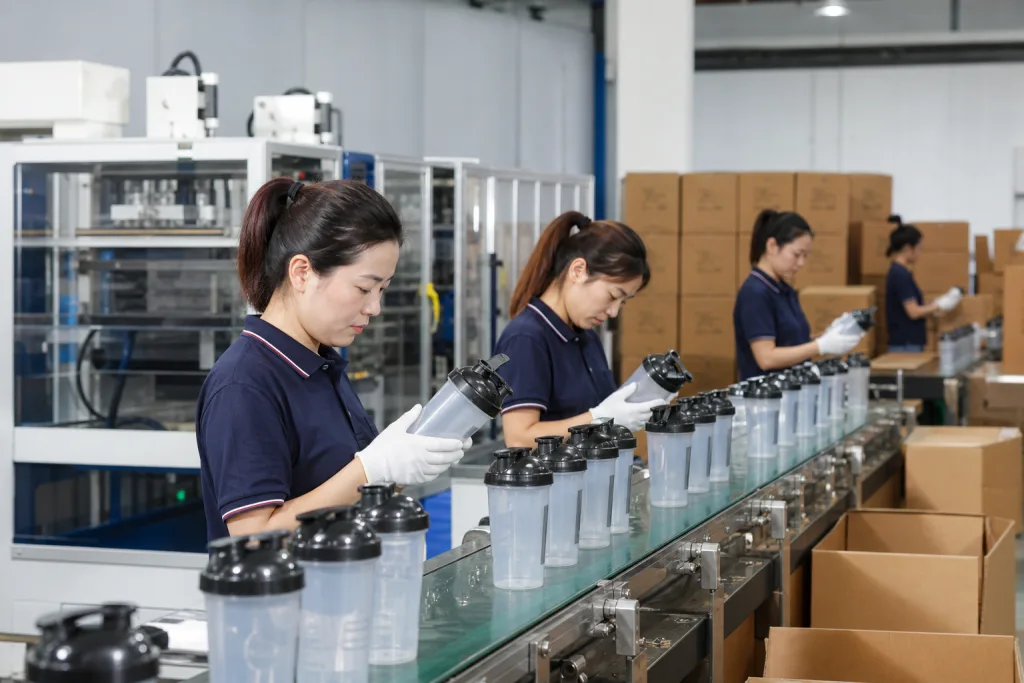
Key Takeaways
- A basic custom protein shaker usually lands at USD 0.85-1.40 ex-works at 5,000 pcs, while Tritan or stainless builds can move to USD 1.80-4.80.
- For stock molds, MOQ is often 1,000-3,000 pcs; for fully custom lids or inserts, expect 3,000-5,000 pcs and 20-45 extra days if tooling is needed.
- A realistic production timeline from approved sample to shipment is 25-45 days in China, with Zhejiang factories often running 300,000+ units per month.
- Leak-proof lids, decoration method, and compliance testing usually change cost more than the bottle body itself.
If you are buying a custom protein shaker for retail, gym chains, supplements, or Amazon, the hard part is not finding a supplier. China has too many. In Zhejiang, 40 factories can fill your inbox before Friday if one trading company forwards your RFQ around Yiwu and Yongkang. The real job is telling a $0.90 shaker with a loose flip cap from a $2.80 shaker that passes a 24-hour inverted leakage test, 3M tape print pull, and daily use with 30 grams of powder. QC pulled one sample last month where the ball whisk rusted after salt-spray testing. Cheap looked expensive fast.
Price the job like we do on the line: resin grade, mold status, cap fit, logo method, packaging, compliance, and vessel closing date. A Zhejiang factory can quote the same day if your spec is clean, but “500ml shaker, logo, best price” is not a spec. We need the lid diameter in mm, target weight in grams, print color count, carton drop-test requirement, and whether FDA or LFGB is needed. If you compare only unit price, this is the wrong question to ask; the hidden items can move landed cost by 18% to 35% and push lead time by 10 to 20 days.
What actually moves your unit cost
Most buyers price the body first and forget the parts that slow the line. Wrong question. On a custom protein shaker, unit cost is usually pushed by resin grade, lid structure, decoration method, packing spec, and new tooling. A standard PP shaker with a stock mold, one-color silk print, and bulk packing can sit around USD 0.85-1.20 at 5,000 pcs. Change to Tritan, add a soft-touch grip, or switch to a flip-top with a threaded cap, and that quote can move to USD 1.60-2.60 before freight. We had one PO last month where the buyer wrote “matte black lid” but the approved sample was glossy black; QC pulled the sample at pre-production, and that small typo cost 3 days.
The lid is often where the math breaks. A simple screw lid is cheap. A two-piece leak-proof lid with a silicone gasket, vent, and snap closure costs more because the mold finish is tighter, workers need extra assembly time, and the rejection rate climbs during leak testing. Mixing inserts count too. A stainless whisk ball is cheap in volume, but a molded blender grid or integrated mixing system can add 8% to 18% to the factory quote. If you want a premium feel, ask for wall thickness instead of writing “heavy duty” in the RFQ. For PP shakers, 1.2-1.8 mm is typical. For Tritan, 1.5-2.0 mm is the range we see on 7 out of 10 gym-brand projects because the cup feels stiffer in hand. On the line, our caliper check at the rim catches this fast.
Decoration changes cost faster than buyers expect. One-color silk screen is still the cheapest choice, especially when the logo fits one side and stays under 80 mm wide. Laser engraving rarely makes sense for plastic shakers, but it matters when you cross over into metal programs like custom drinkware, custom growler, or stainless tumbler lines. If your factory also makes canteen custom, canteen promotional, or custom canteen ranges, that helps because the same pad-print, rotary screen, and heat-transfer stations often support canteen customizable and canteen customized jobs without a fresh setup from zero. We ship mixed drinkware programs every quarter, and the buyer usually flags decoration consistency before they flag the cup price.
MOQ tiers that make sense
MOQ is not a punishment; it is how the line covers setup time, operators, and defect risk. For a stock-mold shaker with your logo, MOQ is commonly 1,000 to 3,000 pcs per color. If you want mixed colors, most canteen suppliers and canteen vendors will split MOQ by colorway, not by total order, so a 3,000 pc program with three colors may still mean 1,000 pcs each. We see this on the PO table every week: Pantone 186C red at 1,000 pcs, black at 1,000 pcs, clear at 1,000 pcs, with separate ink setup on the semi-auto screen printer. Small detail. Big cost. That matters for distributors who need a broad catalog, not just one hero SKU.
For a custom protein shaker with modified lid shape, new cap insert, or new mixer part, practical MOQ is usually 3,000 to 5,000 pcs. If tooling is fully new, some canteen manufacturers will ask for 5,000 to 10,000 pcs before they absorb any mold cost into the unit price. At 10,000 pcs, the landed factory price often drops 8% to 15% versus 3,000 pcs because assembly and overhead get spread out. The math works there. On one lid project, QC pulled the first T1 sample and found a 0.35 mm flash line near the drinking spout, so we had to polish the mold and rerun fit testing before quoting mass production. That is where a canteen distributor or distributor drinkware buyer gets room for margin.
Be careful with low MOQs from a canteen factory or canteen manufacturer. Low MOQ can be real, but it usually means higher piece price, limited decoration options, or stricter artwork rules. If you need 500 pcs for a test launch, expect to pay roughly 20% to 40% more per unit than a 3,000 pc run. We had one buyer flag this after asking for 500 pcs, four colors, full-wrap print, and retail barcode stickers; the line could run it, but the setup time made the quote look ugly. For canteen distributors and distributor canteen programs, the better play is often one stock body, three lid colors, and one print method instead of chasing a fully unique shape too early.
Lead time from sample to shipment
Lead time is where importers get burned; I can name 6 buyers from last year who approved a shaker sample, then lost the ship date after the PO landed. A standard shaker on an existing mold usually takes 5 to 10 days for samples if the AI file and Pantone code are ready. Mass production after sample approval is usually 20 to 30 days for 3,000 to 10,000 pcs. New tooling changes the math. Add 15 to 25 days for mold making, CNC correction, and first trial runs on the injection line. A realistic concept-to-shipment cycle is 35 to 60 days, not the optimistic 14 days some buyers put in their launch plan. That 14-day target is the wrong question to ask unless the mold, color masterbatch, logo file, and packaging die line are already signed off.
In Zhejiang, a strong export factory can hold the schedule because the supply chain is close: resin suppliers in Ningbo, carton plants near Huzhou, and pad-printing vendors within a same-day truck run. We run 300,000 to 500,000 units per month when the line is planned cleanly, but the order only keeps moving if artwork and packaging stay frozen after approval. Every artwork revision can add 2 to 4 days, especially when QC pulled the sample and found the logo 1.5 mm off center after pad printing. Every carton change can add 1 to 3 days. We have seen this go sideways from one small PO typo, like “matte black lid” written as “black matte body.” If your shipment must hit a retail date, build a 10-day buffer before the vessel cutoff.
For buyers who also source a custom canteen, customized drinkware, or a customized growler line, ask the factory to reserve one production window across the full order. One combined schedule is cleaner than three separate schedules, because lids, silicone seals, color sorting, and final assembly can share the same QC table and carton drop test. A Zhejiang supplier with stable planning will tell you the truth about peak season: September to December can add 7 to 14 days because export cartons, lids, and assembly labor all tighten up. We ship during that season every year, but the buyer who approves the sample on Friday and asks for 5,000 pcs packed by next Wednesday is usually looking at air freight or a missed promo date.
Design choices that affect performance
A shaker is judged by how it rides in a gym bag, not by the render. Start with the seal. If the lid does not close with a clear click, we treat that as a return waiting to happen. On our line, QC runs an inverted shake test for 30 minutes and looks for a wet ring at the gasket. Food-grade silicone in the 50 to 60 Shore A range holds its shape after repeated compression. PP is the budget call. Tritan usually adds 20% to 35% at factory level, but it gives better clarity and stain resistance. If a buyer wants a retail SKU that photographs clean and feels steadier in hand, Tritan earns its keep. Saving 3 cents on the seal is the wrong place to cut.
Mixing style matters too. A wire ball works for powder and is cheap to pack. A molded mixer insert can run quieter and look cleaner, but poor geometry traps residue. We have seen QC pull a sample with a 0.88 mm wall, and it softened in a 70°C wash test. That is the number that matters, not the brochure line. For most retail shakers, 1.2-1.8 mm is the workable band. Below 1.0 mm, the cup starts to deform when the buyer runs hot water through it. If you sell to a supplement brand, residue complaints show up fast and the math does not work.
Decoration should match use case. Screen print is fine for a simple logo. If you need a premium feel across a broader custom drinkware line, the same China factory can run canteen customizable, canteen customized, customizable canteen, customized canteen, customizable drinkware, and customized drinkware programs with tighter registration. On our pad-print jig, we hold a 45 mm fixture so the logo lands in the same spot every time. That matters when the buyer flags a 2 mm shift on the PO proof. The better suppliers know the real buyer logic: low return rate, stable print, and cartons that pass the 1.2 m drop test. A canteen promotional line and a protein shaker line live or die on the same checks.
Compliance and QC you should ask for
Do not sign off on a shaker just because the unit price is low or the supplier writes “food grade” in the PI. Ask for material declarations, resin grade, colorant statement, and test references tied to the same PP, PE, Tritan, or 304 stainless parts you are buying. For Europe, REACH compliance is the baseline for chemicals, and for the US you should ask for FDA food-contact declarations. If the order goes to sports retail or Amazon, request migration or heavy-metal testing where the coating, spring ball, printed scale, or color masterbatch touches the drink. ISO 9001 has value, but this is the wrong question to ask if you need product safety; it proves the factory has process control, not that the bottle passed food-contact testing. We ask QC to match the test report to the BOM line by line, because one 2024 PO we saw had “PP lid” typed while the sample used an ABS flip cap.
Your inspection plan should be written in numbers, not soft words. AQL 2.5 is common for major defects on appearance and leakage, while AQL 4.0 is often accepted for minor cosmetic issues if the buyer is price-sensitive. Ask for a drop test from 1.2 m, cap torque check with a torque meter, and a hot-water leak test at 70 to 80°C for 30 minutes. If the shaker has a printed logo, run an abrasion rub test before approving the production sample; QC pulled one sample last month where the black logo lost edges after 80 rubs with a 500 g load. Bad sign. For export cartons, confirm edge crush and inner pack count, for example 24 pcs per carton with dividers if the bottle has a hard mixing ball. One broken carton line can turn a good FOB price into a bad landed price.
Good factories in China will not push back on these requests. Weak ones will ask, “Can we skip testing for this trial order?” and that is usually where the math doesn't work. A serious canteen supplier or canteen manufacturer in Zhejiang should show inspection photos, batch traceability, and pre-shipment records without drama. We run batch labels on cartons and inner bags, then keep the signed QC sheet with sample photos for at least 2 years, because buyers often come back after a warehouse claim. If they also produce canteen factory lines, custom canteen, or distributor growler programs, that is a useful signal: the line already handles mixed colors, mixed caps, and multi-SKU export packing without losing document control.
How to choose the right factory partner
For a first order, pick the factory that answers straight, not the one with the lowest China price. Ask if they are a canteen factory, a canteen manufacturer, or a trading layer. That split decides who owns the mold, the QC, and the delay. Lowest price loses. On our Hangzhou line, a 280T injection press feeds the lid mold in the morning and pad printing in the afternoon, so lead time stays inside the 12-day window instead of slipping to 18. If a supplier claims 300,000 units per month, ask for the split by line. A canteen distributor order and a shaker order do not eat the same labor hours. We have seen buyers chase a cheap quote, then find out the real issue was no in-house mold shop.
Look at response quality. A solid canteen vendors team will quote the body material, lid type, print area, carton size, unit weight, and packed quantity per master carton. If they send only one round number, keep asking. QC pulled the sample on our bench and found a 1.2 mm lid gap, which is the kind of miss that turns into a return claim. For a canteen distributor or distributor canteen buyer, the hidden cost is usually tool wear, extra packing, or a weak print file. We had one buyer flag a PO typo where 5,000 pcs became 500 pcs. The math did not work. Same rule if you buy a custom growler or a canteen customized line for retail.
I would back a China supplier that can move between custom drinkware categories without losing control: custom protein shaker, custom canteen, customized canteen, canteen customizable, canteen promotional, customizable growler, customized growler, and distributor drinkware. That range shows the plant knows repeat B2B work, not just one-off samples. On a 20,000 pc seasonal launch, the line has to keep the same print register and carton count after the third shift, and that is where weaker shops slip. If a Zhejiang factory can handle a 300-piece trial and a 20,000 pc reorder, your procurement job gets easier. We run that mix every week, and buyers who ask for a sample photo, a packing photo, and the actual carton measurement usually avoid trouble later.
Get a real shaker quote, not a guess
Send your target MOQ, artwork, and delivery window. We will price the build, confirm the lead time, and flag the hidden cost before production.
Frequently asked questions
What is the MOQ for a custom protein shaker?
For a stock-mold custom protein shaker with logo print, MOQ is usually 1,000 to 3,000 pcs per color. If you want a new lid, new mixer insert, or new mold, expect 3,000 to 5,000 pcs, sometimes 10,000 pcs if the factory needs to recover tooling faster. In Zhejiang and other export hubs in China, some suppliers will quote lower MOQs, but the trade-off is usually a higher unit price or fewer decoration choices. If your first order is a market test, 3,000 pcs is the sweet spot for most B2B buyers.
How much should I budget per unit?
A basic PP custom protein shaker with one-color print often lands at USD 0.85 to 1.40 ex-works at 5,000 pcs. A Tritan version usually sits around USD 1.60 to 2.60. If you move to a premium leak-proof lid, extra packaging, or a stainless structure, budget USD 2.80 to 4.80 depending on finish and wall structure. Freight, duties, and carton size can add another 15% to 35% to landed cost. If the quotation is far below these ranges, check whether the factory excluded printing, compliance, or packing.
How long does sample and production take?
For an existing mold, sample time is usually 5 to 10 days if your artwork is ready. Mass production for 3,000 to 10,000 pcs normally takes 20 to 30 days after sample approval. If you need a new mold, add 15 to 25 days for tooling and testing. In practice, a full project from file approval to shipment is often 35 to 60 days. Zhejiang factories with strong supply chains can move faster, but only if you keep the spec stable and approve artwork on the first pass.
Which material is better: PP or Tritan?
PP is cheaper and works well for entry-level gym and promotional use. It usually gives you the best starting price and is fine when the buyer cares more about volume than premium appearance. Tritan costs about 20% to 35% more at factory level, but it looks clearer, resists staining better, and often sells better in retail. If you are building a custom drinkware line for fitness retail or premium supplement brands, Tritan is usually the safer choice. If you need a canteen promotional line or budget giveaway, PP is usually enough.
What should I ask for before I approve production?
Ask for a pre-production sample, material declaration, artwork proof, carton spec, and the inspection plan. For compliance, request REACH for Europe and FDA food-contact documents for the US where applicable. For QC, ask for AQL 2.5 on major defects and a leak test on every production batch sample. If the shaker uses a printed logo, request a rub test and a torque check on the lid. A good factory in China should provide all of this without delay.