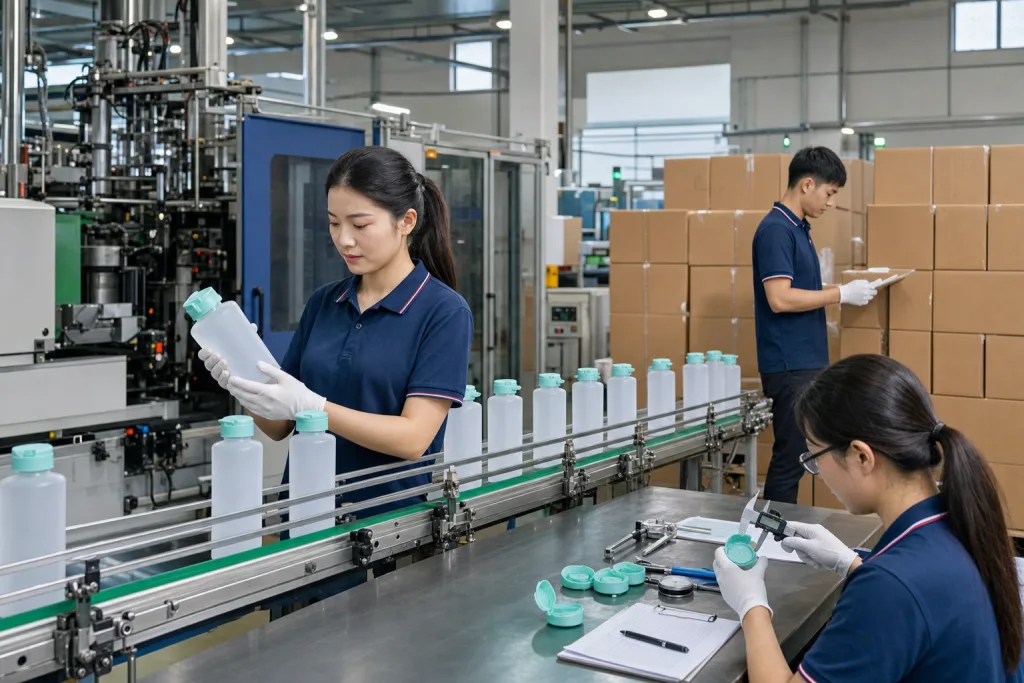
Key Takeaways
- PP bottles usually fit 3,000-10,000 unit orders better than stainless steel when weight and unit cost matter
- For Germany, ask for LFGB, EU 10/2011, REACH-related material declarations, and migration test reports
- Silkscreen is practical from about 1,000-3,000 units per design, while in-mold labeling needs higher tooling commitment
- A good canteen supplier should quote FOB China, carton data, spare caps, and AQL level before you approve samples
If you are sourcing a custom polypropylene bottle Germany buyers can put into retail, school, sports, or promo channels, the hard part is not choosing the shape. The hard part is getting the EU food-contact file, print adhesion, cap fit, MOQ, and landed cost to line up without building a bottle your distributor cannot move. Last month a buyer flagged a 0.6 mm parting-line mark on a PP sports bottle; the mold was fine, but the retail sample still looked cheap under shelf lighting.
As a Zhejiang drinkware factory, we see the same mistake about 8 times a quarter: buyers treat PP bottles like simple plastic giveaways. They are not. A canteen custom order for Germany needs EU food-contact documentation, realistic Pantone tolerance, carton strength, and a production plan that does not collapse during China peak season. Our standard PP bottle MOQ is 3,000 units per color, with normal lead time at 25-35 days after artwork approval. Ask only for the lowest unit price and the math goes wrong; QC pulled one pre-shipment sample where the cap torque passed, but the buyer’s PO had the logo position written 15 mm lower than the approved artwork.
PP Bottle Versus Other Drinkware
For a German buyer, polypropylene sits in a practical middle slot. It is lighter and often cheaper than stainless steel, tougher than low-cost clear plastics we see crack at the hinge, and better for school, sport, outdoor, and canteen promo orders where carton weight and breakage claims hit the margin. On our line, a 650 ml PP body with a 1.2-1.6 mm wall is a normal setup, and QC pulled samples last month after a buyer flagged cap leakage at 30 minutes upside down. PP is the wrong choice for hot coffee, 12-hour heat retention, or executive gift sets. Stainless vacuum bottles and travel tumblers win there.
Here is the head-to-head view we use when a canteen distributor asks what to quote, especially when the PO says “Germany delivery before club season” and the artwork file arrives with a 2 mm logo outline missing:
| Product type | Best use | Typical FOB China range | Trade-off |
|---|---|---|---|
| PP bottle | School, gym, outdoor, event giveaways | USD 0.85-2.20 | Not insulated, lower premium feel |
| Tritan-style bottle | Retail sports bottles and clear body designs where the liquid color needs to show | USD 1.60-3.80 | Higher resin cost, scratches show fast after shelf handling |
| Stainless bottle | Corporate gifts, outdoor retail, premium programs with laser logo or powder coating | USD 3.20-8.50 | Higher freight weight and MOQ pressure |
| Glass bottle | Office, wellness, home use where weight is accepted | USD 1.80-4.50 | Breakage risk, heavier cartons |
If your order is for a canteen customized around a club, school, municipality, or promotion, PP often gives the cleanest commercial answer. A 650 ml PP bottle can weigh 85-130 g depending on wall thickness and cap structure. That matters when we calculate 20GP or 40HQ loading into Germany, because 18 kg cartons get handled differently from 11 kg cartons at the forwarder warehouse. Simple math. The cheaper freight can pay for better cap tooling.
For custom drinkware, the trap is over-specifying. You do not need a premium stainless structure for a one-season sports event, and we have seen this go sideways when the buyer wants a low target price but asks for vacuum insulation, retail box, spare straw, and 6-color print on the same RFQ. You do need a leak-resistant cap, stable color, and documentation your German customer can file without chasing your canteen factory for 14 days. On repeat orders, we keep the signed PP material sheet, color chip, and last AQL 2.5 report in the job folder so the next batch does not start from zero.
Germany Compliance Is Not Optional
Germany catches more suppliers than buyers expect; in our last 20 PP bottle RFQs for German customers, 7 needed extra document checks before we could quote. The bottle looks simple, but the file behind it cannot be casual. For a custom polypropylene bottle Germany import program, start with food-contact compliance, not the lowest FOB price. If a canteen vendor only writes “food grade” in the PI and cannot name the lab, report number, or tested material, walk away. We have seen this go sideways.
For PP bottles shipped from China to Germany, ask for these files before you approve artwork:
- EU 10/2011 migration testing for plastic food-contact materials, matched to the PP grade and color used on the line.
- LFGB testing, often requested by German retailers and distributors before they open a vendor code.
- REACH-related declaration for restricted substances in coatings, inks, cap parts, straps, and any soft-touch finish.
- Phthalate and heavy metal checks when printed logos, colored caps, silicone gaskets, or metallic ink are used.
- Factory quality system evidence such as ISO 9001, BSCI audit status, or equivalent social compliance if your customer requires it.
Do not accept old reports blindly. A report for a natural PP bottle body does not cover a black cap, silicone gasket, metallic ink, or new pigment unless the lab scope says so. If your custom canteen uses a red body, black flip lid, white silkscreen logo, and silicone strap, QC should review every contact or relevant surface; last month QC pulled the sample because the gasket was 1.8 mm instead of the approved 2.0 mm.
Our Zhejiang team asks buyers to freeze the material list before pre-production samples. Changing the pigment after testing can kill the file, even if the bottle shape stays the same. Testing takes 7-10 working days at a third-party lab in China; rush service costs more, and the math does not work if your ship date is already fixed. Put those 7-10 working days into the production calendar before mass production, not after 12,000 bottles are packed in cartons.
Cheap samples are easy. A clean compliance file for Germany is where professional canteen suppliers separate themselves from casual trading vendors.
Spec Table Buyers Should Demand
A proper RFQ should not read, “send price for 500 ml PP bottle with logo.” We see that line on POs every month, and it creates messy quoting. Put the spec table in the enquiry so each canteen manufacturer prices the same bottle, cap, gasket, print, and packing. Last April, QC pulled two 650 ml samples from different quote folders: one body was 82 g with a loose push cap, the other was 126 g with a silicone seal. The cheaper FOB looked attractive. The math did not work once the buyer compared the actual bottle.
| Spec line | Budget PP bottle | Retail-grade PP bottle | Outdoor canteen fit |
|---|---|---|---|
| Capacity | 500-600 ml | 650-750 ml | 750-1,000 ml |
| Body weight | 70-95 g | 95-135 g | 130-190 g |
| Wall thickness | 0.8-1.1 mm | 1.1-1.5 mm | 1.4-2.0 mm |
| Cap | Screw or push cap | Flip lid with gasket | Wide mouth with carry handle |
| Decoration | 1-color silkscreen | 2-4 color print or label | Embossed grip plus print |
| MOQ | 3,000 units | 5,000 units | 5,000-10,000 units |
For distributor drinkware, we usually quote the middle column first. Safe choice. It has enough wall thickness for repeat use, keeps FOB pricing sane, and leaves room for 2-4 color print or label work without slowing the line. A canteen promotional order can sit in the budget column if the bottle is for a 6-week campaign and the buyer is fighting a hard price ceiling. For outdoor retail or school sports use, move to the outdoor column; we have seen thin 0.9 mm bodies come back with dent complaints after carton drop tests.
Ask the canteen supplier to write the tolerances into the quote. Capacity tolerance of plus or minus 5% is common. Color tolerance should be checked against a Pantone target, but exact matching on translucent PP is tougher than on coated metal. If your German customer has strict brand color rules, approve physical color chips. Do not approve from screen renders alone. On our side, the QC desk uses a D65 light box and keeps the signed chip beside the first-off sample; one buyer flagged a red cap because the PO said Pantone 186 C, but the artwork file showed 185 C.
Logo Methods Compared Honestly
Decoration is where 6 out of 10 custom PP bottle projects start to wobble. PP has lower surface energy than stainless steel, so ink adhesion depends on flame or corona treatment, clean jigs, and a real test before mass print. For a canteen customizable for Germany, the right question is not “which logo looks best on the PDF?” It is logo life, unit cost, and how much trouble the line will have holding position within 1.5 mm.
| Method | Good for | Typical MOQ | Buyer warning |
|---|---|---|---|
| Silkscreen printing | Simple logos, sports clubs, promo orders | 1,000-3,000 units/design | Needs adhesion test on PP surface |
| Pad printing | Small curved cap logos | 1,000 units/design | Limited print area |
| Heat transfer | Colorful graphics | 3,000-5,000 units/design | Can peel if low-grade film is used |
| In-mold labeling | High-volume retail graphics | 10,000+ units/design | Higher setup cost and less flexibility |
| Embossed tooling | Permanent brand mark | Usually 10,000+ units | Tooling cost and longer approval cycle |
For most canteen customized orders, one- or two-color silkscreen is the safest working choice. Clean. Repeatable. The cost also stays sane. We run a cross-hatch adhesion test with 3M tape, an alcohol rub test, and warm water exposure at 60°C when the buyer asks for wash resistance. A basic print test usually adds 2 days, not 2 weeks; finding weak adhesion after 20,000 units are packed means rework, repacking, and a freight delay no buyer wants to explain.
If you are a distributor canteen buyer selling to 5 or 6 customers, do not lock into in-mold labeling too early. It looks sharp on the shelf, but the math does not work unless the forecast is stable and the same graphic repeats. We have seen this go sideways when a club changed its event date after film approval. For a customizable canteen program with changing club names or regional campaigns, silkscreen or heat transfer gives the buyer room to move, and the line can change screens without scrapping a full batch of labels.
Spare parts get missed. A customized canteen with a printed cap needs spare printed caps for after-sales, not plain caps pulled from stock. We suggest ordering 1-2% spare caps and gaskets, packed separately in marked PE bags; German retail and school channels will ask for replacements, and QC pulled this issue twice last season when the PO listed “extra caps” but forgot the logo version.
Factory, Vendor, Or Trading Desk
Buyers often use canteen vendor, canteen supplier, and canteen manufacturer as if they are the same job. They are not. A factory controls molding, assembly, inspection, and corrective action; a trading desk is mostly paperwork and supplier chasing. That matters when QC pulled the sample from a 12-cavity cap mold and found 3 caps leaking at the silicone ring. The buyer flagged it. A desk can forward photos, but the line manager can stop the mold, check the core pin, and adjust the assembly jig before another 8,000 pieces are packed.
For polypropylene bottles, the production chain normally includes resin purchasing, injection molding for caps, blow molding or extrusion blow molding for bodies, surface treatment, printing, assembly, leak testing, and carton packing. If your canteen factory outsources too much of this work, the schedule gets weak fast. We have seen this go sideways. In peak China export months before summer and Q4 promotions, a 30-day lead time can become 45 days if the printing slot is not reserved, especially when a 2-color logo needs a second pad-printing pass and 24 hours of ink curing before packing.
At BottleForge Industrial in Hangzhou, Zhejiang, our monthly drinkware output across plastic and metal lines is about 420,000 units, with PP bottle orders usually planned in 3,000-50,000 unit batches. That scale is not the largest in China, and we do not pretend otherwise. It is large enough for distributor drinkware programs, but still controlled enough for custom color and packaging details. On one German PO last spring, the buyer wrote “matte black lid” in the email but “glossy black lid” on the artwork sheet; our pre-production sample sheet caught it before the first 5 kg color masterbatch was mixed.
When comparing canteen manufacturers, ask direct operational questions:
- Who owns the mold and where is it stored?
- What is the daily molding capacity for this exact bottle?
- Is 100% leak testing done, or only sampling?
- Which AQL level is used for final inspection?
- Can you provide carton drop-test photos and packing dimensions?
For Germany, we recommend final inspection under AQL 2.5 for major defects and AQL 4.0 for minor defects unless your retailer specifies stricter rules. Critical defects such as sharp edges, contamination, broken caps, or leakage should be zero tolerance. The math does not work if you save USD 0.03 on inspection and then handle 200 return claims from Hamburg or Munich. We run the leak check with inverted bottles and tissue under the cap; if the tissue shows a wet ring after the set hold time, that carton does not ship.
Use-Case Fit For German Channels
The right spec follows the channel. A trade-fair giveaway, a school tender, and a retail bottle all get judged on different points. On our line, a 3,000 pcs school PO gets a different cap test than a 500-piece promo run. The wrong question is “what is the best bottle?” The better one is “where does this bottle land, and who handles it?”
For school and youth programs, 500-650 ml works. Keep the edges rounded, skip small detachable parts, and use a cap a child can open without forcing it. After five hot-wash cycles at 60°C, QC pulled the sample and checked for odor. PP will hold smell if the resin or color masterbatch is off. For child-related use, check the local safety spec and leave decorative pieces off the table if they can snap loose.
For sports clubs and gyms, 650-750 ml fits the job. A squeeze-friendly body helps, but walls that are too soft will ovalize in transit. We ran a 1.2 m drop test on a 750 ml body and saw the grip zone mark up first. A textured grip or waist groove gives better handling. One-color logos keep unit cost steady and reorders clean.
For outdoor and camping channels, a wider mouth, stronger handle, and thicker wall are worth the extra USD 0.20-0.45 per unit. If the buyer asks for a custom growler or customizable growler, PP is not the right answer for beer or hot liquids. We had a buyer push for a PP growler once, and the carbonation brief killed it fast. A stainless customized growler is the safer call when insulation or pressure resistance is part of the brief. On a 2 mm wall build, the handle mold adds cycle time, so quote it before the PO goes out.
For e-commerce and FBA-style fulfillment, packaging matters as much as the bottle. A polybag can work for bulk promotional cartons, but online sales usually need an individual box, barcode, and sometimes FNSKU label. We ship cartons at 14.5 kg gross weight, not 18 kg, because the line sees more corner crush once pallets hit the warehouse. A PO typo on one FNSKU can waste a full reprint. German canteen distributors stick to conservative specs because complaints cost real money. Paying a few cents more for cap sealing, carton strength, and print testing usually costs less than replacing a bad shipment after launch.
Price, MOQ, And Lead Time
A realistic quote for a custom polypropylene bottle Germany project should show more than unit price. Ask for FOB port, mold status with mold number, MOQ per color, decoration setup cost, sample charge, testing cost, packaging cost, and lead time by production step. We run quotes from a cost sheet, not a WhatsApp guess. If those lines are missing, the low quote is not complete; last month a buyer flagged a USD 0.18 gap because the carton spec was left off the PI.
For standard existing molds from our China production network, a typical 650 ml PP bottle with 1-color logo may land around USD 1.05-1.65 FOB Ningbo or Shanghai at 5,000 units, depending on cap type and body weight. A heavier outdoor-style 900 ml bottle may be USD 1.80-2.60. Custom mold development can add USD 3,000-12,000 and usually 30-45 days before production sampling. The math does not work if someone quotes a new mold price but cannot provide a 2D drawing, cavity count, and target gram weight in writing.
MOQ is driven by resin color, printing setup, and packing efficiency. For a single Pantone body color, 3,000 units is workable on 18 models we quote often. For split colors, custom cap combinations, or multi-language retail packaging, 5,000-10,000 units is more realistic because the injection line loses time during color change and the pad-printing jig must be reset. Canteen vendors who promise 500 units at factory price may be using stock bodies and manual decoration; that is fine for sampling, but it is not the same as controlled mass production. QC pulled one 500-piece sample run where the logo drifted 2 mm across the batch.
Plan the timeline this way: 3-5 days for quote and artwork check, 7-10 days for pre-production samples, 7-10 working days for compliance testing if needed, 25-35 days for mass production, and 3-7 days for inspection and export booking. Sea freight to Germany adds several weeks, depending on port and season. Book early. We have seen Hamburg routing go sideways in peak season, turning a planned 32-day sailing into 41 days after the forwarder rolled one container.
The cleanest buying process is simple: approve the bottle first, approve the material and compliance file second, approve decoration third, then place the purchase order. This order protects you, your German customer, and the canteen supplier trying to build the product correctly. One small thing matters: match the PO item name to the approved sample label, because a typo like “PP 650 ml clear” versus “PP 650 ml frosted” can stop packing for half a day.
Send Your Germany PP Bottle Specification For Review
Share capacity, target price, logo, and compliance needs. We will check the spec, MOQ, testing path, and FOB options before sampling.
Frequently asked questions
What MOQ should I expect for a custom polypropylene bottle Germany order?
For existing molds, expect 3,000 units per body color as a practical starting MOQ. If you need a custom Pantone color, matching cap, printed logo, and retail box, 5,000 units is more realistic. For in-mold labeling or a new private mold, plan for 10,000 units or more. Some canteen vendors offer 500-1,000 units using stock bottles, but decoration choice and color control will be limited. For German distributors, we usually recommend starting at 3,000-5,000 units so production is stable enough for AQL inspection, carton planning, and repeat orders.
Which compliance documents do German buyers usually ask for?
Most German buyers want EU 10/2011 migration testing for plastic food-contact materials and LFGB reports. Depending on the channel, they may also request REACH-related declarations, heavy metal testing for inks, and confirmation that silicone gaskets or straps are food-contact safe. If the bottle is for children, expect extra scrutiny on detachable parts and safety design. Ask your canteen manufacturer to provide reports tied to the actual resin, pigment, cap, gasket, and print system used in your order. A generic “food grade PP” statement is not enough for serious German retail.
Is polypropylene better than stainless steel for promotional canteens?
For price-sensitive canteen promotional programs, polypropylene is often better. A 650 ml PP bottle may cost USD 1.05-1.65 FOB China at 5,000 units, while stainless steel usually costs much more and weighs more per carton. PP is good for sports clubs, schools, gyms, and outdoor events where insulation is not required. Stainless steel is better for premium gifts, hot drinks, and long-term thermal performance. If your buyer wants a custom growler or customized growler for beer, PP is usually the wrong material; stainless steel or glass is safer depending on the use.
How do I compare quotes from different canteen suppliers?
Force every canteen supplier to quote the same specification: capacity, body weight, wall thickness, cap type, gasket material, decoration method, packaging, MOQ per color, FOB port, lead time, and testing status. A USD 0.20 price gap may come from thinner walls, cheaper resin, no leak test, or weak cartons. Ask for unit weight and carton dimensions because freight into Germany can change your landed cost. Also ask whether final inspection follows AQL 2.5 for major defects and whether leakage is treated as a zero-tolerance critical defect.
Can I use one PP bottle model for several German customers?
Yes, and that is often the smartest distributor drinkware strategy. Choose one reliable 650-750 ml model, keep the body color neutral or repeatable, and change logos by silkscreen or heat transfer. This lets you combine resin purchasing, reduce sampling work, and reorder faster. You can run different canteen customized designs at 1,000-3,000 units per logo if the base bottle color stays the same. Just make sure each artwork is approved physically, not only by PDF, and keep spare caps and gaskets at 1-2% of the shipment quantity.