Key Takeaways
- Typical MOQ for a custom PP bottle is 3,000-5,000 units per color, with 35-45 days mass production after approval
- For Germany, request food-contact documentation, REACH screening, and migration test reports before paying a 30% deposit
- Silkscreen is cost-effective for 1-2 color logos, while full-wrap heat transfer needs higher MOQ and tighter artwork control
- AQL inspection should include leak testing, cap torque, color matching, barcode scanning, and carton drop checks
If you are sourcing a custom polypropylene bottle deutschland program, you are balancing German market compliance, landed cost, and hand feel. PP is a good choice for canteens, school bottles, sports promotions, and distributor stock when the wall thickness, cap fit, and process control match the job. Cheap PP feels cheap fast. We run 0.8 mm to 1.2 mm wall checks on the line, and QC pulled samples last month after a buyer flagged a soft shoulder on a 650 ml school bottle.
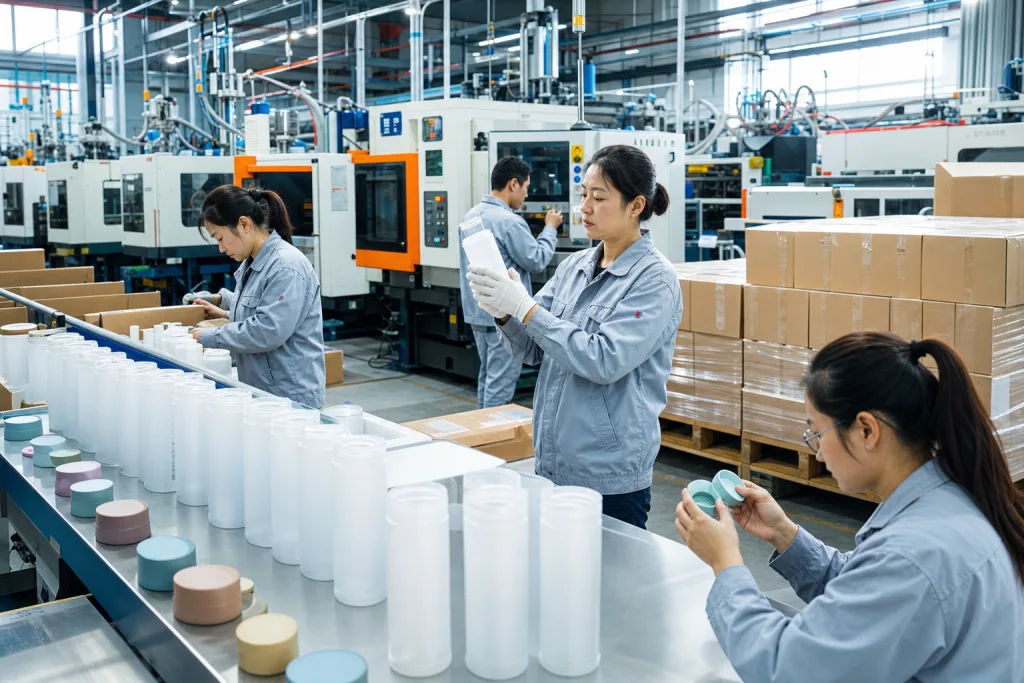
From our factory network in Zhejiang, China, the strongest projects usually start with four decisions: PP material grade with the right food-contact documents, cap structure tested on a torque tester, decoration method matched to scratch risk, and packaging route built around carton strength and pallet loading. Set those before debating Pantone chips or carton artwork. This is the wrong question to ask first. A custom canteen can look fine in the sample room and still fail when the lid leaks after 24 hours, the logo rubs off in a tape test, or the German importer cannot document REACH compliance because one line on the PO was typed as “PP mix” instead of the approved grade.
Start With The Use Case
Polypropylene is not the universal answer. It is light, impact-resistant, and more heat tolerant than PET, PS, and several other low-cost plastics we see on promo briefs, but it will not feel as premium as stainless steel or glass. For a German promotion, school program, festival refill bottle, or outdoor canteen promotional campaign, PP makes sense when the target FOB must stay tight and the bottle still has to survive daily knocks. On our line, QC often checks the drop corner first after a 1.2 m drop test, because that is where cheap PP molds show stress whitening.
Your first decision is not logo size. It is how the user will carry and wash the bottle. A 500 ml school bottle needs a different cap hinge, mouth opening, and wall thickness than a 1,000 ml hiking canteen customized for outdoor retail. A gym bottle needs one-hand drinking without leaking in a sports bag. A corporate welcome pack needs a cleaner silhouette so the insert card and carton do not look cheap. If you are a canteen distributor, this is the wrong question to ask at the start: “How big can the logo be?” We have seen complaint rates move more from a 3 mm hinge pin and a 52 mm mouth opening than from the Pantone color the buyer flagged on the PO.
For most B2B programs, we suggest confirming these points before sampling. Saves time.
- Capacity: 400 ml, 500 ml, 650 ml, 750 ml, and 1,000 ml are the common PP ranges; we run 500 ml and 750 ml most often for German promo orders with MOQ around 3,000 pcs per color.
- Wall thickness: 1.2-1.8 mm is typical, depending on mold and bottle shape; QC pulled one 1.1 mm sample last month because the side wall flexed too much under hand pressure.
- Cap type: screw cap, flip lid, push-pull spout, straw lid, or tethered cap for event use; the buyer should confirm whether the cap must stay attached under EU event rules.
- Temperature use: PP bottles can handle warm liquids in many cases, but boiling water should be tested case by case with the actual cap gasket, not only the bottle body.
A canteen manufacturer in China can usually offer existing molds faster than a new tool. Existing mold sampling may take 7-10 days. A new custom mold can add 25-40 days and several thousand USD in tooling cost. The math does not work for a 2,000 pcs trial order unless the brand needs a protected shape. We ship existing-mold samples by DHL first, then open tooling only after the buyer signs the 2D drawing, usually with the neck diameter, thread pitch, and logo area marked in mm.
Choose Material And Compliance Path
For Germany and the wider EU, treat compliance as a buying specification, not a PDF collected after the container sails. Food-contact plastic bottles need controls on PP resin, pigment, gasket, and printing ink. Ask the canteen supplier for the resin grade on the material lot card; on our line, QC checks it against the injection-molding work order before the first 20 pcs go into the sample bin.
For a custom polypropylene bottle deutschland order, ask for EU food-contact test documentation under Regulation (EC) No 1935/2004 and applicable plastic material requirements. If the bottle uses silicone seals, colored masterbatch, coated artwork, or printed sleeves, those parts matter too. REACH screening matters when your customer is a German retailer, distributor canteen buyer, or public institution. Some buyers request LFGB testing because German purchasing teams know it well; last month a Hamburg buyer flagged a quotation because the cap gasket was missing from the test scope.
Do not accept loose claims like “food grade” without paperwork. Good factories in Zhejiang or other China manufacturing regions normally keep resin purchase records, batch numbers, and retained samples for each production run. At BottleForge Industrial, a normal PP project file includes BOM, color reference, approved sample photos, packing method, test plan, and pre-shipment inspection checklist. We run the retained sample check with a digital caliper and a 24-hour water leak test, because this is where we have seen cheap cap tooling go sideways.
Practical rule: if the supplier cannot send a past test report within 48 hours, they probably cannot manage a new test smoothly under deadline pressure.
Check BPA-free claims carefully. PP itself is generally BPA-free, but buyers still ask for it because end customers recognize the phrase. Put the claim in the purchase order only if your supplier confirms the full bottle assembly, including cap and accessories, matches the claim; we once saw a PO typo list “PP body BPA free” while the buyer expected the lid, straw, and silicone seal to be covered too.
Decoration Decides The Real Cost
Decoration is where 6 out of 10 custom drinkware projects blow past the first budget. The bottle unit price may look fine at USD 0.75-1.60 FOB Ningbo or Shanghai for standard PP models, then the costing sheet picks up logo screens, Pantone matching, single-piece color boxes, barcode labels, carton marks, and LFGB test fees. Small items add up. For a canteen customizable program, treat decoration like engineering work; our line leader checks the print area in mm before sales confirms the PI.
Silkscreen printing is the normal starting point. It is stable, keeps the setup cost under control, and works for 1-2 color logos on straight or lightly curved PP bodies. Laser engraving is the wrong question to ask on PP, because the contrast is weak compared with 304 stainless steel. Heat transfer gives stronger shelf impact and full-color artwork, but QC pulled samples after 3M tape testing when a soft bottle wall flexed too much. In-mold labeling can work for high-volume programs, but the math does not work for a 3,000-unit distributor drinkware order.
Here is the decision trade-off:
- Silkscreen: low setup cost, good for simple logos, usually 3,000 units MOQ per design; we run this when the logo height stays within the flat print window.
- Heat transfer: better graphics, higher reject risk, usually better above 5,000-10,000 units; ask for adhesion testing before approving bulk.
- Pad print: useful for cap logos or small curved areas, such as a 22 mm round mark on a flip lid.
- Embossed mold logo: durable but requires tooling and is hard to change later; we have seen this go sideways when the buyer changed a brand icon after the mold deposit.
Color is another hidden issue. A German brand may request a Pantone shade, but PP resin grade, wall thickness, surface texture, and the masterbatch supplier all shift the final look. Approve a physical color chip or a pre-production sample, not a digital rendering on a laptop. For repeat orders, write the Pantone number, resin batch, and masterbatch ratio into the production file; our QC room keeps the signed chip beside the spectrophotometer, because a Delta E argument at shipment time helps nobody. That is how canteen manufacturers keep the second order from looking like a different product line.
MOQ, Price, And Lead Time
A realistic budget separates buyers who are ready to place an order from vendors who quote low and add charges later. For standard PP bottle molds, our usual MOQ is 3,000 pieces per color for a simple logo and 5,000 pieces when the buyer wants a custom body color plus cap color. For new mold projects, 10,000 pieces is the practical start, since tooling, trial shots, and line setup need volume to spread the cost. We once had a PO typed as 300 pcs instead of 3,000 pcs, and QC caught it before the mold room opened.
As a Zhejiang, China export manufacturer, our monthly capacity for plastic and stainless drinkware combined is about 450,000 units, depending on season and decoration mix. Standard PP bottle lead time is usually 35-45 days after deposit and final sample approval. Add 7-12 days if third-party testing is required before production release. For Germany-bound sea freight, plan another 32-42 days port to port, plus customs and inland delivery. On the line, we check wall thickness at 1.2 mm before we release the first batch.
FOB price depends on bottle weight, cap complexity, decoration, and packaging. A plain 650 ml PP bottle may sit around USD 0.80-1.20 FOB. A customized canteen with custom color, printed logo, silicone loop, and retail box may move closer to USD 1.45-2.20 FOB. If a supplier quotes far below that range, ask for the bottle weight, gasket material, carton strength, and whether testing is included. QC pulled a sample at 58 g once, and the buyer flagged it the moment we put it on the scale.
Payment terms for first orders are commonly 30% deposit and 70% before shipment after inspection. For established canteen distributors with repeat programs, staged payment or LC terms may be discussed, but small custom orders rarely justify the banking cost. Be careful with air freight rescue plans. Flying 5,000 PP bottles to Germany can cost more than the goods themselves. That is the wrong question to ask if the schedule is already tight; we have seen this go sideways when the buyer tried to save 10 days and lost the margin instead.
Packaging For German Distribution
Packaging is not decoration. It decides how the goods move through a German warehouse, whether a retail team can put them on shelf, whether Amazon intake accepts them, and how many bottles arrive with scuffed caps or dented bodies. We have seen 0.45 mm PP bottle walls look fine on the line, then collapse after 9 cartons were stacked on a weak master carton for 18 days in transit. For a distributor growler or custom growler project, heavier cartons are common; PP bottles are lighter, so the carton spec matters more than the bottle weight. For custom polypropylene bottles, we run 5-ply export cartons for heavier retail packs and use 3-ply cartons only when the inner tray or bagging is simple and pallet height is controlled.
If you supply German distributors, choose the pack style early: bulk pack, individual polybag, kraft box, color box, belly band, barcode label, or FNSKU label. Bulk pack saves about USD 0.08-0.18 per bottle on common 500 ml orders, but it pushes labeling work to Europe, and buyers flag that fast when warehouse labor is EUR 15-20 per hour. Individual boxes cost more, yet they let your customer ship single units and reduce handling marks. For event or canteen promotional orders, a recycled kraft box is often enough. For retail, artwork, EAN barcode placement, recycling symbols, and German language copy should be approved before mass printing; one PO typo on “weiß” versus “weiss” cost a client 12 days because the buyer stopped box printing.
Typical packing checks should include:
- Carton drop test: usually from 60-80 cm, depending on carton weight, with QC checking crushed corners, cap cracks, and bottle deformation after the final drop.
- Barcode scan test: every label type should scan before shipment, including EAN and FNSKU labels printed on our Zebra printer.
- Carton markings: PO number, SKU, quantity, gross weight, net weight, and made-in-China origin must match the packing list exactly.
- Pallet plan: confirm carton dimensions before calculating container loading, because a 10 mm carton change can cut a row from the pallet plan.
Do not leave packaging to the end of the order. Bad habit. A good customizable drinkware item can still be rejected if the carton label is wrong or the retail box barcode cannot scan. We have seen this go sideways: QC pulled the sample, the bottle passed, then the buyer rejected 236 cartons because the SKU on the outer mark missed one digit. German buyers are organized; they expect your canteen factory to work the same way.
Quality Control Before Shipment
Quality control for PP bottles is simple. It has to be written on the PO, not discussed later on WeChat. The usual inspection standard is ANSI/ASQ Z1.4, with AQL levels agreed before mass production starts. Most B2B buyers we ship for set AQL 2.5 for major defects and AQL 4.0 for minor defects. Critical defects such as leaking bottles, unsafe sharp edges, or contamination should stay at zero tolerance. QC should also record the actual sample size, carton count, and defect photos; last month QC pulled 200 pcs from a 12,000 pcs lot and found 3 caps with flash over 0.5 mm.
For a canteen vendor or canteen suppliers list, compare inspection discipline before catalog size. Catalogs look good. Bad cartons do not. A proper pre-shipment inspection covers appearance, color, odor, capacity, weight, cap fit, leak test, print adhesion, carton strength, and barcode verification. Leak testing is not a quick shake of one sample near the packing table. For production lots, we run random water fill testing, inversion for at least 30 minutes, and cap torque checks with a torque meter. If the bottle has a straw or vent hole, test it in the positions users carry it: side pocket, school bag, car cup holder, and upside down in a carton. We have seen this go sideways when a buyer approved the sample upright, then flagged leakage after 48 cartons arrived in Germany.
Print adhesion should be checked with 3M tape or an agreed equivalent after curing. For heat transfer artwork, add rub testing and control the dishwasher claim carefully. About 7 out of 10 PP bottle programs we run are sold as hand-wash recommended because high dishwasher heat can deform the body or shorten print life. If your brand wants dishwasher-safe claims, pay for proper testing and put the result in writing. The math does not work if the claim is added after shipment because one line in the listing costs less than one return pallet. QC should note curing time, tape model, rub count, and water temperature; “passed print” is too loose.
Factory audits also matter. BSCI, ISO 9001, or a buyer-specific audit can reduce risk, but certificates do not replace product inspection. For first orders from China, arrange inspection when production is 100% finished and at least 80% packed. That timing gives the inspector access to finished goods while still leaving 1–2 days to correct labels, barcode stickers, or packing errors. We once had a PO with “Deutschland” spelled correctly, but the carton mark file said “Deutchland”; the buyer flagged it before loading, and the line fixed 420 cartons before the truck arrived.
How To Pick The Supplier
The best canteen supplier for your project is not always the cheapest one. Price matters, but the wrong factory can eat the saving in one claim. You need a factory or export partner that knows German documentation, print tolerance, carton marks, and sailing schedules into Hamburg or Bremerhaven. A trading-only canteen vendor can work for a 3,000 pcs promo order if they check the line daily and sign off the pre-production sample with a caliper and scale. For repeat customized drinkware programs, working closer to the canteen manufacturer gives you tighter control over PP resin grade, mold polishing, cap torque, and production slots.
Ask direct questions. What is the exact resin? What is the bottle weight in grams? Which parts touch water? What is the MOQ per color? Can you provide LFGB or EU food-contact testing? How many units did you ship last month? Where is final assembly? We run this check before quoting because vague answers turn into shipment problems after deposit. If the supplier says “food grade PP” but cannot name the resin code or send a 500 ml sample weight, the buyer should push back. QC pulled a sample last month where the cap gasket was 0.4 mm thinner than approved. It leaked.
You should also decide whether PP is the right material. If the buyer wants insulation, move to stainless steel. If the buyer wants a premium table-water look, consider glass. If the buyer wants a low-cost, lightweight bottle with 6 color options for schools, sports clubs, public campaigns, or German distributor drinkware, PP is still a practical choice. The wrong question is “which material is cheapest?” Match the material to the user and the decoration to the budget, then check whether the supplier can carry the compliance load without chasing you for missing PO details.
For buyers comparing canteen manufacturers in China, request two quotes: one for the lowest acceptable specification and one for the recommended specification. The difference is often only USD 0.15-0.35 per unit, but that gap can decide whether the cap leaks, the print survives a 1.2 m carton drop test, and the reorder matches the first shipment. We have seen this go sideways when a buyer approved 58 g on the first PO, then the reorder arrived at 52 g because nobody locked the spec sheet. The math doesn't work if one return claim wipes out the saving.
Send Your PP Bottle Brief For A Factory Quote
Share capacity, color, logo method, target price, and Germany compliance needs. We will reply with MOQ, lead time, and practical options.
Frequently asked questions
What MOQ should I expect for a custom polypropylene bottle for Germany?
For an existing PP bottle mold, a realistic MOQ is 3,000 pieces per color with a simple 1-color logo. If you need a custom bottle color, matching cap, silicone loop, or full-wrap artwork, expect 5,000 pieces or more. New mold development usually starts around 10,000 pieces because tooling and setup costs are too high for small runs. For Germany, also budget for food-contact testing, which can add several hundred USD and 7-12 days depending on the lab and test scope.
Is polypropylene safe for food-contact drinkware in the EU?
Polypropylene can be suitable for food-contact drinkware, but the finished bottle must be supported by proper documentation. Ask your canteen factory for EU food-contact test reports, resin information, pigment details, and confirmation for seals or caps that touch liquid. Many German buyers also request LFGB testing because it is familiar in Deutschland. Do not rely only on “BPA-free” claims. PP is generally BPA-free, but the full assembly, including cap, gasket, printing, and accessories, should match the claim before you print it on packaging.
Can I use the same supplier for PP bottles and stainless drinkware?
Sometimes, yes, but check the actual production setup. Many custom drinkware exporters in Zhejiang, China coordinate both plastic and stainless programs, but the processes are different. PP bottles involve injection or blow molding, color masterbatch, and plastic cap sealing. Stainless bottles involve forming, welding, vacuum insulation, polishing, and powder coating. A good supplier can manage both if they have stable partner workshops and clear QC files. Ask for recent shipment records, inspection reports, and production photos for the exact product category you plan to buy.
Which logo method works best on a customized canteen made from PP?
For most customized canteen orders, silkscreen printing is the safest and most economical choice. It works well for simple 1-2 color logos and usually fits MOQ levels around 3,000 units. Heat transfer gives better full-color graphics, but it needs stronger adhesion checks and is more practical above 5,000-10,000 units. Pad printing is useful for caps or small curved areas. Molded logos are durable, but they require tooling and are not flexible if your artwork changes next season.
How long should I plan from sample approval to delivery in Germany?
For a normal custom polypropylene bottle deutschland order using an existing mold, plan 35-45 days for mass production after deposit and final sample approval. Add 7-12 days if you need new third-party testing before shipment. Sea freight from China to Germany often takes 32-42 days port to port, with extra time for customs clearance and inland trucking. A safe full timeline is usually 75-100 days from final artwork approval to warehouse arrival, especially before summer promotions or Q4 retail programs.