Key Takeaways
- For stainless canteens, 304 inner steel with 0.4-0.5 mm body thickness is a safer retail baseline than thinner promotional builds.
- A realistic MOQ for a custom outdoor canteen is usually 1,000-3,000 units per color, depending on coating and logo method.
- Powder coating adds about USD 0.25-0.60 per unit but improves grip and abrasion resistance for outdoor use.
- Plan 7-12 days for samples and 35-50 days for mass production after artwork and deposit approval.
A custom outdoor canteen looks simple on a line sheet, but the risk is buried in small spec lines: 304 stainless or 201, 0.5 mm vs 0.6 mm wall, cap thread design, powder coating, logo method, and test standard. If you only compare photos and FOB prices, you can end up with a canteen that passes sampling and comes back with coating chips after 60 days in retail. We’ve seen this go sideways. QC pulled one pre-shipment sample where the cap looked fine, but the silicone gasket sat 0.3 mm proud and leaked after a 1.2 m drop test.
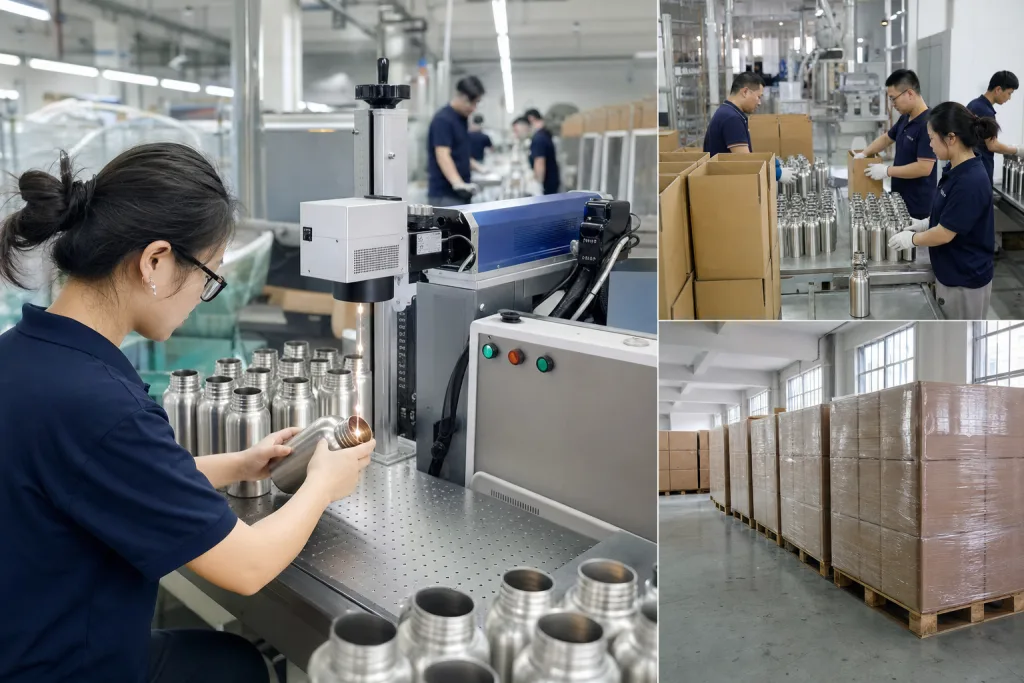
We manufacture custom drinkware in Zhejiang, China, for importers, outdoor brands, and canteen distributors. A factory can quote fast. The harder part is knowing which spec lines change cost, durability, and delivery, because a 10,000 pcs order with laser logo and a matched PMS coating does not run like a plain stock canteen. One buyer once flagged a USD 0.18 price gap as “too high”; the math did not work after we added the thicker body, food-grade cap insert, and AQL 2.5 inspection. Below is how our export engineers review a custom canteen project before we open tooling or confirm a production order.
Capacity Is Not Just Volume
The first spec line is usually capacity: 500 ml, 750 ml, 1 L, 1.2 L, or 1.9 L. Buyers often treat this as a label decision. Wrong question. Capacity decides mold selection, carton cube, freight cost, and which retail channel will accept the item. A 750 ml custom outdoor canteen works for most hiking and camping programs because it covers day use and still fits a side pocket or shoulder strap. On our line, a typical 750 ml body sits around 78 mm wide; the 1 L version often moves past 85 mm, and the buyer flagged that once because it would not enter a 82 mm backpack sleeve.
For a stainless steel canteen manufacturer, a small capacity change can become a tooling job. If you want a unique 850 ml shape instead of an existing 800 ml or 1,000 ml mold, you may need new tooling. Tooling for a drawn stainless body can run from USD 800 to USD 3,000 depending on shape complexity, shoulder angle, and cap interface. We run the first trial with a hydraulic drawing press and a go/no-go gauge at the mouth; if the neck is off by 0.3 mm, the cap seal test starts failing. If you are a canteen distributor testing a new SKU, use an existing mold first and put your money into finish, packaging, and QC. The math does not work for a 500-piece trial order with private tooling.
Check usable capacity against nominal capacity. Some canteen vendors quote brimful volume. Retail labels usually need practical fill volume, with headspace below the cap thread. For example, a bottle that measures 1,040 ml brimful may be labeled as 1,000 ml. QC pulled the sample last month and found 38 ml sitting above the safe fill line, so the PO copy had to change before carton printing. Ask your canteen supplier to confirm the measuring method on the quotation sheet.
Material Grade Drives Complaint Rate
For outdoor canteens, “stainless steel” is too loose. Call out 304, 316, or 201, and split inner and outer walls if the build is vacuum insulated. On our line, QC pulled a 201 coupon that lost the salt-spray check after 48 hours, while the 304 lot passed clean. For most custom canteen programs, 304 stainless steel is the working standard. It gives better corrosion resistance than 201 and clears most European and North American food-contact expectations. 316 handles chloride attack better, but the price jump usually makes no sense unless the canteen goes into marine, medical, or premium outdoor channels.
Single-wall canteens are lighter and cheaper. Double-wall vacuum canteens weigh more, hold temperature, and sell as a higher-ticket item. For a single-wall 1 L canteen, we ship 0.5 mm body thickness as the rugged baseline. At 0.35 mm, the math does not work for warehouse handling; the buyer flags dents after 1 m drop tests, and we have seen cartons arrive clean while the bottle inside had flat spots from stacking pressure. For vacuum canteens, inner and outer walls usually sit around 0.4 mm, though the final gauge follows draw depth and shoulder shape. Asking for “stainless steel” on the PO is the wrong question.
If you buy from China, ask for mill certs and heat numbers, not only a catalogue line. For Europe, buyers usually want LFGB or EU food-contact compliance plus REACH checks on coatings. For the US, FDA food-contact expectations and California Proposition 65 screening may apply. On our Hangzhou floor, we keep 304 certificates by coil batch and tie them to production lots with a barcode label printer, which saves time when a PO typo turns “304” into “304L” and the buyer asks for proof before vessel loading.
Cap, Seal, and Carry Hardware
The cap is where 6 out of 10 canteen customized projects start costing more after sampling. The body may pass a 1.2 m drop test, then QC pulls the sample and finds a cap hinge whitening at the pin or a gasket sitting 0.3 mm proud of the groove. Users do not complain about wall thickness first. They complain about leaks in a backpack. On the spec sheet, call out cap material, gasket material, thread style, leak test, and accessory hardware. For outdoor use, we usually run polypropylene caps with food-grade silicone gaskets. If the cap touches hot water, confirm the temperature rating in writing. Some low-cost plastics deform above 80°C, and we have seen caps oval after the buyer asked for boiling-water filling during a late test.
A screw cap is safer than a flip cap for rough outdoor use. Slower, yes. Safer. A tethered cap cuts loss in camping and military-style channels, especially when the buyer sells replacement caps at retail for USD 3–5 each. A carabiner lid looks good on a photo, but the metal clip and plastic anchor must be load-tested, not just approved by appearance. This is the wrong place to save USD 0.04. Do not let a canteen vendor call a decorative clip load-bearing unless the test report says so. A 5 kg static pull test is a simple requirement for many carry loops; premium buyers may request higher. On our line, we hang the filled sample from the loop for 30 minutes and check for anchor cracking with a 10x loupe.
Leak testing needs plain wording. A practical factory standard is 100% water leak test on the assembly line, followed by random AQL inspection. We ship fewer headaches that way. For vacuum models, add a 100% vacuum performance check before packing; one missed unit in a 3,000 pcs order becomes 12 emails after delivery. If you buy a custom growler or customizable growler in the same order family, use the same gasket material where possible. It simplifies spare parts, compliance documents, and after-sales support for distributor drinkware programs. The buyer flagged this once because the PO said “black silicone ring,” while the sample room used gray TPE; the math does not work when three cap SKUs need separate FDA files and spare-part bags.
Finish, Color, and Logo Method
Finish changes both landed cost and return rate. Plain brushed stainless is tough and low-risk, but it has less shelf pop. Powder coating gives better grip and stronger color depth, and we usually spec 80-120 μm if the buyer wants the coating to survive bag rub and campsite use. Spray painting is cheaper on paper, but if the line control slips, it chips fast. For a promo canteen, that tradeoff can work. For retail outdoor gear, the wrong question is how to save a few cents; the better move is powder coating in matte black, forest green, navy, sand, or white. On our line, QC pulls the sample for a tape test before we release bulk.
Logo method follows the finish and the order quantity. Under 500 pcs, buyers often push for silk screen because tooling is light and the setup is fast. Laser engraving gives a clean, permanent mark on stainless or powder-coated bodies, but it stays one color. Silk screen is cheaper for one-color logos and works on flat or mildly curved panels. Heat transfer handles full-color graphics, but we still ask for an abrasion test before we sign off. For a premium custom outdoor canteen, powder coating plus laser logo is the combination we ship most often; it looks less like giveaway stock and holds up in field use. The buyer flagged one prototype as too promotional, and they were right.
Pantone matching needs a hard check, not a screen grab. Powder coating can usually get close, but not every Pantone shade comes in the same gloss and texture, so a code that looks fine on a monitor can miss badly on the rack. For controlled colors, Delta E under 2.0 to 3.0 is a sane target, but outdoor drinkware buyers should approve physical chips. In our Zhejiang coating line, we normally ask for 5-7 working days to prepare color panels before sample production. We pull 6 chips under a D65 light box and send the buyer the actual panel set. That delay costs less than finding out, after mass production, that 3,000 units are off and the PO has a typo in the color code.
Packaging, Labels, and Distributor Needs
Packaging is not decoration only; it protects margin. A canteen distributor selling into outdoor retail needs a different pack than a brand owner shipping DTC. For wholesale cartons, we usually run an individual white box or kraft box with a 38 x 25 mm barcode label, and the buyer’s warehouse scans it without complaint. Retail is stricter: the color box needs shelf artwork, while the hang tag or paper sleeve carries capacity, material, and care text. Amazon and marketplace orders care less about gloss. FNSKU labels, readable carton marks, and a passed 76 cm drop test save more money than fancy artwork.
Define carton specifications early. A 1 L stainless custom canteen might pack 24 units per master carton, while a larger insulated canteen may pack 12 units. Carton weight should usually stay below 15 kg for easier handling in warehouses. We check this on the line with a digital platform scale before sealing the pilot carton. If you request thick gift boxes, your FOB price and ocean freight cost both rise. For a distributor growler or distributor canteen program, freight efficiency can decide whether the SKU is profitable. We have seen the math go sideways when a buyer chose a 2 mm rigid box and lost 18% carton loading.
Ask your canteen factory for packaging dielines before final artwork. Confirm whether the printed box uses CMYK or spot color, and whether the surface is water-based varnish or matte lamination. If you sell in Europe, recycling marks and language requirements need to match your sales countries; QC pulled one sample last year because the German warning line was missing. If you sell in the US or Canada, check suffocation warnings for polybags and country-of-origin marking. “Made in China” placement should be agreed before mass production, not discovered during final inspection. This is the wrong place to improvise.
Testing Standard and Inspection Plan
A serious custom drinkware purchase needs a written test plan. For a custom outdoor canteen, we run leak testing at the cap and stopper, coating adhesion by 3M tape, cross-hatch test with a 1 mm cutter, drop test, torque check on cap threads, odor check after hot-water filling, capacity verification on a digital scale, and packaging drop test on the finished carton. For stainless vacuum canteens, add insulation performance. A common benchmark is hot water at 95°C, measured after 6 hours or 12 hours, depending on the product promise. Do not print “keeps hot 24 hours” unless the tested result supports it. We have seen this go sideways when a buyer’s artwork promised 24 hours, but QC pulled the sample at 12 hours and the water was already below the agreed spec.
Inspection should use AQL, not a loose “factory checked” promise. A typical third-party inspection might use AQL 2.5 for major defects and AQL 4.0 for minor defects. Critical defects, such as leakage or unsafe sharp edges, should be zero tolerance. For a 3,000-unit order, a normal Level II inspection gives a useful sample size without opening every carton and checking every unit by hand. On the line, we still do spot checks with a torque meter and a 0.01 g scale, but that is not the same as an independent PSI report. If you are new to canteen suppliers in China, pay for third-party inspection on the first order. It costs less than sorting 3,000 pcs in your local warehouse after the buyer flagged wet cartons.
Compliance also depends on market. For Europe, 6 out of 10 B2B buyers we deal with ask for LFGB, REACH, and sometimes BSCI factory audit records. For North America, FDA food-contact support, CPSIA if children are targeted, and ASTM-related mechanical expectations may come up. A canteen manufacturer should tell you what is already available and what needs fresh testing. Fresh lab testing normally takes 7-10 working days after samples arrive at the lab. Ask this before the PO is signed; the math does not work if the vessel leaves Hangzhou on Friday and the missing LFGB report is discovered during customs document review.
MOQ, Price, and Production Timing
MOQ is where a canteen customizable project stops being a mockup and starts hitting the line. For an existing stainless body with a standard cap and one powder-coated color, we usually run 1,000 to 3,000 units per color. For a fully customized canteen with new cap tooling, special shape, molded logo, or custom hardware, MOQ can rise to 5,000 units or more. Buyers ask for 300 units often; the math doesn't work once we add the spray booth color change, logo screen setup, inner carton, export master carton, and barcode label. QC still pulls the sample at the same AQL table, whether the order is 300 pcs or 3,000 pcs.
FOB pricing depends on size, wall thickness, finish, cap, logo, and packaging. As a rough factory range from China, a single-wall 750 ml stainless canteen may sit around USD 3.20-5.20 FOB Ningbo or Shanghai. A double-wall insulated 1 L model may run USD 6.50-10.50. Heavy packaging, full-color transfer printing, or upgraded caps can add USD 0.30-1.50 per unit. We check wall thickness with a micrometer, and 0.1 mm less steel is one reason a quote looks cheap on paper but fails a drop test later. These ranges are guardrails, not promises, so you can spot a price that is suspiciously low or padded for no clear reason.
Our Hangzhou-area production network in Zhejiang can handle about 300,000 stainless drinkware units per month across canteens, tumblers, thermos bottles, and custom growler lines. Normal sample time is 7-12 days after artwork confirmation. Mass production is usually 35-50 days after deposit and pre-production sample approval. Artwork delays hurt. We have seen a PO with the Pantone code typed as 186 C on page one and 185 C on page three; the buyer flagged it only after the spray panels were made. If your retail launch date is fixed, share it before quotation, not after the deposit. A good canteen supplier will tell you if the date is realistic instead of taking the order first and explaining the delay later.
Send us your canteen spec sheet for review
BottleForge will check capacity, material, finish, logo, packaging, MOQ, and FOB risks before you commit to production.
Frequently asked questions
What is the best MOQ for a first custom outdoor canteen order?
For a first order, 1,000-3,000 units per color is usually the best balance. Below 1,000 units, setup cost for coating, logo, packaging, and export handling pushes the unit price up quickly. At 3,000 units, a canteen factory can run production more efficiently and you get better control over color consistency. If you are testing a new channel, choose an existing mold, one body color, and one logo method. Save custom tooling for the second order after sell-through data is clear.
Should I choose single-wall or double-wall for outdoor canteens?
Choose single-wall if your buyers care most about low weight, simple construction, and price. A 1 L single-wall custom canteen can be rugged if the body is around 0.5 mm stainless steel. Choose double-wall vacuum insulation if you sell premium outdoor, travel, or worksite drinkware and want temperature performance. Double-wall models cost more and weigh more, but they support higher retail pricing. For most distributor canteen programs, we suggest single-wall for entry price and double-wall for the premium SKU.
Which logo method lasts longest on a customized canteen?
Laser engraving is usually the most durable because it removes or marks the surface rather than adding ink. On a powder-coated canteen, laser engraving exposes the stainless layer underneath and resists scratching better than ordinary printing. Silk screen is fine for canteen promotional orders with simple logos, but it should pass tape and abrasion testing. Heat transfer works for full-color graphics, yet it needs careful approval. For outdoor retail, powder coat plus laser logo is the safest long-term combination.
What documents should canteen manufacturers provide before shipment?
At minimum, ask for a proforma invoice, packing list, material declaration, food-contact test reports, production photos, and final inspection report. For Europe, request LFGB or EU food-contact support and REACH information for coatings or plastic parts. For North America, FDA food-contact support is common, with Prop 65 review if you sell into California. If your retailer requires social compliance, ask for BSCI, Sedex, or ISO-related factory records before deposit, because audits cannot be created after goods are finished.
How long does a custom canteen project take from idea to shipment?
For an existing mold, allow about 7-12 days for sample production after artwork and color confirmation. Lab testing may add 7-10 working days. Mass production usually takes 35-50 days after deposit and approved pre-production sample. Ocean freight to Europe or North America can add 25-45 days depending on port and season. If you need new tooling for a canteen customized shape or cap, add 20-35 days before final sample approval. A safe retail planning window is 90-120 days.