Key Takeaways
- 0.6 mm 304 stainless is a practical baseline for a custom military canteen; thinner shells cut weight but raise dent risk.
- Most canteen manufacturer MOQs start around 1,000 units, with 35-45 day production windows after sample approval.
- A 100% leak test plus AQL 2.5/4.0 inspection catches more returns than artwork review ever will.
- Laser logo, proper carton specs, and REACH/FDA paperwork matter more than a pretty render for canteen distributors.
A custom military canteen looks simple until you place a 5,000-unit order and a 0.3 mm wall change starts showing up as dents after carton drop tests. We have seen a cap gasket turn into a 2% leak claim on a pilot run, and the wrong coating scratch before the buyer even opens the master carton. This is the wrong question to ask after the PO is signed. The spec sheet decides whether the margin survives.
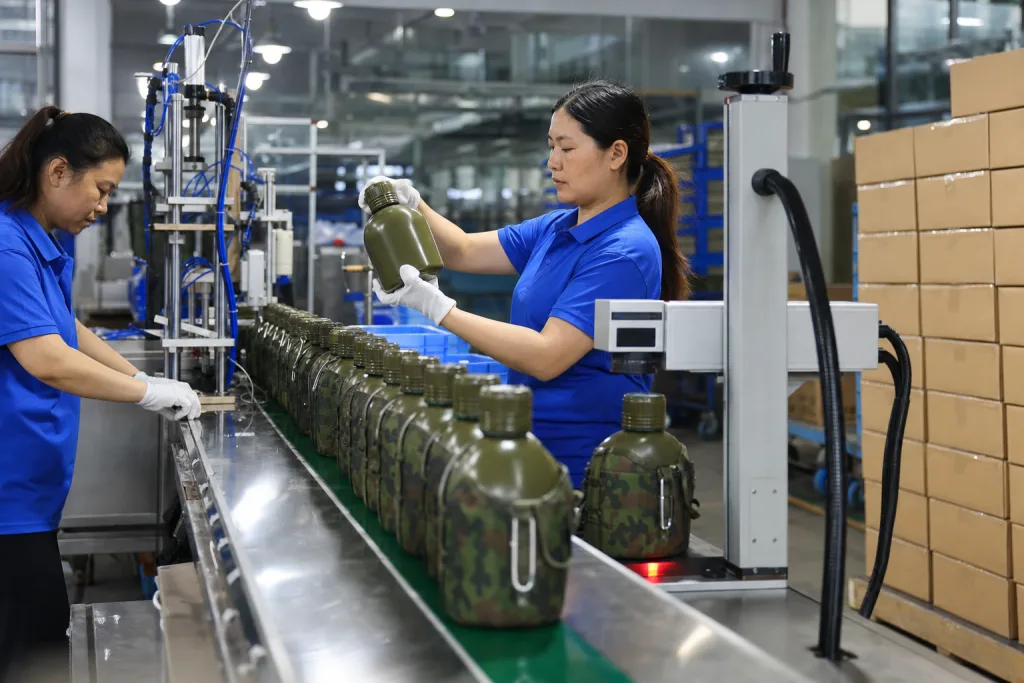
At our Zhejiang line, we start with use case, not artwork. A field canteen, a promo canteen, and a distributor SKU do not want the same cap, coating, or carton pack. QC pulled the sample after a 1.2 m drop test, and the unit still had to clear REACH or FDA with room for a 30 x 40 mm logo. If you skip the line items, the bill shows up later in freight, claims, and dead stock.
Start with the use case
Start with the use case. Are you building for outdoor retail, tactical kits, a canteen promotional campaign, or a distributor drinkware line that needs repeat orders every quarter? A 0.75L field bottle, a 1.0L camp canteen, and a set with a cup behave differently once we put them on the packing bench: carton size, gross weight, drop-test risk, and shelf face all change. Last month QC pulled a 1.0L sample that looked fine in the render, but the shoulder was too wide for a standard side pocket. If you choose shape before function, you get a canteen customizable on paper and annoying in a backpack.
For B2B buyers, the practical check is simple: capacity, footprint, and unit weight. A 1.0L stainless body at 0.6 mm wall thickness may weigh roughly 180-240 g before the cap. A thinner 0.4 mm shell saves grams, but we have seen it dent after only two carton moves from stamping to final inspection. The math does not work if the buyer saves USD 0.08 per piece and then argues over 3% dent allowance at destination. If your customer is a canteen distributor or a distributor canteen buyer, ask how the product will be sold: loose, packed with cup, or nested in a set. That answer changes tooling, carton count, and landed cost more than logo placement does.
- 0.75L suits compact packs, especially side pockets under 90 mm wide
- 1.0L fits general outdoor retail when buyers want one SKU for camping and field use
- Set packaging adds weight fast once the cup, pouch, polybag, and divider are counted
We see the same pattern in other customizable drinkware categories, including custom growler and customized growler programs. The right format is the one that matches the channel, not the mockup. We ship better when the sales sheet starts with store display, pack fit, and carton target weight instead of a pretty CAD screenshot.
Material choice decides lifespan
Material is where a canteen custom order turns into long service or a headache. For export buyers, the real fork is 304 stainless steel versus aluminum. 304, often called 18/8, is the safer pick for Europe and North America because it resists corrosion, handles acidic drinks better, and keeps the compliance file simpler. Aluminum is lighter and usually cheaper. Bare aluminum can taste metallic and it scratches fast, so the buyer often ends up asking for anodizing or an inner treatment anyway. On our line, QC runs a 24-hour salt-spray check before packing, and the sample tells the story fast.
A serious canteen manufacturer should give you the actual gauge, not words like strong or thick. For stainless, 0.5-0.6 mm is a workable commercial range. For aluminum, 0.7-0.8 mm keeps the body stable during forming. We check that with a micrometer, and if the sheet lands 0.03 mm off target, QC pulls the sample. On coated bodies, ask for coating thickness and cross-hatch adhesion data, not just a color chip. If the order goes to a Europe retail program, ask for REACH documents. For North America, buyers usually want FDA food-contact declarations and migration test reports. We once had a PO that listed 304 in one box and 201 in the spec line. The buyer flagged it before the first sample went out. Fair enough. The math does not work if the paperwork is loose.
Buy the surface that touches the user, not the finish that looks good on a screen.
That rule holds for custom drinkware cases, customized drinkware programs for retail shelves, and a custom growler program where taste and dent resistance matter more than a shiny photo. We see this go sideways when a buyer chases a 0.1 mm saving and then pays for rework after the first carton test.
Cap design is the real risk
Most returns on a customized canteen do not come from the body. They come from the closure. We see about 7 out of 10 leakage claims start at the cap: screw cap, bayonet cap, tethered cap, or cup-style cap. Each one changes the way the soldier or camper opens it, and each one carries a different leakage risk. If the lid depth is short by even 0.6 mm, or the thread pitch is cut rough on a worn tap, slow seepage shows up during transit. Then the buyer flags wet inner cartons and asks why their canteen suppliers must open every box. On a military-style item, the cap also needs one-handed operation, a grip that works with gloves, and a tether that stays on after a drop.
The gasket matters as much as the cap shape. A food-grade silicone gasket in the 50-60 Shore A range usually balances sealing and durability. Go softer, and it deforms in a hot container after warehouse storage. Go harder, and it may lose seal after repeated opening. Ask for a 100% leak test on every unit, plus a 1.2 m drop test on filled samples. We run the leak test upside down for 30 minutes, then QC pulled the sample and checks the cap seam with dry tissue. If the canteen includes a cup, check the nesting fit and whether the cap clears the cup wall without binding. This is where we have seen projects go sideways, because the body sample looked fine but the cup scraped the cap on every fifth piece.
For canteen distributors selling to retail, cap replacement parts cut after-sales cost fast. A spare gasket kit at 500 sets per carton is cheap; a pallet of returns is not. The math does not work if a missing 8 mm gasket forces you to credit the full canteen.
Logo methods change unit economics
Decoration is not just branding. It changes yield, wear life, and which channel will accept the carton. Laser engraving is the cleanest call on stainless because the mark stays put and the finish looks sharp on premium custom military canteen programs. On our line, a 20W fiber laser leaves a tight matte mark that QC can spot from across the table. Silk-screen printing costs less on canteen promotional orders and one-color logos, but if the canteen gets thrown in a pack and scraped against gear, the ink can fail fast. The buyer often pushes for the lowest logo cost. That is the wrong question.
If you want a cleaner retail look, powder coating or color coating works, but you need a hard color target before we start. We usually lock Delta E with a signed sample, not a vague email note. A buyer once asked us to “match the blue” after the PO was already open, and that turned into two lost days on the spray booth. A canteen customizable for distributors also has to fit the pack-out plan. If it goes to Amazon or a retailer, the unit box may need barcodes, FNSKU labels, and country-of-origin text. For Europe, some SKUs also need warning copy or recycling marks. On orders above 1,000 units, a single-location laser logo usually gives the best unit math. Multi-color branding adds setup time and scrap. We see the same thing on other customizable canteen, customized canteen, and customizable drinkware programs: keep the decoration path simple, and replenishment stays predictable.
If the artwork is still open, review custom logo options before you release the PO. We run a sample board, check the placement, and catch problems like a logo too close to the weld seam or a typo in the box code before the line starts.
Packaging controls your landed cost
Packaging is where a clean sample turns into a costly shipment. A loose canteen in a polybag is cheap, but it gets banged up in retail and the buyer will flag it the first time the carton drops 80 cm on the corner. A set with cup, instruction card, and printed box looks stronger on shelf, yet it adds carton volume and freight weight. The real question is landed cost, not box price. Before you approve the sample from a canteen supplier in Zhejiang, China, ask for a carton spec sheet. You need unit dimensions, master carton count, gross weight, outer carton strength, and whether the pack passed a drop test. On our packing table, QC pulled the sample twice because the insert was 2 mm loose.
For export, 5-ply cartons are common for standard orders, while 7-ply makes sense for heavier sets or long ocean freight. On the line, one extra inner tray can push the carton size out by 15 mm and break the pallet plan. A typical production line in Zhejiang can run 180,000 units per month across metal drinkware, but your custom military canteen run still depends on tooling, decoration method, and packing complexity. Expect a realistic MOQ around 1,000 units for a straightforward stainless model, with 35-45 days production after sample sign-off. If the order needs new molds, printed retail boxes, or a special cap, add time. We've seen buyers push for the cheapest box, then ask why the freight bill jumped. The math does not work.
Good logistics are not glamorous, but they keep distributor drinkware margins alive. In our warehouse, we check stack strength before the truck leaves, because one crushed corner can turn into three claims. If the outer carton survives stacking, your claim rate drops. If it does not, the nicest logo in China will not save the shipment.
Approve the sample like a buyer
Do not approve a custom military canteen sample because it “looks close.” Use a written checklist. Start with dimensional checks: capacity by fill test, height with a digital caliper, mouth diameter in mm, and unit weight on a 0.1 g scale. Then check seam finish, cap torque, gasket fit, and leak performance after 30 minutes inverted. For coated bodies, match the sample to the Pantone reference in a D65 light box, not under yellow office lights. If you are buying for Europe or North America, ask the canteen manufacturer for the material declaration, test report, and packing list before mass production starts. We’ve seen this go sideways when the buyer approved color by phone photo.
A practical approval set needs three physical samples: one pre-production sample for shape and metal work, one decorated sample for logo and coating, and one fully packed sample with carton marks, polybag, barcode, and inner divider checked. That is where errors show up. For quality control, 7 out of 10 overseas buyers we work with specify AQL 2.5 for major defects and 4.0 for minor defects, with random inspection from the finished batch. If you work with a capable canteen factory in China, ask for production photos from the line and one sealed reference sample kept by both sides. Simple habit. QC pulled the sample last month because the PO said matte black, while the artwork file said gloss black.
- Check logo placement within 2 mm tolerance
- Confirm gasket material and durometer with the supplier’s material sheet
- Keep one signed master sample in a sealed bag with date, PO number, and buyer initials
If you want to compare production capability, review AQL and testing standards and factory capabilities in Zhejiang before you place the order.
Send your spec sheet and get a factory quote
If you have target capacity, material, logo method, and carton needs, we can price the run fast and tell you where the hidden cost sits.
Frequently asked questions
How long does production and shipping usually take from China?
For a standard custom military canteen, production usually takes 35-45 days after sample approval. If the order uses existing tooling and simple logo work, it may be faster. If you need new molds, special coating, or retail packaging, add 1-2 weeks. Ocean freight from China to Europe or North America usually adds another 20-35 days depending on port and season. If your shipment comes from Zhejiang and you ship FOB Ningbo or Shanghai, your lead time is not just factory time; it also includes booking, export paperwork, and vessel schedule. Plan around that if your distributor canteen launch date is fixed.