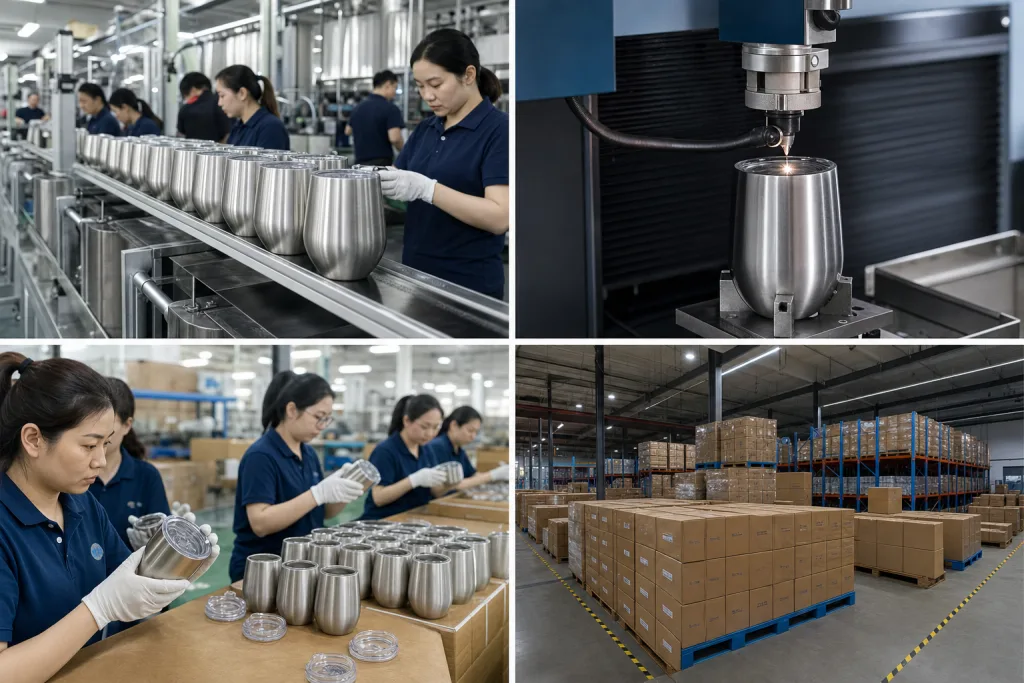
Key Takeaways
- Plan MOQ from 1,000 pieces per color for powder-coated custom made wine tumbler orders
- Use 304 stainless steel inside and 201 or 304 outside depending on target price
- Laser engraving is stable for 10,000+ pieces, but silk screen gives stronger retail color
- Set AQL 2.5/4.0 inspection and request 5-7 pre-production samples before mass production
A custom made wine tumbler looks simple until you need 5,000 pieces delivered to a warehouse in Rotterdam, Toronto, or Dallas with the right lid fit, coating color, carton strength, and logo position. The hard part is not finding a canteen supplier in China. The hard part is locking specs that survive a 1.2 m carton drop test, retail shelf handling, and the first customer who says the lid feels loose.
At our Zhejiang factory, we see buyers lose time on the same decisions: stainless grade, insulation target, decoration method, packaging level, and inspection standard. QC pulled one 12 oz wine tumbler sample last month because the logo sat 4 mm off the approved drawing; small miss, big email chain. A wine tumbler is not a custom growler or a sports canteen, but the sourcing logic is similar. You need commercial trade-offs, not catalog poetry, and sometimes the cheapest coating is where the math goes sideways.
Start With The Selling Channel
The first decision is not color or logo. It is the selling channel. A corporate gifting distributor has different failure points than a retail wine accessory range, and an event canteen order is another job again. We run these on different assumptions at the quote stage; last month QC pulled a 12 oz sample that passed logo check but failed the buyer’s shelf-box rub test after 30 strokes.
For retail, we quote shelf-ready packaging, barcode placement with a 0.3 mm quiet-zone check, cleaner polishing, and a color control card for repeat orders. For promotional buyers, the math is tighter; the buyer often pushes back on USD 0.08 for a gift box, then accepts a stronger export carton instead. For online sales, especially marketplace fulfillment, settle the drop test, FNSKU label position, inner box scuff risk, and carton size before the PO is signed. We have seen this go sideways when the PO says “Amazon box,” but nobody defines the 1.2 m drop standard.
For a custom made wine tumbler, most B2B buyers choose 10 oz, 12 oz, or 14 oz. The 12 oz size is the safest commercial option because it feels substantial without turning into a coffee tumbler. A 10 oz tumbler suits wine clubs and hotels when the powder coating is smooth and the box insert fits within 1 mm. A 14 oz version gives more room for ice or mixed drinks, but freight gets heavier fast; on one 3,000 pcs order, the carton CBM changed enough for the buyer to flag the sea freight line item.
We normally ask buyers to define four numbers before quoting: annual volume, first order volume, target landed cost, and acceptable defect rate. Give us the MOQ target too if your launch order is below 1,000 pcs. Without those numbers, every canteen manufacturer will quote a different wall thickness, lid grade, packing method, or inspection level, and you will compare prices that are not technically equal. This is the wrong question to ask if the only brief is “best price.”
Choose The Body Construction
About 8 out of 10 custom made wine tumbler orders we quote now use double-wall vacuum insulation. Single-wall stainless cuts the ex-factory price, but it sweats on cold wine and gets warm in the hand fast. For B2B orders in Europe and North America, double-wall vacuum is the baseline; last month QC pulled a 12 oz single-wall sample from the line and the buyer rejected it after a 30-minute ice-water check.
The normal build is 304 stainless steel for the inner wall, with 201 or 304 stainless for the outer wall. Inner 304 is where we do not like to save money. It touches the drink, and it makes LFGB, FDA, and REACH-related paperwork cleaner when the importer asks for test files before shipment. Outer 201 can reduce cost by about USD 0.15-0.35 per unit depending on gauge, but if a carton rubs through the powder coat and exposes metal, 201 has weaker corrosion resistance; we have seen that complaint show up after a 6-month warehouse hold.
Wall thickness usually sits around 0.4 mm to 0.5 mm per layer for this category. Go thinner and the dent rate moves fast. The math doesn't work for retail or distributor canteen programs if a USD 0.12 saving turns into 3% returns from side-wall dents. For event giveaways, a lighter gauge can work if the PO says it clearly and the buyer accepts the trade-off; our caliper check on incoming coil is where this gets caught.
Lid choice matters too. A clear AS or Tritan-style sliding lid is common, but buyers should not treat lids as free accessories. A loose lid creates complaints even when the steel body passes vacuum testing. We test lid fit after powder coating because 60-80 μm coating thickness changes the rim tolerance slightly. Small gap, big headache. For large canteen customized programs, the same tolerance check applies to caps and silicone seals, especially when the buyer flagged leakage on a previous order.
Our practical rule: do not save USD 0.20 on steel and lose USD 2.00 in claims, replacements, and distributor trust.
Set Decoration Before Pricing
Logo method changes both cost and risk. If you ask 5 canteen vendors for a price without naming the decoration method, you will not get 5 comparable quotes. You will get 5 assumptions, and the buyer only finds out after QC pulls the pre-production sample.
Laser engraving is the safest choice for powder-coated wine tumblers. It removes the coating and exposes the stainless surface underneath, usually with a 0.08 mm to 0.12 mm beam mark depending on the machine setting. It works well for small logos, corporate names, and one-position branding. Setup cost is usually modest, repeatability is strong, and it avoids ink adhesion problems. The limit is color. Laser is not a full-color decoration method, and we have seen buyers reject good samples because they expected white artwork on a black cup, not bare stainless.
Silk screen printing gives better color control for simple one- to three-color artwork. It is common for promotional custom drinkware, but curved surfaces need proper jigs and artwork adjustment; a flat 60 mm logo can distort near the shoulder of a 12 oz wine tumbler. Pad printing can work for smaller marks, but we do not like it for larger wine tumbler logos. The math does not work once the mark gets wide. Heat transfer or water transfer can produce full-wrap graphics, although unit cost and defect risk go up, especially when the line finds bubbles or edge lifting after the tape test.
For a retail custom made wine tumbler, we usually recommend powder coating plus laser engraving or powder coating plus one-color screen print. For a hotel or wine club, a satin stainless finish with laser engraving often looks cleaner and avoids color matching arguments. For a canteen promotional campaign, screen print may win because the brand color matters more than long-term abrasion resistance. We had one PO typo list “Pantone 186C” while the artwork showed 185C; catch that before sample charge, not after 500 pcs are printed.
Ask for logo size in millimeters, not only a PDF. A 35 mm wide logo and a 70 mm wide logo can use the same artwork file but behave differently on a curved tumbler. Your canteen factory should show a placement drawing before sample production, with distance from rim and bottom called out in mm. No drawing, no sample. That is how small logo debates turn into 12 days vs 18 days on the delivery schedule.
Know The Real Cost Drivers
A normal FOB China price for a 12 oz double-wall custom made wine tumbler sits around USD 2.20 to USD 4.80, depending on stainless grade, coating, lid type, logo method, packaging, and order quantity. If a supplier quotes USD 1.65, the math doesn't work. Ask if the cup is true vacuum insulated, if the inner wall is 304 stainless, if FDA or LFGB testing is covered, and if the price includes the gift box or only bulk packing. Last month QC pulled a random sample from a low-price comparison order and found the inner wall was 201 stainless, not 304 stainless as the buyer's PO stated.
MOQ is where buyers often get a soft answer. At our Hangzhou, Zhejiang operation, a practical MOQ is 1,000 pieces per color for powder coating and 3,000 pieces when you need a custom PMS coating with stable repeatability. Mixed colors are possible, but each color means a line changeover, 6-8 kg powder loss during cleaning, and separate inspection records. For standard finishes, we can produce about 300,000 drinkware units per month across tumblers, bottles, and canteen customizable models. We run this on shared coating lines, so a 500-piece color split sounds simple on email but usually slows the line and raises the defect rate.
Tooling is usually not required for a standard wine tumbler shape. Tooling becomes relevant if you want a new silhouette, special lid, molded silicone part, or a proprietary base design. For true custom molds, expect 30-45 days before mass production sampling, and 55-60 days is more realistic if the lid has multiple plastic parts, a slider, and a silicone gasket. One buyer flagged a 0.4 mm mismatch on a lid rim during pre-production sampling; small on paper, but enough to cause wobble and water seepage during the tilt test.
Packaging often surprises new buyers. A white box may add only USD 0.08-0.15. A printed retail box can add USD 0.20-0.45. A magnetic gift box may add more than USD 1.00 and increase carton volume. For distributor growler or customizable growler orders, packaging can be even more expensive because size and weight increase. Packaging sells the product, but we ship cartons, not artwork; a 24-piece master carton that grows by 18% can push freight from USD 0.32 per cup to USD 0.41 on a normal LCL shipment. We've seen this go sideways when a PO typo listed “white box” while the buyer expected a 4-color retail box with barcode sticker.
Protect Compliance And Inspection
Lock compliance before deposit, not after the line is already running. For North America, buyers usually ask for FDA food-contact support, CA Prop 65 review when the coating or ink needs it, and ASTM-style checks for sharp edges or small parts if the cup will sit near children in retail. For Europe, importers or chain stores often ask for LFGB, REACH, and sometimes EU 1935/2004 documentation. We had one PO where the buyer wrote “FDA approved stainless steel” in the remarks; QC flagged it because FDA support applies to food-contact safety, not a magic stamp on 304 stainless.
A good canteen manufacturer should explain what material certificates cover and which finished-product tests still need to be booked. A steel certificate is not the same as a finished tumbler test. Coating, ink, plastic lid, silicone gasket, and packaging ink can all affect the result in your market. We usually check the lid gasket with a 0.02 mm feeler gauge during sample review, because one loose silicone ring can turn a clean test report into a leaking-carton claim.
Use AQL inspection for mass production. A common setting is AQL 2.5 for major defects and 4.0 for minor defects. Critical defects should be zero tolerance. For custom made wine tumbler orders, we classify leaking lids, failed vacuum, sharp burrs, wrong logo, severe dents, and wrong color as major or critical depending on severity. Small dust marks under coating may be minor if they match the approved limit sample. The math doesn't work if the buyer wants gift-box grade finishing at a promo-cup defect standard; we see that argument on 3,000 pcs orders more than anyone enjoys.
Pre-production samples are not decoration souvenirs. Approve 5-7 samples and keep one signed sample at the China factory, one at your office, and one with the inspection agency if you use third-party QC. Simple system. It prevents arguments about whether matte black means soft matte, rough powder texture, or semi-gloss black. For canteen distributors managing 6 or 8 customer projects at once, that signed sample system cuts down the uncomfortable emails when the buyer flagged it after cartons were sealed with 48 pcs per master carton.
Plan Lead Time Honestly
For a standard custom made wine tumbler using an existing mold, we plan 7-10 days for sampling after artwork confirmation, 25-35 days for mass production after sample approval and deposit, then 3-7 days for AQL inspection, vessel booking, and export paperwork. Our merchandiser starts the clock only after the buyer signs the AI/PDF artwork, because one 2 mm logo shift can send the sample back to the laser room. Sea freight then adds about 25-40 days to Los Angeles, New York, Rotterdam, Hamburg, and similar North American and European ports, with routing and season changing the final ETA.
Air freight can save a late promotional order, but the math gets ugly fast. A stainless wine tumbler is not a USB stick. Once we pack 24 pcs into inner boxes and a master carton, freightable volume becomes the real cost driver, not only gross weight. We have seen buyers approve a nice FOB price, then reject the air quote after DHL measured the carton at the warehouse. If your landed cost target is tight, planning around emergency air shipment is the wrong question to ask.
Chinese holidays also matter. Before Lunar New Year, factories in Zhejiang and other parts of China deal with stainless coil shortages, workers leaving early, and tight container space. The line slows down. Powder coating ovens may still run, but polishing and packing teams are often short by 20-30% in the last two weeks. If you need delivery in March, do not place the first serious inquiry in late January. For Q4 retail or holiday gifting, confirm specifications by July or August if possible.
Buyers working with canteen suppliers across several categories should align production calendars. A custom canteen, customized growler, and wine tumbler may run on different lines, but we can often put them into the same coating batch, match carton artwork style, book one inspection window, and load one container. QC pulled the sample on one mixed order last year because the PO said matte black for the tumbler and satin black for the growler. Small typo, big delay. That is why experienced distributor drinkware buyers usually prefer fewer, better-organized canteen manufacturers instead of chasing the lowest quote from a new canteen vendor every season.
Use A Quote Checklist
A quote request for custom made wine tumbler orders should be boringly specific. Good. On our line, one missing item like “lid: clear AS slider, no straw hole” can change the mold match, carton height, and packing labor by 0.03–0.06 USD per piece.
Include capacity, body size in mm, stainless grade, wall construction, finish, lid type, logo method, logo size, packaging, test requirements, Incoterm, delivery address or port, first order quantity, and forecast quantity. If you compare 3 canteen suppliers, send the same RFQ file to each one, including artwork version and barcode rules. We once had a buyer flag a 10,000 pcs quote because one factory priced a white box and another priced a color box with inner egg-crate; the “cheap” offer was not cheaper after packaging was corrected.
For Incoterms, FOB Ningbo or FOB Shanghai is common for Zhejiang production. EXW can look cheaper, but it pushes local trucking, export handling, and customs coordination back to you. DDP works for some small buyers, but ask who is importer of record and what happens if customs asks for food-contact documents. This is where the math doesn’t work: a 1,200 pcs trial order saved 180 USD on paper, then lost 9 days because the forwarder asked for LFGB files after the cartons had already left Hangzhou.
Ask for photos of current production, not only showroom samples. A real line shows welding marks, polishing consistency, powder coating racks, and whether lids are being matched with go/no-go gauges instead of guessed by hand. If the factory also makes canteen customized bottles, custom growler products, or other customizable drinkware, check whether they know your category or are trading from another workshop. QC pulled the sample for one 12 oz wine tumbler project because the rim OD was 0.7 mm off, and the lid fit looked fine until the leak test.
Your goal is not to find a perfect factory. It is to find a canteen factory that gives clear answers, records changes, controls tolerances, and tells you when your target price is unrealistic. We ship better orders when the PO, artwork, carton mark, and test standard match before deposit. A low quote that ignores those details usually looks good only until the cartons arrive.
Send Your Wine Tumbler RFQ For Review
Share quantity, target price, logo file, packaging idea, and delivery market. We will flag cost risks before sampling starts.
Frequently asked questions
What is a realistic MOQ for a custom made wine tumbler?
For an existing 10 oz, 12 oz, or 14 oz mold, 1,000 pieces per color is a practical MOQ for many China factories if you use standard powder coating and one logo position. Custom PMS coating is usually better at 3,000 pieces per color because color matching, powder setup, and waste become more manageable. If a canteen vendor offers 100 pieces with full customization, it may be using stock goods, local rework, or digital decoration rather than normal factory production. That can be fine for testing, but not for a stable distributor program.
Should I choose 304 stainless steel for both inner and outer walls?
Inner 304 stainless steel is strongly recommended because it contacts wine, cocktails, water, or other beverages. For the outer wall, 201 stainless can be acceptable if you use a good coating and target a sharper price. Full 304 construction is better for premium retail, coastal markets, and buyers who want a simpler material story. The cost difference is often around USD 0.15-0.35 per unit for a wine tumbler, depending on gauge and market conditions. For customized drinkware sold under your brand, the safer specification is inner 304 with outer 304 when budget allows.
Which logo method lasts longest on powder-coated wine tumblers?
Laser engraving is usually the most durable because it removes the powder coating instead of adding ink on top. It is excellent for corporate logos, winery marks, and distributor drinkware programs where repeat orders must look consistent. Silk screen printing gives stronger color, but adhesion depends on ink, curing, coating texture, and handling. For full-color artwork, heat transfer is possible, but unit cost and rejection rate are higher. For orders above 5,000 pieces, approve actual decorated samples and run tape, rub, and dishwasher-related checks if your market claims require them.
How long does production take after sample approval?
For a standard custom made wine tumbler from an existing mold, mass production usually takes 25-35 days after sample approval and deposit. Sampling often takes 7-10 days once artwork and specifications are confirmed. Add 2-4 days for inspection and export preparation. Sea freight to Europe or North America commonly adds 25-40 days port to port, plus local delivery time. If your order involves a new lid, custom mold, special packaging, or multiple coating colors, add another 10-30 days. Zhejiang factories can move fast, but they cannot remove curing, assembly, and QC time safely.
Can one supplier handle wine tumblers, canteens, and growlers together?
Yes, if the supplier has real stainless drinkware production capacity and not only trading access. Many canteen manufacturers also produce wine tumblers, custom canteen bottles, and customized growler items, but the tooling, lids, welding, and testing are not identical. Ask for production photos, monthly capacity, test reports, and references by product type. A factory producing 300,000 units per month can usually coordinate shared coating colors, carton markings, and inspection schedules across several SKUs. For canteen distributors, that can reduce communication time and improve container loading efficiency.