Key Takeaways
- A practical MOQ for custom made water bottles is usually 1,000-3,000 pcs per SKU, depending on mold, color, and logo method
- Wall thickness, lid material, coating, and carton drop strength affect real landed cost more than the cheapest FOB quote
- AQL inspection, REACH/LFGB/FDA checks, and leak testing should be written into the purchase order before deposit
- A normal China production lead time is 25-45 days after artwork and pre-production sample approval
A water bottle quote looks simple until you put 3 factory sheets side by side and the specs do not match. One canteen supplier writes 304 stainless steel, another says food grade steel, and a third sends a lower FOB price but leaves out 0.5 mm versus 0.6 mm wall thickness, powder coating grade, and 1 pc/polybag + egg-crate packing. We see this weekly. That is how a buyer approves a nice-looking sample, then QC pulled the sample after carton drop testing because the coating chipped on the shoulder.
If you buy custom made water bottles for retail, promotions, Amazon, or distributor drinkware programs, your spec sheet is not paperwork. It is the product. Our Zhejiang team checks these details every day with canteen distributors and brand owners sourcing from China; vague specs create expensive surprises, usually after the deposit is paid. The buyer flagged it too late on one PO last month: “matte black” was written, but no Pantone, no gloss range, no abrasion standard. The math does not work if you save USD 0.18 per bottle and then rework 3,000 pcs before shipment.
Start with bottle construction
The first line of a custom made water bottles spec sheet should not be the logo. It should be construction. On our line, QC pulls a cut sample before printing starts. Are you buying single-wall stainless, double-wall vacuum, plastic, glass, aluminum, or a hybrid design with a plastic lid and silicone boot? Each choice changes price, weight, testing, and what the buyer expects on arrival.
For stainless vacuum bottles, ask for the exact steel grade on both walls. A normal export spec is 304 stainless steel for the inner wall, 201 or 304 for the outer wall, and 0.4-0.5 mm wall thickness before forming. If a canteen factory only writes “stainless steel,” you do not have a real spec yet. We have seen buyers get stuck on that line item, then the line has to stop while the thickness gauge and mill certs are checked. For acidic beverages, fruit infusions, or children’s ranges, 304 inner steel is the safer commercial baseline.
Capacity also needs discipline. A 500 ml bottle from one canteen manufacturer may have 480 ml usable fill volume after lid displacement. We had a buyer flag a PO because the carton said 500 ml and the sample poured 476 ml to the brim, which is the wrong question to ask if the legal fill mark is not set. If you are selling into Europe, the label claim must match reality. For North America, buyers often care more about ounce markings, such as 18 oz, 24 oz, 32 oz, or 40 oz. Put both metric and imperial capacity in the artwork file and carton marks to avoid warehouse confusion.
Shape affects more than shelf appeal. A slim 70 mm diameter bottle fits many car cup holders but limits vacuum insulation space. A wide-mouth 90 mm custom canteen is easier to clean and takes ice cubes, but carton size increases. The shoulder radius matters too; one extra 2 mm can change cap fit and slow the lid tool at trial. For distributor canteen programs, we usually recommend two shared body platforms first, then change colors, lids, and decoration. That gives you range variety without multiplying tooling and inventory risk.
Define performance, not adjectives
“Keeps drinks cold all day” belongs on a gift box, not on a factory spec. Write the test method. For a double-wall vacuum bottle, we normally test with hot water at 95°C, room temperature at 20°C, then record liquid temperature after 6, 12, and 24 hours with a calibrated probe thermometer. A mid-market 500 ml bottle may hold above 60°C after 6 hours. A heavier premium bottle can beat that, but only when the vacuum station is stable and the lid seal passes the same check on every lot.
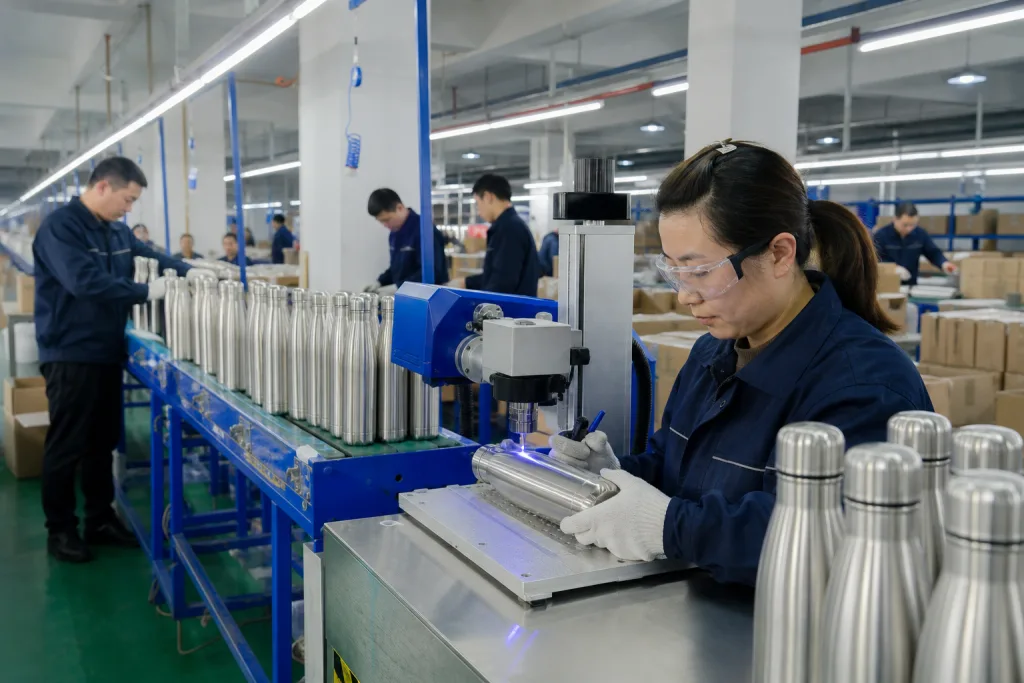
Leak testing needs plain wording. At our Zhejiang facility, a normal line check includes vacuum integrity testing and 100% leak testing for finished bottles before packing; QC pulls samples from sealed cartons too, because one loose gasket can ruin a 1,000 pcs order. For screw lids, request an inverted water test for at least 30 minutes. For flip lids or straw lids, define whether the product is “leakproof,” “spill-resistant,” or only suitable for upright use. Retail buyers care about those words because returns get charged back fast.
Drop resistance depends on material and geometry. A powder-coated stainless bottle can pass a 1.0 m drop on the base and still show coating damage; that is cosmetic damage, not a failed bottle. If you need a canteen promotional item for outdoor events, add a silicone boot or use a thicker base. If you need a premium custom growler or customized growler, the filled weight is higher, so handle welding and lid thread strength need extra attention. We have seen this go sideways when a buyer approved the body sample but skipped the filled drop test.
Do not accept performance claims without sample testing. Ask the canteen supplier for the test report format, not just the result; a one-line “passed” on a PDF tells you almost nothing. Good canteen manufacturers in China can provide internal test records and arrange third-party testing when needed, but the buyer must specify which claims will appear on packaging or sales pages. Last month the buyer flagged a PO typo: “24H cold” on the carton, “12H cold” on the insert. Fix it before mass production.
Lock material compliance early
Lock compliance first, then lock color and logo. The selling market decides the material stack. For the EU, we run LFGB, REACH, and, on some plastic or silicone parts, migration testing. For the US, FDA food-contact compliance is the normal baseline, and children’s products can bring in CPSIA and ASTM checks. If the bottle has a straw, bite valve, painted coating, silicone gasket, or printed sleeve, each part goes into the file. On one line run, QC pulled the straw and gasket samples before pad printing started, and that saved a rework.
A canteen for adult gym use is a different job from a retail kids bottle. Children’s drinkware may need lead, cadmium, phthalate, and small-parts review. A glass bottle with a silicone sleeve can look simple, but the ink, sleeve, lid gasket, and glass body still need control. For customized drinkware programs, keep a bill of materials with part numbers, material grades, and approved suppliers. The buyer flagged a backup gasket vendor once, and the whole batch was on hold until we matched the file. This is the wrong question to ask: “Does it look fine?” The real question is whether every part matches the approved spec.
Factory audits and product compliance are separate things. BSCI, Sedex, ISO 9001, or similar audit documents help with vendor approval, but they do not prove the bottle is food safe. A serious canteen vendor should separate factory qualification from product test evidence. If you are a canteen distributor serving multiple retail accounts, build your compliance matrix by market: EU, UK, US, Canada, and any state-level packaging rules. On audit day, we have seen the line running clean while the paperwork was missing a signature stamp. Buyers mix those two up, and it costs them a month.
One practical point: testing costs are usually not in the lowest FOB quote. Third-party testing can add USD 300-1,500, depending on the number of materials and standards. That is still cheaper than sitting on 10,000 pcs in a warehouse because one lid pigment was never checked. We once held a batch after the spectrometer caught a blue cap issue, and the math did not work for the buyer. Plan the test budget early, or the line will ship late.
Decoration changes the risk profile
Logo method is not a branding-only call. It changes packing time, scrap rate, and how the bottle survives daily use. Laser engraving on stainless steel stays clean and there is no ink migration risk, but it is one-color by nature. Silkscreen is the low-cost route for a simple logo, usually 1-2 colors on a round body. Heat transfer and water transfer can carry full-wrap art, but they need tighter color control and a harder abrasion test. On the line, QC pulled the sample after the 200-rub test and the edge on the wrap print started to lift.
Powder coating is standard on custom made water bottles because it gives a better hand feel than spray paint. We usually check 60-80 microns with a gauge, depending on color and texture. Matte white and light pastel shades show dirt and scuffs sooner than dark hammertone or semi-matte black. If your distributor drinkware program has 8 colors, approve each one on the actual bottle shape. Flat color chips lie. We have seen the buyer flag a pastel tone after the first cart drop test, and the sample on the table looked fine until it was handled for 10 minutes.
For a canteen customized with retail packaging, artwork placement should be measured from fixed points: base line, seam line, handle center, or lid direction. “Logo centered on front” is not enough when the bottle has a carry loop, straw spout, or molded grip. I have seen a PO say “front center” and the logo landed 12 mm off because the seam was used as the reference. Ask for a 2D artwork proof and a physical pre-production sample before mass production. That is the clean way. Anything else invites a reprint.
MOQ also depends on decoration. A stock bottle with laser logo may start around 500-1,000 pcs per design. A fully customizable canteen with custom powder color and printed box may need 2,000-3,000 pcs. New mold development can start at USD 1,500 and go much higher for complex lids. One lid tool we ran took 28 days to get a first T1 shot, and the buyer still wanted color, mold, and carton changes on the same order. The math does not work. Any canteen vendor promising very low MOQ, custom color, custom mold, and fast delivery at the same time is hiding a compromise.
Price the whole export unit
FOB price is one line on the quote sheet. A workable custom drinkware quote should spell out bottle body, lid type, logo process with print size in mm, color finish, packaging, carton quantity, gross weight, carton dimensions, testing, spare parts, and Incoterms. If two canteen suppliers skip these fields, you are not comparing the same export unit. We see this on RFQs every week: one price includes a powder-coated body and color box, the cheaper one is a plain bottle in a polybag.
As a rough export range from China, a basic single-wall stainless bottle may quote around USD 1.20-2.20 FOB at volume. A double-wall vacuum bottle often sits around USD 3.00-6.50 depending on capacity, lid complexity, coating thickness, and packaging. A larger custom growler or distributor growler can move higher because the steel weight jumps, the handle needs stronger welding, and the carton eats more CBM. Not a promise. These are guardrails so you can catch a USD 2.10 “vacuum growler” quote before QC pulls the sample and finds thin steel, weak paint adhesion, or a loose lid thread.
Packing deserves more attention than buyers give it. A bottle in a polybag and white box costs less than a printed retail box with molded pulp insert, but it often fails the e-commerce test. For Amazon FBA or direct-to-consumer distribution, ask for a 5-ply export carton, barcode or FNSKU labeling, master carton limit under 15-18 kg where possible, and a carton drop test based on ISTA-style handling. We have seen this go sideways: the buyer saved USD 0.08 per unit on packaging, then the warehouse flagged 37 crushed retail boxes in one shipment.
At BottleForge Industrial in Zhejiang, our monthly capacity is about 600,000 stainless drinkware units across standard and customized lines, with typical MOQ at 1,000 pcs for stock-shape logo orders and 3,000 pcs for custom color runs. Normal lead time is 30-40 days after deposit and sample approval. Before China holidays, add 10-15 days. The line fills fast, and a PO with one typo in the Pantone code can hold a color run while the buyer’s team is still arguing over artwork approval.
Inspection belongs in the PO
Quality control works best when it is boring and written down. Put the inspection standard straight into the purchase order: AQL level, critical defects, major defects, minor defects, sample size, and who pays for reinspection. Spell it out. For drinkware, we treat leakage, sharp edges, rust, foreign odor, unsafe material substitution, wrong capacity, and barcode mismatch as critical points. Last year QC pulled 32 pcs from a 3,000 pcs lot after a 0.6 mm burr showed up on a stainless mouth rim; without that defect list in the PO, the argument becomes about opinions.
A practical inspection plan for customized canteen orders includes incoming material checks, first-piece approval on logo and color, in-process leak testing, final random inspection, and carton condition review. If you are ordering 5,000 pcs, do not wait until the final day to discover the lid gasket is too loose. We run a 15-minute upside-down leak test on the line before packing, and one loose silicone ring can turn into 600 leaking bottles by lunch. A mid-production video call or inline check can save two weeks, sometimes 12 days vs 18 days on a rework schedule.
Color tolerance should be realistic. Powder coating and plastic injection parts will not always match Pantone perfectly because surface texture changes visual color. Define an approved sample as the control, then sign and date it with the factory sample label. For printed logos, specify acceptable position tolerance, such as ±1.5 mm for laser engraving or ±2 mm for silkscreen on curved surfaces. If your brand guideline requires tighter tolerance, say so before production. The wrong question is “can you match it 100%?” The better question is whether the buyer accepts the signed sample under the light box before we load powder into the spray booth.
For canteen distributors supplying chain retailers, final inspection should include retail details: UPC/EAN scan test, warning label check, country-of-origin marking, carton assortment ratio, and instruction leaflet language. For North America, “Made in China” marking must be visible where required. For EU, recycling symbols and importer details may matter. We have seen this go sideways over one PO typo, “EAN 13” entered as “EAN 18,” with 80 cartons already sealed. A dependable canteen manufacturer will follow your checklist, but you need to provide the checklist before cartons are sealed.
Choose vendors by response quality
The best canteen vendors do more than quote in 2 hours; they ask the questions that protect the order. They ask your sales channel, capacity tolerance in ml, lid style, compliance target, packing route, and reorder cycle. If a canteen supplier sends a price without checking whether the bottle is for retail, promotion, e-commerce, or distributor replenishment, that quote is sitting on guesses. We see this every week: the buyer asks for “750ml,” QC later measures 732ml to the brim with a graduated cylinder, and the buyer flags it after artwork has already been made.
For a first order, send a one-page spec sheet and ask the same questions to every canteen factory: exact materials, wall thickness in mm, available certificates, MOQ by decoration method, sample cost, sample lead time, mass lead time, carton size, defect policy, and payment terms. Make them answer in writing. A serious canteen manufacturer will tell you, for example, that powder coating needs a different MOQ than laser engraving, or that a 0.5mm body dents too easily in courier drop tests. A catalog copier just sends 3 photos and a unit price.
Payment terms also show maturity. Common terms for China custom drinkware are 30% deposit and 70% balance before shipment, sometimes after passed inspection. For established accounts, different terms can be negotiated, but new buyers should care more about spec control than saving 2 points on payment timing. The math does not work if the goods miss the event date. If you are building a canteen promotional campaign for a fixed event, 12 days of sampling versus 18 days can decide whether the line ships by vessel or gets pushed into air freight.
Good sourcing is not about finding the cheapest customizable drinkware. It is about buying the same product twice. When your second PO matches the first approved batch, your distributor canteen or distributor drinkware program can scale without fresh arguments on every reorder. That takes clear specs, controlled materials, repeatable decoration, and a factory team in China that treats the spec sheet as a production document, not a sales attachment. We run the pre-production sample against the signed spec with a caliper, color card, and carton drop record; if the PO says matte black but the artwork file says PMS 426C, QC pulls the sample before the line starts.
Send us your bottle spec sheet for review
We will check materials, MOQ, decoration, packaging, and lead time before you commit to your next custom drinkware order.
Frequently asked questions
What MOQ should I expect for custom made water bottles?
For a stock bottle shape with one-color logo, expect 500-1,000 pcs as a realistic starting MOQ. For custom powder coating, full-wrap print, printed retail box, or multiple lid colors, 2,000-3,000 pcs per SKU is more practical. New mold projects usually need higher volume, often 5,000 pcs or more, because tooling, sampling, and line setup must be justified. Some canteen suppliers advertise 100 pcs MOQ, but that usually means stock colors, limited logo area, higher unit price, and no serious packaging customization.
How long does production take after I approve the sample?
A normal lead time from China is 25-45 days after deposit, artwork confirmation, and pre-production sample approval. Simple laser logo orders on stock bottles can be faster, sometimes 15-25 days if materials are ready. Custom colors, new lids, printed boxes, or large customized drinkware programs need more time. Add another 20-35 days for ocean freight to many Europe or North America ports. Before Chinese New Year or major holiday periods, build in at least 10-15 extra days.
Which logo method is best for a custom canteen?
It depends on the product position. Laser engraving is best for durability and a clean premium look, especially on stainless steel or powder coating. Silkscreen works well for simple 1-2 color logos and lower cost. Heat transfer or water transfer is better for large full-color graphics, but you should test abrasion and dishwasher resistance if you plan to make durability claims. For promotional canteen orders, laser or silkscreen usually gives the best balance of cost, speed, and defect control.
Can one canteen manufacturer handle retail and Amazon packaging?
Yes, but you must specify the route. Retail packaging may need printed boxes, hang tags, UPC/EAN codes, warning labels, and shelf-facing artwork. Amazon FBA or e-commerce packing may need FNSKU labels, stronger cartons, drop-test thinking, and lower carton weights, often under 15-18 kg. A good canteen manufacturer can pack either way, but the cost and carton dimensions change. Do not approve FOB pricing until the packing method is written into the quote.
What documents should I request from canteen vendors?
Ask for a formal quotation, material specification, product drawing or size sheet, compliance reports relevant to your market, factory audit documents if needed, and a sample invoice. For production, request a pre-production sample approval record, AQL inspection checklist, packing list template, and carton marking proof. If selling in the EU, discuss LFGB and REACH early. If selling in the US, discuss FDA food-contact compliance and CPSIA/ASTM if the item is for children.