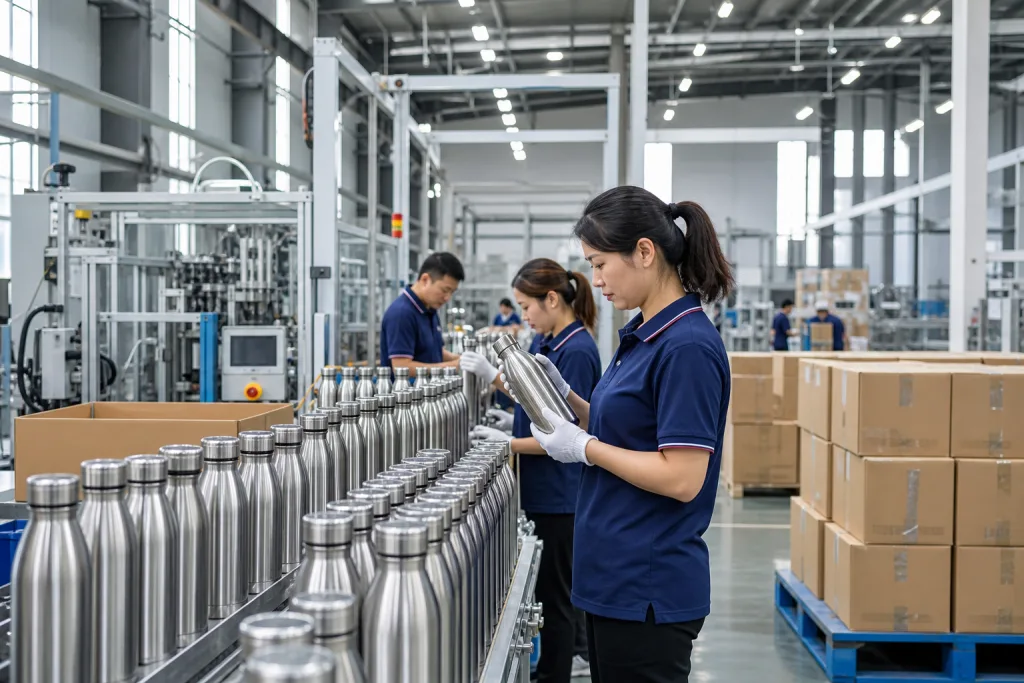
Key Takeaways
- A standard customized thermos usually starts at 1,000-3,000 pcs per SKU; new molds often need 5,000-10,000 pcs
- Typical FOB China pricing for a 500 ml double-wall stainless bottle runs USD 3.20-6.80 depending on steel, lid, coating, and packaging
- Normal production lead time is 30-45 days after deposit and artwork approval; new tooling can add 20-35 days
- For Europe and North America, budget 3-7 days for lab sample checks and use AQL 2.5/4.0 for final inspection
A custom made vacuum bottle looks simple on a product sheet: capacity, color, logo, carton, ship date. The hard part is knowing which choice moves landed cost by USD 0.20 and which one turns a 35-day lead time into 60 days. We see it on the line often: the buyer approves laser artwork first, then flags the gift box finish after QC pulled the pre-production sample with a 0.3 mm logo shift.
From our factory floor in Zhejiang, China, the practical question is not “can you make it?” Most stainless thermos suppliers can make something close. The better question is what fits your MOQ, budget, test requirement, and delivery window without creating risk we already know about. This is the wrong question to ask too late; last month one PO had “matte black” in the email and “gloss black” on the attachment, and that typo stopped 3,000 bottles before powder coating.
Start with the price range
For a custom made vacuum bottle, the base FOB price usually sits in a wide but workable range. A 350 ml children’s or compact outdoor bottle often runs USD 2.80-4.50 FOB Ningbo or Shanghai. A 500 ml stainless steel thermos with powder coating, standard screw lid, and one-color logo is often USD 3.20-6.80. A 750 ml or 1,000 ml outdoor bottle with handle lid, silicone boot, upgraded box, and stronger coating can move to USD 6.50-11.50. Last week the buyer flagged a PO typo on the carton mark, and the quote only made sense after we corrected the capacity.
That range is not a sales trick. It comes from steel weight, vacuum yield, lid parts, decoration method, packaging, and inspection scope. On the line, a 500 ml bottle with a 0.45 mm outer wall and 0.40 mm inner wall is a different build from one using 0.55 mm and 0.50 mm. We ran both through the dent check with a 1 kg steel ball at 300 mm, and the heavier body took the hit better. For outdoor retail, that extra metal earns its keep. For a short promo run, the lighter build is often enough. Saving 20 grams looks smart on paper, then the bottle comes back from freight with a flat side.
At BottleForge Industrial in Zhejiang, we run about 420,000 stainless thermos units a month across standard shapes. That scale helps when you order thermos bulk in common capacities like 500 ml, 600 ml, and 750 ml. QC pulled the sample from the leak bath at 2 kPa and 8 seconds, and the result was clean, but scale does not erase the cost logic: one extra gasket, two print colors, a thicker carton, or a stricter drop test all add money.
If a thermos supplier quotes far below the market, ask what changed: steel grade, wall thickness, coating process, vacuum rejection allowance, carton strength, or QC scope. We’ve seen this go sideways when a cheap factory thermos looked fine on arrival and failed after a 1.2 m drop test. That is the wrong place to save.
MOQ tiers change your options
MOQ is where custom thermos projects either work on paper or start bleeding margin. For an existing manufacturer thermos shape, we usually run 1,000 pcs per color and logo as the clean MOQ. At 3,000 pcs, PMS powder coating, custom carton artwork, and better unit cost become easier because the spraying line is not stopping after half a shift. At 5,000 pcs and above, a thermos manufacturer can usually talk about lid options, private label packaging, and tighter component control without forcing the price up too much. QC still checks the basics: mouth diameter in mm, coating adhesion, and vacuum performance after the first trial run.
For promotional brands, 500 pcs can work if you accept stock bottle colors, laser engraving, and a standard white box or bulk pack. The unit price will be higher. Line change, logo jig setup, inner carton labels, and export paperwork cost almost the same whether we ship 500 pcs or 5,000 pcs. We had one buyer push back on a 500 pcs quote because the price was close to retail; the math doesn’t work if every bottle needs a special color and individual barcode sticker. For outdoor retailers, 1,000 pcs per SKU is a cleaner starting point because retail packaging, barcode labels, and color consistency need tighter control on the line.
New body shapes are different. If you want a fully custom made vacuum bottle with new mold, new cap structure, or unusual capacity, plan for 5,000-10,000 pcs minimum. Tooling for stainless body molds can range from USD 800-3,500 depending on shape. Plastic lid tooling can be USD 1,500-6,000, especially when it has a push button, carry handle, straw system, or leakproof gasket design. We’ve seen this go sideways when a buyer approves a 520 ml drawing, then the PO says 500 ml and the carton mark says 18 oz.
A practical MOQ ladder looks like this:
- 500-999 pcs: stock colors, laser logo, simple promotional thermos use, with standard white box or bulk pack.
- 1,000-2,999 pcs: custom thermos color, one or two logo methods, standard packaging, and more predictable color matching from batch to batch.
- 3,000-4,999 pcs: stronger packaging control, silicone boot, insert card, and more stable pricing because the powder coating line runs with fewer stops.
- 5,000+ pcs: customized thermos components, private label retail program, better supplier thermos planning, and tighter incoming inspection for lids, gaskets, and cartons.
Where customization adds cost
Customization is not one line item. It is a stack of decisions, and color is usually where the quote starts moving. Standard powder coating is affordable and durable; custom PMS coating often adds USD 0.15-0.45 per unit and 5-7 days for color panel approval. Gloss and matte run smoothly on most lines, but gradient, metallic, rubberized, and ceramic-look finishes need tighter control of film thickness, oven temperature, and curing time. We check coating thickness with a digital gauge, usually around 60-80 μm for powder coat. A nice sample means little if the same finish cannot stay stable on 8,000 pcs.
Logo decoration is the second cost driver. Laser engraving is clean, durable, and good for lower MOQ distributor thermos orders, often adding USD 0.10-0.30 per unit. Silk screen printing works better for bold one-color logos and large print areas, typically USD 0.08-0.25 per print position. Heat transfer, water transfer, and full-wrap artwork can add USD 0.40-1.20 because setup takes longer, alignment has less tolerance, and rejection rates climb fast. QC pulled one sample last month because the wrap seam shifted 2 mm; the buyer flagged it before we packed the pre-production set.
Lids are where buyers often underestimate cost. A basic screw lid may be USD 0.35-0.70 inside the bottle price. A flip lid with stainless accent, carry loop, straw, vent hole, and multiple silicone parts may add USD 0.80-1.80. If your outdoor customer expects one-hand drinking, glove-friendly opening, or car cup holder fit, that extra cost can make sense. If it is a thermos promotional giveaway, the math often does not work. We run lid leak tests upside down for 30 minutes, and one weak silicone gasket can hold up the whole line.
Packaging also moves the price. A plain egg-crate bulk pack is cheap for thermos distributors. A printed color box with E-flute protection, instruction sheet, barcode, and master carton drop-test requirement may add USD 0.30-0.90 per unit. For North American retail, add FNSKU or UPC label control if the goods go into marketplace or warehouse systems. For Europe, include multilingual warnings if required by your channel. We have seen this go sideways from small PO details, like a UPC typo or a carton mark missing “Made in China,” which then costs more than the box upgrade itself.
Lead time by project type
Lead time starts after three things are locked: deposit in the bank, artwork approved, and the spec sheet frozen. For an existing thermos factory model with stock color and laser logo, 15-25 days is enough for 500-1,500 pcs. For a custom made vacuum bottle order with custom color, logo, and retail box, plan 30-45 days. From September to November, the line is stacked with Q4 and Q1 orders, so add 7-14 days. We run a 12-slot powder coating line, and that schedule gets tight fast.
Pre-production samples are the schedule item buyers miss. A logo sample usually takes 5-7 days. A custom powder coating sample takes 7-10 days. A new lid or body mold sample can take 25-40 days because tooling, trial fitting, leak testing, and vacuum testing all need time. If lab testing is required before mass production, add another 5-10 working days depending on the test house. QC pulled one sample straight from the leak tester at -0.08 MPa last month, and the buyer still asked for one more round. That is the wrong question to ask if the mold is new.
A realistic timeline for a 3,000 pcs outdoor retail order is:
- Day 1-3: quotation, specification sheet, and artwork check on the prepress table.
- Day 4-10: sample logo or color panel production, then QC pulls it for confirmation.
- Day 11-14: buyer approval and deposit.
- Day 15-35: material preparation, coating, welding, vacuuming, assembly on the line.
- Day 36-42: packing, internal QC, buyer inspection, booking.
Ocean freight is separate from production. Ningbo to Los Angeles may be 14-22 days on water, while Ningbo to Hamburg is often 30-40 days port to port. If your launch date is fixed, do not treat production time and freight time as one number. They are two different risks. We once saw a PO with “Hamburg” typed as “Humburg”, and the booking desk lost half a day just sorting it out.
Testing and compliance costs
A vacuum bottle touches drinking water, so testing is not optional for retail or promo channels. For Europe, buyers often ask for LFGB or food-contact testing, with REACH screening on powder coating, PP lids, and silicone rings. For the United States, FDA food-contact expectations and sometimes California Proposition 65 checks may apply. Children’s bottles may need ASTM or CPSIA-related review depending on age grading and small parts. QC pulled one kids cap last year because the straw stopper measured 31 mm and the buyer’s lab wanted the age label checked before shipment.
Lab testing cost depends on scope. A basic stainless steel and plastic food-contact test may cost USD 250-600 per model. A wider program covering coating adhesion, silicone gasket migration, plastic lid material, heavy metals, and overall migration can reach USD 800-1,800. If each color coating must be tested separately, the bill climbs fast. The math does not work on a 1,000 pc trial order if 6 colors each need a separate report, so we usually suggest one coating family and shared material specs across the line.
Factory audits are another line item. Some promotional brands require BSCI, Sedex, or ISO 9001 documentation before they release a PO. BSCI means social compliance files and worker interview readiness; Sedex buyers often ask for corrective action records; ISO 9001 checks whether the factory controls drawings, inspection forms, and batch traceability. Large outdoor retailers will ask about social compliance and traceability before they talk about carton artwork. Our Zhejiang facility keeps inspection records by production batch, including vacuum retention sampling from the aging rack, leak test results from the water tank, coating adhesion checks with 3M tape, and carton drop checks at 76 cm.
For final inspection, use AQL instead of a vague “check quality” request. A common setup is AQL 2.5 for major defects and 4.0 for minor defects, with 100% leak testing handled during production. Critical defects should be zero tolerance. Set the standard before production starts, not when goods are packed. We have seen this go sideways when a buyer flagged “minor scratches” after 3,000 pcs were sealed in export cartons; clear QC rules reduce arguments and make the supplier thermos relationship stronger over repeat orders.
Freight and landed cost surprises
FOB price is only one slice of landed cost. Stainless bottles are bulky, and carton loading decides whether the quote still works after freight. A 500 ml customized thermos may pack 24 pcs per master carton, around 8-11 kg gross weight, depending on packaging; last month our line measured a gift-box version at 46 x 32 x 28 cm, and it killed 9% of the container plan. A 1,000 ml outdoor bottle may pack 12 pcs per carton and take much more container space. Compare carton dimensions and gross weight before you argue over USD 0.08 on unit price. Wrong question.
For thermos bulk shipments, sea freight is usually the clean choice above 1,000 pcs. Air freight can rescue a late campaign, but it may add USD 1.50-4.50 per unit depending on destination and season; we’ve seen a 2,400 pcs rush order turn from profitable to break-even after the forwarder updated the rate on Friday. Courier for samples is fine. Courier for mass production hurts unless the goods carry strong margin or the launch date cannot move.
Import duty and tariff classification should be checked with your broker before we print the commercial invoice. Stainless vacuum flasks, travel mugs, and bottles may not share the exact same code in every market, and one wording change can trigger customs questions. We once had a PO typo that said “aluminum mug” while the goods were 304 stainless, and the buyer flagged it before vessel closing. For distributors thermos programs, the packing list, carton marks, and SKU labels need to match your receiving system exactly.
Retail packaging also changes freight damage risk. Thin color boxes look cheaper at purchase but collapse easily in LCL shipments; QC pulled samples after a 90 cm drop test and found crushed corners on 7 of 20 boxes. For outdoor retailers, we usually recommend an E-flute or reinforced box for bottles above 600 ml, plus a five-layer export carton. It may add USD 0.12-0.25 per unit, but that is still cheaper than handling dented packaging claims after arrival in Canada, Germany, or the United States.
How to brief the factory
A tight brief saves more money than hard price pushing. If you send only “quote 500 ml custom thermos,” every thermos suppliers team has to guess. We see that on the line all the time. Quotes look similar, then the buyer flags the lid, coating, or carton on the sample, because each factory was pricing a different build.
Your RFQ should include capacity, target FOB price, order quantity by color, destination country, logo method, packaging type, compliance requirement, and launch date. Add reference photos, and say if they show the shape, lid style, finish, or just the overall look. If the bottle must fit a 75 mm car cup holder, write that down. If you want 12 hours hot and 24 hours cold, state the test method too; one client sent “keep warm enough,” and QC pulled the sample because that note was useless.
For outdoor retail, ask for steel grade, wall thickness range, lid material, gasket material, coating type, vacuum test method, and spare parts policy. For promotional thermos orders, push for fast approval, logo accuracy, carton marking, and delivery date. Different channels need different controls. If you sell to a chain store, a 0.35 mm shell and a 0.5 mm shell are not the same cost, and the buyer will spot the gap.
A factory can protect your cost, or it can protect your specification. It cannot protect either one if the brief changes every three days.
China manufacturing works best when the buyer locks decisions early. Zhejiang factories can move fast, but welding, coating, vacuuming, assembly, and inspection still happen in sequence. On one stainless run, the coating oven was booked for 18 minutes per batch, and a late lid change pushed the whole plan back a day. If your team is still choosing between three lids and five colors, build that time into the schedule before you promise a ship date. The math does not work any other way.
Send your thermos brief for a costed quote
Share capacity, quantity, logo, packaging, destination, and deadline. We will return a practical FOB quote with MOQ and lead-time notes.
Frequently asked questions
What is the normal MOQ for a custom made vacuum bottle?
For an existing stainless thermos shape, 1,000 pcs per SKU is the normal practical MOQ. Some thermos suppliers can accept 500 pcs if you use stock colors, laser engraving, and simple packaging. For custom PMS coating, retail color box, or multiple logo positions, 3,000 pcs gives better cost and production stability. If you need a new body mold, new cap, or unusual size, expect 5,000-10,000 pcs because tooling and trial production need enough volume to make sense.
How much does a 500 ml custom thermos cost from China?
A 500 ml double-wall stainless custom thermos usually costs USD 3.20-6.80 FOB China, depending on steel thickness, lid design, coating, logo, and packaging. A simple laser logo on a stock color bottle may stay near the low end. A powder-coated retail bottle with silicone boot, printed box, insert card, and stronger lid can move above USD 5.50. Always compare wall thickness, carton size, and test scope before choosing a thermos manufacturer by price alone.
Can I order one customizable thermos sample before bulk production?
Yes. A logo sample using an existing bottle usually takes 5-7 days after artwork confirmation, plus courier time. A custom color sample normally takes 7-10 days because the coating panel or bottle must be prepared. A fully customized thermos sample with a new lid or mold can take 25-40 days. Sample charges often range from USD 50-200 for existing models, while new tooling samples are quoted separately.
What tests should outdoor retailers request?
For outdoor retail, request leak testing, vacuum insulation testing, coating adhesion, dishwasher guidance if claimed, and food-contact compliance for your market. Europe buyers often ask for LFGB and REACH-related checks. North America buyers may need FDA food-contact review and Proposition 65 screening. A typical final inspection uses AQL 2.5 major and 4.0 minor, with critical defects at zero. For large orders above 5,000 pcs, pre-shipment inspection is worth the cost.
How early should I start a distributor thermos project?
For a standard distributor thermos order, start 60-75 days before your required ship date. That allows 7-10 days for sampling, 30-45 days for production, and time for inspection and vessel booking. If you need new tooling, start 90-120 days ahead. If your delivery window is before summer camping season or year-end promotional demand, add at least 2 weeks because China factory schedules and ocean freight space tighten quickly.