Key Takeaways
- A realistic MOQ for a custom made travel mug is usually 1,000 pieces per color for standard molds
- 304 stainless steel, 0.4–0.5 mm inner wall, and vacuum insulation are the normal export baseline
- Laser engraving, screen print, and powder coat logos each change cost by roughly USD 0.15–0.80 per unit
- Use AQL inspection, leak testing, carton drop testing, and compliance checks before final payment
A custom made travel mug looks simple until you place a 5,000-piece PO for a coffee launch or corporate gift program. Then small misses cost money. Will the lid leak after a 30-minute upside-down test? Will the powder coat pass the buyer’s dishwasher claim, or did someone only run a tape test on one sample? Is the FOB price missing carton drop testing, REACH paperwork, barcode stickers, or the color box your retail team already showed to sales?
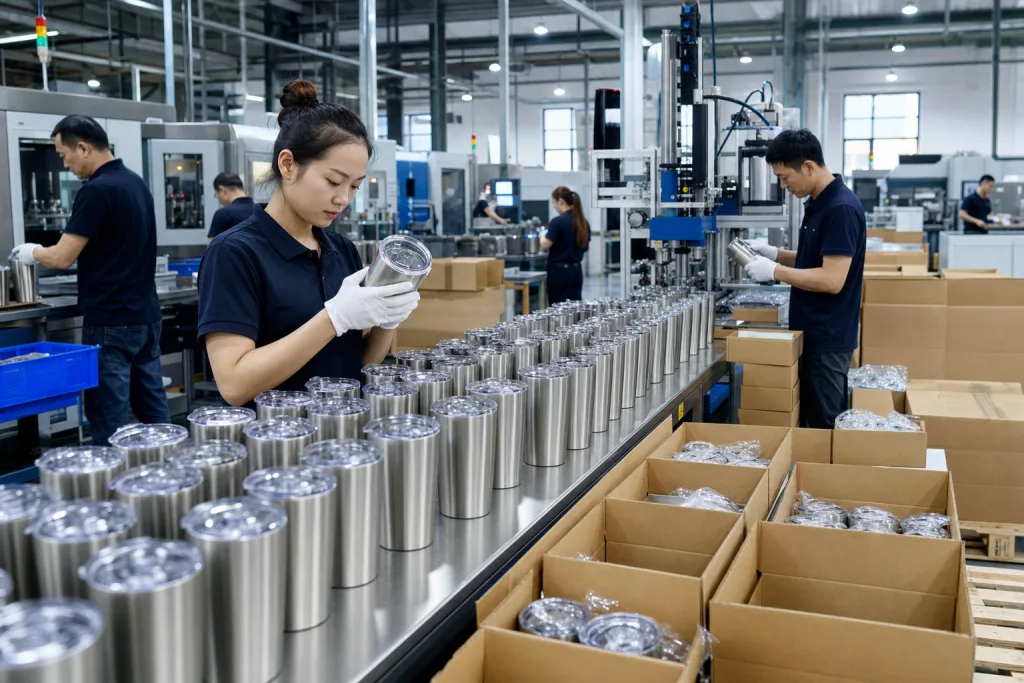
From our factory team in Zhejiang, China, the safe buyers are not the ones pushing for the lowest FOB number on the first email. That is the wrong question to ask. The better buyers lock capacity, insulation target, lid structure, logo method, and AQL 2.5 inspection rules before sampling, because QC will pull the sample apart if the silicone ring sits 0.3 mm loose. BottleForge Industrial produces stainless travel tumblers for export programs from Hangzhou, Zhejiang, with typical MOQs from 1,000 pieces per color and 30–45 day production after sample approval.
Start With The Mug Job
Before you ask for a coffee mug supplier list or send RFQs to every coffee mug factory you can find, lock down the mug job. A travel mug for a coffee subscription brand does one job. A bulk coffee travel mug for a bank’s year-end gift pack does another. One has to sit on a retail shelf, survive 50 dishwasher cycles, and keep the coating clean. The other needs a tight logo color match, a printed gift box insert, and split delivery to 3 warehouses before a fixed campaign date. We run this on the line every week. If the buyer cannot say where the mug will be used, this is the wrong question to ask first.
For a custom made travel mug, we ask five points first. QC pulled the sample lid through a 500-cycle open-close test on the torsion rig last week; that tells us more than a pretty mockup.
- Capacity: 12 oz, 16 oz, 20 oz, and 24 oz are the common North American sizes. Europe labels the same mug as 350 ml, 450 ml, or 600 ml, and that changes the artwork layout.
- Use case: car cup holder, office desk, outdoor commute, retail coffee counter, or employee gift. A 70 mm base may fit one cup holder and fail another.
- Lid expectation: splash-resistant is not leakproof. A sliding lid spills when inverted; a threaded lid with a silicone seal holds up better in a courier bag.
- Branding method: laser logo, one-color screen print, full wrap, debossed silicone sleeve, or retail packaging artwork. A 1-color laser mark takes a different setup from a 360° print.
- Sales channel: wholesale, ecommerce, corporate gifting, or coffee shop resale. MOQ, packing style, and carton label rules change with the channel.
This matters because a bulk travel tumbler runs from USD 3.20 to USD 7.80 FOB China, depending on steel grade, paint, lid design, packaging, and inspection scope. Our pad printer holds a 0.2 mm logo shift on a straight wall, but a wrap print on a curved body needs more setup time. If you only ask for “best price coffee mug custom made,” the math doesn’t work, and the factory will quote the easiest build. A typo on the PO, like 16OZ instead of 16 oz, slows file check before we even start sampling.
What Specs Actually Matter?
The core spec we run for most export travel mugs is double-wall vacuum insulated 304 stainless steel. For food-contact drinkware, 304 is the practical baseline; our incoming steel coil certs usually list 0Cr18Ni9 or SUS304, and QC checks the sheet mark before deep drawing. Some buyers ask for 316 stainless to support premium pricing, but for normal coffee use the math doesn't work unless the retail story needs it. If a quotation only says “stainless steel” without the grade, ask again.
Wall thickness is worth checking before you approve the PI. A common build is 0.4 mm inner wall and 0.5 mm outer wall. Thinner steel can cut weight and cost, but it also raises dent risk in carton drop testing and daily use; we have seen 0.35 mm outer walls come back with side dents after a 12 kg master carton test. Ask directly. A coffee mug manufacturer should state steel thickness instead of hiding behind “standard quality.”
Insulation performance needs test numbers, not soft words. For a 20 oz travel tumbler, a reasonable target is hot water above 45°C after 6 hours when filled at about 95°C and tested at room temperature around 20–25°C. On the line, we log this with a probe thermometer after vacuum pumping, and QC pulled the sample if the weld area shows heat loss. Cold retention is easier to sell in a catalog, but coffee brands should care more about hot performance and lid comfort.
For lids, Tritan or PP plastic with a food-grade silicone ring is common. Tritan gives a clearer premium look; PP costs less and takes knocks well. Ask whether the lid is push-on, threaded, flip, slide, or straw-compatible, because one buyer once flagged a PO that said “leakproof lid” while the approved sample was only a push-on desk lid. A push-on lid is fine for a desk tumbler. A commuter custom made travel mug needs a stronger seal. If you are sourcing a coffee mug promotional program, do not promise “leakproof” unless the structure supports it and the factory has passed inverted leak testing.
Logo Choices And Their Tradeoffs
Most buyers treat branding as decoration. On a coffee mug custom project, the logo choice also changes lead time, rejection rate, and carton handling. We have seen a USD 0.12 print saving turn into 7% rework after QC pulled rubbed samples from a 1.2 m carton drop test. Cheap is not the right question; landed pass rate is.
Laser engraving
Laser engraving gives a clean, durable mark for corporate-gift orders where the buyer wants the logo to last. We run it most often on powder-coated stainless steel, because the laser burns through the coating and exposes the metal underneath. Cost is usually around USD 0.15–0.35 per unit depending on logo size and position. The hard limit is color: laser cannot match a Pantone logo, and one buyer flagged this after seeing the silver mark under 6500K inspection light.
Screen printing
Screen printing works for one or two solid colors; three colors need tighter registration and slower line speed. It suits coffee mug promotional products and bulk coffee mug campaigns where the logo must follow brand guidelines. Setup cost is often USD 40–80 per color, and per-unit cost may be USD 0.10–0.30. Curved bodies and large wrap artwork need real sampling, not guesswork, because a 210 mm wrap can stretch near the seam and make round icons look oval.
Powder coating and full-color options
Powder coating gives better grip and shelf value than plain stainless. Custom Pantone powder coating generally requires 1,000–3,000 pieces per color, depending on the color and coating supplier. Heat-transfer or UV full-color artwork can work for retail designs, but abrasion testing should be included; on our line we use a 3M tape pull and a basic rub check before sending photos. If you need a coffee mug customizable range with ten colors, start with factory stock colors. Custom coating for every SKU can trap your cash in slow-moving inventory, and we have seen this go sideways when a PO listed “mint” while the artwork file said “sage.”
Our blunt advice: approve a physical pre-production sample under office light and daylight. PDF artwork approval is not enough for a coffee mug customized order, especially when the buyer will reject a 1 mm logo shift after mass production.
MOQ, Price, And Real Lead Time
For standard mold travel mugs from a China coffee mug factory direct source, we usually run 1,000 pieces per color. Stock-color programs sometimes start at 500 pieces, but the unit price climbs by USD 0.25–0.60 and logo choices often drop to one-position laser or simple screen print. For a private mold, 8,000–20,000 pieces annual volume is the point where tooling, lid testing, and engineering hours start to make sense. Below that, the math doesn't work. Last month one buyer asked for a new 18 oz body at 2,000 pieces; our mold room quoted 28 days just for T0 samples, before any production slot.
FOB pricing for a 16–20 oz stainless custom made travel mug usually falls into these rough bands:
- USD 2.80–3.80: basic stainless or simple powder coat, standard push lid, bulk pack or simple white box. We normally see 0.40–0.45 mm outer wall steel in this range.
- USD 4.00–5.80: better coating with fewer pinholes, laser or screen logo, retail box, stronger lid, and insulation checked on the line with 95°C water for 6 hours.
- USD 6.00–8.50: premium lid system, matched custom color by Pantone chip, better gift packaging, added testing, or special finish such as ceramic coating or gradient spray.
These are not promises; steel price, exchange rate, order quantity, packaging, and compliance requirements move the number. They do help spot fantasy quotes. If one coffee mug oem manufacturer is 25% below everyone else, something was probably cut: steel thickness, vacuum yield control, coating quality, packaging strength, or inspection time. We have seen this go sideways. QC pulled a sample from a low-price comparison order in Ningbo and found the retail box flute crushed at 9 kg stacking pressure, while the buyer’s PO still said “Amazon ready.”
For lead time, plan 7–10 days for a logo sample using an existing mold, 3–5 days for your review and revisions, then 30–45 days for mass production after deposit and sample approval. Add 5–7 days for final inspection and export paperwork. Before Q4 gifting, Zhejiang and wider China factories get tight on coating line capacity; a 25-day promise is the wrong number to trust unless the factory has booked the line and can show the spray schedule. We ship faster when artwork is clean. A typo like “matte balck” on the PO can cost 2 days because production will stop and ask before mixing powder.
Private Label Packaging Checklist
Coffee brands and corporate-gift buyers usually spend 80% of the discussion on the mug and push packaging to the last two emails. Bad move. Coffee mug private label and coffee mug private labeling work need barcode control, ΔE color targets on the printed box, and a carton spec the warehouse can actually stack. Last month QC pulled the sample after the FNSKU scanned on a phone but failed on our Zebra DS2208 scanner; that would have been a receiving hold at Amazon. A beautiful tumbler in a weak box becomes a complaint once it hits parcel networks.
Use this checklist before approving a purchase order. Check the box spec line by line, not just the artwork PDF.
- Gift box paper: 300–350 gsm white card is common; corrugated color boxes are stronger for ecommerce and add about 0.8–1.2 mm wall thickness.
- Insert: choose paper insert, molded pulp, or EPE foam based on retail price point and the buyer’s sustainability rules. EPE protects better, but some EU buyers will reject it.
- Barcode: UPC, EAN, or FNSKU must be scannable after printing. Test it with a phone and a warehouse scanner if possible; we run this before mass packing.
- Warning text: include hot liquid warnings and hand-wash guidance if required, plus country of origin marking in the exact wording shown on the PO.
- Master carton: 5-ply export carton is preferred for heavier bulk travel mug orders. Typical pack is 24 pieces per carton for 16–20 oz sizes, usually around 13–16 kg gross weight.
- Drop test: request ISTA-style carton drop testing or at least internal drop testing from 76 cm on corners, edges, and faces. If the corner splits, the math does not work.
If your program ships to 6 corporate offices, ask the factory to label cartons by destination and SKU, not just by item number. For ecommerce, discuss inner carton strength and whether the retail box can survive without an extra mailer; we have seen this go sideways when a buyer approved a 300 gsm box and then shipped single units by courier. A bulk coffee tumbler order that looks cheap at FOB can become expensive if 3–5% of gift boxes crush in transit.
Quality And Compliance Questions
A serious coffee mug manufacturer should be able to talk through AQL, food-contact standards, and factory audits without calling the merchandiser three times. For most export orders, we run final random inspection under ANSI/ASQ Z1.4, usually AQL 2.5 for major defects and 4.0 for minor defects. Critical defects get zero tolerance: sharp rims, oil contamination inside the cup, cracked lids, or leakage after the 180-degree inversion test. QC pulled one 40 oz sample last month with a 0.6 mm burr on the drinking edge. That carton stopped.
Your inspection checklist should include:
- Capacity check against declared oz or ml volume, measured to the fill line or practical drinking level.
- Vacuum insulation test on randomly selected units, with starting water temperature and test hours written on the report.
- Leak or splash test based on the lid claim, not a generic shake test for every lid style.
- Logo position, size, and color check against the approved sample, including Pantone code and print tolerance in mm.
- Coating adhesion by cross-hatch or tape test where suitable, especially on powder-coated bodies.
- Carton quantity, barcode, shipping mark, and packaging check, because one wrong PO number can delay a full pallet at the warehouse.
For Europe, ask about LFGB or EU food-contact testing, plus REACH for coatings and components where relevant. For the United States, 7 out of 10 buyers we deal with ask for FDA food-contact documentation; children’s products bring extra ASTM and CPSIA questions. Adult travel mugs are simpler than kids’ bottles, but the document still needs to match the exact material and coating used. “304 stainless” on a quotation is not enough if the lab report was issued for another lid gasket or another paint batch.
Factory audits also matter, but this is the wrong question to ask if you expect an audit logo to guarantee good mugs. BSCI, Sedex, or ISO 9001 shows the supplier has been checked against a system; it does not catch a loose slider lid on line 3 at 4:30 p.m. If you found a company through a coffee mug supplier directory, do not assume it is the actual factory. Ask for the business license, production photos, audit reports, and whether they control polishing, vacuuming, coating, and assembly in-house or subcontract key steps elsewhere in China. We have seen this go sideways when the PO says Hangzhou supplier, but the coating line is 900 km away and the buyer only finds out after a color mismatch.
How To Compare Supplier Quotes
When coffee mug distributors or brand teams compare quotes, they often line up unit price only. That is how bad purchasing decisions happen. A proper comparison sheet needs the item code, capacity, steel grade, wall thickness, lid material, coating type, logo method, packaging, carton size, MOQ, sample fee, production days, testing included, payment terms, and Incoterm. We once saw a PO where the buyer typed “liid” instead of lid; the supplier still had to stop and confirm the drawing before the line could start.
Also separate a coffee mug in bulk reseller from an actual coffee mug factory. Distributors help with 200-piece mixed orders and local follow-up. Factory direct sourcing works better when you need repeat runs, stable color, custom packaging, and cost control. At BottleForge in Zhejiang, our monthly stainless drinkware capacity is about 600,000 units across travel tumblers, sports bottles, and thermos lines, and QC pulled the sample from the drop-test rack before we released any order that would push the line into unsafe shortcuts. A buyer once asked for a 30-day ship date, Pantone-matched coating, and a price cut in the same email. The math does not work.
For a first order, keep the design controlled. Choose one proven body, two colors, one logo method, and one packaging structure. If the MOQ is 3,000 pcs, do not ask for six lid colors and three box styles on the same run. Once the first shipment performs, expand into extra colors or a coffee mug bulk seasonal set. If you need a bulk coffee mug program for several departments, consolidate artwork sizes and use variable carton labels rather than changing the mug itself every time. We run this setup a lot, and it saves at least one proof round on the packing table.
The best quote is not the shortest email with the lowest number. It is the quote that tells you exactly what you are buying, what is excluded, how defects will be judged, and when the goods can realistically leave China. If one supplier says 12 days for samples and 18 days for mass production, check whether that includes print proof, lid fitting, and pre-shipment inspection; those three steps change the schedule fast. That is the wrong question to skip.
Send Your Travel Mug Spec For Factory Review
Share capacity, quantity, logo, packaging, and delivery market. We will return a practical quote with MOQ, lead time, and sample options.
Frequently asked questions
What is a normal MOQ for a custom made travel mug?
For an existing stainless travel mug mold, a normal MOQ is 1,000 pieces per color with a custom logo. If you use factory stock colors and a simple laser logo, some orders can start at 500 pieces, but the unit price is usually higher. Custom Pantone powder coating often needs 1,000–3,000 pieces per color because the coating line has setup loss. Private mold projects are different; expect tooling cost and a serious volume plan, usually 8,000–20,000 pieces per year.
How much should a bulk coffee travel mug cost?
A realistic FOB China price for a 16–20 oz double-wall stainless bulk coffee travel mug is usually USD 3.00–6.00, depending on steel thickness, lid type, coating, logo, and packaging. Premium lids, full-color artwork, gift boxes, or extra compliance testing can push the cost above USD 7.00. Be careful with quotes that are 20–30% below the market. The saving may come from thinner steel, weak vacuum performance, low-grade coating, or packaging that will not survive export handling.
Which logo method is best for corporate gifts?
For corporate gifts, laser engraving is usually the safest because it is durable, clean, and does not depend on ink adhesion. It costs roughly USD 0.15–0.35 per unit on many travel mugs. Screen printing is better when you need a Pantone logo, especially for one or two colors, but you should approve a curved-surface sample before mass production. For premium gift sets, combine powder coating with laser engraving and a 300–350 gsm printed gift box.
Can I sell the same mug through coffee shops and ecommerce?
Yes, but design the packaging for the tougher channel. Coffee shop retail can use a nice color box with shelf appeal, while ecommerce needs stronger protection against drops and compression. For a coffee mug private label program, we usually recommend a reinforced color box or inner protection plus a 5-ply master carton. If you use FNSKU or UPC labels, confirm barcode placement before production. Also check that product claims, capacity, and country-of-origin marking match your sales market.
How do I know if a coffee mug supplier is really a factory?
Ask for the business license, factory address, production line photos, audit reports, and a live video call from the workshop. A real coffee mug factory should explain polishing, vacuuming, coating, assembly, and inspection steps. Some suppliers are trading companies, which is not always bad, but you should know who controls quality. If you need coffee mug factory direct pricing, repeated colors, and stable packaging, ask whether the supplier owns the production equipment or subcontracts major processes.