Key Takeaways
- A practical custom made toddler bottle MOQ starts at 1,000-3,000 pcs per color for molded or color-matched parts
- Use 304 stainless steel, food-grade PP, and LFGB or FDA silicone for toddler contact parts
- Plan 35-55 days production after artwork approval, plus 7-10 days for pre-production sampling
- AQL inspection should separate functional leaks from cosmetic defects, not combine them in one loose checklist
A custom made toddler bottle is not a mini sports bottle. It gets chewed, dropped from a 90 cm table, steam-sterilized, tossed into school bags, and checked by parents who spot sour silicone, lid seepage, and weak pad printing before your warehouse team does. One bad 3,000 pcs batch can turn into returns across a full retail program. We’ve seen this go sideways.
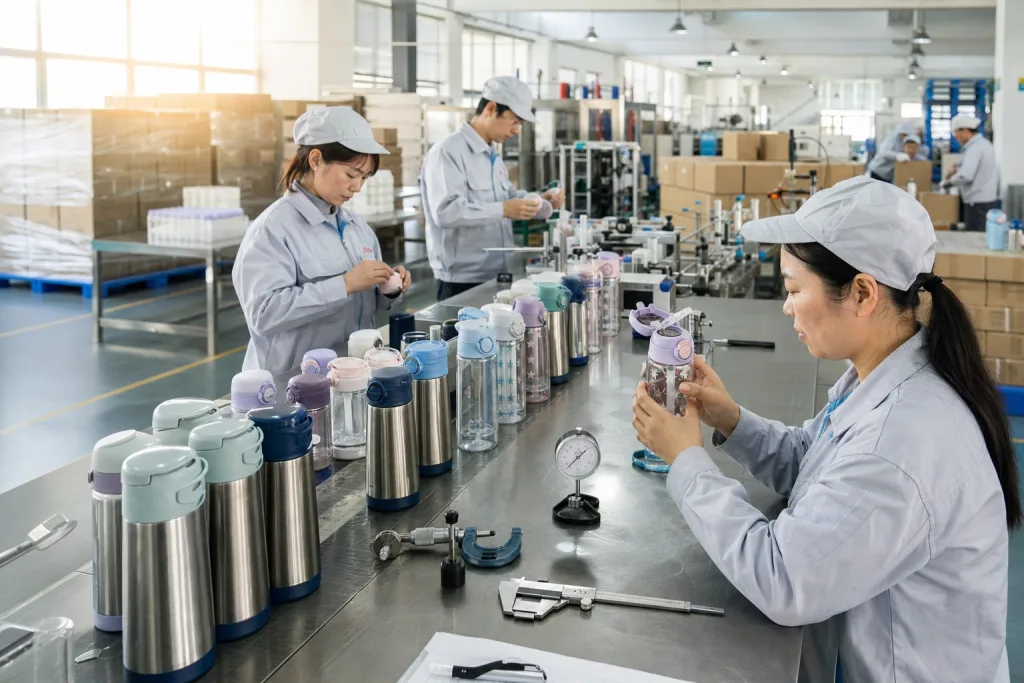
At our Zhejiang, China facility, we run toddler bottles on a different checklist from standard custom drinkware because the failure points are different. A normal canteen promotional order might pass with a loose Pantone match or a body that is 8 g over target. A toddler bottle needs tighter checks on material certificates, lid torque, straw flow, 1.2 m drop testing, print adhesion, and compliance files before the line opens; last month QC pulled a pre-production sample because the silicone bite valve smelled wrong after boiling.
Start With the Drinking System
The first buying question should not be logo method or carton size. Ask this instead: how does a two-year-old drink from the bottle without soaking a car seat? For a custom made toddler bottle, the drinking system drives most complaint rates. We ran a sample last week with a 2.8 mm straw bore, and the buyer flagged the bite feel after 20 cycles. Straw lids are common because parents know them, but the straw bore, valve cut, and silicone hardness decide whether the bottle passes or comes back. A straw that is too soft collapses when a child bites it. A straw that is too hard gets rejected by parents who want a gentle mouthfeel.
For B2B projects, we usually specify food-grade silicone at Shore A 50-60 for bite parts, PP for internal lid structures, and 304 stainless steel for the bottle body when the product is insulated. Choosing the body first is the wrong question to ask. Start with the lid. A single-wall canteen custom project can work with Tritan or PP bodies, but toddler use needs extra drop testing because children do not set bottles down carefully. On our line, QC pulled one sample after a 90 cm base drop left a hairline crack at the shoulder.
Ask your canteen supplier for these samples before you approve a purchase order:
- Drinking flow sample: fill with water, invert it, shake for 30 seconds, then check suction resistance with a real tester, not a quick hand squeeze.
- Drop sample: drop filled bottles from 80-100 cm on the base, shoulder, and lid, and watch for cap pop, leak, or dent marks.
- Cleaning sample: check whether parents can remove the straw and gasket by hand, with no tools and no guesswork.
- Hot water sample: pour 60°C water into the bottle and check odor after 2 hours.
If a canteen manufacturer cannot explain the straw valve design or gasket seating, you are not dealing with the right factory for toddler products. A general canteen factory may ship adult bottles well, but toddler lids need slower engineering. We saw one gasket seat come in 0.3 mm off on a PO last month, and the cap leaked on the third shake. The math does not work if the factory cannot talk through that detail.
Materials Parents Will Question
Parents may not know the difference between 201 and 304 stainless steel, but they know rust, odor, and plastic taste after one week in a school bag. For Europe and North America, we specify 304 stainless steel on the inner wall, 201 or 304 on the outer wall depending on the FOB target, and BPA-free PP or Tritan for plastic parts. If you sell into Germany, France, Scandinavia, or premium retail, LFGB testing is worth the extra cost in most programs we run. For the U.S., FDA food-contact compliance and CPSIA-related checks are standard buyer requests; last month QC pulled one lid sample where the material report said PP, but the injection line was marked PC on the resin bag.
For insulated toddler bottles, a normal wall structure is 0.4-0.5 mm inner 304 stainless steel and 0.5 mm outer stainless steel. Thin material can cut FOB cost by USD 0.10-0.25, but it dents faster in drop use, and the math does not work if customer service replaces 3 bottles per 100 pieces. We have seen this go sideways. On the line, the 0.35 mm outer shell looks fine before powder coating, then a 1.2 m carton drop test shows flat spots near the bottom curve. For a non-insulated customized canteen, Tritan gives a bright, lightweight look, but the lid still needs a proper gasket, hinge pin, and bite-resistant straw seat.
Do not approve vague material claims like “eco plastic” or “safe silicone.” Your specification sheet should state grade, test standard, color, and contact area. This is the wrong place to save 30 seconds on the PO. A practical material checklist is:
- Inner bottle: 304 stainless steel, food-contact polish, no copper exposure.
- Lid body: PP, BPA-free, color matched by Pantone or approved chip.
- Straw and gasket: LFGB or FDA silicone, removable for cleaning.
- Paint: powder coating or spray coating meeting adhesion and migration requirements.
As a Zhejiang canteen manufacturer, we see around 40 RFQs a month from buyers who ask only for “child safe.” That is not enough for China production. Write the standard into the PO, and make the canteen vendors quote against the same document. One buyer once sent “304 inside” in email, while the PO said “stainless steel”; the factory quoted 201 outer and the buyer flagged it after the gold sample arrived.
MOQ, Tooling, and Real Unit Cost
MOQ is where 7 out of 10 toddler bottle projects start to drift away from the budget. If you choose an existing mold and standard lid color, 1,000 pcs per color is often workable. Ask for a canteen customizable body shape, exclusive lid, custom silicone color, or new handle, and the practical MOQ moves to 3,000-5,000 pcs because the line has to separate resin, silicone batches, and assembly bins. New plastic injection tooling can run from USD 1,200 to USD 8,000 depending on part size and cavity count. A full new toddler lid system costs more because each gasket, straw, button, hinge, and cap piece must fit tightly; QC checks the lid with a 0.05 mm feeler gauge before we approve the first trial shot.
For a typical 350 ml insulated custom made toddler bottle, FOB China pricing often sits around USD 3.20-5.80 per piece for bulk B2B orders, depending on coating, lid complexity, packaging, and inspection level. A basic non-insulated plastic customized canteen may be lower, but compare the same scope. Cheap is easy. The math doesn't work if the quote leaves out individual boxes, testing, spare straws, Pantone color matching, or 5-ply inner carton protection. We had one buyer flag a USD 0.38 gap, then found the lower quote did not include spare straws or carton drop-test packing.
Use this procurement checklist before comparing canteen suppliers:
- Is the MOQ counted by total order, by body color, or by lid color? One PO typo on “assorted color” can turn 3,000 pcs into 3,000 pcs per color.
- Does the quote include logo setup, mold charge, and packaging artwork setup with barcode placement checked on a printed box sample?
- Are spare straws or cleaning brushes included, and are they packed loose, in the box, or in a separate polybag?
- Is the price FOB Ningbo, FOB Shanghai, EXW Zhejiang, or DDP? Freight terms change the landed cost fast.
- Does the carton pass a 76 cm drop test for courier and retail handling, with no cracked lid, dented body, or crushed color box after testing?
Our BottleForge capacity for drinkware projects is about 450,000 units per month across stainless steel bottles, travel tumblers, kids bottles, and related custom drinkware. Even with that capacity, toddler bottle programs still need orderly scheduling because lid assembly and leak testing take more labor than simple distributor drinkware orders. We run every toddler lid through a pressure leak test fixture, and one slow gasket station can push shipment from 12 days to 18 days if the schedule is squeezed.
Decoration That Survives Toddler Use
Brand owners often overrate a cute print on a toddler bottle. We see these bottles hit playground rubber flooring, then come back with brush scratches around the waist after 20 dishwasher cycles. For logos, laser engraving holds up on bare 304 stainless steel, but it gives you no real color pop. Silkscreen printing is fine for simple one- or two-color marks, as long as the ink system and oven curing time match the coating; our line records 160°C for 18 minutes on the last batch before QC signs off. Heat transfer can carry full-color graphics, but edge lifting shows up fast when the bottle curve is tight, especially near a 58 mm body radius.
For a custom made toddler bottle, we usually keep the main logo inside one protected panel instead of wrapping small artwork around the full body. Full wraps sell well in renderings. The math doesn't work on the line. Real production has seam alignment tolerance, and a 1.5 mm shift is enough for a parent to notice a crooked cartoon face. If you need character artwork, ask for a pre-production sample after mass-production coating, not just a digital mockup; QC pulled one last month where the mockup looked clean, but the actual yellow bear lost detail after the topcoat.
Decoration options commonly used for toddler and canteen customized projects include:
- Laser engraving: best for long-life logos, no ink migration concern, limited color effect.
- Silkscreen: good cost for 1-3 colors, usually USD 0.05-0.18 per position.
- Heat transfer: better for full-color artwork, higher setup control required.
- Powder coating: stronger feel than basic spray paint, but Pantone matching is approximate.
If you are a canteen distributor selling to schools or kids retail, ask for an adhesion test before you approve bulk. A simple cross-hatch tape test, 3M tape pull, and 300-cycle rub test will expose weak decoration fast; we run the rub test with a 500 g load because light hand-rubbing tells you almost nothing. Do not rely only on a showroom sample from a canteen vendor. We've seen this go sideways. The sample may be hand-selected and not made on the same line as your order, and one buyer flagged this after 2,400 pcs arrived with cleaner artwork than the approval sample but weaker ink adhesion.
Compliance Files You Should Request
Toddler bottles sit close to the children’s product category, even when sold as drinkware. The compliance route changes by market and label claim. In the EU, buyers ask us for LFGB, REACH, and food-contact migration reports on most kids’ bottle POs; last month, one German buyer flagged a report because the silicone straw color on the lab file was “natural,” while the order was Pantone 186C red. In the U.S., FDA food-contact documentation is normal, and larger retailers often ask for CPSIA-related lead and phthalate checks for coated or printed parts. Canada and the UK may add separate paperwork requirements.
A serious canteen manufacturer in China should provide recent test reports from recognized labs, but report scope is where orders get messy. Check the pages, not just the cover. We have seen reports covering only 304 stainless sheet or a plain PP lid, while the shipment was a final decorated bottle with UV print, silicone bite valve, and powder coating. If your order uses a new coating, a new silicone color, or a new printed design, old reports do not cover enough risk. The math does not work.
Your compliance folder should include:
- Bill of materials with food-contact parts clearly marked, including straw, gasket, valve, lid insert, and inner wall.
- FDA or LFGB reports for silicone, PP, Tritan, and stainless steel contact surfaces.
- Heavy metal and migration testing for coating and print where required, especially on mouth-area graphics or handle coating.
- BSCI, ISO 9001, or factory audit documents if your customer requires social compliance.
- Pre-shipment inspection report with leak, drop, torque, and appearance results from the packed goods.
For Amazon, marketplace, school, and distributor canteen programs, paperwork can decide the order before the sample leaves Hangzhou. We ship samples by carton, but QC still pulls 8 pcs when the PO names a toddler SKU, because one leaking straw cap can stop a 3,000 pcs repeat order. If a canteen factory says “many customers sell this, no problem,” treat that as a warning. Ask for documents tied to materials, production dates, and preferably your SKU or model.
Inspection Points Before Shipment
Inspection for toddler bottles needs a tighter line than a standard custom growler or adult sports bottle. Adults accept a cap that feels a bit stiff. Parents complain fast when 180 ml of juice leaks into a school bag. Before the third-party inspector arrives, we sort defects into critical, major, and minor on the QC table, using the same defect board the line leader signs at 9:00 a.m. Critical defects include sharp edges, foreign material inside the bottle, unsafe odor, detached small parts, and leakage. Major defects include poor lid fit, weak printing, coating scratches, wrong color, and carton damage. We have seen this go sideways when a buyer says “just check appearance”; that is the wrong question to ask for a toddler bottle.
A common inspection level is AQL 0 for critical defects, 2.5 for major defects, and 4.0 for minor defects. For higher-risk launches, reduce major AQL to 1.5. Ask the inspector to fill 20-32 samples with water, shake them 30 times, invert them for 10 minutes, and test straw drinking function. QC pulled the sample last month and found 3 lids with a 0.4 mm gasket gap after the flip-top hinge was pressed by hand. For insulated models, vacuum performance can be checked by hot water temperature drop, but full thermal testing takes about 4 hours versus 45 minutes for a normal visual inspection.
Here is the buyer-side pre-shipment checklist:
- Confirm barcode, FNSKU, warning label, and country of origin on retail packaging; one PO typo in “Made in China” can hold 62 cartons at the forwarder.
- Check carton marks, gross weight, net weight, and carton dimensions against shipping plan, using the packing list and a digital scale.
- Open random lids to confirm gaskets and straws are installed correctly, then press the straw valve until it seats flat.
- Rub printed logos with wet cloth and alcohol where specified; we run 20 back-and-forth strokes on the sample logo.
- Photograph color under neutral light, not only factory office lighting, because warm LEDs can hide a 1-2 shade difference.
For canteen distributors and distributor growler buyers who already know adult drinkware, the main adjustment is patience. Toddler bottle assembly has more small parts, usually 6-9 parts per lid set before the bottle even reaches final packing. The line slows down. Rushing the final 48 hours creates the defects you were trying to avoid, especially missing straws, tilted silicone gaskets, and mixed color lids in the same export carton.
A Practical Order Timeline
A realistic timeline protects both sides. For an existing mold custom made toddler bottle, we run 7-10 days for artwork layout and pre-production sample after deposit and confirmed AI/PDF files. Mass production normally takes 35-55 days, depending on order size, color count, carton packing, and whether the line is already booked before Canton Fair season. Sea freight to North America or Europe can add 25-40 days port to port, plus customs and inland delivery. Air freight works for 300-500 launch pieces, but toddler bottles are bulky; once the carton hits 0.08 cbm for 24 pcs, the cost per piece climbs fast.
For a new canteen customizable lid or body, add 25-45 days for tooling, first shots, adjustment, and testing before mass production. QC pulled one first-shot lid last month with a 0.35 mm gap at the silicone straw seat, so we had to polish the mold and shoot again. If you also need retail packaging, instruction sheets, spare straw bags, and multilingual labels, prepare those files early. Packaging approval delays more orders than bottle production. We have seen this go sideways over a missing French warning label or a wrong barcode digit on the PO.
A clean order flow looks like this:
- Day 1-3: confirm spec sheet, target FOB, test requirements, and quantity. Send the capacity in ml, cap type, straw material, and MOQ target, not only a competitor screenshot.
- Day 4-10: approve the sample, artwork proof, packaging dieline, and Pantone color chip. The buyer often flags logo size here when a 28 mm print area looked bigger on screen.
- Day 11-20: pay deposit, book 304 stainless or Tritan material, lock the production schedule, and agree on the inspection plan. AQL 2.5 needs to be written before the line starts.
- Day 21-50: finish production, coating, printing, assembly, and internal leak testing. We run random upside-down leak checks with water at room temperature before cartons are sealed.
- Day 51-60: arrange third-party inspection, balance payment, vessel booking, and loading. If the inspection finding is a loose straw brush bag, fix it before the container arrives.
Whether you are buying customizable drinkware, a customized growler, a custom canteen, or a toddler bottle program, start with a written specification instead of a screenshot. This is the wrong question to ask: “Can you make something like this?” Send the target age, capacity, market, test standard, packaging style, and annual forecast. A good canteen supplier in Zhejiang can then tell you what is realistic before you lock a retail launch date and pay for ads.
Send Your Toddler Bottle Spec for Review
Share capacity, market, logo, packaging, and quantity. We will check feasibility, MOQ, lead time, and China compliance risks before quoting.
Frequently asked questions
What is the best capacity for a custom made toddler bottle?
For toddlers, 300-400 ml is usually the safest commercial range. A 250 ml bottle looks cute but may be too small for daycare or travel. A 500 ml bottle can become heavy once filled, especially with stainless steel insulation. For Europe and North America, we often quote 350 ml as the balanced size. It gives enough volume for preschool use while keeping the filled weight manageable. If you sell through retail, check shelf height and carton cube early. A taller straw lid can add 25-40 mm, which affects display trays and master carton efficiency.
Can we use the same supplier for toddler bottles and adult canteen orders?
Yes, but only if the canteen manufacturer has real experience with small lids, silicone straws, and leak testing. Adult canteen promotional bottles and custom growler projects are more forgiving because the lid structure is usually simpler. Toddler bottles require tighter control on small removable parts, gasket fit, odor, and drinking flow. Ask the factory for recent toddler or kids bottle samples, not just adult customizable growler samples. Also request an AQL inspection plan that treats leakage as a critical or major defect, not a minor cosmetic issue.
How much should I budget for testing a toddler bottle?
A basic food-contact test package may cost USD 300-800 per material group, depending on lab, market, and scope. A more complete EU package with LFGB, REACH-related checks, coating migration, and silicone testing can exceed USD 1,000. U.S. programs may include FDA food-contact documentation and lead or phthalate testing for coatings and printed areas. If you change silicone color, coating, or plastic resin, budget for retesting. For a 3,000-10,000 pc order, testing cost is small compared with a retail recall or marketplace listing suspension.
What logo method is safest for toddler drinkware?
Laser engraving is the most durable when used on exposed stainless steel, but it does not provide bright color. For coated bottles, silkscreen printing is reliable for simple logos if the ink is matched to the coating and cured properly. Heat transfer is better for full-color artwork, but you should run adhesion and rub tests before mass approval. For toddler bottles, avoid placing fine print where hands and lunch bag friction hit constantly. Ask for a production-material sample and test it with wet rubbing, tape pull, and 300-cycle abrasion if the order is retail-facing.
What order information should I send to get an accurate quotation?
Send target capacity, body material, insulated or single-wall structure, lid type, straw requirement, Pantone colors, logo method, packaging style, test market, quantity by color, and target ship date. Also state whether you need FOB Ningbo, FOB Shanghai, EXW China, or delivered pricing. If you are a canteen distributor, include annual forecast and first order quantity because MOQ and unit price change at 1,000, 3,000, and 10,000 pcs levels. A clear spec sheet reduces back-and-forth and prevents canteen vendors from quoting different assumptions.