Key Takeaways
- A practical MOQ for a custom made thermos flask is usually 3,000 units per color for standard molds
- FOB China cost often ranges from USD 3.20 to USD 8.80 depending on capacity, lid, coating, and packaging
- Sampling normally takes 7-12 days for logo and color approval, or 20-35 days if new tooling is needed
- Plan 30-45 days for bulk production plus 7-10 days for inspection, booking, and export paperwork
A custom made thermos flask looks simple on a quote sheet: capacity, color, logo, carton quantity, FOB price. The problem starts when 2 supplier thermos quotes differ by USD 1.20 and both write “same quality.” Same quality? Usually not. For outdoor retailers and promotional brands, that gap can come from 0.4 mm vs 0.5 mm inner wall steel, weaker vacuum retention, shared lid tooling, thin powder coating, or a factory cutting margin just to win the first email.
At our factory thermos production base in Zhejiang, China, we see buyers lose 5–8 days on unclear specs before the line even opens a work order. BottleForge Industrial runs stainless thermos orders from 3,000 to 120,000 units, with normal mass production lead time at 30–45 days after deposit and sample approval. QC pulled one pre-production sample last month because the PO said “matte black” but the approved sample was rubber paint black; that small wording gap would have changed both cost and scratch test results. Here is how cost and timing actually move.
Where the FOB price moves
The FOB price of a custom made thermos flask is not driven by one big item. It is a pile of small choices: steel grade, wall thickness, vacuum process, lid structure, coating method, logo process, packaging, and order quantity. We see this on the quotation sheet every week. A 500 ml stainless vacuum flask using 304 inner steel, 201 outer steel, powder coating, and one-color silk screen can sit around USD 3.20–4.20 FOB Ningbo or Shanghai at 5,000 pieces. Move to full 304 stainless steel, a carry handle lid, laser engraving, individual kraft box, and stricter AQL inspection, and the same volume may become USD 4.80–6.50. The buyer usually asks, “Why did the price jump USD 1?” The answer is often 6 or 7 small cost lines, not one trick from the supplier. On the line, a 0.05 mm change in outer body gauge already changes coil usage and scrap after stretching.
Capacity also matters, but not in a straight line. This is the wrong question to ask if the buyer only says, “How much for 350 ml versus 500 ml?” A 350 ml promotional thermos may not be 30% cheaper than a 500 ml unit because the lid, vacuuming labor, coating setup, and carton handling are similar. The vacuum oven still runs the same batch cycle. Larger 750 ml or 1,000 ml outdoor bottles need more steel and bigger cartons, so freight per unit also rises. We run carton drop tests at 76 cm for export packing, and the bigger bottles fail more often when the insert is too thin. For outdoor retailers, the best retail margin often sits in 500–750 ml because the shelf price looks strong while the unit still packs well, usually 24 pcs or 30 pcs per master carton depending on lid height.
Do not compare a thermos supplier quote only by capacity and logo. Ask for steel grade, outer body gauge, inner wall thickness, lid material, sealing ring material, coating type, test standard, and packing dimensions. Also ask whether the quote includes a spare silicone ring, barcode sticker, and 5-ply export carton, because those three lines have caused arguments after PO release. We have seen this go sideways: one buyer flagged the carton size after artwork approval because the PO showed 58×39×25 cm, while the supplier quoted 62×42×28 cm. If a thermos manufacturer cannot answer those points within one business day, you are probably speaking with a trading desk, not the factory engineer who will control production.
MOQ tiers that change your options
MOQ is where a first-time custom thermos project stops looking cheap. For standard factory molds, a workable MOQ is usually 3,000 units per color. At that run, we can keep existing capacities, Pantone-matched powder coating, one logo position, and standard retail packaging. For a simple promo order, 3,000–5,000 units keeps the price steady and avoids a line stoppage. On our side, QC pulls a 5-piece color check before the coating run starts.
At 1,000–2,000 units, some thermos vendors will still take the job, but the unit price climbs. That is not greed. Coating lines, vacuum ovens, laser stations, and packing teams all carry setup cost whether you run 1,200 pieces or 12,000 pieces. A low MOQ order may add USD 0.35–0.90 per unit compared with 5,000 pieces. The buyer flagged this on a PO once and asked why the quote moved so much. The math does not bend. Small powder batches also make color matching harder, and the spray booth has to be purged between shades.
At 10,000 units and above, the cost curve improves. You can usually negotiate better lid pricing, dedicated carton marks, more detailed QC reporting, and sometimes free sample reimbursement. At 30,000–50,000 units, a custom thermos project can justify semi-exclusive mold use or a modified lid, if the annual forecast is real. We run one lid assembly jig for hours in that range, so the savings show up fast. Do not promise 50,000 if your sell-through is still a guess.
New mold development is a different job. A true custom bottle shape may need USD 3,000–12,000 in tooling and 35–60 days before pilot samples. The EDM machine in the mold shop does not care about your launch date. If the date is fixed, start with a customizable thermos from existing molds and spend the budget on color, logo placement, packaging, and a better lid. That route is faster and usually safer. We have seen this go sideways when a buyer chases a new silhouette before the reorder plan is clear.
Decoration costs and hidden delays
Logo decoration looks like small money until it stops the line. For a bulk thermos order, silk screen printing is usually the cheapest choice, around USD 0.08–0.18 per position for one color at normal volume. It works on flat panels and gentle curves, but fine text under 0.6 mm often fills in after the second pass; QC pulled the sample on a 500 ml bottle last month for exactly that reason. Laser engraving costs more, often USD 0.15–0.35 per position, but the mark is clean and wear-resistant for outdoor retail products that get scratched in backpacks or truck cup holders.
Heat transfer works for gradients. A 360-degree wrap suits artwork that must meet at the back seam. Full-color printing is better when the brand file has photos or shaded graphics. These finishes add setup time, and the reject rate climbs if the bottle has a strong taper or rough powder texture. Expect USD 0.35–0.90 extra per unit depending on coverage, film, and curing process. For retail packaging, a printed color box may add USD 0.20–0.60 per unit, while a premium rigid gift box can add more than USD 1.00 and increase carton volume; on one 24 pcs carton, we saw the CBM move from 0.078 to 0.096. The math does not work if freight was quoted on the old box size.
Color is another timing trap. A Pantone number on paper is not enough. Powder coating shifts with gloss level, orange-peel texture, and warehouse lighting. We check plaques in a D65 light box, then compare them against a coated bottle because curved stainless reflects color differently. We normally ask for one physical color plaque or coated bottle sample before mass production. In Zhejiang, China, a standard color sample takes 5–7 days; a difficult matte or metallic finish may take 10–14 days. The buyer flagged “same as Pantone 186C” before, but the matte red looked darker once it came off the line.
For Amazon, retail chains, and distributor thermos programs, barcode labels, FNSKU, suffocation warnings, carton marks, and country-of-origin labels must be locked before packing starts. Do this early. Changing labels after goods are boxed can cost 2–4 extra days and unnecessary repacking labor. We have seen this go sideways from one PO typo: “Made in PRC” approved by the buyer, then their retailer demanded “Made in China” after 86 cartons were sealed.
A realistic sampling calendar
A clean sampling process saves more time than hard price pushing. If you choose an existing thermos factory mold with a standard lid and standard coating, we run a pre-production sample with your logo in 7–12 days after artwork confirmation. Custom color adds 3–7 days because the coating line needs a Pantone card, spray plate, and buyer sign-off under a light box. If the lid needs a new silicone seal, straw change, handle adjustment, or mold polishing, plan 20–35 days. The math does not work if sales promises 10 days while the tooling room is still cutting a 0.8 mm seal groove.
The first sample should answer practical questions, not just look good in photos. Check capacity tolerance, mouth diameter, lid thread feel, one-hand opening if applicable, powder coating adhesion, logo position, and whether the product fits your retail shelf or shipping mailer. Use calipers. For outdoor retailers, test the bottle in a real backpack side pocket and vehicle cup holder, not just on a meeting table. A bottle that misses common cup holders by 3 mm becomes a customer complaint. We have seen QC pull a nice-looking sample because the logo sat 6 mm too low once the shrink bag was applied.
For insulation, typical stainless vacuum performance for a 500 ml flask should keep hot water above 50°C after 6 hours when filled with 95°C water at room temperature. Premium structures can perform better, but the test method must stay consistent. Ask your supplier thermos partner to state the test procedure, not only “keeps hot 12 hours.” We record start temperature, room temperature, fill volume, and test time on the QC sheet; otherwise two factories can both be “right” and still give you different results.
Once the sample is approved, freeze the specification sheet. No loose ends. That sheet should include material grade, capacity, weight, dimensions, coating, logo file version, packaging, carton size, AQL level, and compliance requirements such as REACH, LFGB, FDA food-contact expectations, or California Proposition 65 if relevant. We also attach the carton mark and PO number because one buyer once flagged a shipment where “matte black” was typed as “matt black” on the PO and the warehouse held 86 cartons. Without a frozen spec, your thermos manufacturers may produce what they understood, not what your marketing team imagined.
Production lead time by order size
For a standard manufacturer thermos order, mass production lead time runs 30–45 days after deposit and approved pre-production sample. At BottleForge Industrial, our Zhejiang stainless drinkware lines run about 450,000 units per month across thermos, tumbler, and sports bottle categories, but the schedule is still split by coating color, lid assembly, and vacuum process. We check the board by line number, not by wishful ETD. Confirm 7 days earlier and we can usually hold the coating slot; confirm after artwork approval drags, and your ship date is the first thing that gets squeezed.
For 3,000–5,000 units, production can finish in 25–35 days if 304 stainless steel stock, standard powder color, and regular lids are already in the warehouse. For 10,000–30,000 units, plan 35–45 days. For 50,000 units or mixed-color programs, 45–60 days is the safer number, especially before peak export seasons. August to November gets tight for holiday retail shipments, and the two weeks before Chinese New Year are worse because polishing labor and subcontract coating capacity drop fast. We had one buyer push for 18 days on a 20,000 pcs matte black order with a new gift box; the math did not work, and QC later pulled the sample for coating thickness below spec at the cup bottom.
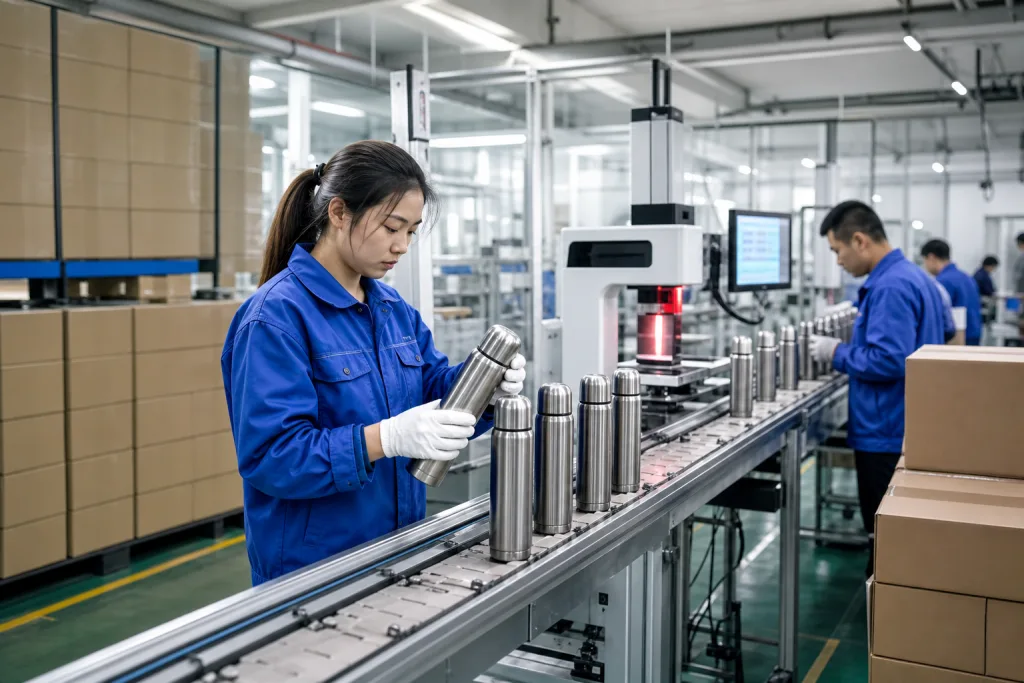
The production flow is usually: stainless tube cutting, body forming, welding, vacuuming, leak testing, polishing, coating, logo decoration, lid assembly, final QC, packing, carton sealing, and warehouse release. Vacuum testing and coating curing cannot be rushed without quality loss. Simple point. If a thermos supplier promises 20 days for 30,000 customized thermos units with new color and retail box, ask which steps are being skipped. On our line, the vacuum oven record, leak-test water tank, and curing tunnel temperature chart all need to match the batch card; skipping one step is how a nice-looking flask becomes a return claim after 60 days.
Add time after production. Third-party inspection normally needs 1–2 days to book and 1 day on site. If the inspection fails and sorting is required, add 3–7 days. Export booking, VGM, customs paperwork, and trucking to Ningbo or Shanghai port usually take 5–8 days. A realistic purchase order should show product lead time and shipment lead time separately. We have seen this go sideways when a PO writes “delivery 35 days” but the buyer means warehouse arrival in Hamburg, while the factory means goods ready in Hangzhou cartons.
Quality checks that affect price
QC is not free. Bad QC costs more. For thermos bulk orders, we run AQL inspection with critical defects at 0, major at 2.5, and minor at 4.0 for most promotional and retail programs. Critical defects mean leaking, sharp edges, unsafe materials, broken lid locking, or severe vacuum failure. Major defects mean visible dents, wrong logo position, coating peel, loose assembly, or carton marking errors. Last month QC pulled 32 samples from a 3,200 pcs tumbler order and found 4 cartons with the buyer’s SKU printed one digit wrong; cheap to catch in Hangzhou, expensive after the container lands.
Put the factory tests into the price talk early. A normal leak test checks each unit or a controlled lot after assembly, often with an air-pressure jig or inverted water test for 30 seconds. Vacuum insulation testing is usually sampled because it takes hours; write the sampling plan on the PI, not in a WeChat message. Coating adhesion can be checked by cross-hatch tape test. Salt spray may be used for some metal parts, although stainless bottle bodies are usually judged by corrosion resistance and surface finish rather than decorative salt spray alone. We’ve seen this go sideways when the buyer asks for 24-hour heat retention after mass production starts.
Food-contact compliance changes the quote. For European buyers, REACH and LFGB-related documentation may be requested. For North America, FDA food-contact expectations and BPA-free lid materials are common. If you sell to children, ASTM and CPSIA questions may appear depending on product design and age grading. A kids bottle is not the same risk profile as an adult outdoor flask. The line may use the same 304 stainless body, but the lid gasket, straw hardness, and small-part pull test can add lab cost and 7-10 working days.
A serious thermos manufacturer should provide material declarations, test reports for similar materials, and a production QC plan before deposit. If you require BSCI, ISO 9001, Sedex, or retailer-specific audits, say so before quotation. Audit-ready factories in China carry higher overhead than loose workshops, but they reduce the risk of shipment holds, failed onboarding, and recall calls nobody wants to join. This is the wrong place to chase a USD 0.03 saving; one failed carton drop test or missing audit file can stop the whole PO.
How to brief a supplier
A good RFQ for a custom made thermos flask should be boringly specific. Send capacity, target FOB price, estimated annual volume, launch date, destination market, logo file, Pantone color, packaging style, compliance needs, and inspection requirement. If you need distributor thermos pricing for 6 SKUs, split them by capacity and decoration; “best price for all bottles” usually wastes 2 days because our sales team has to ask the same basic questions again. We run quotes from a BOM, not from a guess.
Here is a practical starting specification: 500 ml double-wall vacuum flask, 304 stainless inner wall, 201 or 304 outer wall, powder coated body, leak-proof PP lid with food-grade silicone seal, one-color logo or laser logo, individual kraft box, 24 pieces per export carton, AQL 2.5/4.0, FOB Ningbo, MOQ 3,000 units per color. Add the carton mark position and logo size in mm if you have them; last month QC pulled a sample where the logo was approved at 42 mm, but the PO typo said 24 mm. With that brief, thermos suppliers can quote side by side.
State what cannot move. If your retail price is fixed, tell the thermos vendor the target cost. If the delivery window is fixed, ask whether standard molds and existing lids can meet it; a new lid mold can add 18 days, while a stock lid keeps sampling near 7 days. If your outdoor customer cares most about durability, put the money into coating, lid structure, and wall thickness before fancy packaging. We’ve seen this go sideways when the gift box got upgraded and the coating failed the 3M tape test.
The cheapest quote matters only if it ships on time and survives use. A manufacturer thermos partner should push back when your cost target conflicts with the specification. That is not bad service. It is the difference between an order that looks profitable on a spreadsheet and a bulk thermos shipment that creates returns and chargebacks. The math doesn’t work if a 500 ml flask needs a 0.5 mm body, 304 stainless, powder coating, and a gift box, but the buyer’s target is below the raw material cost we see on the line.
Send your thermos spec for a firm factory quote
Share capacity, logo, color, MOQ, market, and delivery date. We will return practical FOB pricing and lead-time options.
Frequently asked questions
What is the normal MOQ for a custom made thermos flask?
For standard stainless thermos molds, the normal MOQ is 3,000 units per color. Some factories in China may accept 1,000–2,000 units, but expect a higher unit price, limited color options, and less flexibility on packaging. For new bottle shapes or custom lid tooling, MOQ often moves to 10,000 units or more, because tooling, trial runs, and material purchasing must be justified. If you are testing a new outdoor retail SKU, start with an existing 500 ml or 750 ml mold and customize coating, logo, and box. It keeps launch risk lower.
How much should a bulk thermos order cost FOB China?
A basic 500 ml stainless bulk thermos with double-wall vacuum insulation, 304 inner steel, powder coating, and one-color logo often falls around USD 3.20–4.20 FOB China at 5,000 units. A stronger retail-grade customized thermos with full 304 stainless steel, better lid, laser engraving, color box, and tighter QC may be USD 4.80–6.50. Larger 750 ml or 1,000 ml bottles can reach USD 6.00–8.80 depending on structure. Always compare steel grade, lid material, carton size, and inspection standard before accepting a low price.
Can you make a thermos custom color with my logo?
Yes, a thermos custom color is usually made by powder coating matched to a Pantone reference. For standard colors, sample time is often 5–7 days. For matte, metallic, textured, or difficult brand colors, plan 10–14 days because the coating supplier may need several trials. Logos can be silk screen printed, laser engraved, heat transferred, or wrapped around the bottle. For outdoor retail, laser engraving is more durable; for promotional brands, silk screen is more cost-efficient. Minimum artwork line thickness should be checked before mass production.
How long does a manufacturer thermos order take from deposit to shipping?
For a standard manufacturer thermos order using existing molds, plan 7–12 days for sample approval and 30–45 days for mass production after deposit and confirmed sample. Add 5–8 days for inspection booking, export documents, port trucking, and customs handling in Zhejiang or nearby ports such as Ningbo and Shanghai. If you need new tooling, unusual color matching, retail packaging development, or multiple SKUs, add 2–6 weeks. Before Chinese New Year and peak holiday export months, confirm production slots earlier.
What documents should thermos suppliers provide for Europe and North America?
For Europe, ask thermos suppliers for REACH-related material declarations and LFGB food-contact testing where applicable. For North America, FDA food-contact expectations, BPA-free declarations for plastic lids, and California Proposition 65 review may be needed. If the item is for children, ASTM and CPSIA questions may apply depending on age grading and design. For factory qualification, BSCI, ISO 9001, Sedex, or retailer audit documents may be required. Confirm these before quotation, because audit-ready production and lab testing can affect both cost and lead time.