Key Takeaways
- Start with use case: 500-750 ml is safer for outdoor retail, while 350-500 ml often works better for promotional thermos campaigns
- For most bulk thermos programs, 304 stainless steel with 0.4-0.5 mm inner wall and vacuum insulation is the practical baseline
- Logo method changes both cost and durability: laser engraving can add USD 0.18-0.45 per piece, while full-wrap print needs higher MOQ
- Do not approve mass production without AQL inspection, lid leak testing, coating adhesion checks, and packaging drop-test confirmation
A custom made thermos bottle looks simple on a quotation sheet: capacity, color, logo, carton quantity, FOB price. Then the line starts checking the details. A heavier 18/8 body feels better in hand, but a 40g weight increase can push a 12kg export carton close to the buyer’s freight limit. A low MOQ helps a test order, but it cuts down color choices and lid molds. A nice gift box looks good in a sales meeting; the math doesn’t work if your retail landed-cost target is already tight.
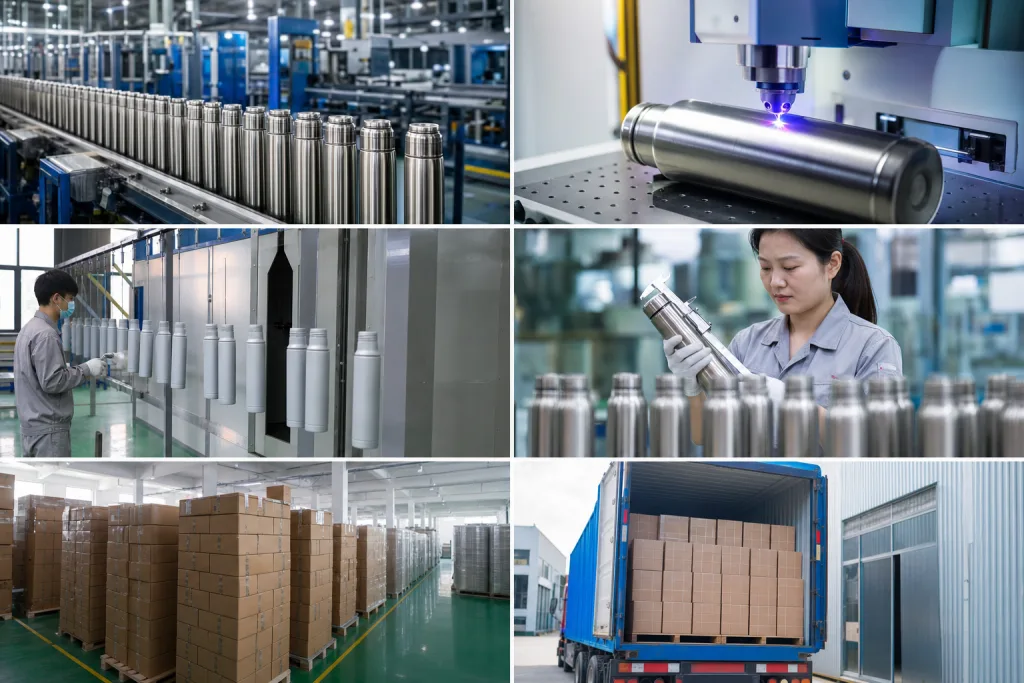
If you buy for an outdoor retailer or a promotional brand, you need buying decisions tied to cost, lead time, and inspection risk, not 80 catalog pages. Our Zhejiang factory in China produces up to 600,000 stainless drinkware units per month, with typical MOQ from 1,000 pieces per color and 35-45 days mass production after sample approval. We run 304 stainless body forming, powder coating, laser marking, and carton drop checks in-house; last month QC pulled a sample because the logo position was 3mm off the approved artwork.
Start with the buying decision
Before you ask a thermos supplier for pricing, decide what the bottle must do commercially. Outdoor retail and promotional gifting are not the same job. A retail bottle has to pass shelf comparison, daily use, barcode scanning, and consumer returns. A promotional thermos has to print the logo cleanly, reach the event date, and stay inside the campaign budget. We had one buyer approve a sample, then flag the retail barcode because the EAN sticker wrinkled on a curved color box. Small issue. Big delay.
I would sort the first decision into four boxes: user scenario, target landed cost, decoration requirement, and acceptable risk. If your customer is a hiking chain, insulation time, lid feel, powder coating, and retail packaging matter more than saving USD 0.20. If your customer is ordering 5,000 pieces for a winter campaign, delivery date and logo accuracy usually matter more than a new lid mold. This is the wrong place to chase fancy tooling. On the line, a 0.20 mm coating thickness difference can change both scratch resistance and carton rub marks after a 12 kg drop test.
A good custom thermos quotation should not be only “500 ml, USD 4.20 FOB Ningbo.” It should state steel grade, wall thickness, lid material, coating, logo method, carton size, sample time, mass lead time, and inspection standard. If any item is missing, you are comparing noise. QC pulled one sample last month where the PO said 304 stainless, but the supplier sheet only listed “SS inner”; that wording is not enough for serious buying.
For a new custom made thermos bottle, a practical starting point is 500 ml or 750 ml, double-wall vacuum construction, 304 stainless inner and outer body, food-grade PP lid, silicone sealing ring, powder coat or spray paint, and one-position logo. That spec covers outdoor and promotional use without pushing you into tooling you do not need. In Zhejiang, China, we see about 7 out of 10 first orders at 1,000-3,000 pieces per color because that quantity gives the painting room to run stable, pays for logo setup, and lets carton production hold the right paper grade. Below that, the math often does not work.
Choose capacity before appearance
Capacity is not just a user preference. It sets the body diameter, carton cube, filled weight, drinking feel, and sometimes the lid structure. A 350 ml promotional thermos sits neatly on a desk and keeps the project inside a tight gift budget, but we have seen buyers complain that it feels “sample size” for camping or winter retail. A 1,000 ml bottle sells the outdoor story better, while freight and shelf space jump fast. QC pulled a 1,000 ml sample last month at 92 mm body diameter, and the buyer’s display tray only allowed 85 mm. That problem was not a color issue.
For most outdoor retailers, the safe working range is 500-750 ml. A 500 ml customized thermos is easier for daily carry, school, commuting, and gift sets; our standard 500 ml line usually runs around 70 mm body diameter, depending on the shape. A 750 ml model feels more serious for hiking and fishing clubs because the hand weight feels right after powder coating and logo printing. If you sell through distributors, thermos dimensions also decide mixed cartons, pallet count, and warehouse slotting. The margin can disappear there. We have had a buyer save USD 0.18 on the bottle and lose more than that because the pallet count dropped from 48 cartons to 36.
Promotional brands usually push for lower unit price, faster production, and clean logo visibility. That points to 350-500 ml, not 750 ml. You can still make the item look premium with matte powder coating, laser engraving, or a contrasting PP lid, but do not overload it with outdoor features nobody asked for. We run plenty of 500 ml gift orders at 3,000-5,000 pcs MOQ, and the line moves cleaner when the logo area is straight and the artwork file has no tiny 0.2 mm strokes. A promotional thermos does not need to pretend it is mountaineering gear if people will use it beside a conference notebook.
Watch mouth diameter. A wide mouth around 50-55 mm is easier to clean and takes ice cubes, but the cap gets larger and the silicone ring cost goes up. A narrow mouth around 35-42 mm pours better and can improve heat retention slightly, while cleaning is less convenient. For outdoor retail, wide mouth is usually worth the trade-off. For office gifting, a slimmer silhouette often looks better. We once changed a buyer’s 52 mm mouth to 42 mm after their sales team flagged that the bottle looked too bulky next to a laptop sleeve.
Carton cube is where buyers get surprised. A 500 ml thermos bulk order may pack 24 pieces per export carton, while a 1,000 ml model may pack only 12. The FOB unit price may rise by USD 0.80, but the landed cost gap can be wider after ocean freight, inland trucking, and warehouse handling. This is the wrong question to ask if you only compare FOB. Ask for carton size, gross weight, and loading quantity before approving the sample; our packing team measures with a tape and scale before we quote the final CBM, because a 10 mm taller gift box can change the full-container math.
Set the steel and insulation baseline
The safest baseline for a custom made thermos bottle is 304 stainless steel for the inner wall. Some buyers ask for 316 stainless steel because it sounds premium on a spec sheet. 316 does give stronger corrosion resistance for salty drinks, lemon water, or acidic liquids, but for normal coffee, tea, and water, 304 is the better commercial choice in most programs. If you move to 316, expect the cost to jump, and ask for the mill certificate before sampling; we also run spot checks with an XRF analyzer when QC pulls the sample from the line.
Wall thickness matters. Thicker is not automatically better. A common structure is about 0.4-0.5 mm inner wall and 0.5-0.6 mm outer wall, depending on shape and forming process. Steel that is too thin dents in carton drop tests and feels cheap in the buyer’s hand. Overbuilt steel adds weight and cost. For outdoor retail, customers often connect weight with quality, but the math doesn’t work if a 500 ml bottle becomes annoying to carry every day. We once had a buyer flag a 38 g weight increase after the first PP sample, even though the drawing looked “stronger.”
Vacuum insulation performance comes from welding, vacuum quality, copper plating or reflective treatment, and cap sealing. “Keeps hot 24 hours” is just a claim unless the test method is written down. Ask for the filling water temperature, ambient temperature, measurement points, and final temperature after 6, 12, and 24 hours. A practical 500 ml bottle may hold hot water above 60°C for 6-8 hours under common test conditions, but the lid design can change the result fast. On our line, QC checks the vacuum with a temperature decay test after the bottle leaves the vacuum furnace; a loose silicone ring can ruin a good bottle.
For compliance, outdoor retailers in Europe and North America should request LFGB or FDA food-contact testing where applicable, plus REACH checks for coatings and external parts. If your market includes children or school channels, ask about ASTM or CPSIA requirements based on the product design. A reliable thermos manufacturer in China should know these terms and should not look confused when you ask for test reports. We’ve seen this go sideways when a PO said “FDA coating” but the buyer actually needed FDA food-contact testing on the inner 304 stainless surface.
The goal is not to buy the most expensive construction. Set a stable baseline so every thermos factory quotes the same bottle. Otherwise one thermos manufacturer may quote thinner steel, cheaper paint, or a loose lid seal, then look attractive only on paper. Ask for the steel grade, wall thickness, coating system, lid structure, MOQ, and test standard in the RFQ; if those lines are blank, the low price usually has a reason.
Match logo method to order size
Decoration is where custom thermos projects start to go sideways. A logo that looks clean on a flat PDF can stretch on a curved bottle. We have seen a 6 mm stroke hold up on screen and break near the shoulder radius on the line. Fine text can vanish in powder coating texture, and a full-wrap mountain graphic may look sharp while the setup cost and scrap rate tell a different story.
For 1,000-3,000 pieces, laser engraving, one-color silkscreen, or pad printing are usually the practical picks. Laser engraving looks premium and lasts well, especially on powder-coated bottles, but it exposes the metal or underlayer color, so it will not hit every brand shade. Silkscreen gives tighter color control for simple artwork, but abrasion resistance depends on ink, curing, and surface treatment. On our shop floor, the buyer flagged a 0.3 mm text size as too small, and they were right. Typical logo cost sits around USD 0.08-0.25 for simple printing and USD 0.18-0.45 for laser engraving, depending on size and factory setup.
For larger orders, heat transfer, water transfer, gas transfer, or full-wrap UV printing can make a customizable thermos look more retail-ready. These methods suit gradients, patterns, and lifestyle graphics. The trade-off is higher MOQ, longer sampling, and more QC attention. If your artwork must line up with a seam or lid position, say the tolerance early. We measure that with a caliper on the rotary jig. A 2 mm shift may be fine for a loose pattern, but it is the wrong answer for a centered retail graphic.
Pantone matching is another place where projects get messy. Powder coating and print ink do not always read the same under warehouse lights, store LEDs, and daylight. Ask for a physical color chip or pre-production sample, not a screen photo. QC pulled a navy sample last month and it looked almost purple under the tube light. For outdoor retail, matte black, navy, forest green, and sand sell steadily. For thermos promotional campaigns, white, black, silver, and brand Pantone colors are common because the logo stays readable.
If you are working with a thermos vendor for the first time, freeze the artwork early. A PO typo on the lid artwork code can turn into a new film, a jig reset, and another sample round. Changing logo size after sample approval can add 3-7 days and may trigger a new charge. We ship faster when the buyer locks the file before we start the sample print.
Do not ignore lids and packaging
Buyers fixate on bottle color and leave the lid until the end. That is the wrong question to ask. The lid carries the leak risk, the button parts, and the rework cost. On our line, the torque tester and the water bath catch problems before packing. A simple screw cap keeps the part count low and ships clean. A flip lid looks handy, but it brings springs, buttons, silicone plugs, and more assembly stops. A cup lid works for camping and travel, yet it raises the bottle height and pushes up carton size.
For outdoor retail, ask for spare sealing rings from day one. A USD 0.03 ring can save a complaint and a return. We have seen a buyer push back on this because the ring looked like a tiny line item, then one leaky unit cost the whole margin. Confirm the lid body is food-grade PP and lock the silicone hardness to your leak spec. QC pulled the sample, and a 0.4 mm gap at the seat was enough to fail. Run leak testing on every batch. Fill, close, invert, shake, and add pressure if your spec calls for it. If the channel is strict, write the inspection steps down and get both sides to sign.
Packaging needs its own decision. Brown box is fine for distributor thermos orders where the bottle goes into a kit or is resold B2B. A color box fits retail shelves and e-commerce better. A rigid gift box looks premium, but it can add USD 0.50-1.50 per unit and eat freight cube fast. On the carton drop table, we use a 70 cm corner drop, and weak inner trays show up right away. If you sell online, do not assume retail packaging can survive parcel delivery. Ask for ISTA-style drop testing, or at least a factory drop from 60-80 cm on corners, edges, and faces. We've seen this go sideways.
Barcode labels, FNSKU labels, warning labels, and country-of-origin marking must be fixed before mass packing starts. Reworking labels after cartons are sealed is slow and ugly. One PO came in with “country of origin” typed as “Chin,” and the buyer flagged it only after 12,000 cartons were packed. For Amazon or marketplace programs, send the label files early and confirm placement on the product box and master carton. We ship this every week in Zhejiang, but only when the final artwork lands before the line starts packing.
Read quotations like an engineer
A bulk thermos quotation should be clear enough that your merchandiser does not need three WeChat calls to decode it. We expect to see model number, capacity in ml, 304 stainless steel or other material grade, finish such as powder coating or mirror polish, logo method with size in mm, packing details, MOQ, sample cost, sample time, production lead time, payment terms, Incoterms, and validity date. If a thermos supplier sends only a photo and one unit price, the risk has been pushed to your side. We see this problem weekly: QC pulled a sample, the PO said “black logo,” but nobody wrote whether it was silk screen or laser.
FOB Ningbo or FOB Shanghai is common for drinkware from Zhejiang, China. EXW looks cheaper on the first line, then you pay for local trucking, export documents, warehouse loading, and coordination with the forwarder. For North America and Europe, about 8 out of 10 serious buyers we work with compare FOB against their own forwarder rate. If you ask for DDP, duties, taxes, unloading point, and destination delivery conditions need to be written in the quote. DDP is simple on paper, but the math does not work if the logistics provider underquotes and later adds a “remote area” fee. We have seen cartons sit 6 days at a Los Angeles warehouse because the delivery appointment was never booked.
MOQ depends on the customization. A stock shape with custom logo may start around 500-1,000 pieces. Custom color often needs 1,000 pieces per color because the paint line needs stable setup, and one 20 kg powder batch cannot be split cleanly across too many small orders. New mold development is a different project: tooling can range from several thousand USD upward, with 30-45 days for mold and samples before normal production even starts. Ask for the mold drawing revision number too. One buyer flagged a 2 mm lid-height change after T1 samples, and that small change delayed approval by 9 days.
Payment terms for a first order are usually 30% deposit and 70% balance before shipment after inspection. If you are buying through thermos distributors, terms may differ, but the factory still needs enough deposit to buy steel, lids, cartons, and packaging. Be careful with unusually low prices. They often mean 0.4 mm steel instead of 0.5 mm, lower-grade coating, mixed material, loose inspection, or a factory planning to renegotiate after deposit. We run AQL 2.5 on most export orders; if the price cannot cover proper inspection time, someone will skip the drop test or vacuum test. Bad trade.
For a manufacturer thermos program, ask what is included in the price. Does it include one logo position, a color box with 350 gsm paper, individual polybag, carton marks, palletizing, and a 5-layer export carton? Small details can move the final cost by 3-8%. This is the wrong place to be vague. A buyer once sent a PO with “standard packing,” then rejected the shipment photo because the carton had no side mark; the side mark plate cost only USD 35, but the argument wasted two days before loading.
Lock quality before production starts
Quality control starts at quotation, not after cartons are sealed. For a custom made thermos bottle, approve a golden sample covering Pantone color, logo position in mm, lid fit, packaging, and surface finish. Keep one sample in your office and ask the factory to keep one signed sample beside the line; we usually hang the sample tag with order number, color code, and buyer signature. Do this early. It stops the usual argument about whether the shade shifted, the logo grew 3 mm, or the lid texture feels different from the approved piece.
Use AQL inspection for bulk orders. A common consumer goods inspection level is General Inspection Level II with AQL 2.5 for major defects and 4.0 for minor defects, but tighten it if your retail channel rejects small cosmetic issues. Critical defects such as sharp edges, heavy leakage, unsafe burrs, wrong material, or contamination should be zero tolerance. QC pulled one sample last year with a burr inside the drinking spout; the buyer called it “minor.” Wrong call. Anything that touches the mouth is critical.
QC points should include capacity check, weight check, coating adhesion, logo rub test, lid torque, leak test, odor check, insulation spot test, carton drop condition, barcode scan, and carton count. For powder coating, we run a cross-hatch adhesion test with a 1 mm cutter and 3M tape. For printed logos, a tape test plus alcohol rub test will expose weak curing fast. For vacuum performance, random samples can be filled with hot water and measured over a defined period; on a 500 ml bottle, we normally record start temperature, room temperature, and the reading after 6 hours.
Pre-shipment inspection is worth the cost on first orders above USD 5,000-8,000. It is cheaper to catch 6% logo defects in China than after the goods reach a warehouse in Germany, Canada, or the United States. We have seen this go sideways: 42 cartons opened in Hamburg, half the logos sitting 5 mm too low, and no approved sample photo attached to the PO. If your order is time-sensitive, schedule inspection 3-5 days before planned loading, not on the same morning as container pickup.
A serious thermos manufacturers partner will not resist inspection. They may discuss standards, but they should accept clear checkpoints, signed samples, and written limits. The best supplier thermos relationship is not built on “trust us”; it is built on a spec sheet, a checked sample, and measured results. We ship better when both sides know what fails.
Send your thermos specification for a factory quote
Share capacity, quantity, logo method, packaging, and destination port. We will return a practical FOB quotation with MOQ and lead time.
Frequently asked questions
What MOQ should I expect for a custom made thermos bottle?
For an existing stainless thermos shape, expect 500-1,000 pieces for a simple logo on stock color, and about 1,000 pieces per color for custom powder coating. Full-wrap printing, special lids, or retail gift boxes may push MOQ to 2,000-3,000 pieces. If you need a new mold, MOQ is usually discussed separately because tooling, trial runs, and component purchasing change the cost structure. For outdoor retail testing, 1,000 pieces is often the lowest practical quantity. For promotional thermos orders with tight deadlines, using an existing factory thermos model is much safer than developing a new shape.
How long does sampling and production normally take?
A logo sample on an existing model usually takes 7-12 days after artwork confirmation. A custom color sample may take 10-18 days because the coating line needs color matching and curing checks. Mass production is commonly 35-45 days after sample approval and deposit, assuming packaging files are ready. Add 7-14 days if you need complex full-wrap decoration or special retail packaging. New mold projects can add 30-45 days before normal production starts. During peak China export seasons, especially before major holidays, confirm capacity early instead of relying on standard lead times.
Is 304 stainless steel enough for outdoor thermos bottles?
For most outdoor retailers and promotional brands, 304 stainless steel is the right baseline. It is food-safe, corrosion-resistant for normal water, tea, and coffee, and commercially efficient. 316 stainless steel is stronger against salt and acid exposure, but it usually raises cost and is not necessary for most bulk thermos programs. More important than chasing 316 is confirming real material, clean welding, stable vacuum insulation, and safe lid components. Ask your thermos manufacturer for food-contact test reports, and consider third-party testing if your program is large or your retailer requires documentation.
Which logo method is best for a promotional thermos?
For 1,000-5,000 pieces, laser engraving and one-color silkscreen are the most common choices. Laser engraving is durable and looks premium on powder coating, usually adding about USD 0.18-0.45 per unit depending on size. Silkscreen is cheaper for simple artwork, often around USD 0.08-0.25, and gives better brand color visibility. If your design uses gradients, photos, or full-wrap artwork, consider heat transfer or UV printing, but expect higher MOQ and longer approval time. Always approve a physical sample because curved stainless bottles can make small text and thin lines look different from the digital proof.
What quality checks should I require before shipment?
Use an AQL inspection, commonly Level II with AQL 2.5 for major defects and 4.0 for minor defects. Check material, capacity, weight, coating surface, logo position, barcode scan, packaging, carton count, and country-of-origin marking. Functional tests should include leak testing, lid opening and closing, odor check, insulation spot test, coating adhesion, and logo rub testing. For e-commerce or retail cartons, add a drop test from around 60-80 cm. On first orders above USD 5,000-8,000, a third-party pre-shipment inspection is a sensible cost, especially if your goods are going directly to distributors or retailer warehouses.